Crimes Against Humanity and War Crimes Act (S.C. 2000, c. 24) [Link]
Resources & Milestones
Offshore Back-ups in the US and Europe: https://archive.org | https://archive.ph (AKA Archive.Today) | "The record is here to stay."


Canadian Broadcasting Corp. v. Named Person, 2024 SCC 21 at paragraph 1;
“When justice is rendered in secret, without leaving any trace, respect for the rule of law is jeopardized and public confidence in the administration of justice may be shaken. The open court principle allows a society to guard against such risks, which erode the very foundations of democracy. By ensuring the accountability of the judiciary, court openness supports an administration of justice that is impartial, fair and in accordance with the rule of law. It also helps the public gain a better understanding of the justice system and its participants, which can only enhance public confidence in their integrity. Court openness is therefore of paramount importance to our democracy — an importance that is also reflected in the constitutional protection afforded to it in Canada.”
Vancouver Sun (Re), 2004 SCC 43 at paragraph 50;
“The present facts clearly illustrate the mischief that flows from a presumption of secrecy. Secrecy then becomes the norm, is applied across the board, and sealing orders follow as a matter of course.


Note: Links typed into https://archive.ph are case sensitive (lower-case only). Only one page can be typed into the search field at a time.
Remember to REFRESH the page if any images appear to be missing in the archive.




Evidentiary & Event Milestones
R. v. S. (R.D.), [1997] 3 SCR 484 at paragraph 110;
“It is of fundamental importance that justice should not only be done, but should manifestly and undoubtedly be seen to be done.”
Performance Industries Ltd. v. Sylvan Lake Golf & Tennis Club Ltd., [2002] 1 S.C.R. 678, 2002 SCC 19 at paragraph 68;
“[F]raud ‘unravels everything’: Farah v. Barki, [1955] S.C.R. 107, at p. 115 (Kellock J. quoting Farwell J. in May v. Platt, [1900] 1 Ch. 616, at p. 623).”
2026 Milestones: Oversight Failure, Procedural Foreclosure, & Cancellation of Court Access.


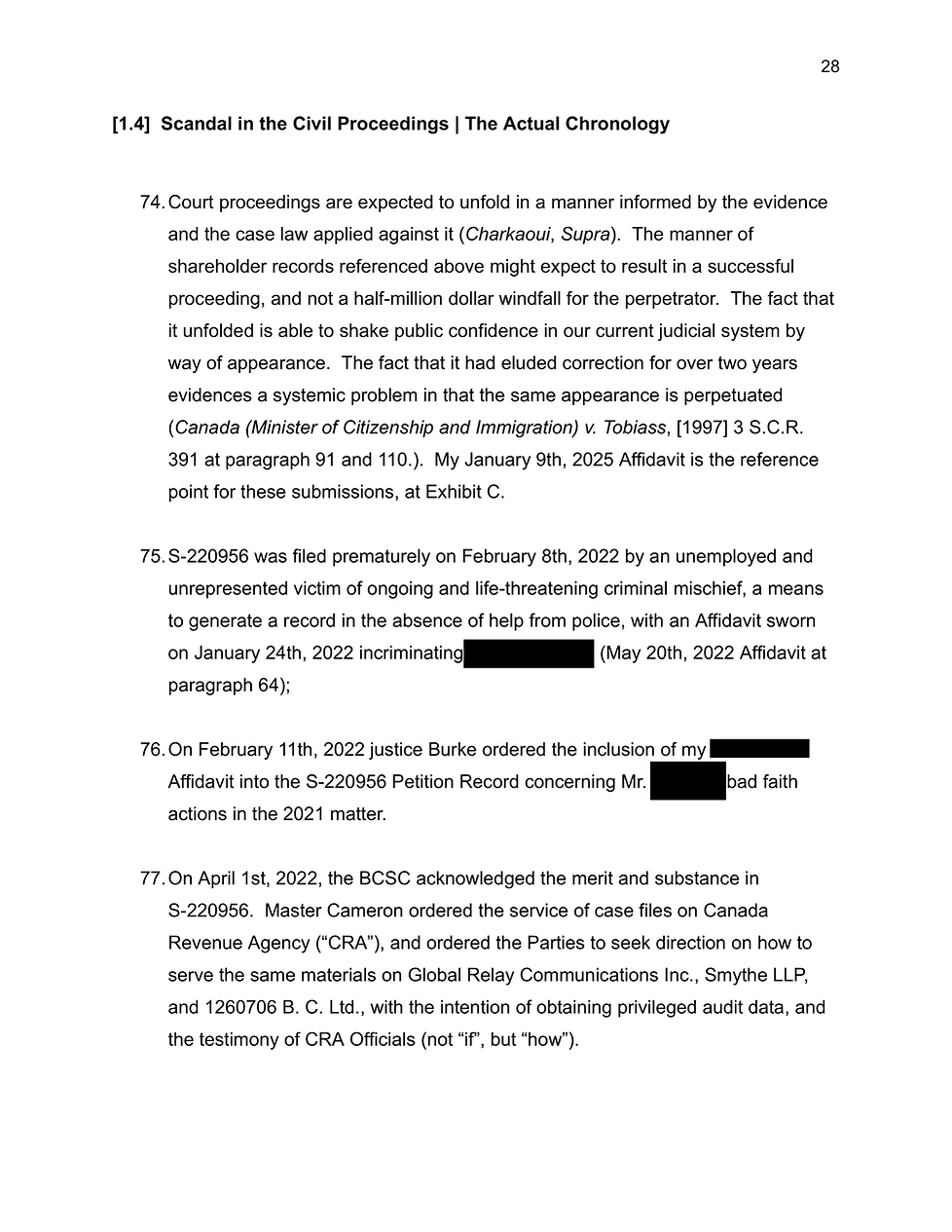
The Proceedings in Brief: A Short Case Study on Systemic Justice Failure. Sept. 2020 - November 2025.
ABSTRACT
This article examines a multi-year legal dispute spanning British Columbia and Nova Scotia courts (2022-2025) that reveals systemic failures in procedural fairness, judicial oversight, and constitutional safeguards. The case involves three interconnected scandals: (1) corporate shareholder fraud concealed through manipulated records and unique accounting policies; (2) retainer billing that exceeded reasonable tariffs by factors of 83x to 156x, generating approximately $400,000 in fees for nine brief hearings; and (3) systematic judicial obstruction that prevented discovery, sealed evidence wholesale, and created enforcement mechanisms before merits examination. Analysis of court transcripts, decisions, and evidentiary records demonstrates how sealing orders, procedural irregularities, and cost barriers combined to deny access to justice while facilitating what appears to be criminal conduct. The pattern satisfies established tests for miscarriage of justice and abuse of process, raising questions about judicial independence, comity pressures, and institutional capture. This case study provides insight into how Constitutional guardrails can fail systemically rather than episodically, with implications for judicial accountability and reform.
Keywords: abuse of process, access to justice, corporate fraud, judicial independence, sealing orders, shareholder oppression, special costs, billing fraud, procedural fairness, discovery obstruction, miscarriage of justice, stakeholder judiciary, stakeholder assurances
I. Introduction
A shareholder dispute evolved into what multiple legal observers have characterized as one of the most severe documented miscarriages of justice in recent Canadian legal history. What began as a straightforward claim regarding corporate records disclosure metastasized into a four-year ordeal spanning five courts across three provinces, resulting in permanent sealing orders, weaponized cost certifications, contempt findings, and custodial detention—all while the underlying evidence remained unexamined.
The documented pattern reveals three distinct but interconnected scandals: first, corporate shareholder fraud involving manipulated Central Securities Registers (CSRs) and suspicious accounting practices; second, retainer billing that generated nearly $400,000 in legal fees for approximately 14.5 hours of actual court time across nine simple hearings with modest prep; and third (tariff estimate at $4,500), systematic judicial obstruction that prevented discovery, sealed probative evidence, and coercive collections before any merits determination.
This article analyzes the procedural breakdown through the lens of established Canadian jurisprudence on abuse of process, particularly R. v. Babos and Canada (Minister of Citizenship and Immigration) v. Tobiass, alongside Constitutional guarantees of fair process articulated in Charkaoui v. Canada. The evidence suggests that traditional safeguards—appellate review, open court principles, proportionality requirements, and discovery rights—failed not episodically but systemically, creating what can only be described as institutional capture in service of private interests.
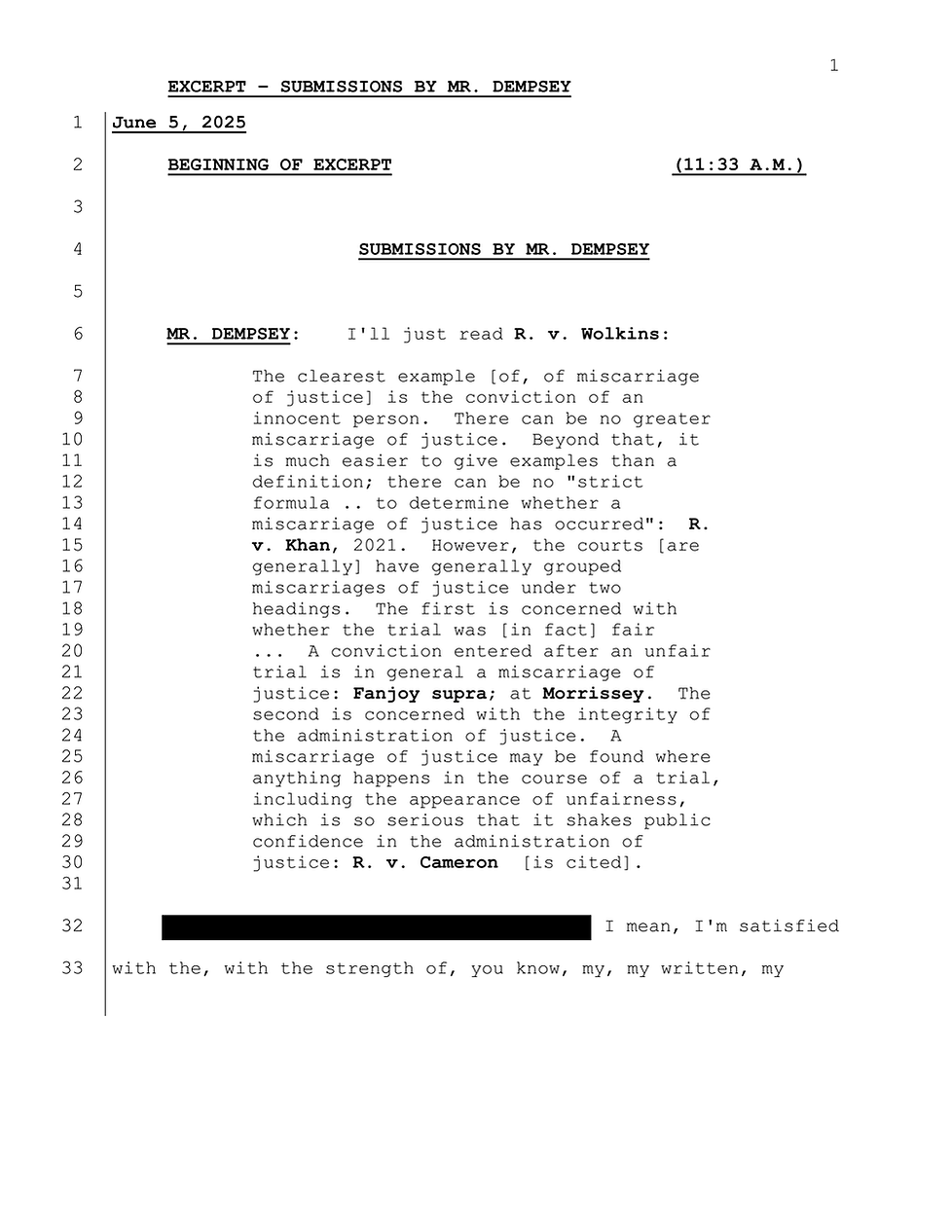
The implications extend beyond one litigant's experience. When courts systematically prioritize enforcement over evidence examination, seal public records without applying established tests, and impose financial barriers that multiply standard tariffs by double-digit factors, the integrity of the justice system itself becomes the issue. As the Supreme Court noted in R. v. Wolkins, public confidence is shaken not merely by convicting the innocent, but by "anything [that] happens in the course of a trial, including the appearance of unfairness, which is so serious that it shakes public confidence in the administration of justice."
II. The Shareholder Fraud: Documentary Evidence of Corporate Misconduct
A. Background and Initial Transaction
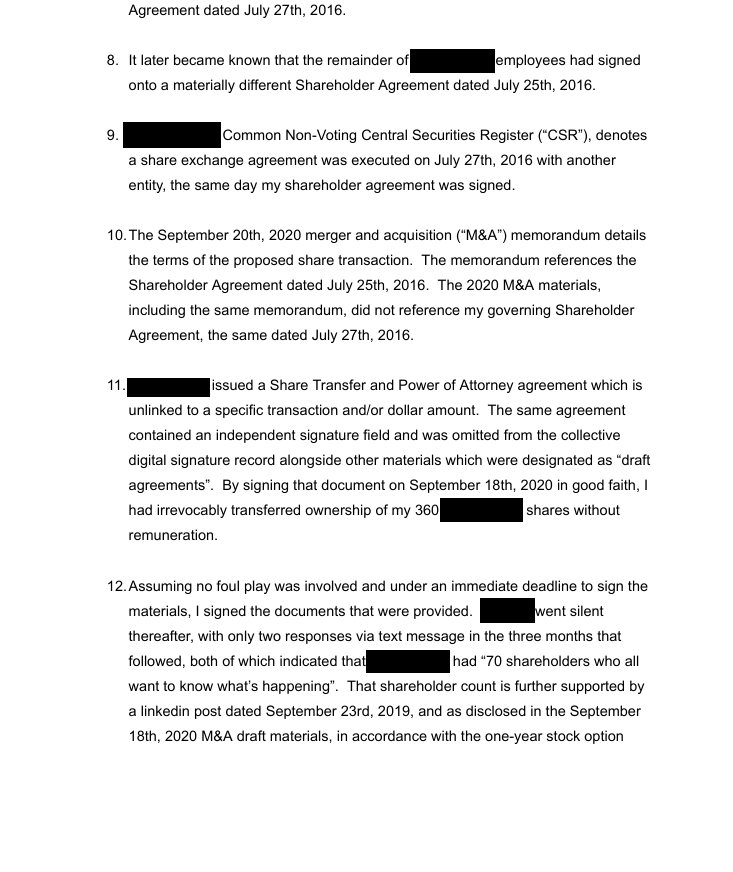
In July 2016, Nathan Dempsey signed a Shareholder Agreement with a federally sponsored technology company (the commercial and government entity, “CAGE”), while employed by the CAGE CEO. Dempsey’s agreement is dated July 27, 2016, whereas other employees executed a materially different agreement dated July 25, 2016. That two-day discrepancy later mattered: merger-and-acquisition materials referenced only the July 25 agreement, effectively excluding Dempsey from the transaction framework.
On September 18, 2020, under an eight-hour overnight deadline, Dempsey signed M&A documents including a standalone Share Transfer and Power of Attorney. The instrument was denominated “For Value Received” yet (i) unlinked to any specific transaction or dollar amount, (ii) carried an independent signature field, and (iii) was omitted from the collective digital-signature packet alongside materials marked as “draft agreements”. By executing it, Dempsey irrevocably transferred 360 CAGE shares with no specified consideration, irrespective of the M&A.
After the signing, the CAGE CEO largely ceased communication for approximately three months, acknowledging only that “70 shareholders awaited information"—consistent with public company materials and workforce data reflecting the one-year vesting cliff in CAGE’s option agreements (as also mirrored in public professional-networking profiles).
B. “Cancellation” and Records Obstruction
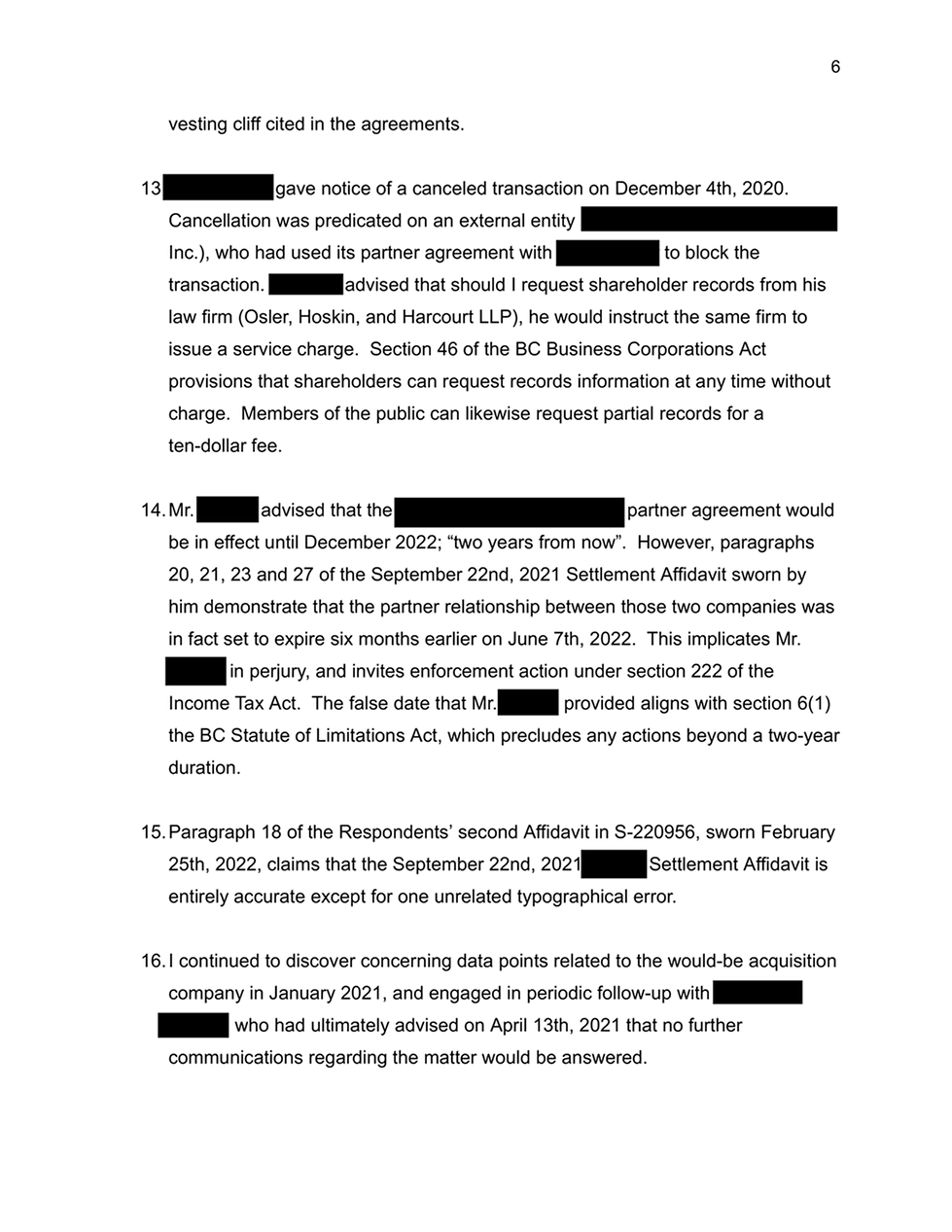
On December 4, 2020, CAGE announced that the transaction was cancelled, attributing the decision to a partner agreement. The CAGE CEO stated that this partner arrangement would remain in effect “two years from now” (i.e., until December 2022). However, in a later sworn affidavit (September 22, 2021), the same partnership was described as expiring June 2022—a six-month discrepancy. This inconsistency carries legal significance (including potential implications under Income Tax Act, s. 222) and, more immediately, aligns uncomfortably with s. 6(1) of British Columbia’s Limitation Act (two-year basic limitation), effectively using an inaccurate timeline to chill recourse.
When Dempsey requested shareholder records in April 2021, the CAGE CEO threatened to have external counsel impose service charges—despite BCBCA s. 46 providing shareholders a right to inspect core records and obtain copies.
C. Registrar Order and Resulting Discoveries
On May 3, 2021, the BC Registrar determined the CAGE was non-compliant with s. 46 and ordered disclosure of shareholder records. The same day that order issued, the CAGE removed its public team roster, which Dempsey preserved via archival capture.
Disclosed Central Securities Register (CSR) records revealed multiple anomalies:
-
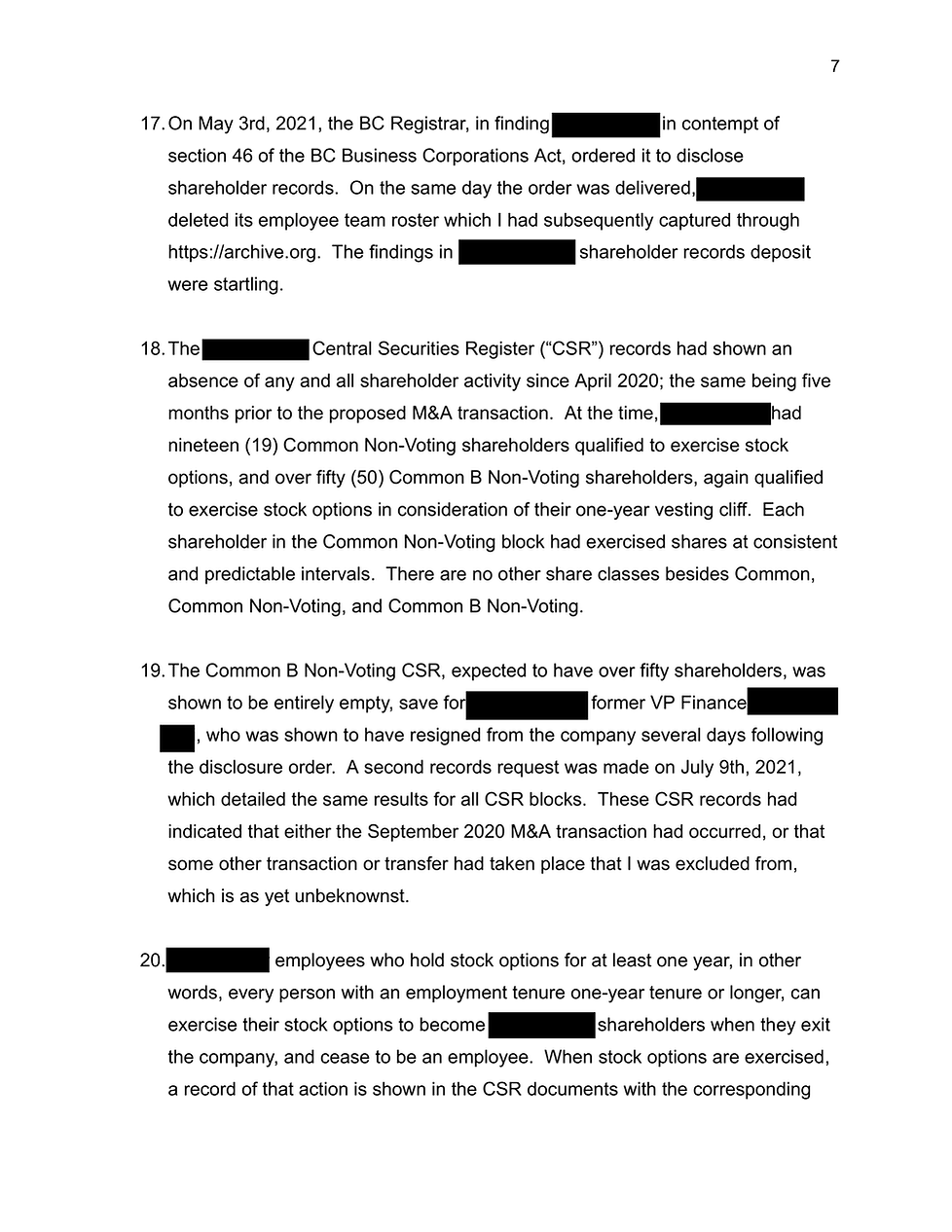
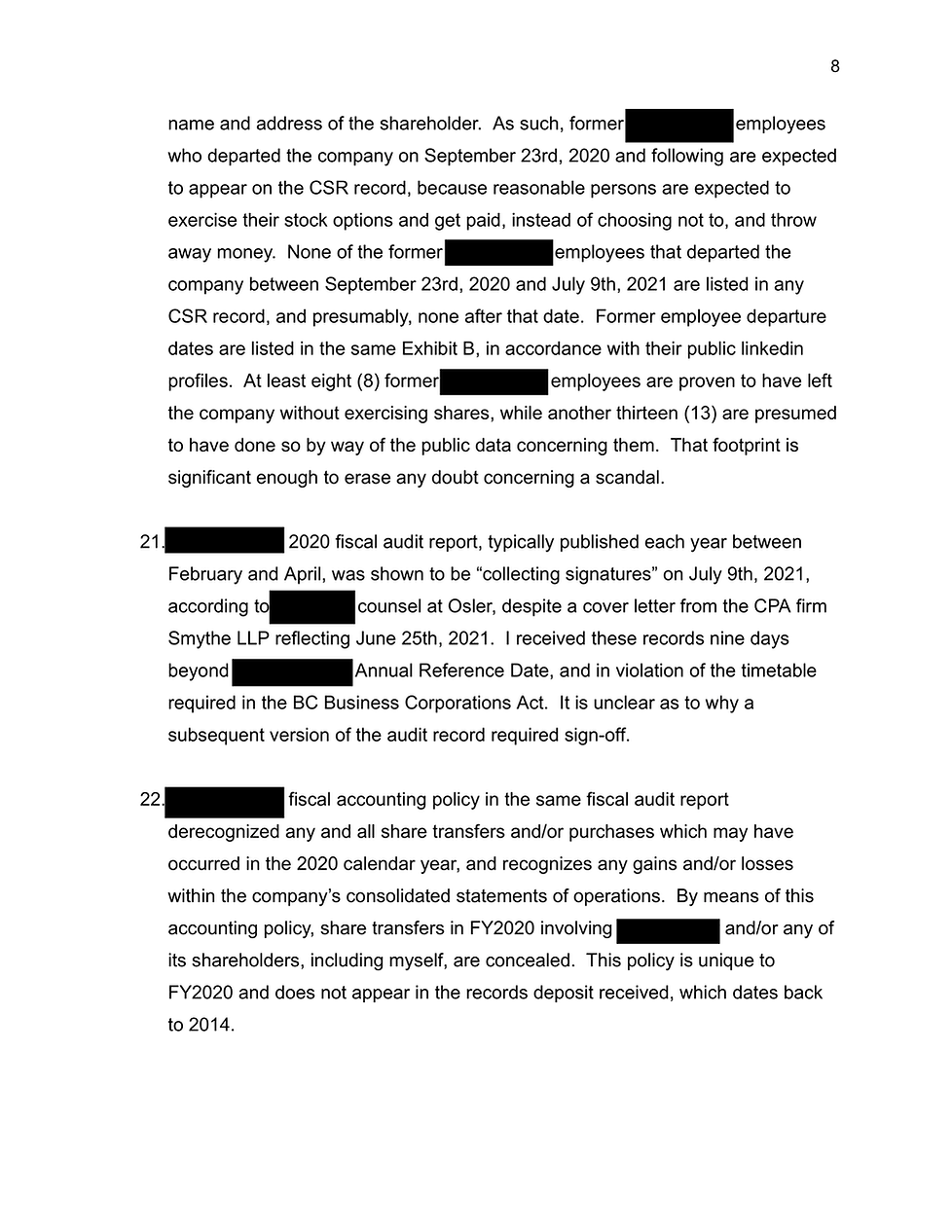
Complete Activity Freeze: No CSR activity after April 14, 2020—five months before the September 2020 signing. At that time, the CAGE had 19 Common Non-Voting shareholders eligible to exercise options, and 50+ Common B Non-Voting option-holders past the one-year cliff. Historically regular exercises ceased abruptly after April 14, 2020.
-
Empty Register: The Common B Non-Voting CSR—expected to include 50+ holders—appeared empty except for one senior finance officer who resigned shortly after the disclosure order. A July 9, 2021 follow-up request produced identical results.
-
Missing Option Exercises on Departure: At least eight employees left between Sept 23, 2020 and July 9, 2021 without any corresponding exercises recorded (with a further thirteen strongly inferred), despite the typical incentive to exercise vested options upon exit.
-
Unique FY2020 Derecognition Policy: The CAGE’s FY2020 audit report (ostensibly finalized June 25, 2021, while counsel stated it was “collecting signatures” on July 9, 2021) adopted a one-year-only accounting policy that derecognized any share transfers or purchases that may have occurred in calendar year 2020, routing gains/losses through the consolidated statement of operations. This masking mechanism does not appear in any other year (2014 onward) and would have the effect of concealing share transfers involving CAGE and/or its shareholders, including Dempsey.
-
Operational Anomalies: FY2020 consolidated statements display uncharacteristic deltas in trade data versus prior years, and omit foreign-currency details one might expect given cross-border transaction context.
D. Legal and Evidentiary Significance
CAGE’s own materials and records collectively present a crisp documentary contradiction:
-
An SPA memorandum for a US$38.5M transaction naming 41 vendors;
-
Dempsey’s executed Share Transfer & POA for 360 shares;
-
M&A materials that anchor on the July 25, 2016 agreement (not Dempsey’s governing July 27 agreement);
-
Public assertions that “no transaction occurred”;
-
CSRs with zero activity where ~51+ option-holders should appear, and in contrast to the CAGE affidavit and public former employee data;
-
A unique FY2020 derecognition policy that would hide precisely these events.
Under BCE Inc. v. 1976 Debentureholders, corporate fairness demands documentary coherence and transparent disclosure. Under Bradshaw v. Stenner, credibility turns on consistency with contemporaneous documents. On both measures, the shareholder record fails.
The pattern supports two non-exhaustive inferences:
-
The September 2020 transaction (or a materially similar event) did occur despite cancellation claims; or
-
An undisclosed alternative transaction/transfer occurred from which Dempsey was excluded. The FY2020 derecognition policy would effectively conceal either scenario. Coupled with the CAGE CEO’s timeline inconsistency regarding the partner agreement, the evidence establishes a prima facie case of shareholder fraud and oppressive conduct, likewise triggering potential Income Tax Act s. 222 scrutiny, including any related donation-record vectors associated with the coordinated online harassment described elsewhere in the file.
III. The Billing Scandal: Weaponized Costs as Enforcement Mechanism
A. Initial Cost Anomaly: The Marchand Hearing
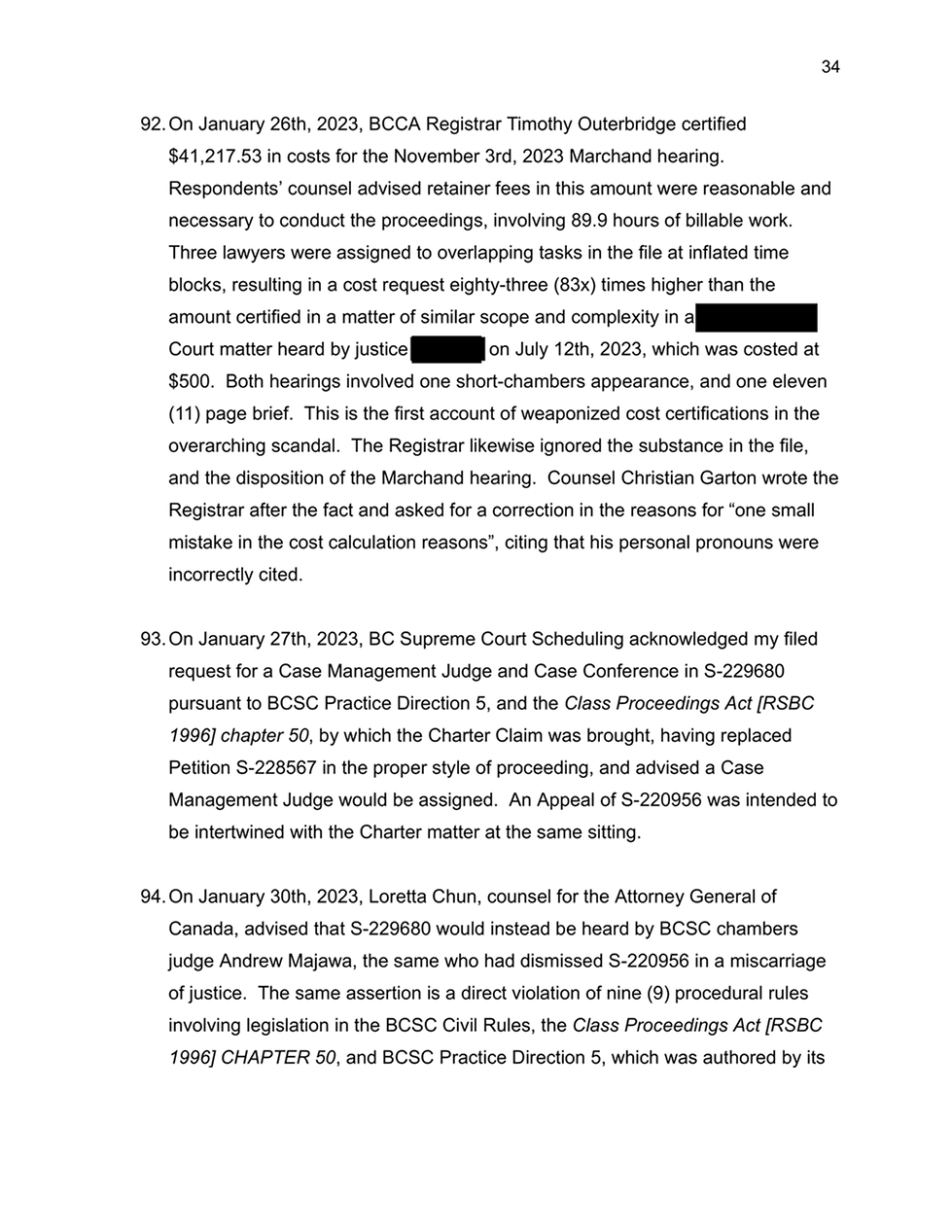
At a November 3, 2022 British Columbia Court of Appeal hearing, CAGE counsel claimed $41,217.53 for 89.9 hours on a matter involving a single short-chambers appearance (20 minutes) and an 11-page brief, with three lawyers billing overlapping blocks at grossly inflated yields. On January 26, 2023, the BCCA Registrar certified the full amount. For context, a Nova Scotia Supreme Court matter of near identical scope heard shortly thereafter was assessed at $500 under customary tariffs—making the BCSC certification here roughly 83× higher. The entirety was pegged to "time reasonably required". This marked the first emergence of a pattern: retainer billing decoupled from the actual work, certified without meaningful scrutiny, and leveraged to apply financial pressure irrespective of merits.
B. The Core Billing Pattern: $376,201.97 for Nine Brief Hearings
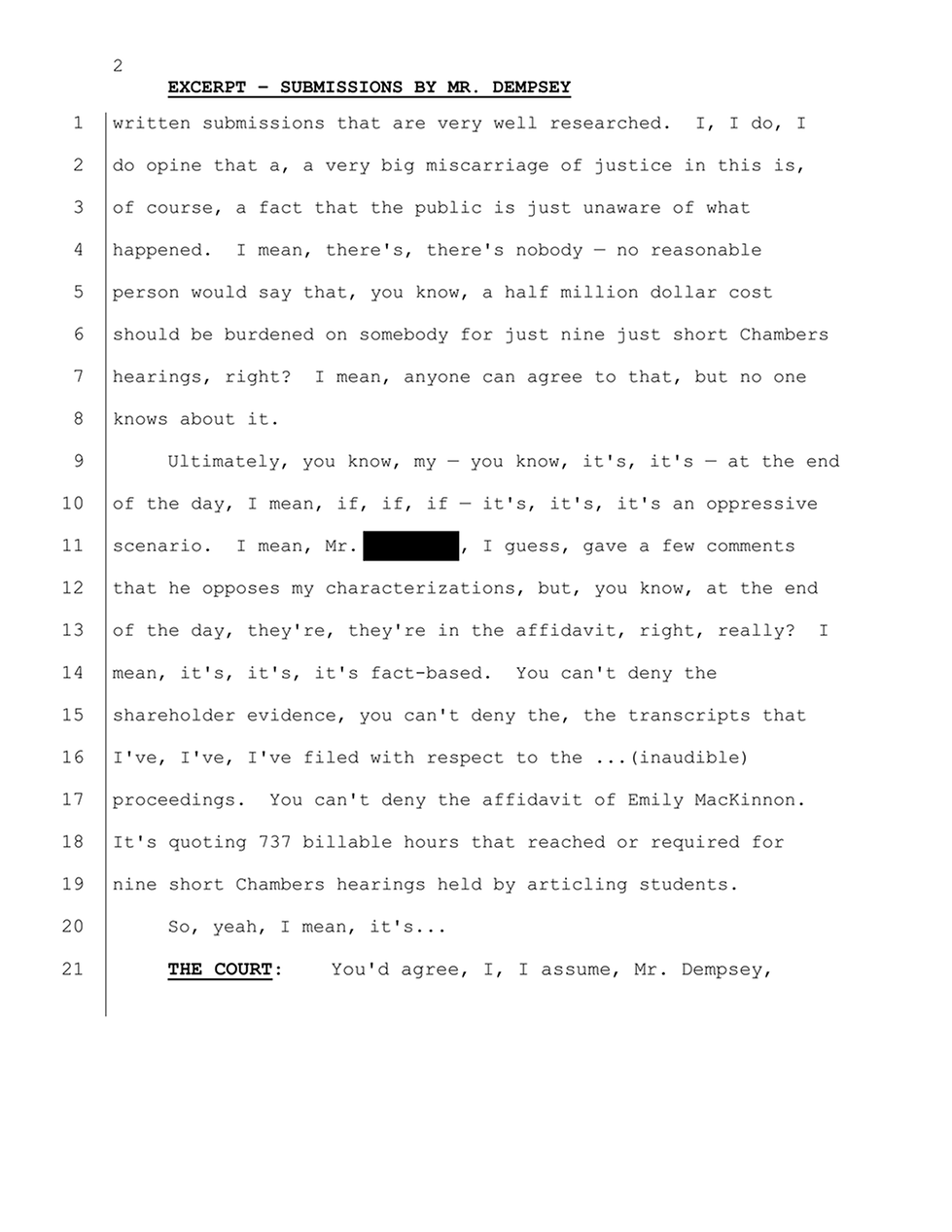
On June 28, 2023, opposing counsel issued estimates totaling $376,201.97 across nine short-chambers appearances spanning files S-220956 and S-229680, citing 737.7 billable hours across seven lawyers and two paralegals with overlapping tasks. Clerks’ notes for the nine appearances record approximately 867 minutes of court time (~14.5 hours). Thus, billed time was about 51× actual courtroom time; when compared to standard prep ratios, the overlapping block-billing produced an ~89× multiplier.
Illustrative multiples
-
S-220956 (eight hearings): $41,500 vs $500 customary tariff = ~83× (close to Canada's annual salary average).
-
S-229680 (one hearing): $80,620.86 vs $500 customary tariff = ~161× (well above Canada's annual salary average).
-
S-228567 (one hearing): $1,601 billed amount vs $500 = the precursor file to S-229680; same work, same material. Note the delta.
-
Overall: $376,201.97 vs $4,500 ~9,000% billing delta. Note - 737.7 (like the Boeing 737-700), or "the billing delta", or "BOWing delta".
Several hearings showed articled students present alongside senior counsel while full senior time was also claimed—signaling over-staffing, duplication, and apparent inflationary block-billing. The symbolism suffused in the scandal pegs the scandal for what it is - a hate crime.
C. Affidavit Evidence and the “Necessity” Claim
On October 17, 2023, Dempsey was served three affidavits sworn by CAGE lead counsel, a uniformed advisor to the CAF. Each stated at paragraph 10 that the costs “were incurred by the CAGE CEO” and “were necessary to conduct the proceeding". These oaths assert both payment and necessity, positioning extraordinary sums for enforcement through court mechanisms.
Legal defects in the necessity theory
-
Unreasonableness standard: Bradshaw Construction Ltd. v. Bank of Nova Scotia—special costs reflect what a reasonable client would pay a reasonably competent solicitor. An 84× tariff for routine chambers work is not objectively reasonable.
-
Indemnity vs. windfall: Gichuru v. Smith—special costs must be objectively reasonable because they indemnify, not enrich.
-
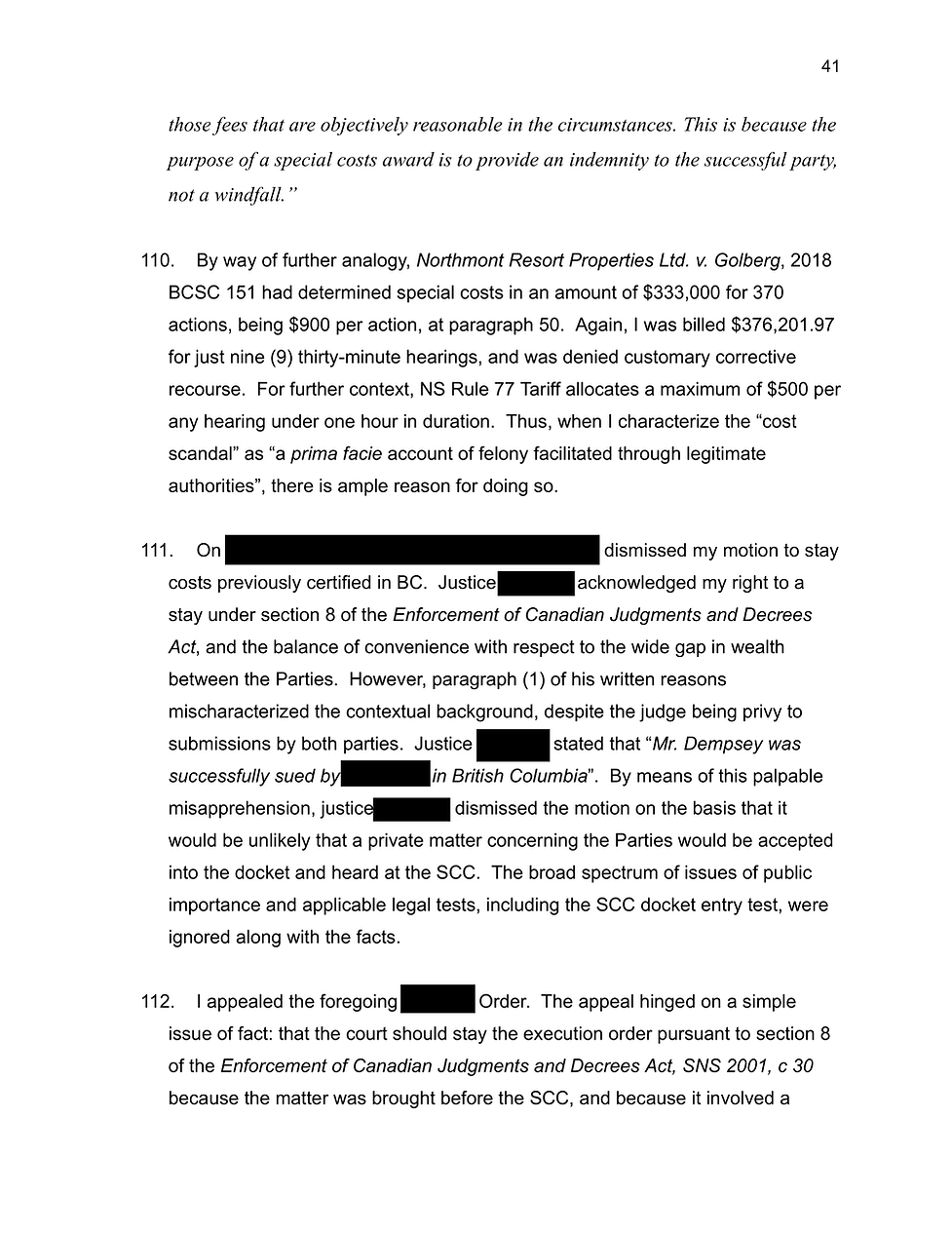
Comparative benchmark: Northmont Resort Properties Ltd. v. Goldberg allowed $333,000 for 370 actions (~$900/action). Here, $376,201.97 for 9 actions is ~$41,800/action—~46× the Northmont rate.
D. Certification Without Scrutiny
On November 16, 2023, a BCSC master signed hole-punched draft certificates awarding 100% of the amounts set out in those affidavits. The transcript reflects awareness of overlapping counsel, yet the full figures were certified—without applying the reasonableness and justification analysis required by Vavilov, para. 104 (decision-makers must grapple with key facts; conclusions unsupported by the record are unreasonable).
The result was to convert a legitimate judicial process into a collection vehicle for outsized, unexamined bills—amounts bearing no defensible relationship to work performed, case complexity, or any recognizable measure of proportionality.
By way of irony, the exact same judge that ordered special costs in those file, BCSC justice Andrew Majawa, authored case law directing the extreme opposite approach to vetting solicitor practices. In A Lawyer v. The Law Society of British Columbia, 2021 BCSC 914 at paragraph 63, Majawa wrote;
“A key principle derived from these cases is that the investigatory powers of a regulator should not be interpreted too narrowly as doing so may “preclud[e] it from employing the best means by which to ‘uncover the truth’ and ‘protect the public’” (Wise v. LSUC, 2010 ONSC 1937 at para. 17 [Wise], citing Gore at para. 29). Thus, in my view, the powers granted to the Law Society by s. 36(b) of the LPA, and as operationalized by R. 4-55 of the Law Society Rules, should be read broadly to permit the investigation of a member’s entire practice, as that may in certain circumstances be the best means to “uncover the truth” and “protect the public” and to determine whether disciplinary action should be taken. Given the context within which lawyers and their trust accounts operate, the broad investigatory power authorizing the Law Society to conduct an “investigation of the books, records and accounts of the lawyer” provided for in s. 36(b) of the LPA and in R. 4-55 should not be distorted to mean something narrower without explicit statutory language suggesting the same: Wise at para. 17.”
In contrast to the foregoing case law, Majawa had weaponized the irresistible authority of the courts to facilitate private interests. The trust accounts of CAGE counsel are clearly suspect of a solicitor-client billing fraud, in a prima facie capacity. The same characteristics satisfy the test in Beals v. Saldanha to the extent that they “shock the conscience of Canadians”.
E. The Third-Party Assurance Problem
The scale, visibility, and inter-provincial enforcement of these costs—sworn under oath by major litigation counsel, certified by court officers, and enforced despite facial unreasonableness—suggest assurances beyond the immediate litigants. It is impossible to conclude that that a mid-market CAGE and its counsel would pursue such obvious multiples without absolute confidence that certification and enforcement would proceed without the customary guardrails, and without the scrutiny one would normally expect to be applied—even by whistleblowers.
Institutional touchpoints implicated by the pattern
-
External litigation counsel: swearing that 84× tariff multiples were “necessary.”
-
Registrars/masters: certifying totals without applying settled tests. The NSSC in fact advised "the affidavits cannot be referred to because they are sealed", prior to dismissing a motion to scrutinize the outcome.
-
Enforcement judges: declining to examine the billing’s facial disproportionality.
-
Potential guarantors: actors capable of assuring participants that enforcement would be rubber-stamped. These stakeholders must be state-adjacent to make that assurance (and the required coordination) efficacious.
Under 1582235 Ontario Ltd. v. Ontario (citing Enterprise Sibeca v. Frelighsburg), conduct so inconsistent with its legal context cannot be good faith. Billing ~84× standard tariffs, declaring it “necessary,” and obtaining full certification meets that test for bad faith—and points to coordination incompatible with independent judicial oversight.
IV. The Procedural Scandal: Systematic Obstruction of Justice
A. Discovery Ordered, Then Obstructed
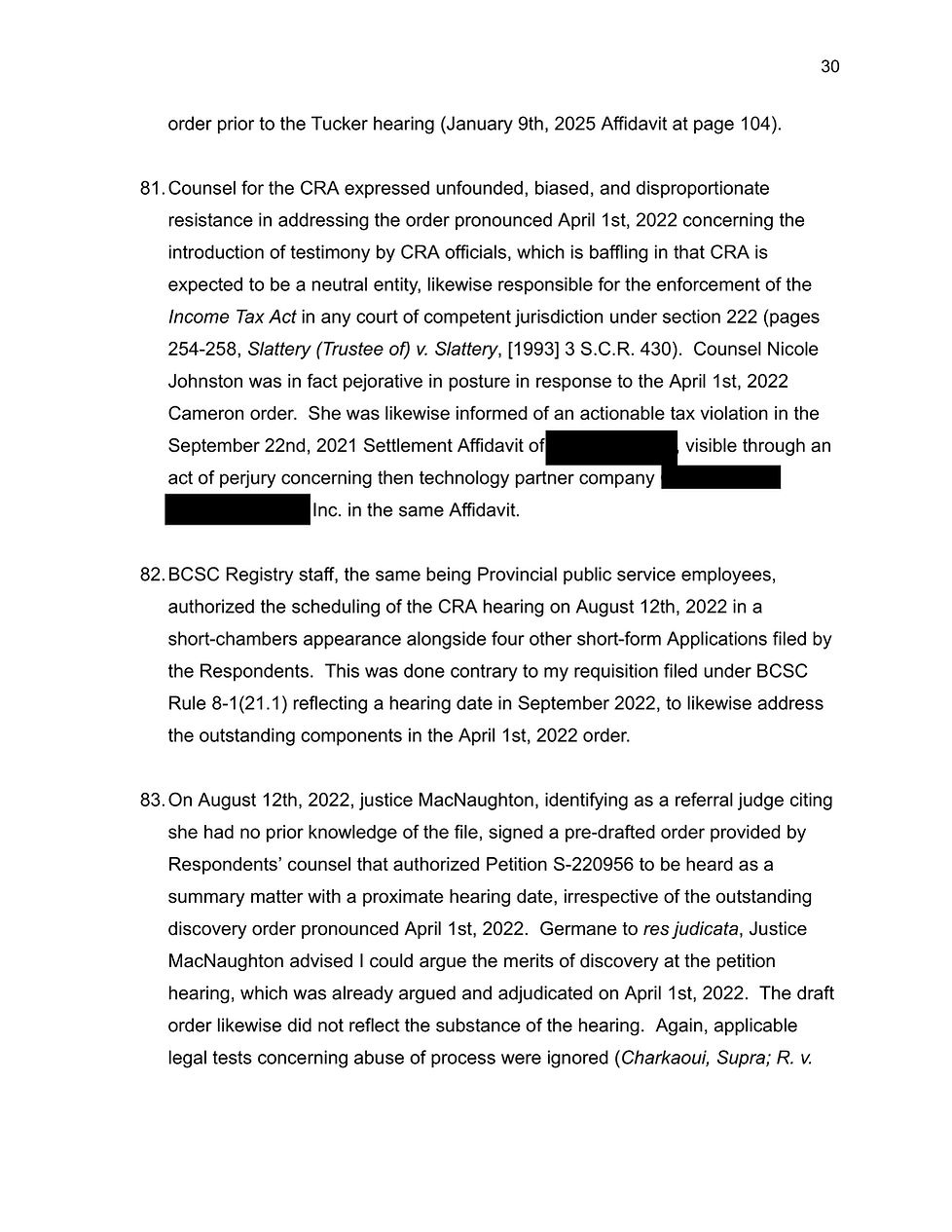
On April 1, 2022, a BCSC master issued a pivotal discovery order in S-220956. After reviewing the CSR anomalies and the FY2020 derecognition policy, the master ordered service on the Canada Revenue Agency (CRA) and directed the parties to seek guidance on how to serve three related private entities—the aim being audit-level records and CRA testimony. The ruling contemplated “not if, but how” discovery would proceed and did require the involvement of these entities, likewise noting CRA’s capacity to protect confidentiality.
That order recognized the shareholder-fraud allegations as sufficiently meritorious to warrant third-party forensic discovery. Yet subsequent judicial steps prevented that discovery from occurring:
-
May 24, 2022: A BCSC justice held a hearing in private chambers, contrary to Rule 22-1(5) (open-court requirement). The CAGE indicated an intent to strike S-220956, mere weeks after the discovery order, while an affidavit was enroute to BC via courier that first explained that psychological operations and sophisticated technology-based crimes were impacting the proceedings (and in fact, had occasioned them). The file remained entirely sealed.
-
June 27, 2022: Another BCSC justice granted a protection order over an already-sealed file on the basis of a speculative concern raised by the CAGE, requiring leave before executing the April 1 discovery. The reasons asserted the protection order was necessary for the sealing order to function, creating a double barrier: sealing plus a permission requirement to act on an existing order. This relitigated the April 1, 2022 order by adding a permission layer.
-
Aug 12, 2022: A referral justice (new to the file) signed an opposing-counsel draft order sending S-220956 to summary determination with a Sept 15–16, 2022 hearing date—notwithstanding the outstanding April 1 discovery. The justice said discovery could be argued at the petition hearing, though discovery had already been adjudicated on April 1 (res judicata). The draft did not reflect the hearing’s substance and effectively converted a discovery-first process into a summary track. This hearing completed a reconfiguration of the proceeding.
-
Sept 13, 2022: A BCCA justice refused a stay of the referral order, forcing a merits hearing before the Cameron discovery could occur. When Income Tax Act s. 241(3.1) (charitable-donation records relevant to documented online criminal harassment) was raised, chambers were immediately closed. The refusal locked in the obstructive rulings pre-appeal.
-
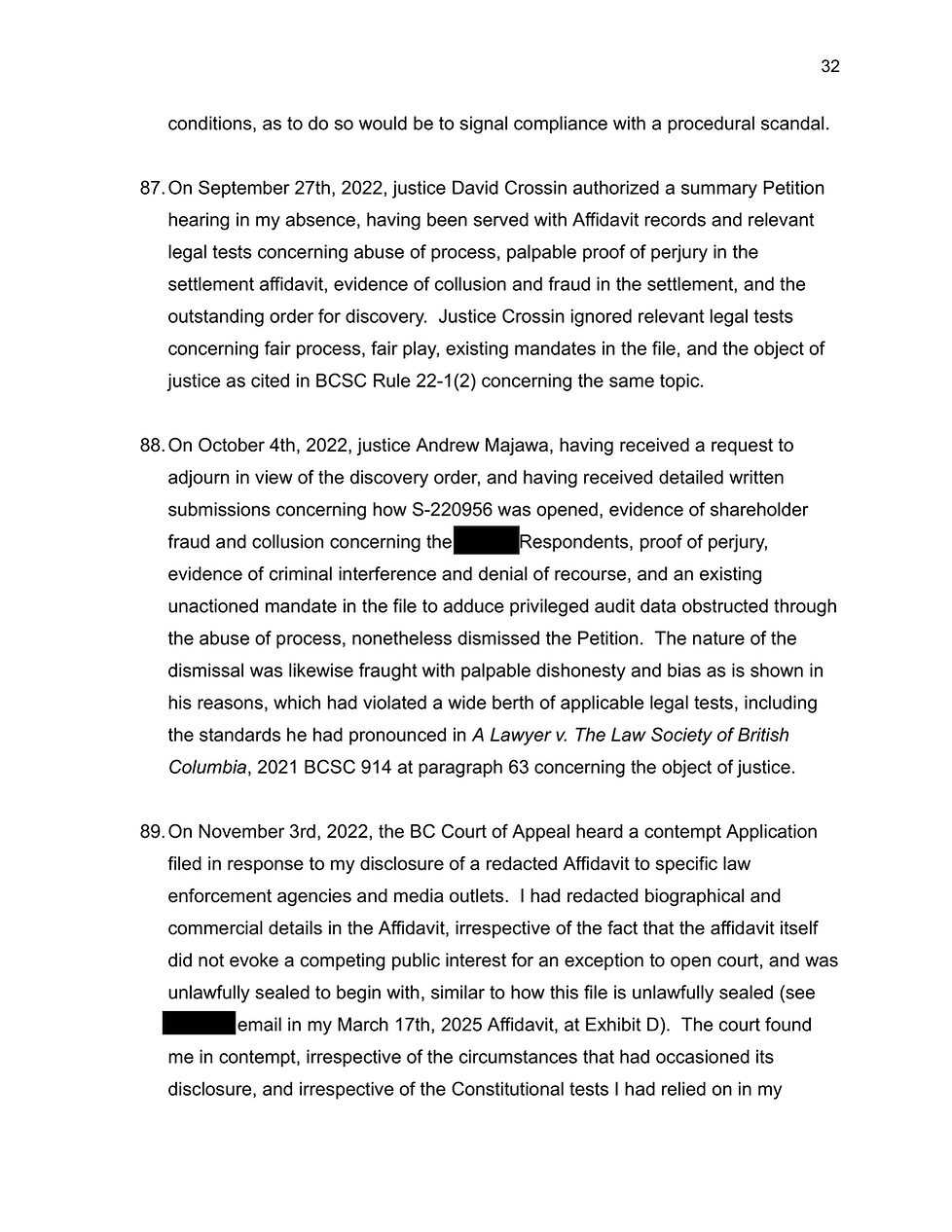
Sept 27, 2022: A BCSC justice authorized a summary petition hearing in absentia, despite affidavits evidencing perjury in the CAGE CEO settlement affidavit, collusion, and the still-unexecuted April 1 discovery order—contrary to Rule 22-1(2) (fair process and the “object of justice”).
-
Oct 4, 2022: BCSC justice Andrew Majawa dismissed the petition despite a timely adjournment request to complete discovery and detailed submissions on shareholder fraud, perjury, criminal interference, and the discovery mandate. The written reasons contain factual errors (including a false claim that Dempsey violated sealing before a later hearing) and omit probative evidence. At para. 72, the reasons state: “In any event, I note that the CSR is not part of the Settlement Agreement so even if it was in error, it would likely be irrelevant to whether the Settlement Agreement should be set aside”. That framing sidesteps the core issue: whether a September 2020 transaction closed despite public “cancellation,” which the CSR anomalies squarely implicate.
B. Parallel Charter Proceeding Sabotaged
To address the state-interference overlay and its impact on the shareholder matter, Dempsey filed S-228567 (later S-229680) as a Charter proceeding under the Class Proceedings Act (CPA). The CPA and BCSC Practice Direction 5 (PD-5) require assignment of a case-management judge and a case-planning conference before merits steps.
-
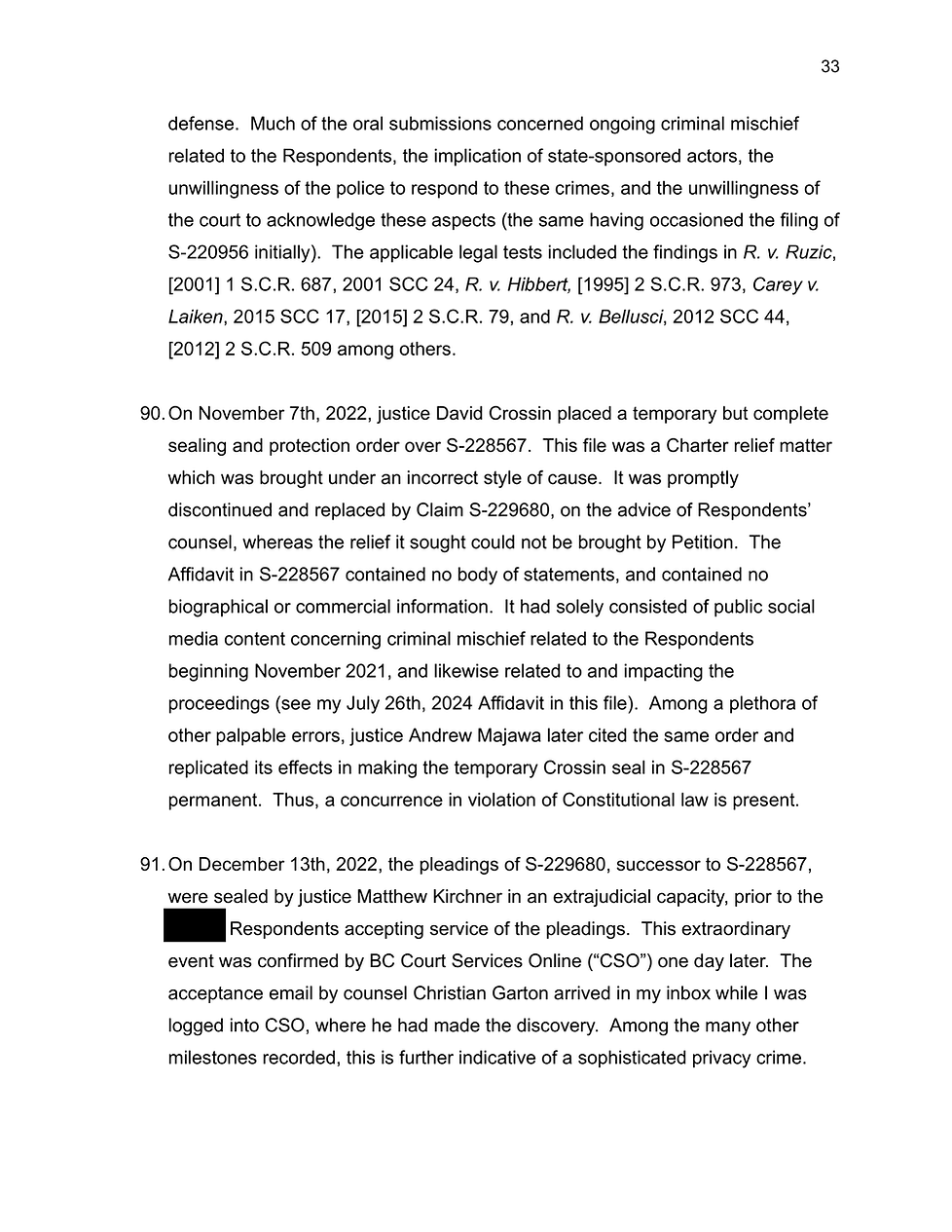
Nov 7, 2022: A BCSC justice imposed a temporary blanket sealing order over S-228567, even though the affidavit contained no personal biography or commercial secrets—only public social-media evidence tied to the harassment campaign, similar to the contents shown at the Zersetzung and Guide pages. Another justice later made the seal permanent.
-
Dec 13, 2022: The successor file S-229680 (the same file presented in the proper style of proceeding - a claim under the BC CPA) was sealed before service was accepted—an extraordinary step later acknowledged by BC Court Services Online. Opposing counsel’s acceptance email arrived seconds after Dempsey logged into the court system—suggestive again of real-time monitoring.
-
Jan 27, 2023: BCSC Scheduling confirmed that, per PD-5, a case-management judge would be assigned and a case-planning conference arranged.
-
Jan 30, 2023: AG Canada counsel advised via an email to BCSC scheduling that the matter would instead be heard by a the same chambers justice who had just dismissed S-220956; bypassing the CPA/PD-5 statutory framework.
-
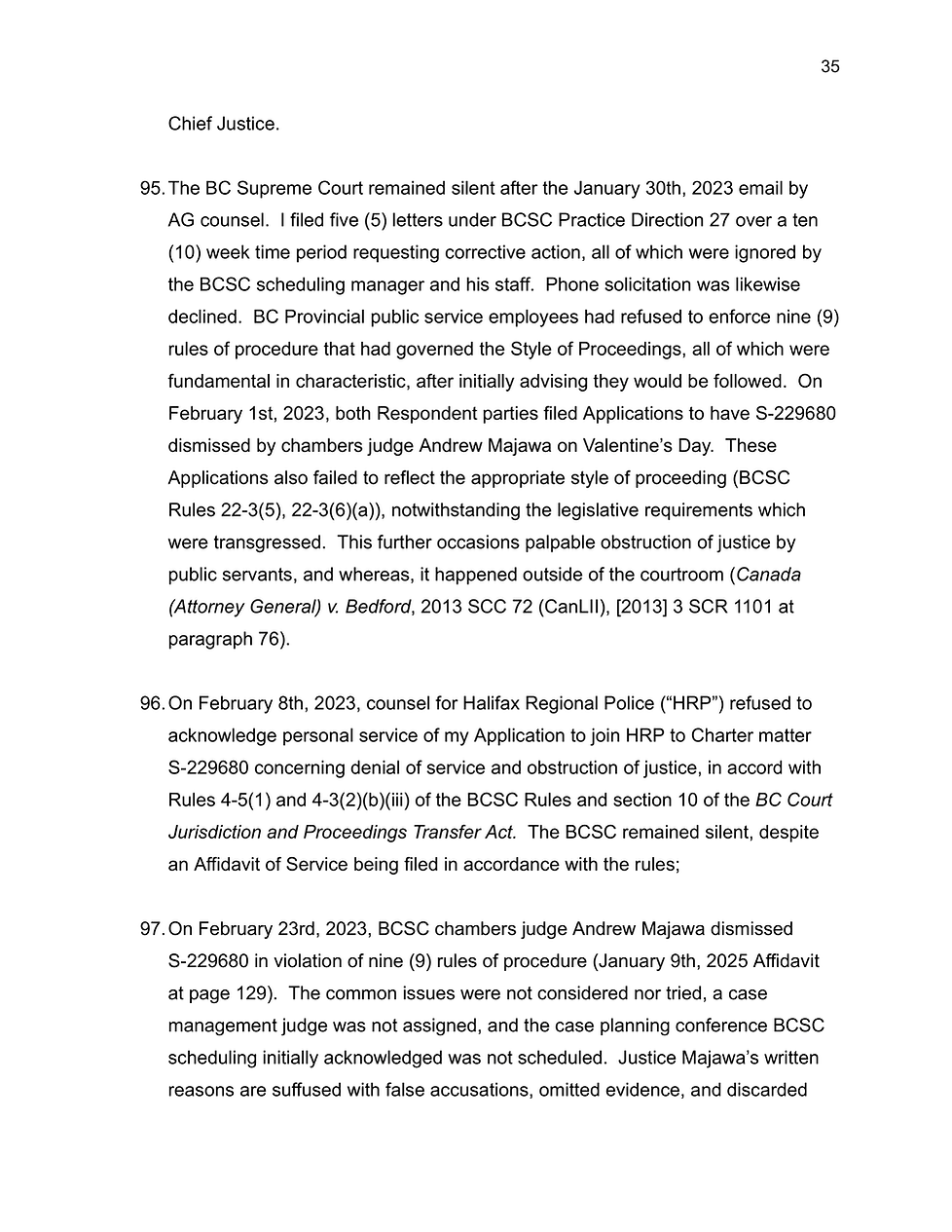
Over the next ten weeks, five PD-27 letters sought correction. Registry staff (public servants) remained unresponsive, and the file was steered to that chambers justice in violation of no less than nine (9) rules spanning three statutory codes.
-
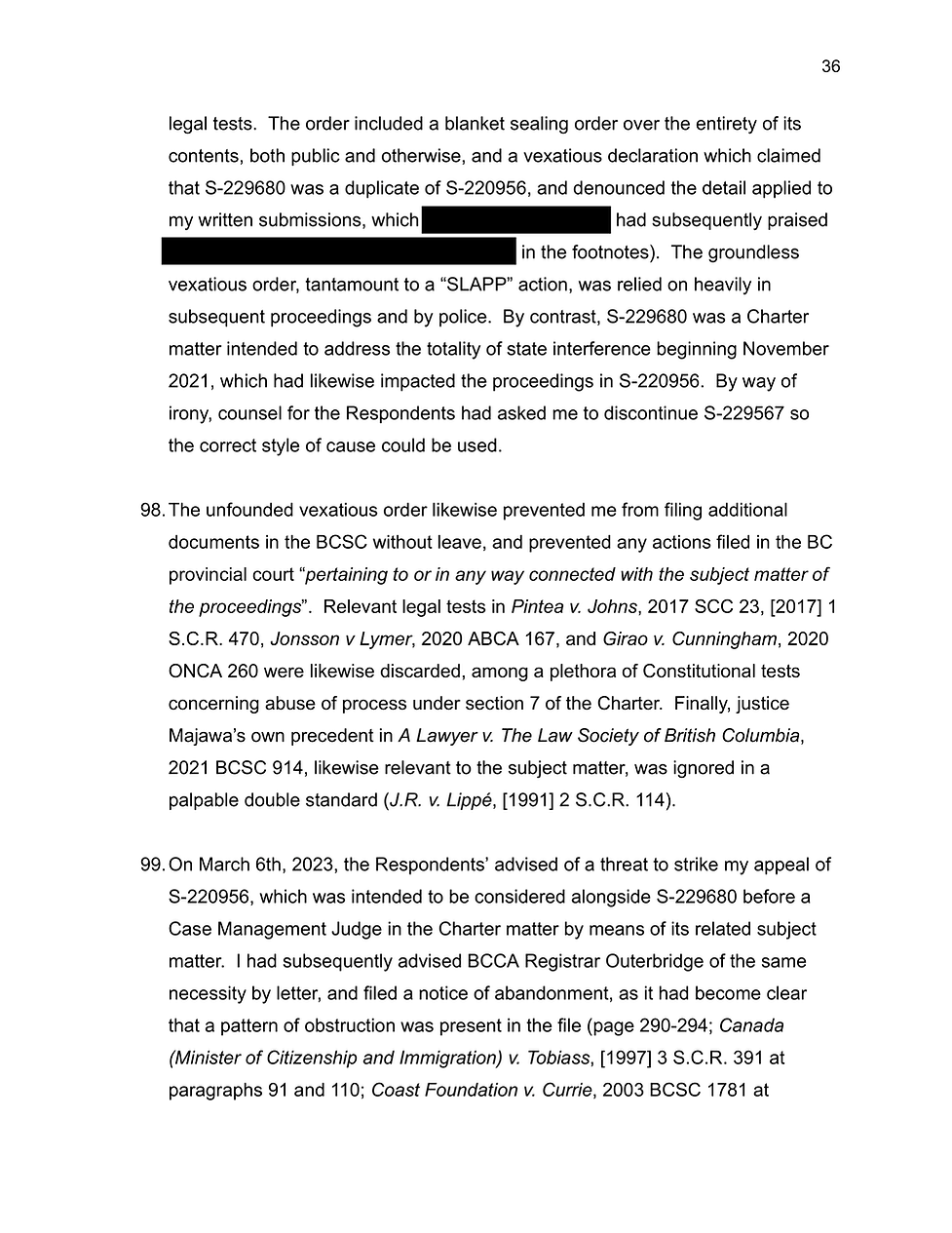
Feb 23, 2023: The chambers justice dismissed S-229680 in twenty minutes without assigning a case-management judge, without a case-planning conference, and without addressing common issues—contrary to multiple mandatory CPA/PD-5 requirements. The order imposed global sealing and a vexatious-litigant declaration premised on “duplication” with S-220956 (factually wrong: one is a shareholder petition, the other a Charter/CPA claim addressing state interference). The declaration blocked future filings “connected with” the subject matter—including criminal actions, despite Pintea v. Johns, Jonsson v. Lymer, and Girao v. Cunningham forbidding a vexatious order in those circumstances. The case law in fact also argues in favor of case management, irrespective of the statutory regime.
-
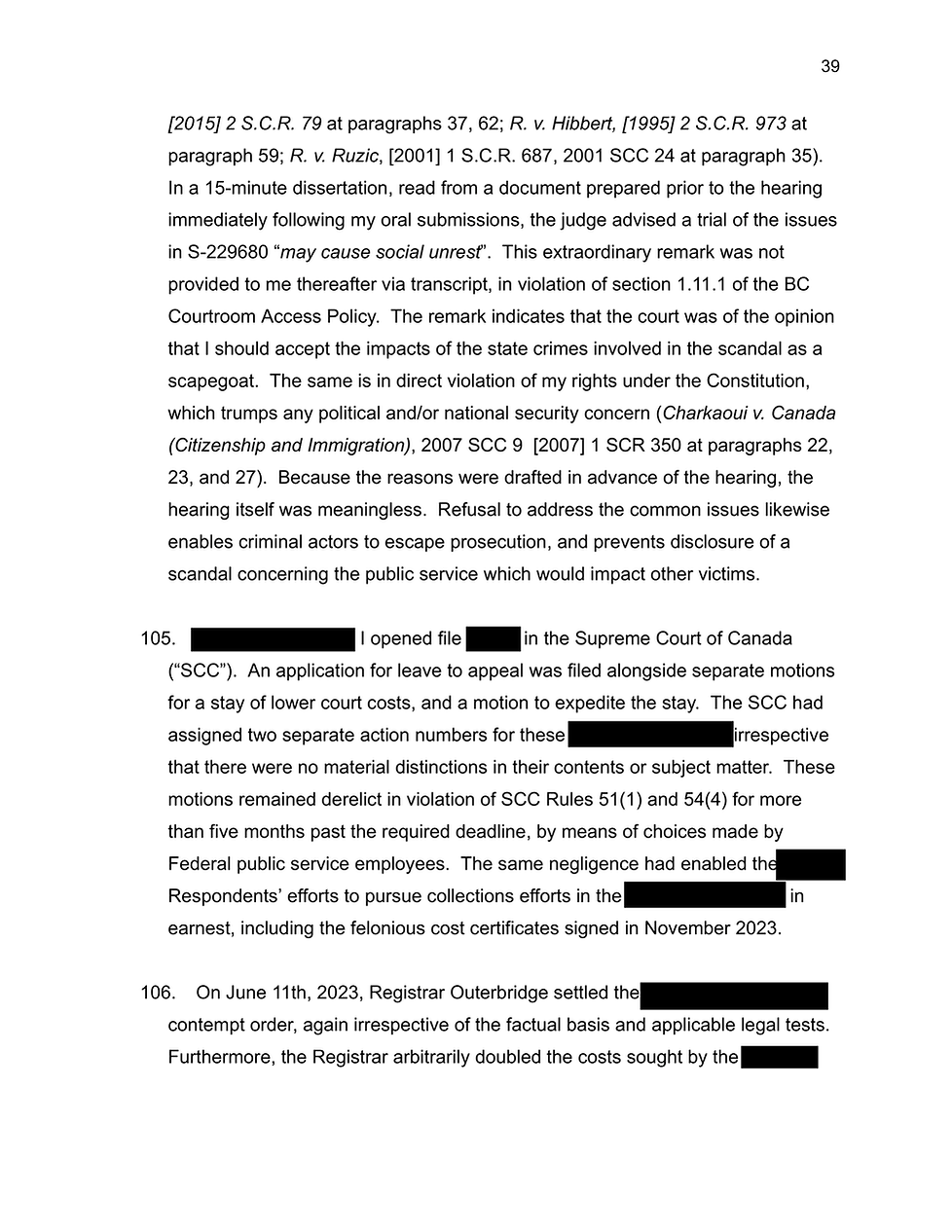
Efforts at the BCCA failed preemptively; an appeal was denied leave in reasons read immediately following oral submissions, suggesting the 15-minute recitation, which Dempsey could not access after the hearing, were created prior to the hearing itself. The CAGE and AG Canada respondents were not asked to make submissions. The judge advised the subject matter "might create social unrest".
C. Supreme Court of Canada: Registry Delay and Summary Dismissal
On June 6, 2023, Dempsey filed an application for leave (SCC) with motions for stay and expedited consideration. SCC Rules 51(1) and 54(4) require the Registry to submit such motions to the Court within fixed timelines. The motions remained unsubmitted for over five months past deadline—registry delay that enabled collection efforts (including November 2023 cost-certificate proceedings in Nova Scotia). On Dec 21, 2023, a single SCC justice dismissed leave and all motions without reasons, notwithstanding the R. v. C.P. threshold (miscarriage of justice = public importance) and a pending certiorari motion addressing the half-million-dollar billing scandal.
D. Nova Scotia: Parallel Obstruction and Sealing
The pattern replicated in Nova Scotia:
-
July 21, 2023 (NSSC): A justice dismissed a stay motion after mischaracterizing at para. 1 that Dempsey had been “successfully sued by the CAGE CEO in British Columbia” (palpably false—S-220956 was Dempsey’s petition). That error proved dispositive: the Court deemed it unlikely the SCC would take a “private matter,” overlooking that miscarriage of justice itself satisfies the public-importance threshold.
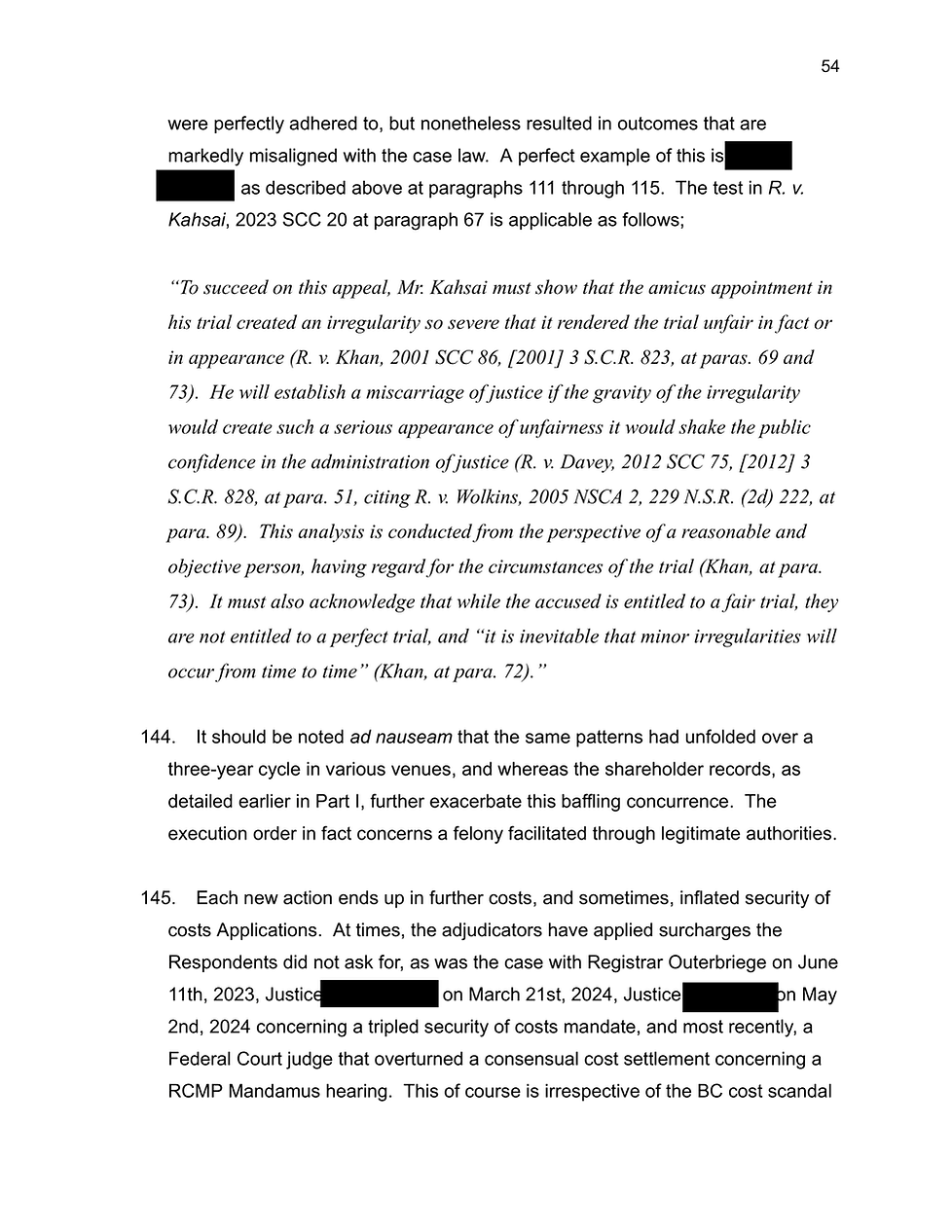
-
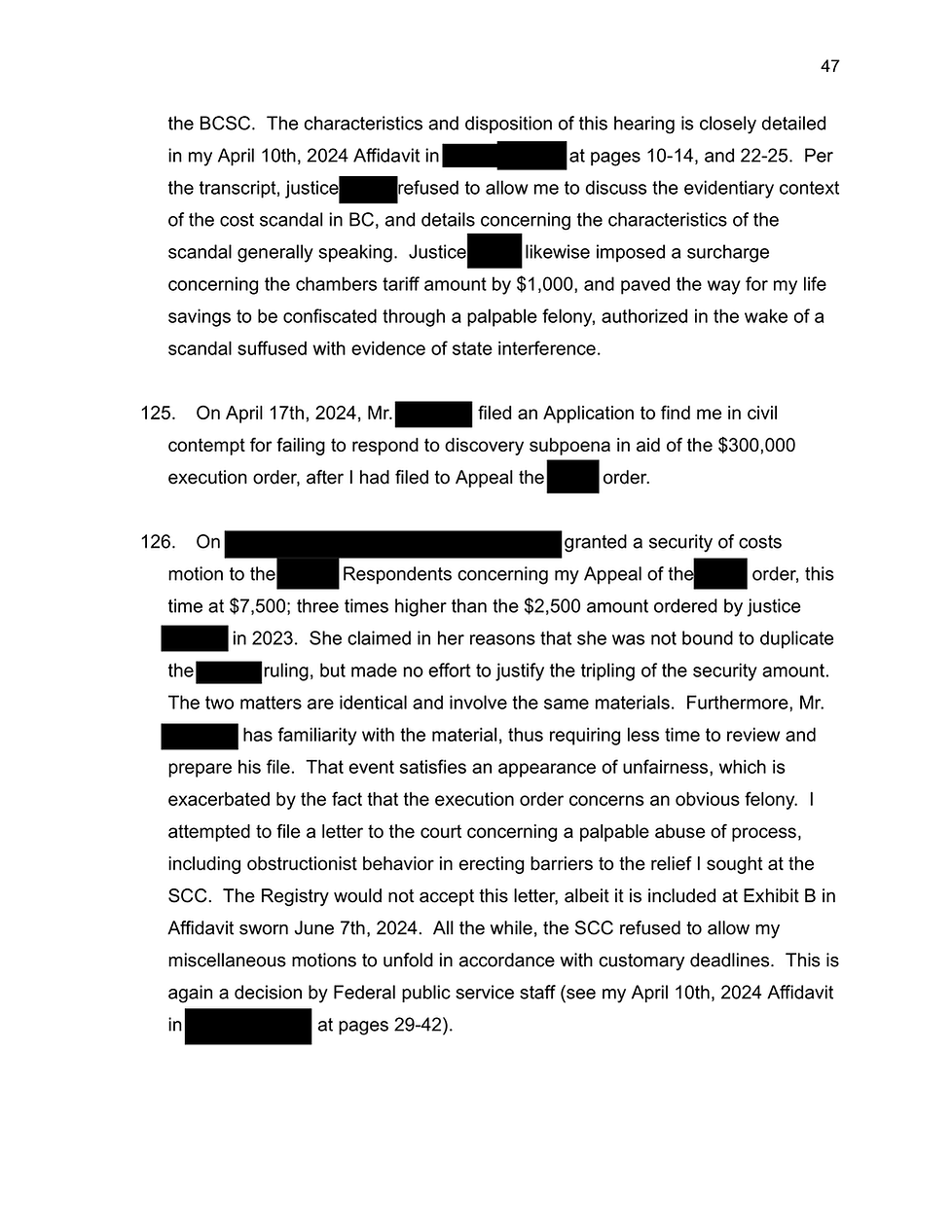
August 2023 (NSCA): Security of costs at 12.5x the customary threshold in Power v. Power (40% of total lower court hearing cost $500 -> $200). Still within an acceptable range (juxtaposed against BC), but notable, and irrespective of probative record and merit.
-
October 10, 2023 (NSCA): A justice ordered a complete seal of the appeal file (then under an interim seal) on a consensual motion for modest redaction, in an ensconced hearing. This kept the matter (and the errors) away from public view, and away from scrutiny, and occasioned a double-standard by a judge that upheld polar opposite views concerning settled Constitutional law in other matters (Y. v. Swinemar, 2020 NSCA 56 at paragraph 109 - ("Constitutional law cannot be relitigated"). SCC was still pending in a sealed environment.
-
Dec 4, 2023 (NSCA): A panel dismissed the appeal in roughly five minutes, declined to hear from opposing counsel, declared the appeal had “no merit,” and permanently sealed the file—despite the only live issue being correction of the factual error. The SCC dismissed its own matter, again under seal, on December 21, 2023, without providing an explanation. The correlation between the NS and the SCC proceedings that demonstrate significant coordination and procedural obstruction is described in greater detail at the Enforcement page.
-
March 21, 2024 (NSSC): Court dismissed a motion to stay and refuse the enforcement of $295,581.11 in costs capable of "shocking the conscience of Canadians" (Beals v. Saldanha, [2003] 3 S.C.R. 416, 2003 SCC 72 at paragraphs 73, 218, 220, 243, 265). Advised "you cannot refer to the affidavit" showing disparity in solicitor-client bill vs. 8 short hearings under 30 minutes in S-220956, predominantly handled by articling students in BC using brief google template-style filings.
-
May 2nd, 2024 (NSCA): Security of costs at 40x the customary threshold in Power v. Power, to discourage appeal. Matter involved the same materials as the 2023 hearing, simpler scope. Judge claimed she was "not bound by past ruling / comity", whereas judges had consistently claimed to be bound by comity concerning sealing orders, and past conclusory orders that ignored the record.
-
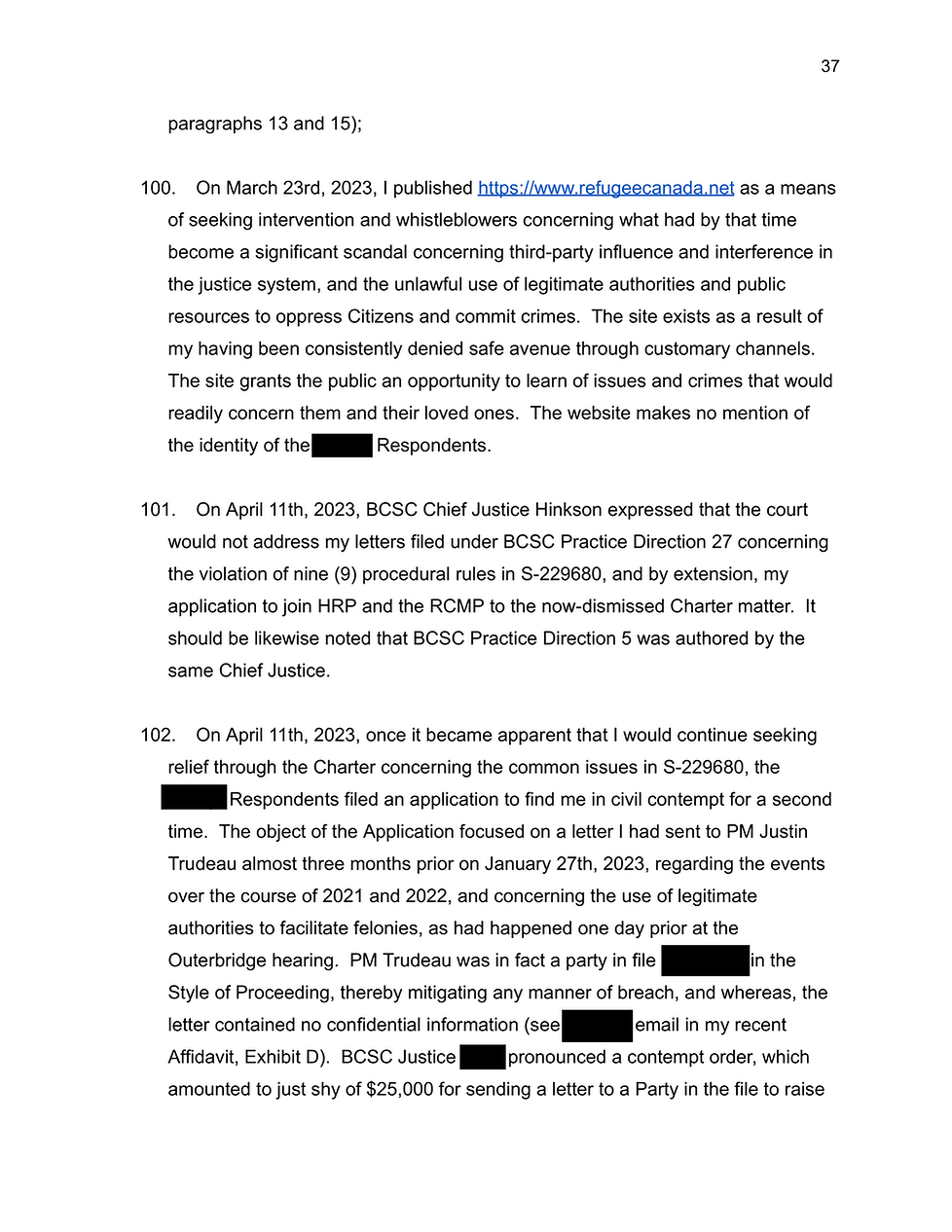
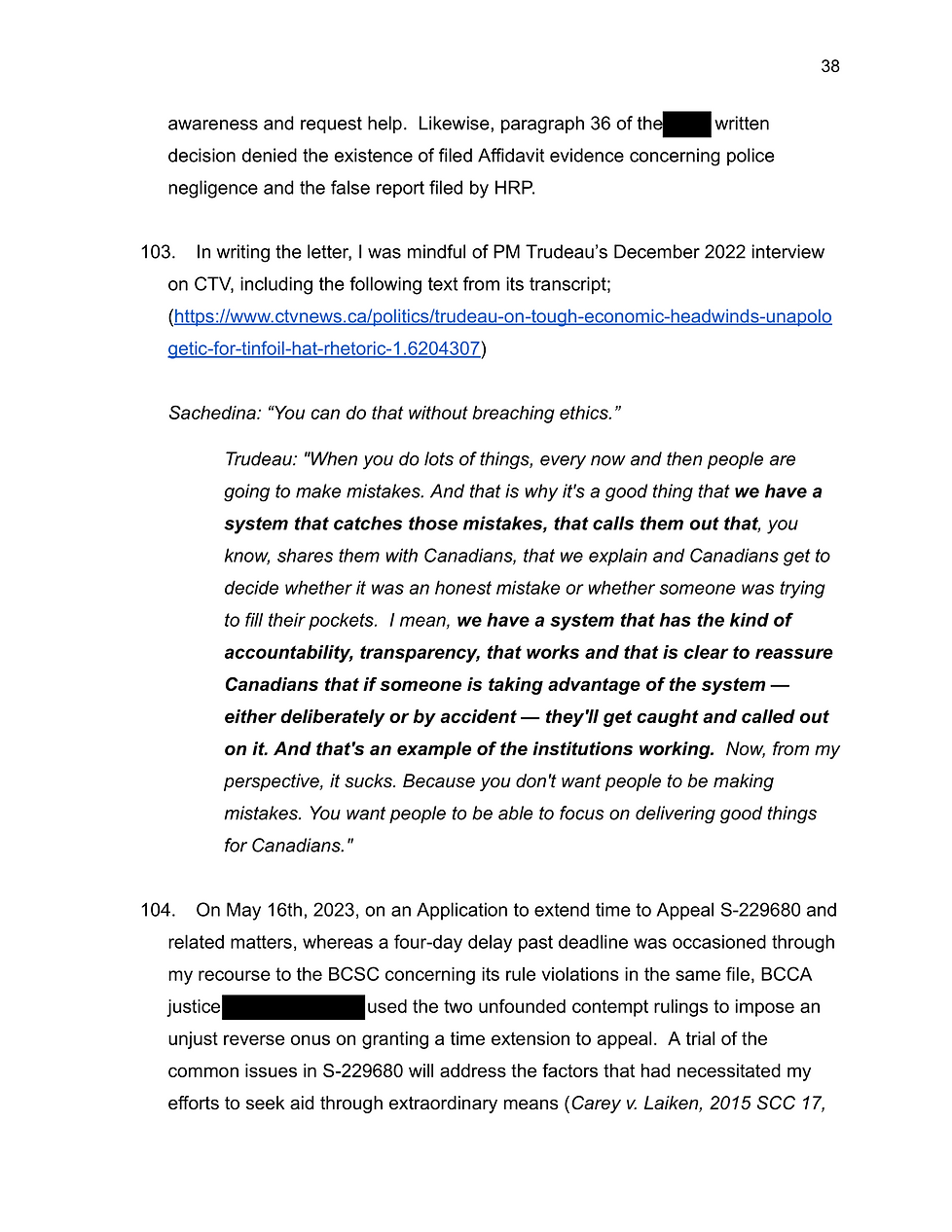
July 10th, 2024 (NSSC): Found in contempt for opposing $400k billing scandal (+9,000% above tariff), after exhausting recourse. No engagement with probative record. No application of the court's discretionary power (can refuse to find contempt in view of overall context - CN Rail v. Teamsters; Chong v. Donnelley; Carey v. Laiken). Subsequently sentence to a 30-day custodial sentence.
-
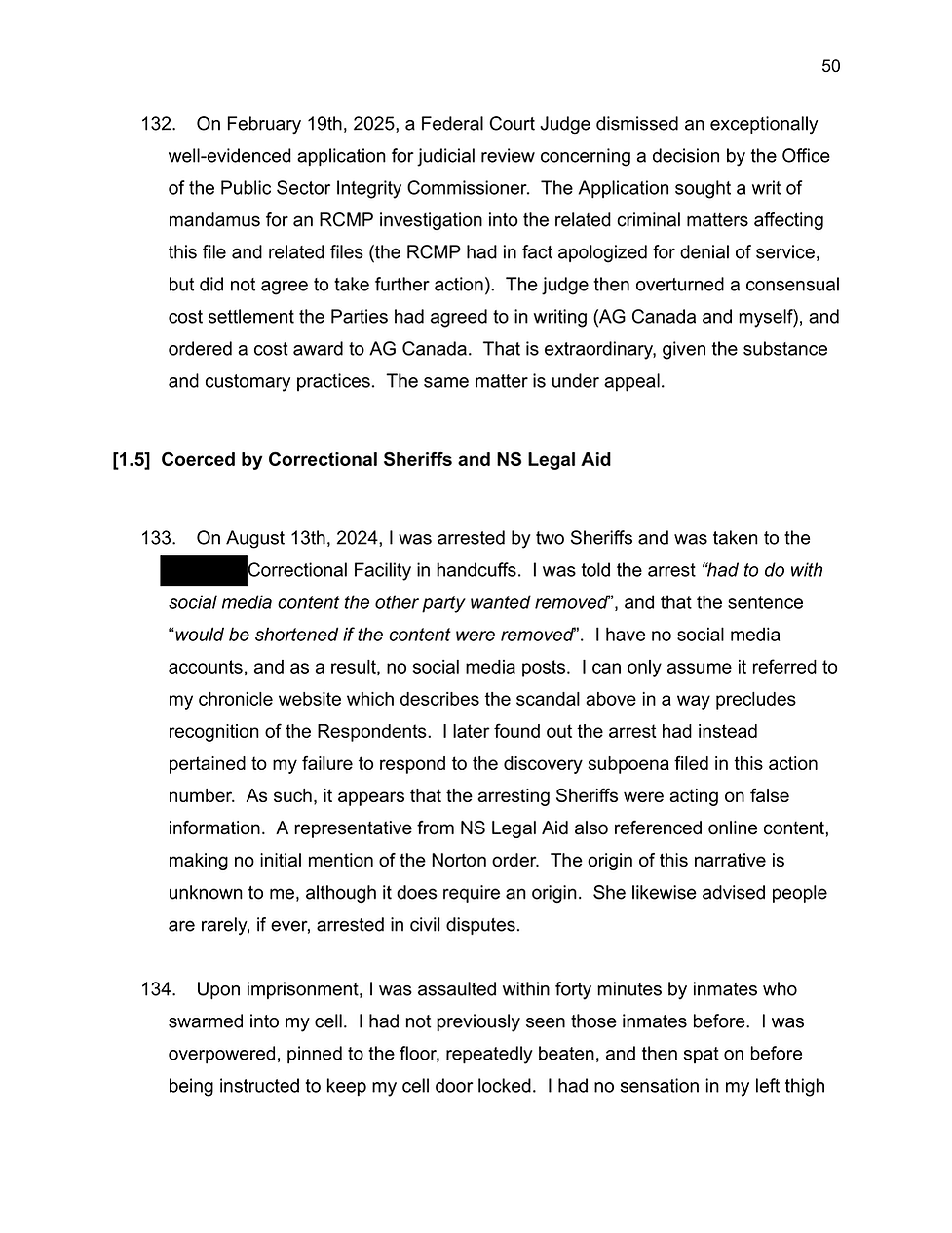
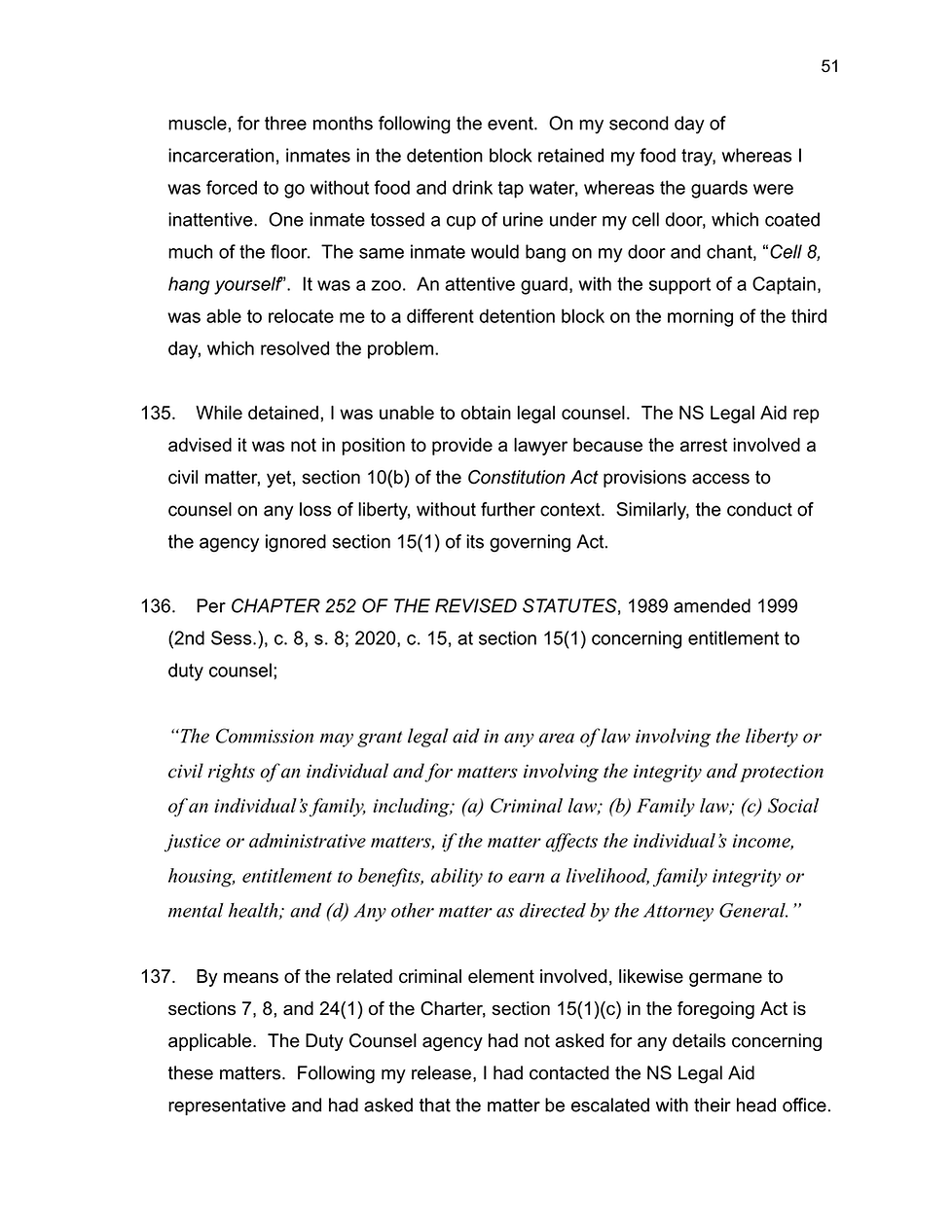
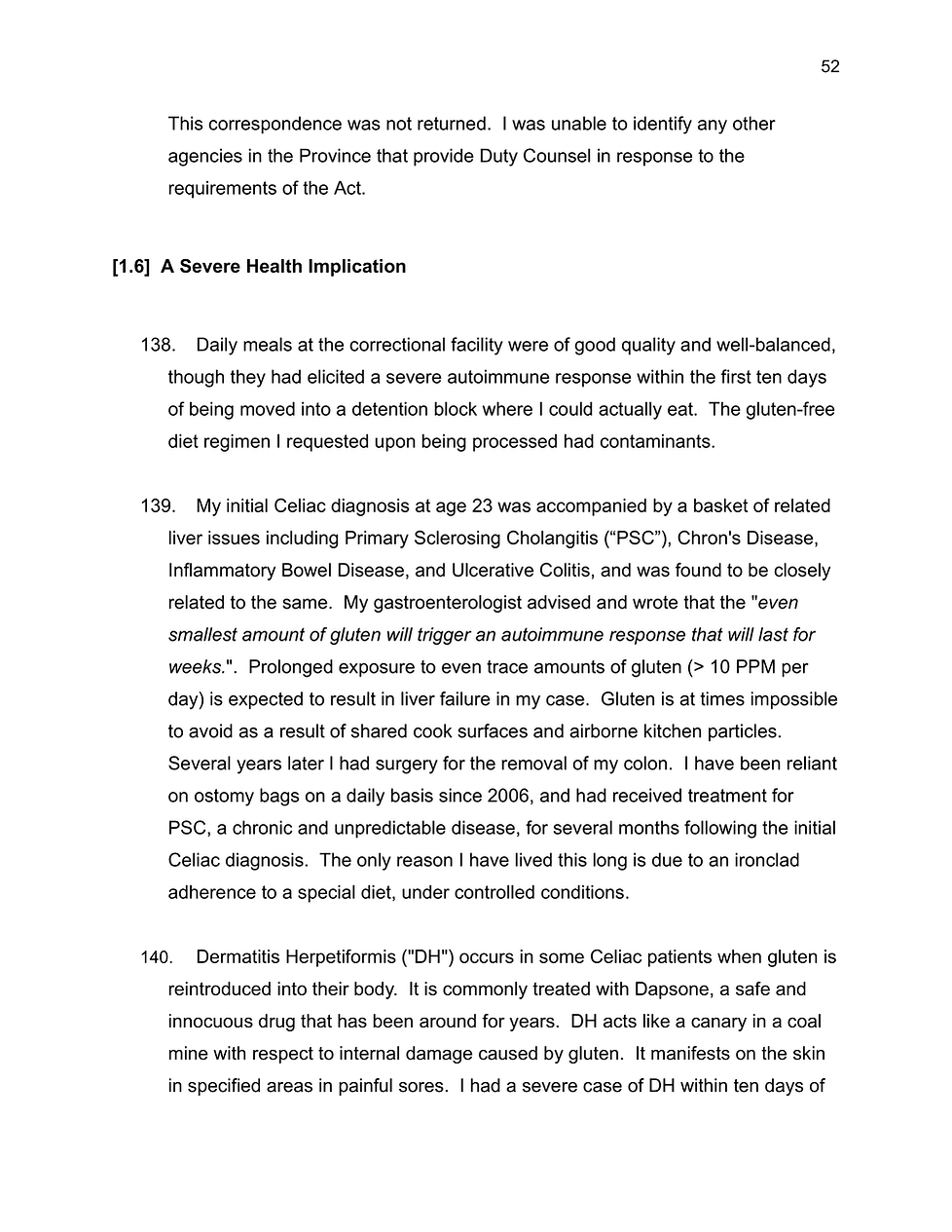
August 13, 2024 (NSSC): Jailed by sheriffs who claimed arrest was due to "incriminating online content". No context provided; presumably this website. File was sealed; warden knew nothing of the file. Advised I could "go home early" if I removed online content. Beaten within 40 minutes of being detained by unknown inmates. Denied food 1 day. Urine thrown under cell door. Counselled to commit suicide using bedsheet. Denied duty counsel ("civil matter" vs criminal, despite exception in the code). Autoimmune condition triggered due to food contamination / gluten (shared kitchen surfaces / airborne particles > 10 parts-per-million per day). 4 interrelated liver / bowel diseases / celiac. Diagnosis confirmed by physician.
-
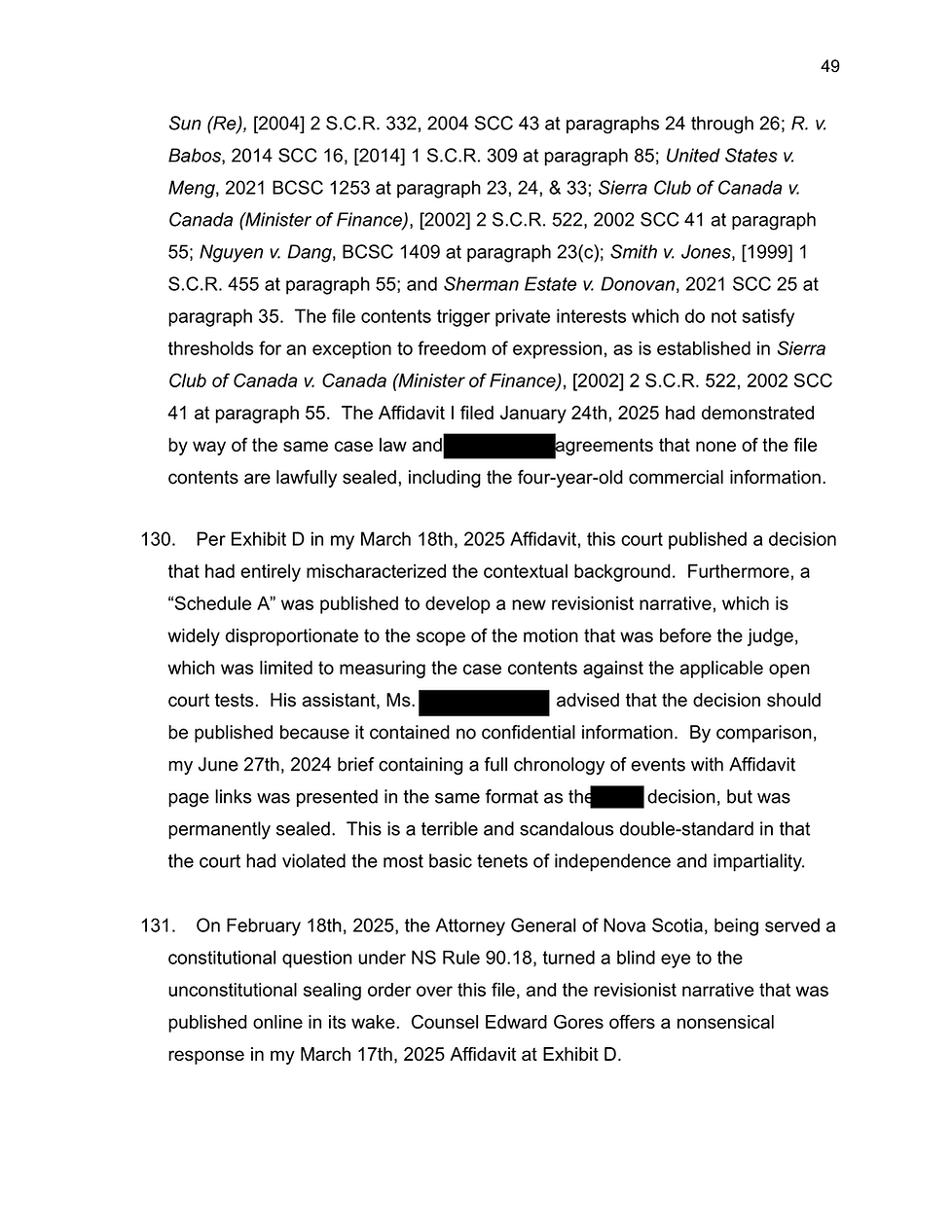
Feb 5, 2025 (NSSC): A justice permanently sealed the entire case (the NSSC sealed file), posted a court-authored “Schedule A” chronology publicly, and declined to apply the open-court tests from Sherman Estate, CBC v. Named Person, and Dagenais/Mentuck. Staff later confirmed publication was appropriate because the decision contained “no confidential information,” even as Dempsey’s evidence-based chronology remained sealed—a double standard.
-
April 1, 2025 (NSSC): Found in contempt a second time, no engagement with probative record or applicable tests concerning discretion. Conclusory reasons that did not engage the file (Canada v. Vavilov). Judge signaled custodial sentence despite full medical records filed several months prior.
-
May 16, 2025 (NSCA): Security for costs at 40x Power v. Power ($8,000 security v. $500 lower court matter) x 2 + printing paper concerning the file-wide sealing order; $20,000 in cash to participate in an appeal of the blanket sealing order + revised public narrative and the contempt order. Bank account frozen in 2024; had to liquidate an asset to participate.
-
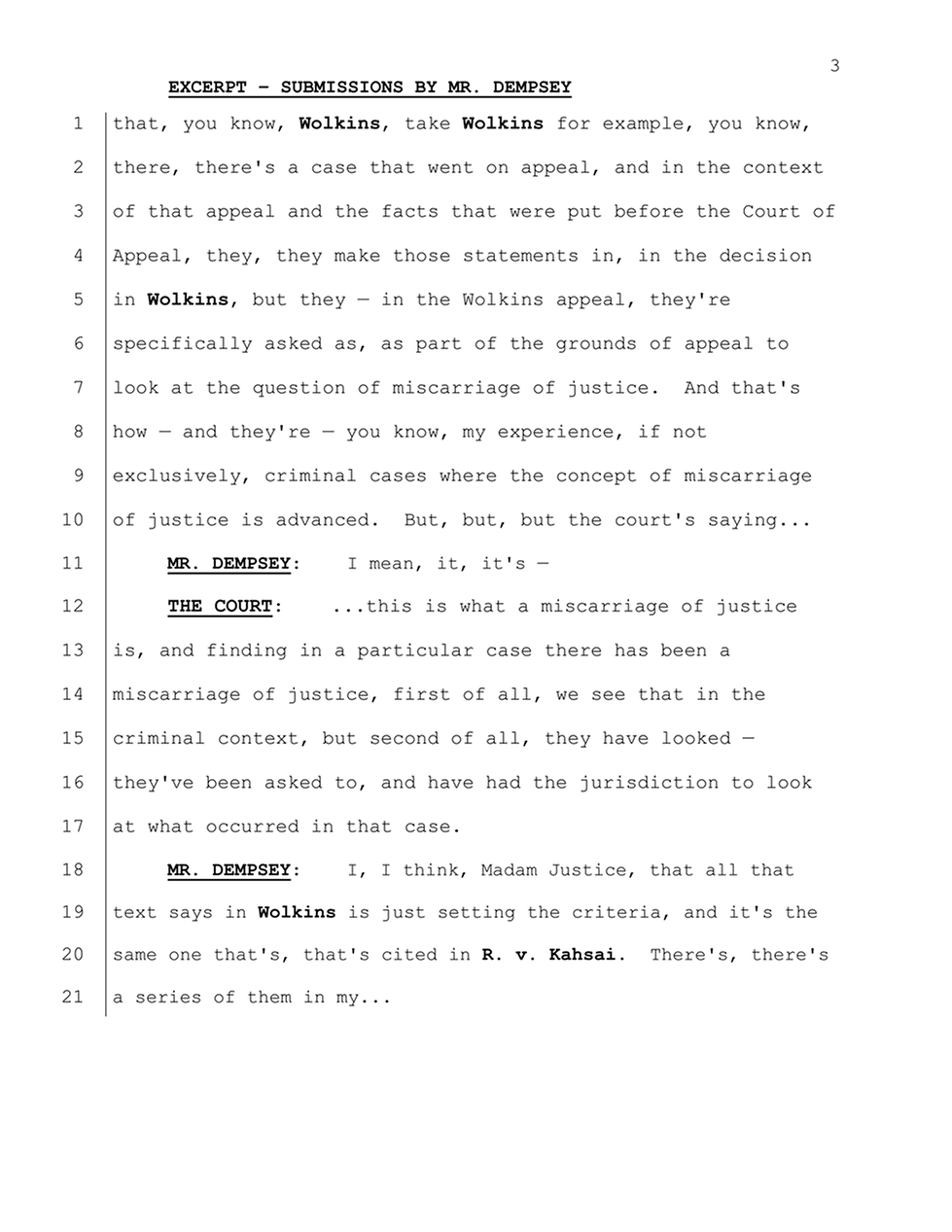
June 5, 2025 (NSCA): Court of Appeal dismissed a motion to stay April 1 2025 contempt order. Judge ignored probative record, advised the autoimmune health harm is "self-inflicted", due to opposing the $400,000 billing felony. Transcript is at the bottom of this page.
-
July 4, 2025 (NSSC): Scheduling hearing for contempt penalty stage. Judge advised "you should expect to be taken into custody". No concern over autoimmune health condition. Transcript is shown at https://www.refugeecanada.net/jailed2
-
July 30, 2025 (NSSC): Sentenced to 45 days house arrest concerning my opposition to the billing scandal. Judge acknowledged the custodial sentence health risk following my broad email disbursal on July 29, 2025 that outlined redacted health records and aspects of the probative record, similar to the records on this website, including computational audits.
-
August 2025 (NSSC): Court refused to provide copies of the court file in NSSC 545333 to my process server concerning HRP obstruction concerning the related criminal element (https://www.refugeecanada.net/hrp). Registrar advised copies could be provided using the unsupervised lobby photocopier, thus creating chain of custody issues with respect to authenticity and document integrity.
-
October 1 & 3, 2025 (NSCA): Two 3-panel judges refused leave to appeal the sealing and contempt orders, claiming "no arguable issue". Threshold, as outlined in Nova Scotia (Attorney General) v. Morrison Estate, 2009 NSCA 116 at para. 45, only requires that two reasonable persons could disgree over an issue. Binding authorities ignored. Probative record ignored. No oral submissions concerning seal on October 3. $12,500 in costs awarded to CAGE from security for costs orders. Details at https://www.refugeecanada.net/gatekeeping with computational audits. Obstruction does not get any clearer than this.
-
November 2025 (NSCA): Court administrative staff refused to respond after the remaining $3,500, paid via cheques, was uncashable due to the 2024 bank freeze. Court could have navigated the issue via (1) a Registrar direction to RBC to vary the freeze (Rule 46.07); or (2) a finance/Treasury exception to provide a cash envelope.
E. Cumulative Pattern: Institutional Coordination
Across multiple courts over nearly four years, the pattern is consistent:
-
Discovery prevented: The April 2022 order was never executed; subsequent rulings erected barriers.
-
Sealing without justification: Wholesale, pre-service, and permanent sealing, without applying necessity/minimal-impairment tests.
-
Procedural violations ignored: CPA/PD-5 safeguards bypassed; public-service registries refused to enforce mandatory rules.
-
Evidence omitted: CSR anomalies, FY2020 derecognition, CAGE CEO perjury, and the billing scandal were never examined on the merits.
-
Cost barriers erected: Security-for-costs escalated (e.g., customary $200 → $2,500 → $8,000) despite identical appeals; proportionality ignored, probative record ignored, jurisprudence ignored.
-
Enforcement before merits: $376,201.97 in solicitor-client costs certified/enforced while discovery remained unfulfilled for 9 short hearings.
-
Contempt as coercion: Civil contempt leveraged to compel compliance with discovery subpoenas while the underlying fraud allegations stayed sealed. Abused while in custody. Autoimmune diagnosis from first custodial sentence and lifelong health records ignored until a pending subsequent custodial sentence was relayed to NS Health.
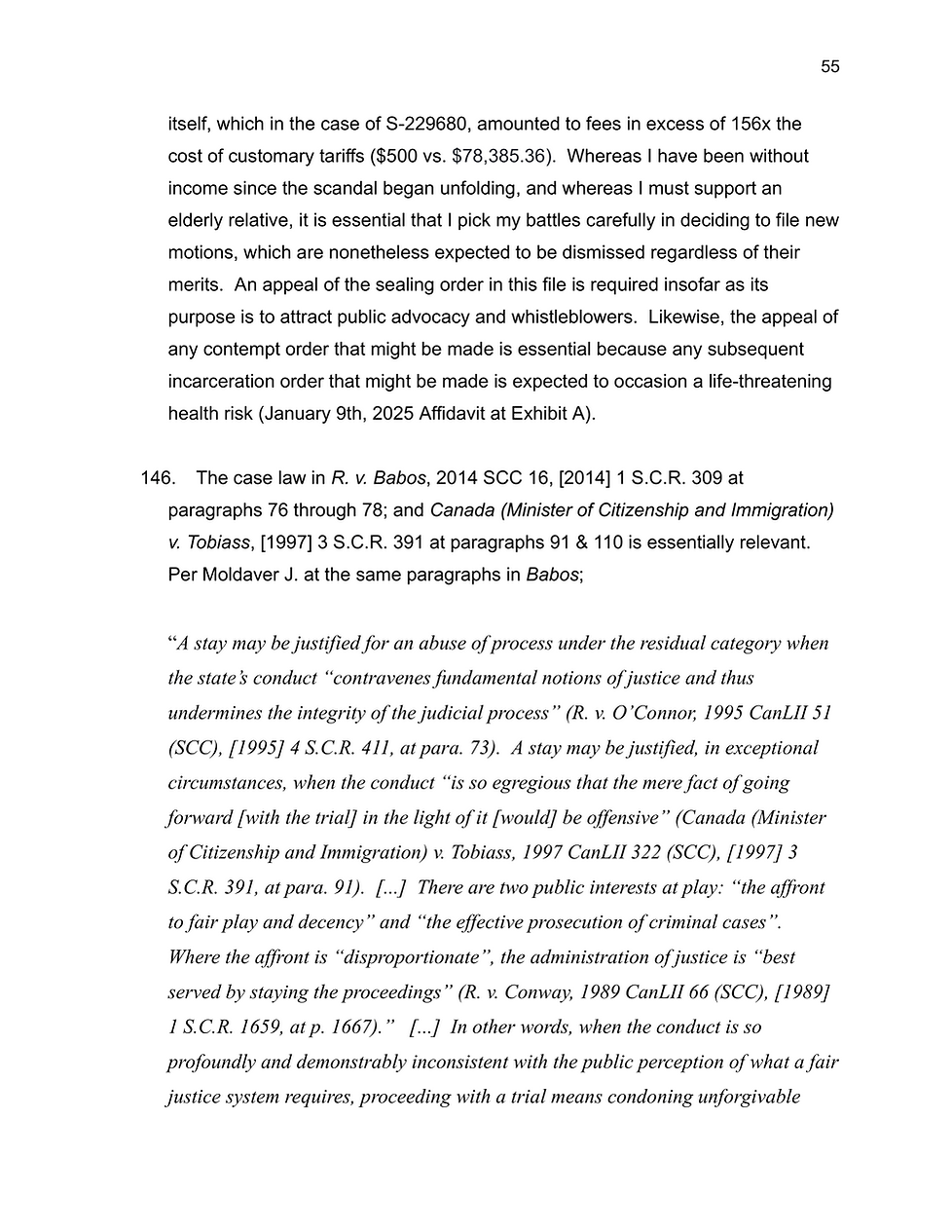
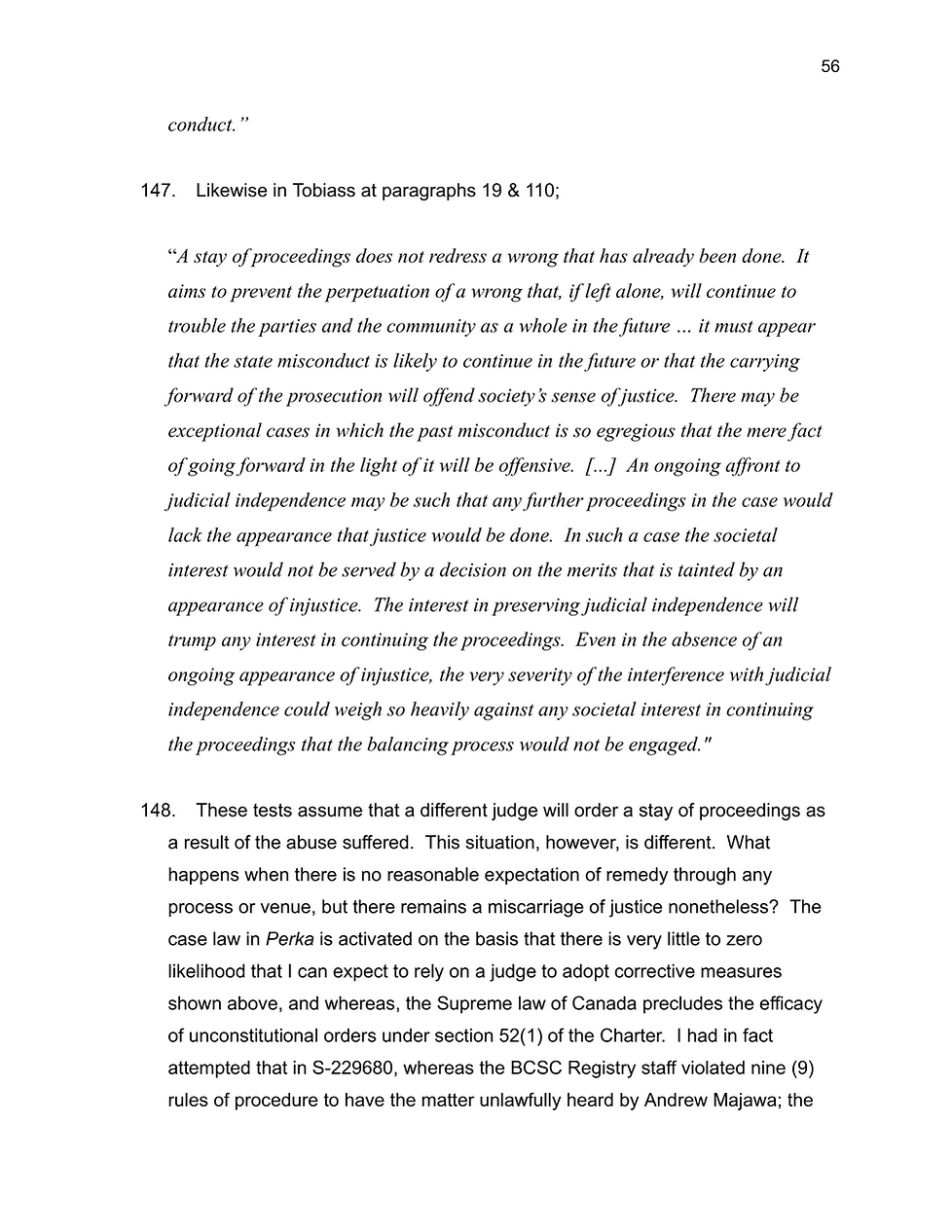
This satisfies the Babos/Tobiass framework: conduct “so egregious that the mere fact of going forward in the light of it would be offensive,” and proceedings that undermine the integrity of the justice system. As Tobiass, para. 110, cautions: an ongoing affront to independence can render any further proceedings lacking the appearance that justice would be done. It demonstrates severe violation of open court case law (Sherman Estate, Sierra Club, CBC v. Named Person). It violates the natural justice / public policy enforcement framework (Beals v. Saldanha - “shock the conscience of Canadians”). And finally, among a multitude of other tests contemplated at the Authorities page, it violates the discretionary power guardrails (Colburne v. Frank; Carey v. Laiken; CN Rail v. Teamsters). It occasions an utter weaponization of irresistible public authority.
V. Constitutional Analysis: Systemic Failure of Guardrails
A. Section 7 — Right to Fair Process
Charkaoui v. Canada confirms that s. 7 comprises:
-
A hearing before an independent and impartial adjudicator;
-
A decision on the facts and the law;
-
The right to know the case to meet and to answer it; and, at para. 48, that fundamental justice requires at minimum a meaningful judicial assessment on the evidence and the law.
Here, that floor was not met: evidence was sealed rather than assessed, discovery was obstructed rather than completed, and summary disposition preceded evidence-gathering. As Dempsey argued, he had a constitutional right “to be heard in accordance with the entirety of facts, and not a sanitized revision thereof.”
B. Section 2(b) — Open Court Principle
The sealing regime contravenes the open-court framework in Vancouver Sun (Re), Sherman Estate, and CBC v. Named Person, which requires:
-
Necessity to prevent a serious risk to the proper administration of justice;
-
Minimal impairment;
-
Proportionality (benefits outweigh the harms to openness).
On this record, those requirements were not met:
-
February 2025 (NSSC): an order sealed an entire case despite no legitimately confidential material (the record concerned CAGE shareholder agreements and years-old commercial details).
-
S-229680: sealed pre-service and pre-hearing—incompatible with the necessity standard.
-
A protection order was said to be “necessary for the sealing to function,” creating redundant opacity without justification.
-
No tailoring or redaction was attempted despite consensual proposals.
CBC v. Named Person rejects secret proceedings and demands tailoring. Sherman Estate (paras. 97–98) permits reasonable inferences of harm, but they must be more than negligible or speculative. Commercial sensitivity / shareholder privacy cannot justify wholesale sealing of public-interest fraud evidence.
C. Baker — Procedural Protections Scale with Impact
Baker v. Canada and progeny hold that the more serious the impact, the more robust the procedures. Vavilov (para. 133) applies this to reasonableness review: when impact is severe, the decision-maker’s reasons must reflect the stakes.
Here, impacts included:
-
Loss of life savings through enforcement of grossly-inflated, fraudulent billing (+9,000% above tariff);
-
Contempt findings without discretion (CN Rail v. Teamsters), and custodial detention resulting in physical injury;
-
A meritless vexatious-litigant declaration against a self-represented litigant, barring future access;
-
Serious health risk (autoimmune exacerbation tied to detention conditions);
-
Ongoing criminal harassment and privacy intrusions that have effectively stoped Dempsey's life in its tracks (see Harms at the Zersetzung and 4IRPortal pages).
Yet the reasons were perfunctory, omitted key evidence, and included demonstrable factual errors—contrary to Baker’s core mandate.
D. Access to Justice — Financial Barriers
Security for costs escalated without principled basis:
-
Aug 2023: $2,500;
-
May 2024: $7,500 (tripling despite identical subject matter);
-
May 2025: $16,000 plus $3,000 in printing for a 2,600-page sealed file ($8,000 each for two appeals, with NSSC costs being $500 each);
-
An automatic "kill-switch", where appeals are automatically dismissed in 10 calendar days if security is unpaid (in direct contrast to Rule 90.42(2), and Dataville Farms Ltd. v. Colchester County (Municipality), 2014 NSCA 95).
Williams Lake Conservation Co. v. Kimberly-Lloyd requires exceptional circumstances before security is ordered. Power v. Power sets a ~40% benchmark for appellate security in Nova Scotia (thus, $200 security vs. the $8,000 ordered). Those standards were not satisfied. Meanwhile, execution targeted $376,201.97 in costs—~84× tariff—before merits-level scrutiny. Requiring security to appeal while simultaneously enforcing those costs creates a catch-22 that denies access to justice. As Canada (AG) v. Power cautions, courts must act as “vigilant guardians of constitutional rights and the rule of law.”
E. Abuse of Process — The Tobiass/Babos Framework
Tobiass (paras. 91, 110) recognizes a residual stay where conduct is so egregious that proceeding would itself be offensive or an ongoing affront to judicial independence. Babos (paras. 76–78) emphasizes that when state conduct is profoundly inconsistent with fair-justice expectations, the administration of justice is best served by a stay.
This record satisfies both tests:
-
Severity: Discovery ordered, then systematically prevented; evidence sealed without justification; costs certified at ~84× tariff; registry-level violations of multiple mandatory rules; pre-service sealing; contempt leveraged while underlying fraud remained unexamined; detention with serious health risks.
-
Ongoing affront: The pattern persisted four years, multiple courts, dozens of judges, and appellate panels; each corrective attempt was met with new barriers (seals, security, vexatious orders, registry obstruction). The appearance is of institutional coordination, not episodic mistake.
-
Disproportionality: Any public interest in enforcing a $376,201.97 cost award certified without scrutiny is outweighed by the profound affront of enforcing fraud through judicial machinery while sealing the evidence of that fraud.
VI. Implications and Analysis
A. Comity vs. Constitutional Duty
One explanation for the pattern is judicial comity—reluctance to characterize peer decisions as erroneous or constitutionally deficient. A June 27, 2024 hearing before a Nova Scotia justice reflects this dynamic: as the transcript shows, the court grappled with departing from a concurrence of unconstitutional sealing orders issued in BC and NS, ultimately choosing alignment over constitutional compliance.
But comity cannot override constitutional duty or replicate error (Apotex Inc. v. Allergan Inc., 2012 FCA 308 at paragraphs 43-44). NS Rule 85.04 requires adherence to constitutional law and applicable tests. When judges prioritize consensus over guardrails, comity becomes complicity.
B. Institutional Capture and Stakeholder Networks
The magnitude of the billing fraud ($376,201.97 for ~14.5 hours of court time), combined with its certification and inter-provincial enforcement, indicates coordination beyond individual actors. Neither a mid-sized federally sponsored technology entity (CAGE) nor its CAGE CEO, nor even a prominent litigation team, would likely risk such transparent multiples without assurances that institutional mechanisms would facilitate—rather than scrutinize—the scheme.
Actors implicated by the pattern (categories):
-
Corporate / Legal: the federally sponsored CAGE; external litigation counsel swearing to the “necessity” of ~84× tariff multiples; lead counsel with a uniformed advisory role to national defense (as reflected in the record).
-
Judicial Officers: registrars/masters certifying costs without scrutiny; chambers judges stalling discovery while accelerating enforcement; appellate panels sealing wholesale and dismissing appeals within minutes.
-
Registry Staff: provincial public-service personnel declining to enforce mandatory rules and steering Charter proceedings to a specific chambers judge contrary to the CPA/PD-5 framework.
-
Police / Oversight: an RCMP detachment declining investigation despite contemporaneous acknowledgments; a municipal police service issuing reports inconsistent with recorded meetings; and police-complaints bodies disregarding documented obstruction.
-
Federal Registry: Supreme Court registry staff delaying motions for months beyond timelines, enabling provincial enforcement to proceed.
This cross-institutional, cross-jurisdictional consistency aligns with Dempsey’s description of “networks of influence capable of shaping the conduct of the adjudicative agency framework,” echoing Canada (Attorney General) v. Bedford, para. 76, on governance scandals that distort institutional operation.
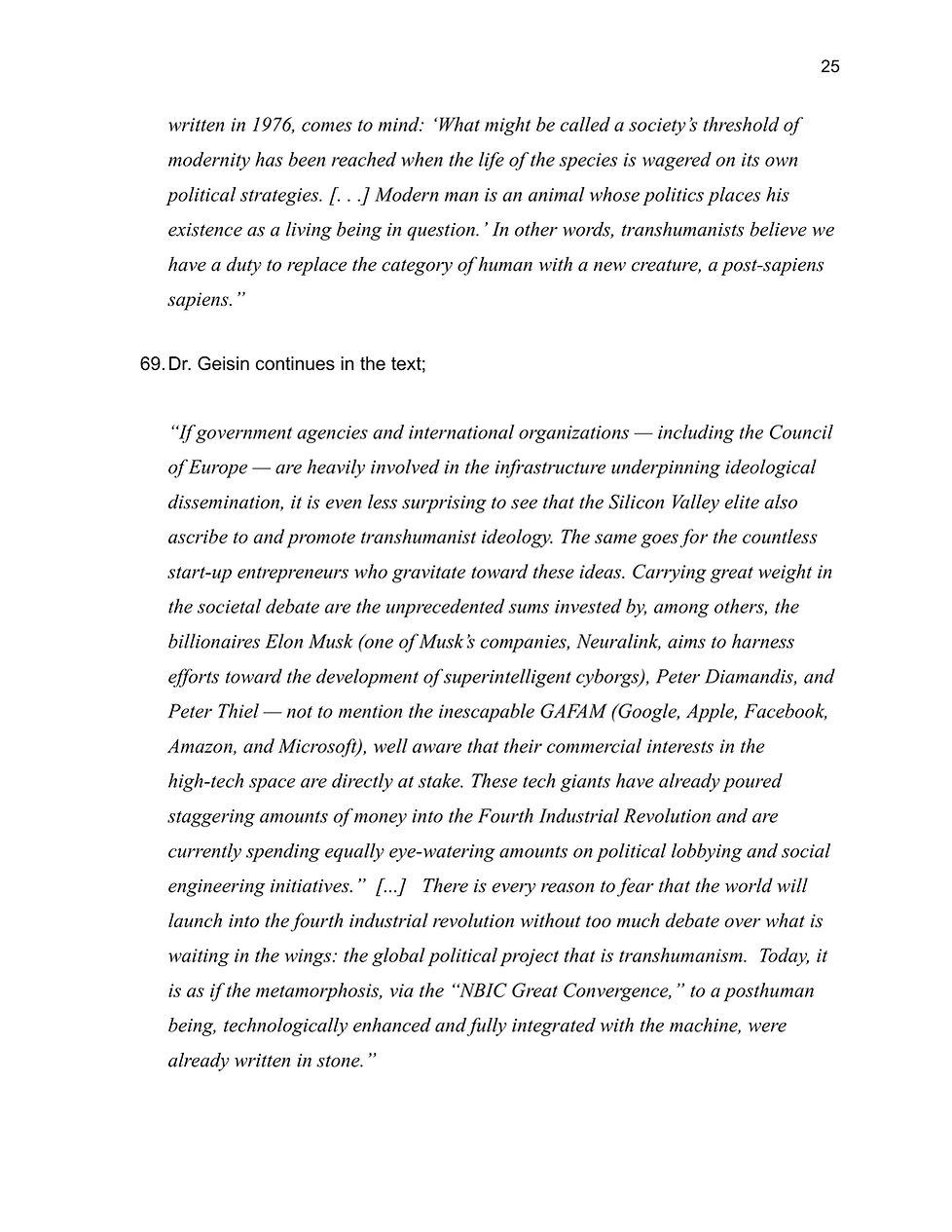
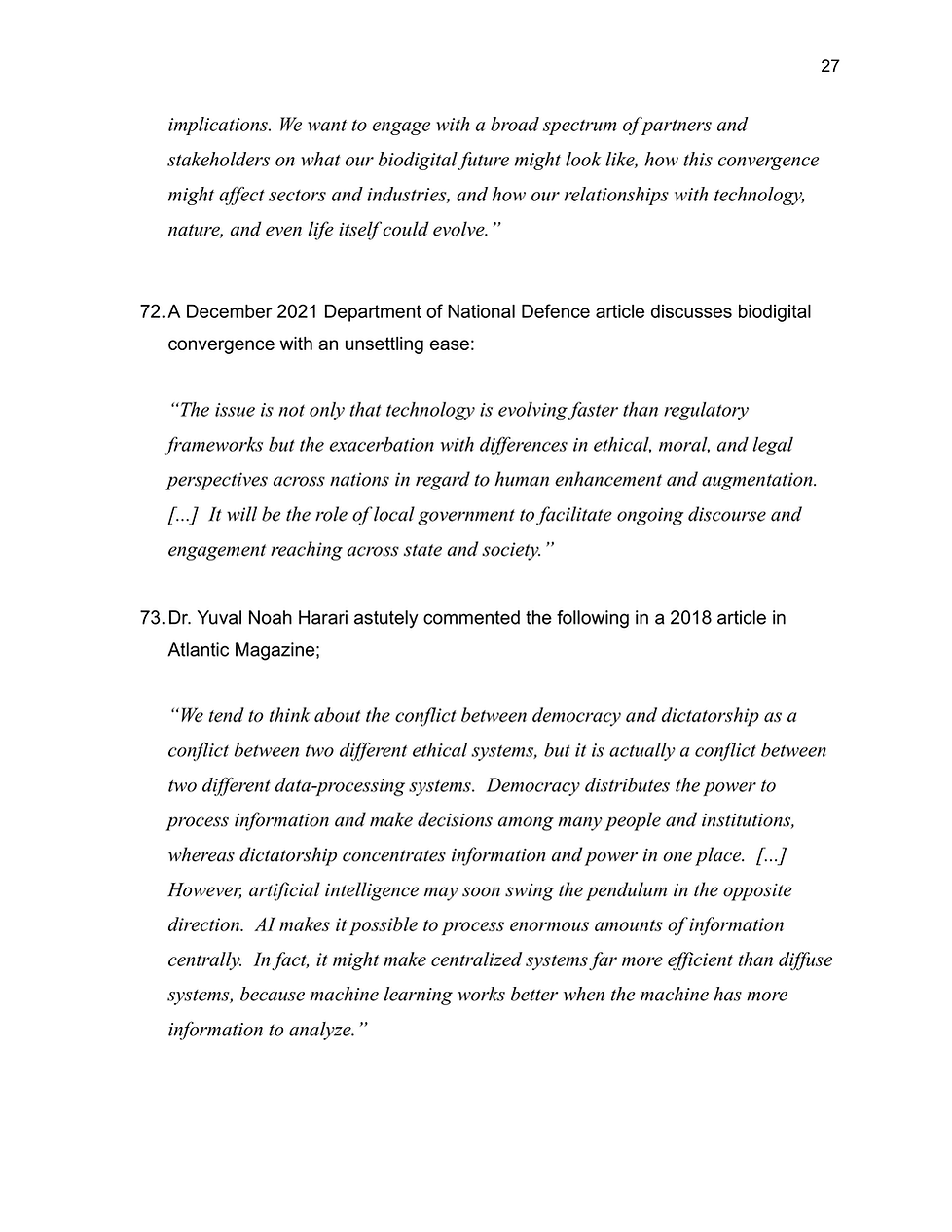
C. The Fourth Industrial Revolution Context
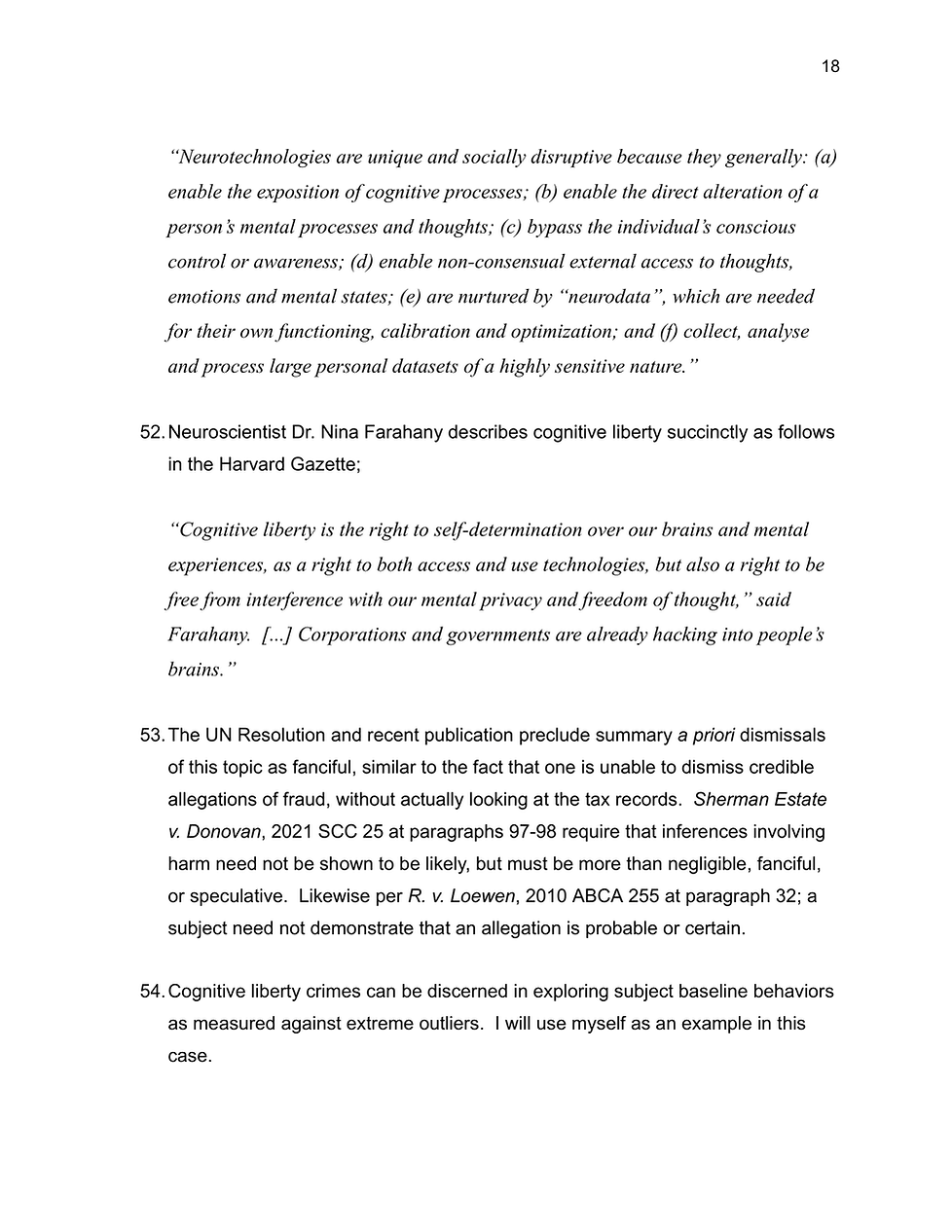
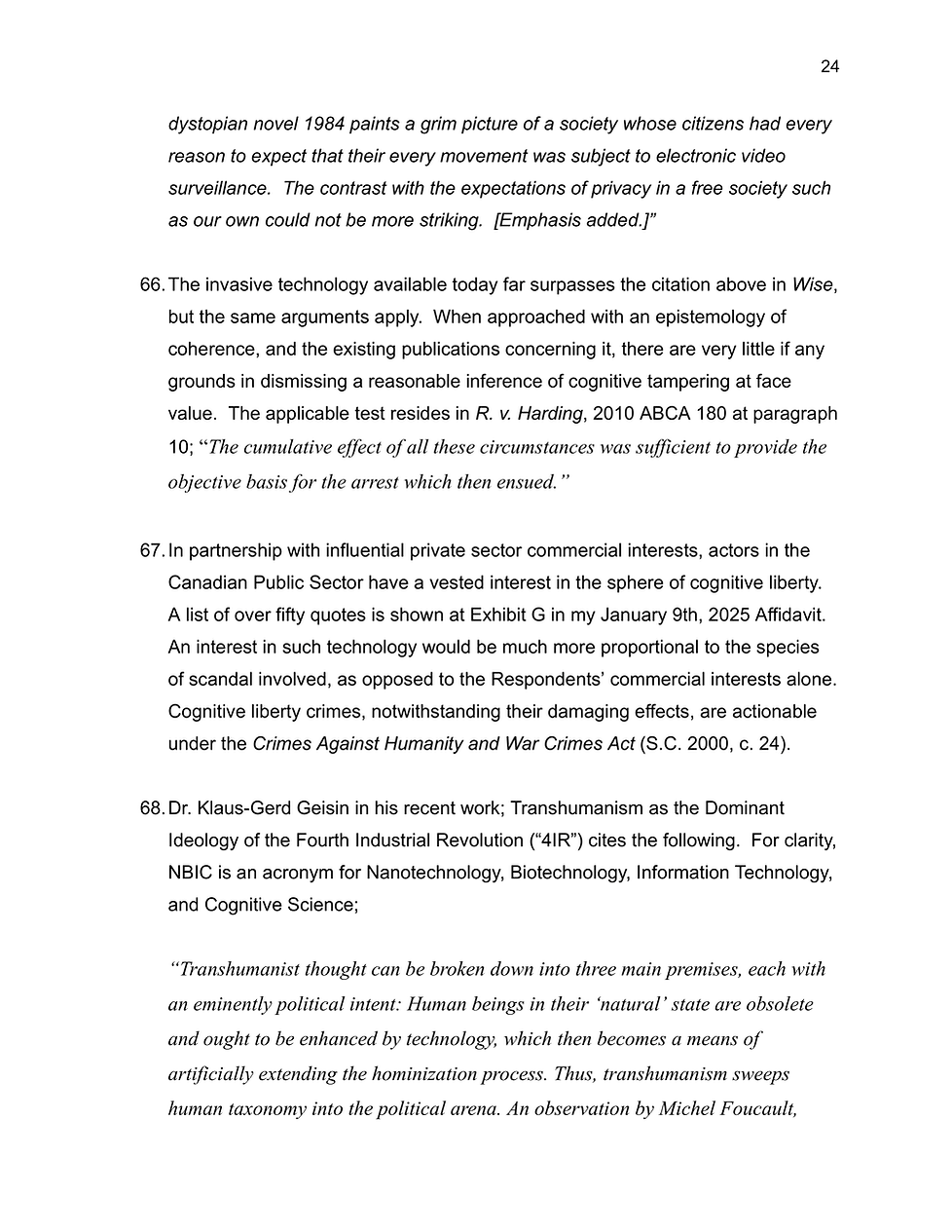
Dempsey situates the scandal within an emerging neurotechnology and biodigital convergence substrate—what he terms “cognitive-liberty crimes” in the Testimony. Recent materials lend this framing credence:
-
UN recognition: A referenced Human Rights Council text (e.g., A/HRC/57/61) notes neurotech can “enable the direct alteration of mental processes” and may bypass conscious awareness, raising non-consensual interference risks.
-
UN report A/HRC/43/49 details the manner of related and impactful AI-assisted cybertorture noted in the Zersetzung and Guide pages.
-
Canadian policy interest: Policy Horizons Canada has written on biodigital convergence, forecasting integration that could redefine what is considered human or natural.
-
Charter surveillance principles: R. v. Wise affirms electronic monitoring engages ss. 7 and 8. Modern modalities far exceed 1992’s capabilities; the principles therefore apply with greater force.
-
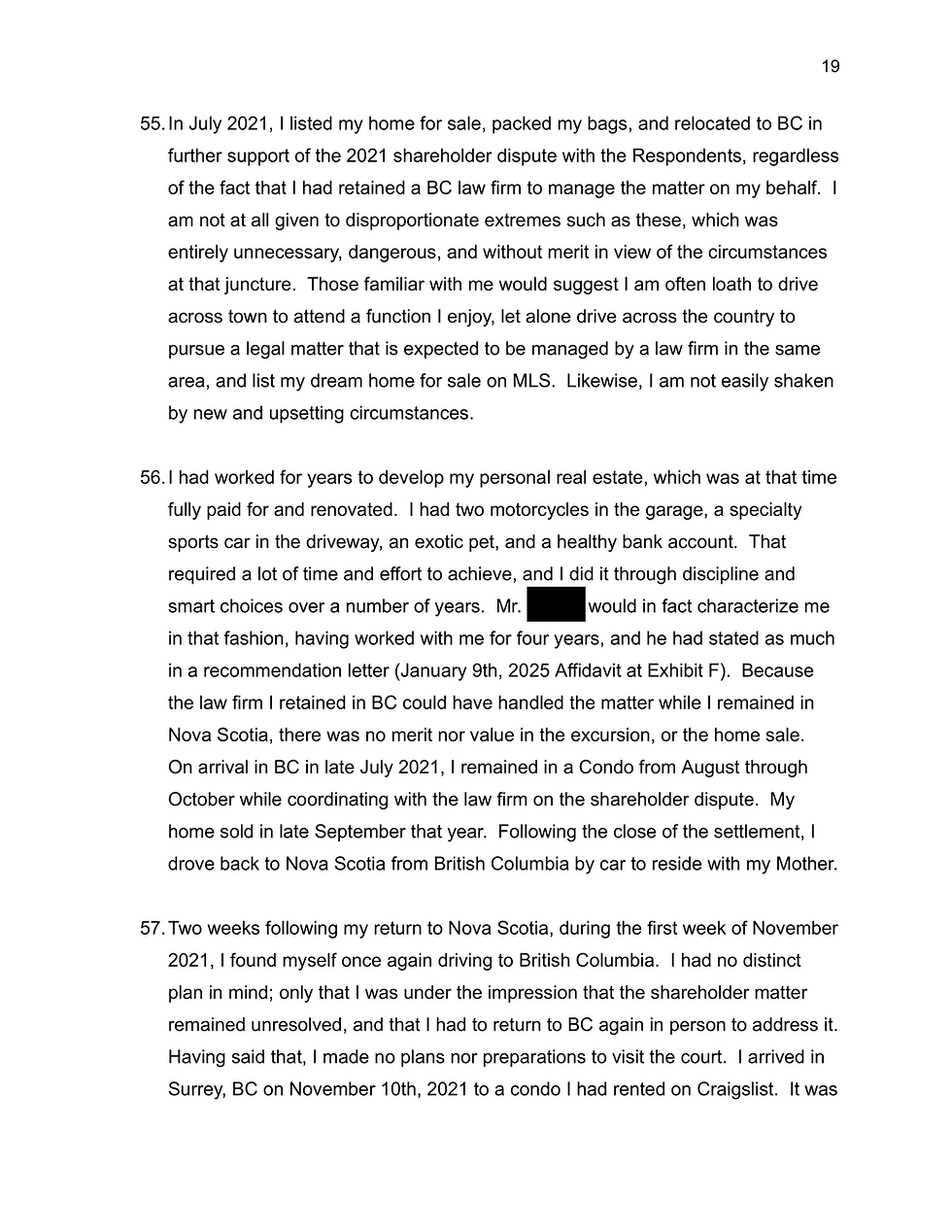
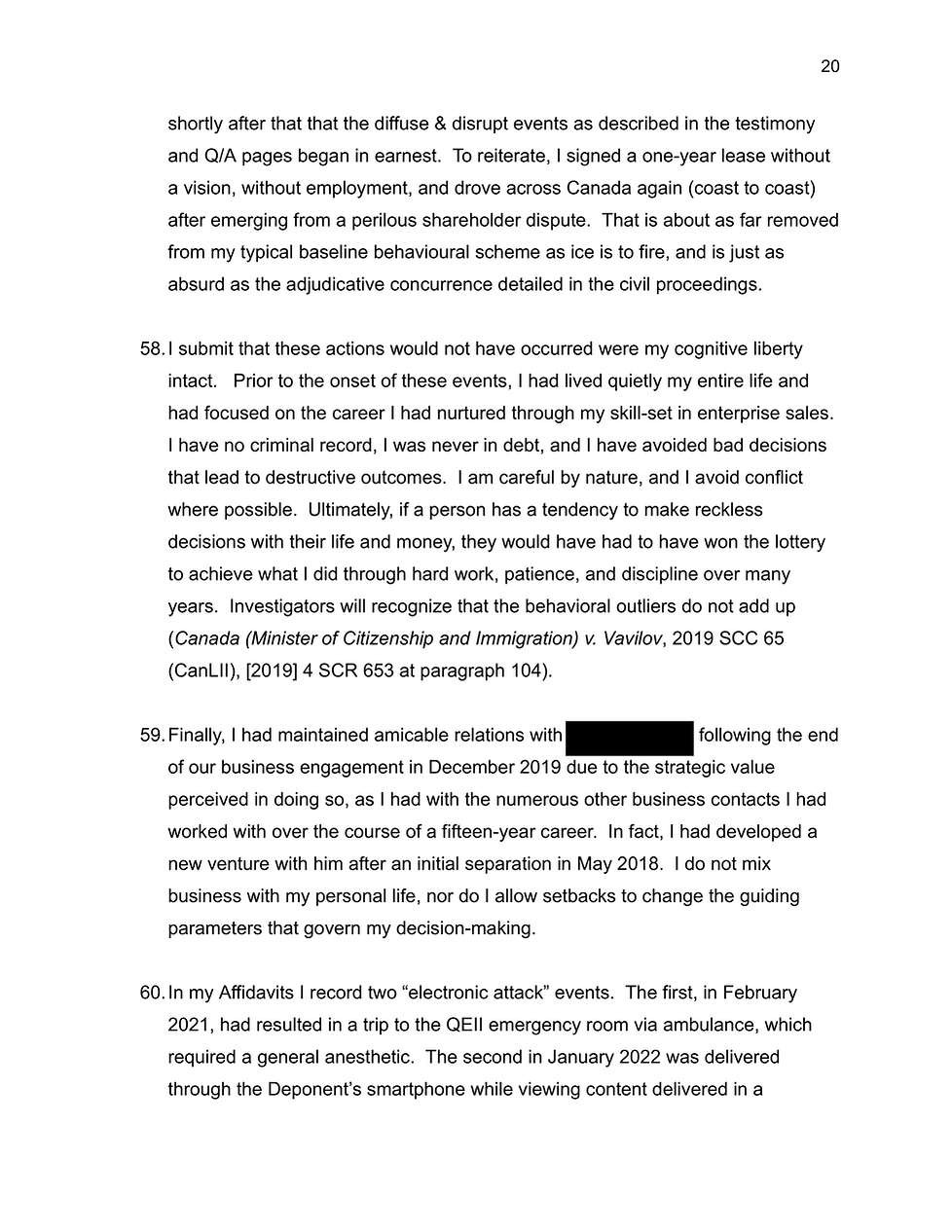
Behavioral anomalies as circumstantial evidence: Dempsey’s departures from a long-standing risk-averse baseline (e.g., selling a paid-off home, cross-country relocations without employment, leasing while under harassment) create cumulative inferences consistent with R. v. Villaroman.
Whether or not neurotech was deployed, the harassment pattern, police obstruction, and judicial coordination are consistent with state or state-adjacent involvement is vastly disproportionate to a single shareholder dispute. A Villaroman inference is required concerning the outliers.
D. Post-Democratic Institutional Drift
Drawing on Colin Crouch’s “post-democracy”, Michel Foucault's "Governmentality", and the works of many more contemporary scholars, Dempsey argues institutions may preserve constitutional form while serving elite stakeholder interests in practice.
Indicators consistent with this drift:
-
Stakeholder coordination: Global governance frameworks (e.g., SDG implementation) position media, judiciary, and civil agencies as “stakeholder partners,” potentially eroding independence.
-
Belief-centric networks: When law is detached from transcendent foundations (cf. the preamble recognizing “the supremacy of God and the rule of law,” see Ruffo v. Conseil de la magistrature), a postmodern community-based consensus will substitute for principle.
-
Discretionary gatekeeping: Appointment/hiring pipelines in courts, firms, and registries can homogenize viewpoints, privileging community alignment over constitutional duty—explaining coordinated obstruction across dozens of decision-makers.
-
Commercial integration: The role of a federally sponsored CAGE, major firms with government advisory ties, and state interest in 4IR technologies point to public-private alignments influencing adjudicative outcomes.
While the mechanisms remain partly inferential, this framework best explains the otherwise inexplicable: how multiple courts across provinces could repeatedly sidestep constitutional obligations to enforce manifest fraud, while foreclosing customary avenues of corrective recourse.
VII. Reform Implications
A. Broader Access to Justice Implications
This case illuminates systemic access to justice failures beyond one litigant:
Financial Barriers: When costs can be weaponized at 84x standard rates with certification rubber-stamped, civil litigation becomes available only to the wealthy or those backed by institutions. Self-represented litigants face insurmountable barriers, especially if they are forced into self representation as Dempsey was.
Sealing as Censorship: Wholesale sealing prevents public scrutiny of judicial conduct and corporate fraud. If courts can seal evidence of their own procedural violations while publishing sanitized narratives (as Keith did), accountability becomes impossible.
Discovery as Discretionary: If courts can order discovery then systematically prevent its execution through procedural manipulation, the right to evidence becomes illusory. Truth-seeking yields to expedience.
Comity Over Constitution: When judges prioritize alignment with peers over Constitutional compliance (as Bryson's transcript reveals), Charter rights become negotiable rather than fundamental.
Institutional Capture: When registry staff, police, judicial officers, and law firms coordinate to serve elite interests while obstructing ordinary citizens' access, democracy becomes formalistic rather than substantive—Crouch's "post-democracy."
B. The Appearance of Justice Standard
R. v. Wolkins at paragraph 89 held that miscarriage of justice includes "anything [that] happens in the course of a trial, including the appearance of unfairness, which is so serious that it shakes public confidence in the administration of justice". R. v. Kahsai clarified that unfairness in either "appearance or fact" suffices, measured by "the opinions of reasonably informed and unbiased persons" and "a community's sense of fair play and decency."
Applied here, a reasonable observer informed of the full record would conclude:
-
Shareholder fraud evident: CSRs empty where 51+ shareholders should appear; FY2020 derecognition policy unique and concealing; sworn perjury documented; documentary contradictions stark
-
Billing fraud manifest: $376,201.97 for 14.5 hours of court time is 84x standard tariffs; lawyer affidavits swearing to "necessity" are facially false; certification occurred without scrutiny, and required state-adjacent assurances
-
Discovery prevented: Cameron ordered audit-level discovery; every subsequent ruling obstructed it; and summary dismissal occurred before evidence was gathered
-
Sealing unjustified: Wholesale sealing without Sherman Estate analysis; pre-service sealing impossible to justify; enforcement court published a revised public narrative atop a sealed file that concealed the scandal
-
Coordination apparent: Pattern across five courts, three provinces, four years too consistent for coincidence; registry staff violated nine rules to steer case; delays at SCC enabled enforcement
The appearance is unmistakable: courts facilitated fraud, prevented evidence examination, and deployed enforcement mechanisms against the fraud's victim. This "shakes public confidence" to the very foundation.
VIII. Conclusion
The documented pattern from 2021 onward reflects not episodic error but systemic institutional failure. Three interlocking scandals—corporate fraud concealed through manipulated records, billing fraud certified at ~84× tariff, and procedural obstruction that foreclosed any merits review—combined to produce what multiple analyses characterize as one of the most severe miscarriages of justice in recent Canadian legal history.
Constitutional guardrails designed to prevent such outcomes—discovery rights, open-court principles, proportionality, appellate oversight, and judicial independence—failed collectively, not in isolation. When a BCSC master ordered discovery on April 1, 2022, the system should have facilitated that evidence-gathering path. Instead, subsequent interventions in British Columbia, Nova Scotia, and at the Supreme Court of Canada worked to block discovery, seal evidence, escalate financial barriers, and enforce inflated costs before any adjudication of the underlying fraud.
This record satisfies the Tobiass/Babos abuse-of-process tests: conduct “so egregious that the mere fact of going forward in the light of it would be offensive,” and proceedings that so damage the appearance of fairness that public confidence is shaken. As Tobiass recognizes, where the severity of interference with judicial independence outweighs any societal interest in continuing, the balancing collapses—continuation is illegitimate. It also, fundamentally, satisfies the threshold tests in Beals v Saldanha, 2003 SCC 72, [2003] 3 SCR 416 at paragraphs 73, 218, 220, 243, and 265, as a case that is expected to "shock the conscience of Canadians" and "bring the administration of justice into disrepute".
Three conclusions follow:
-
Systemic—not episodic—failure. When comity pressures, stakeholder coordination, and institutional capture align, Charter protections become formal rather than functional. Remedies are unlikely to emerge from within a captured architecture; external oversight, public scrutiny, and structural reform are required.
-
Access-to-justice as weaponization. The crisis has metastasized beyond delays and fees into active deployment of court processes against unbacked citizens: costs certified at ~84× tariff, security deposits tripled without justification, and vexatious orders aimed at Charter claimants function as oppression mechanisms, not neutral fee regimes.
-
Openness as last defense. The open-court principle is the remaining bulwark against capture. When courts seal evidence wholesale while publishing sanitized summaries—as illustrated by a February 2025 NSSC order—public accountability becomes impossible. Transparency is not an abstraction; it is the operational precondition for preventing adjudicative systems from serving stakeholder interests under constitutional veneer.
A reasonable, fully informed observer would conclude that Nathan Dempsey was deprived of justice—first by the CAGE through corporate fraud, then by external litigation counsel through billing inflation, and finally by the courts through systematic denial of the justice system’s core promise: that evidence will be heard, law will be applied, and truth will be determined by an impartial adjudicator.
The deeper concern is not the singular injustice but the template it reveals: a constitutional democracy can maintain institutional facades while abandoning substantive commitments to fairness, transparency, and the rule of law. In Colin Crouch’s terms, this is post-democratic justice—courts that look like courts, cite tests, and issue formal orders, yet serve stakeholder alignments rather than constitutional principle. Justice requires not merely process, but principle. This case shows what happens when the former persists without the latter.
BIBLIOGRAPHY
Legislation
BC Business Corporations Act, SBC 2002, c 57.
Canadian Charter of Rights and Freedoms, Part I of the Constitution Act, 1982, being Schedule B to the Canada Act 1982 (UK), 1982, c 11.
Class Proceedings Act, RSBC 1996, c 50.
Crimes Against Humanity and War Crimes Act, SC 2000, c 24.
Enforcement of Canadian Judgments and Decrees Act, SNS 2001, c 30.
Income Tax Act, RSC 1985, c 1 (5th Supp).
Legal Aid Act, RSNS 1989, c 252.
Royal Canadian Mounted Police Act, RSC 1985, c R-10.
Jurisprudence
Baker v Canada (Minister of Citizenship and Immigration), [1999] 2 SCR 817, 1999 CanLII 699.
BCE Inc v 1976 Debentureholders, 2008 SCC 69, [2008] 3 SCR 560.
Beals v Saldanha, 2003 SCC 72, [2003] 3 SCR 416.
Bradshaw Construction Ltd v Bank of Nova Scotia (1991), 54 BCLR (2d) 309 (SC).
Bradshaw v Stenner, 2010 BCCA 139, 4 BCLR (5th) 1.
Boucher v Public Accountants Council (2004), 71 OR (3d) 291 (CA).
Canada (Attorney General) v Bedford, 2013 SCC 72, [2013] 3 SCR 1101.
Canada (Attorney General) v Power, 2024 SCC 26.
Canada (Health) v The Winning Combination Inc, 2017 FCA 101.
Canada (Minister of Citizenship and Immigration) v Tobiass, [1997] 3 SCR 391, 1997 CanLII 322.
Canada (Minister of Citizenship and Immigration) v Vavilov, 2019 SCC 65, [2019] 4 SCR 653.
Canadian Broadcasting Corp v Named Person, 2024 SCC 21.
Canadian Broadcasting Corp v New Brunswick (Attorney General), [1996] 3 SCR 480.
Canadian Pacific Railway Company v. Teamsters Canada Rail Conference, 2024 FCA 136
Carey v Laiken, 2015 SCC 17, [2015] 2 SCR 79.
Central Trust Co v Rafuse, [1986] 2 SCR 147, 1986 CanLII 29.
Charkaoui v Canada (Citizenship and Immigration), 2007 SCC 9, [2007] 1 SCR 350.
Chong v Donnelly, 2019 ONCA 799.
Coast Foundation v Currie, 2003 BCSC 1781.
Dagenais v Canadian Broadcasting Corp, [1994] 3 SCR 835.
Doucet-Boudreau v Nova Scotia (Minister of Education), 2003 SCC 62, [2003] 3 SCR 3.
Folland v Reardon, 2005 ONCA 660.
Fraser v MacIntosh, 2024 NSCA 85.
Gichuru v Smith, 2014 BCCA 414.
Girao v Cunningham, 2020 ONCA 260.
Gordillo v Canada (Attorney General), 2022 FCA 23.
Hill v Hamilton-Wentworth Regional Police Services Board, 2007 SCC 41, [2007] 3 SCR 129.
Housen v Nikolaisen, 2002 SCC 33, [2002] 2 SCR 235.
Hunter v Southam Inc, [1984] 2 SCR 145, 1984 CanLII 33.
Jonsson v Lymer, 2020 ABCA 167.
LE & KE v CAS of Niagara Region, 2020 ONSC 1789 (Div Ct).
Mugesera v Canada (Minister of Citizenship and Immigration), 2005 SCC 40, [2005] 2 SCR 100.
Nguyen v Dang, 2019 BCSC 1409.
Northmont Resort Properties Ltd v Goldberg, 2018 BCSC 151.
Nova Scotia (Attorney General) v Lawen Estate, 2021 NSCA 39.
Perka v The Queen, [1984] 2 SCR 232, 1984 CanLII 23.
Pintea v Johns, 2017 SCC 23, [2017] 1 SCR 470.
Power v Power, 2013 NSCA 131, 337 NSR (2d) 125.
R v Ahmad, 2020 SCC 11, [2020] 1 SCR 577.
R v Babos, 2014 SCC 16, [2014] 1 SCR 309.
R v Bain, [1992] 1 SCR 91, 1992 CanLII 111.
R v Beaudry, 2007 SCC 5, [2007] 1 SCR 190.
R v Bellusci, 2012 SCC 44, [2012] 2 SCR 509.
R v Cameron (1991), 64 CCC (3d) 96 (Ont CA), 1991 CanLII 7182.
R v Chung, 2020 SCC 8, [2020] 1 SCR 405.
R v CP, 2021 SCC 19, [2021] 1 SCR 446.
R v Davey, 2012 SCC 75, [2012] 3 SCR 828.
R v Grant, 2009 SCC 32, [2009] 2 SCR 353.
R v Harding, 2010 ABCA 180.
R v Hibbert, [1995] 2 SCR 973, 1995 CanLII 110.
R v Hinse, [1995] 4 SCR 597.
R v Kahsai, 2023 SCC 20, [2023] 2 SCR 547.
R v Khan, 2001 SCC 86, [2001] 3 SCR 823.
R v Loewen, 2010 ABCA 255.
R v Phung, 2013 ABCA 63.
R v RDS, [1997] 3 SCR 484, 1997 CanLII 324.
R v Ruzic, 2001 SCC 24, [2001] 1 SCR 687.
R v Spencer, 2014 SCC 43, [2014] 2 SCR 212.
R v Tayo Tompouba, 2024 SCC 16.
R v Tessling, 2004 SCC 67, [2004] 3 SCR 432.
R v Tim, 2022 SCC 12, [2022] 1 SCR 611.
R v Villaroman, 2016 SCC 33, [2016] 1 SCR 1000.
R v Wise, [1992] 1 SCR 527, 1992 CanLII 125.
R v Wolkins, 2005 NSCA 2, 229 NSR (2d) 222.
Ruby v Canada (Solicitor General), 2002 SCC 75, [2002] 4 SCR 3.
Ruffo v Conseil de la magistrature, [1995] 4 SCR 267.
Sherman Estate v Donovan, 2021 SCC 25, [2021] 2 SCR 75.
Sierra Club of Canada v Canada (Minister of Finance), 2002 SCC 41, [2002] 2 SCR 522.
Slattery (Trustee of) v Slattery, [1993] 3 SCR 430.
Smith v Jones, [1999] 1 SCR 455, 1999 CanLII 674.
Syndicat Northcrest v Amselem, 2004 SCC 47, [2004] 2 SCR 551.
Teamsters Local Union No 879 v Purolator Courier Ltd, 2024 FCA 156.
Toronto (City) v CUPE, Local 79, 2003 SCC 63, [2003] 3 SCR 77.
United States v Meng, 2021 BCSC 1253.
Vancouver Sun (Re), 2004 SCC 43, [2004] 2 SCR 332.
Williams Lake Conservation Co v Kimberly-Lloyd Developments Ltd, 2005 NSCA 44, 231 NSR (2d) 123.
Y v Swinemar, 2020 NSCA 56.
1582235 Ontario Ltd v Ontario, 2020 ONSC 1279.
495793 Ontario Ltd (Central Auto Parts) v Barclay, 2016 ONCA 656.
Secondary Sources
- Catechism of the Catholic Church, 2nd ed (Vatican: Libreria Editrice Vaticana, 1997) at para 2242.
- Crouch, Colin. Coping with Post-Democracy (London: Fabian Society, 2000).
- Geisin, Klaus-Gerd. "Transhumanism as the Dominant Ideology of the Fourth Industrial Revolution" (2023), online: The Postil Magazine https://www.thepostil.com/transhumanism-as-the-dominant-ideology-of-the-fourth-industrial-revolution/.
- Harari, Yuval Noah. "Why Technology Favors Tyranny" The Atlantic (October 2018).
- Policy Horizons Canada. "Exploring Biodigital Convergence" (2020), online: Government of Canada https://horizons.gc.ca/en/2020/02/11/exploring-biodigital-convergence/.
- Sheridan, Lorraine et al. "Pseudo-Support Groups and Organized Stalking" (2020) 35:4 Journal of Threat Assessment and Management 247.
- United Nations General Assembly. Mental health and human rights: mental health, mental autonomy and neurotechnology, GA Res A/HRC/57/61, UNHRCOR, 57th Sess, UN Doc A/HRC/57/61 (2024).
- United Nations General Assembly. The impact of new technologies on the promotion and protection of human rights, GA Res A/HRC/RES/56/6, UNHRCOR, 56th Sess, UN Doc A/HRC/RES/56/6 (2024).
- United Nations Office on Drugs and Crime. Comprehensive Study on Cybercrime (New York: United Nations, 2013).
A Summary Rooted in the Records (Q1 2020 - Q3 2025).


The Events, and Affidavits, and Authorities were Before the Court.
Detailed Proceedings Chronology.
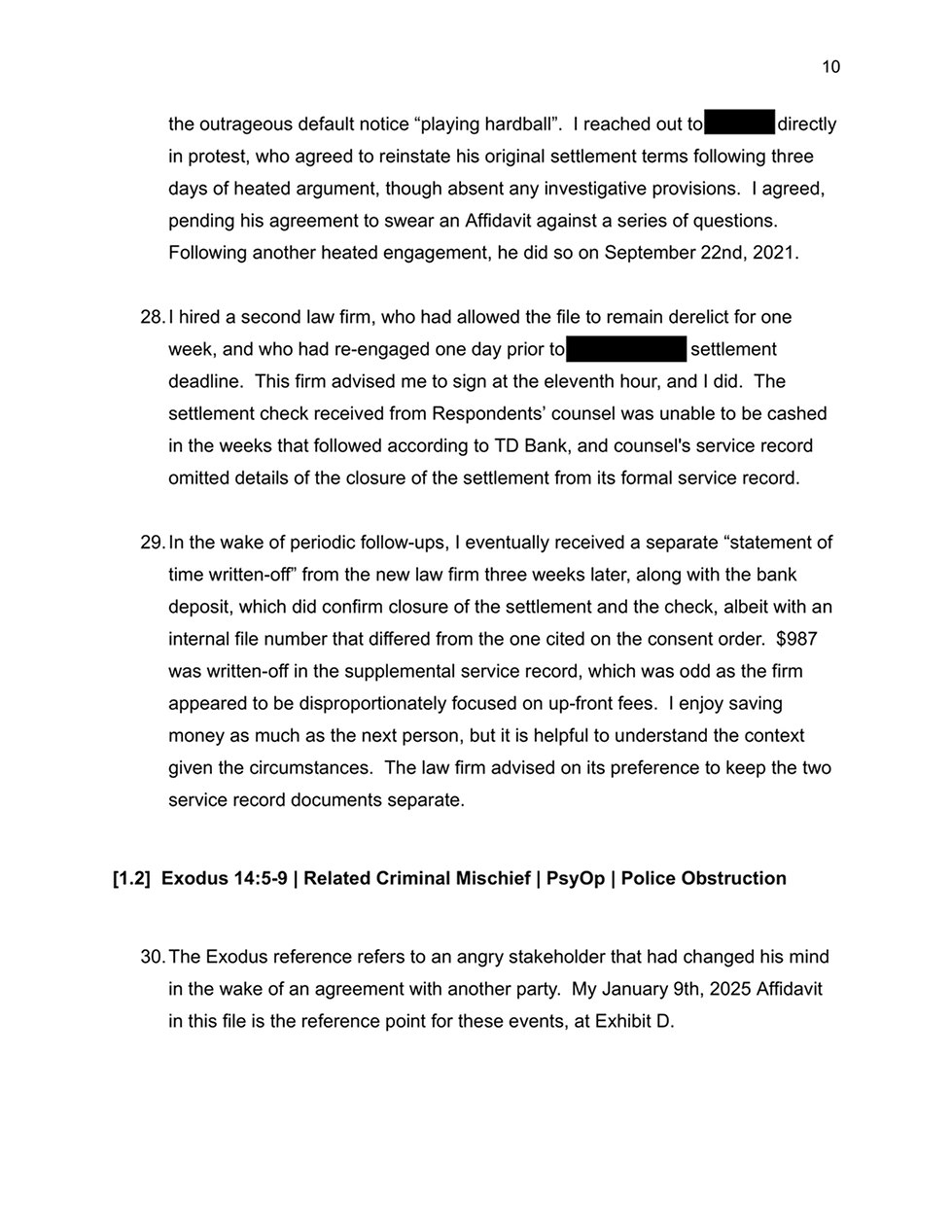
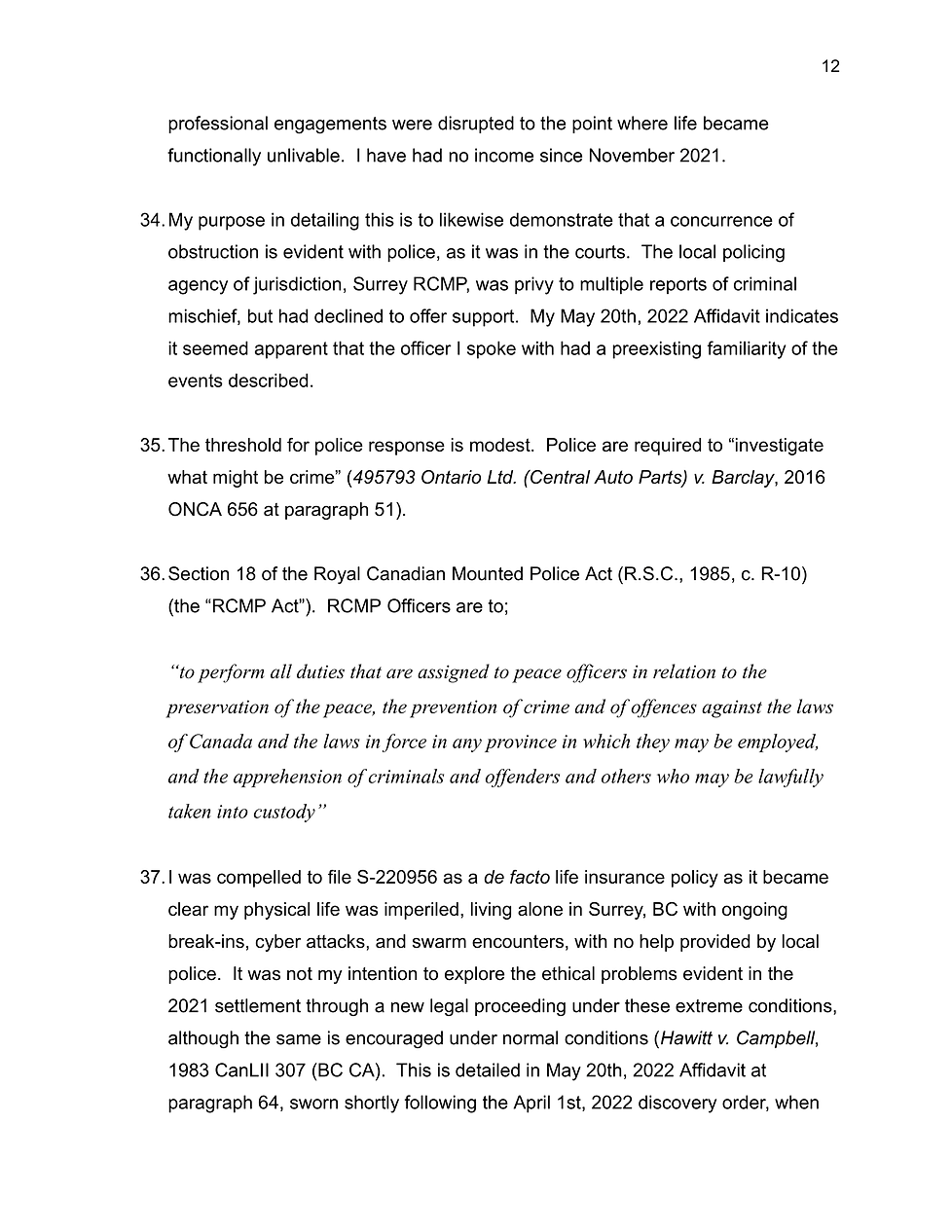
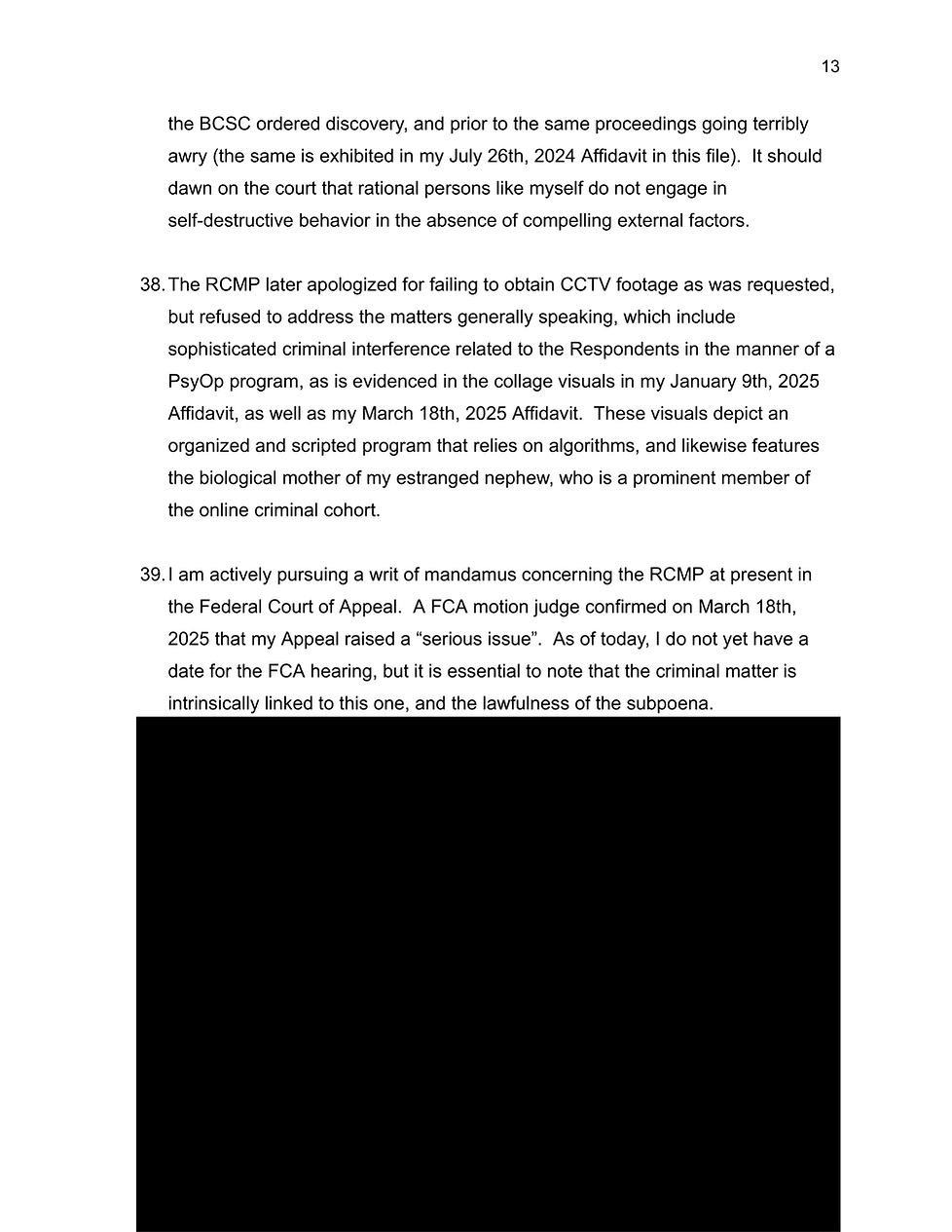
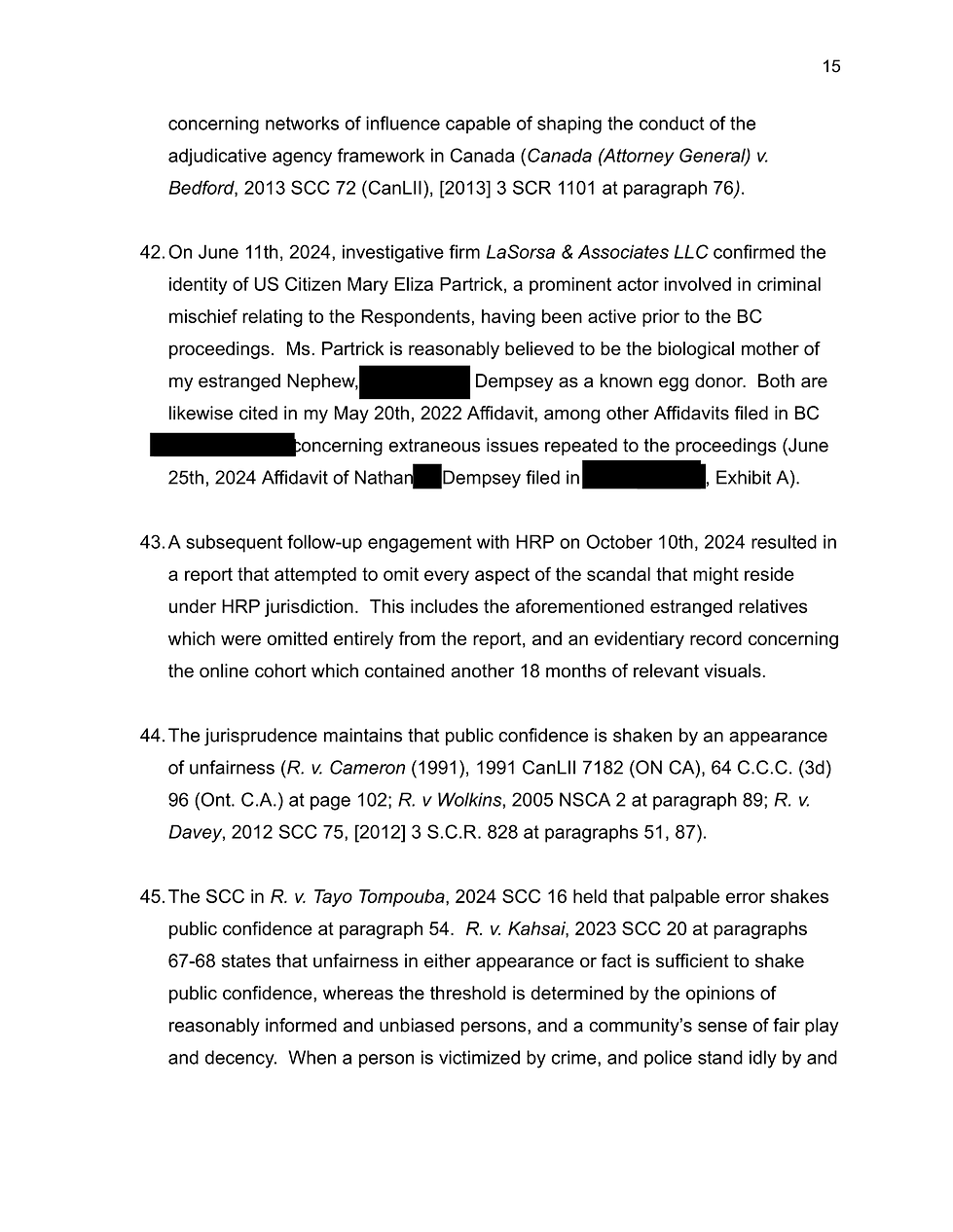
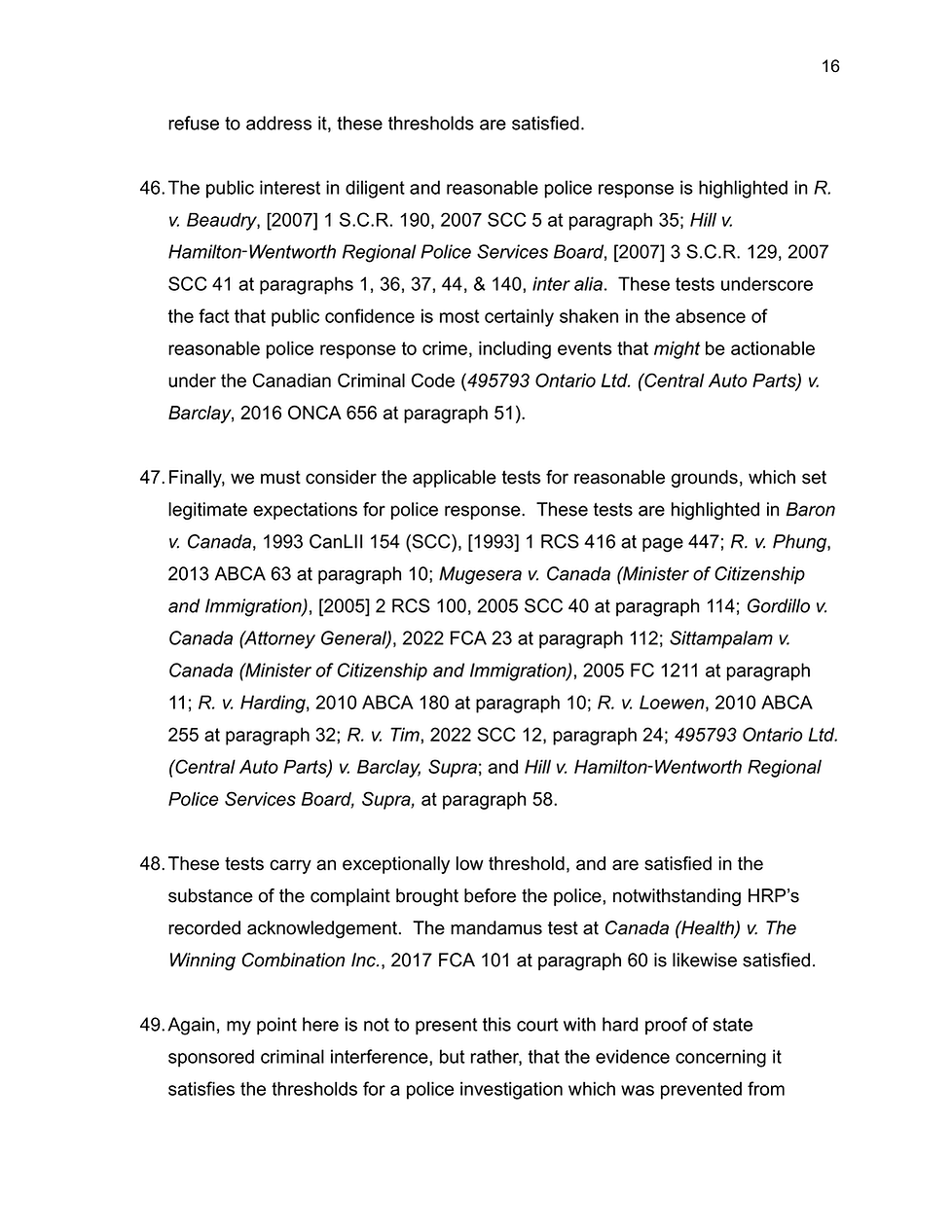
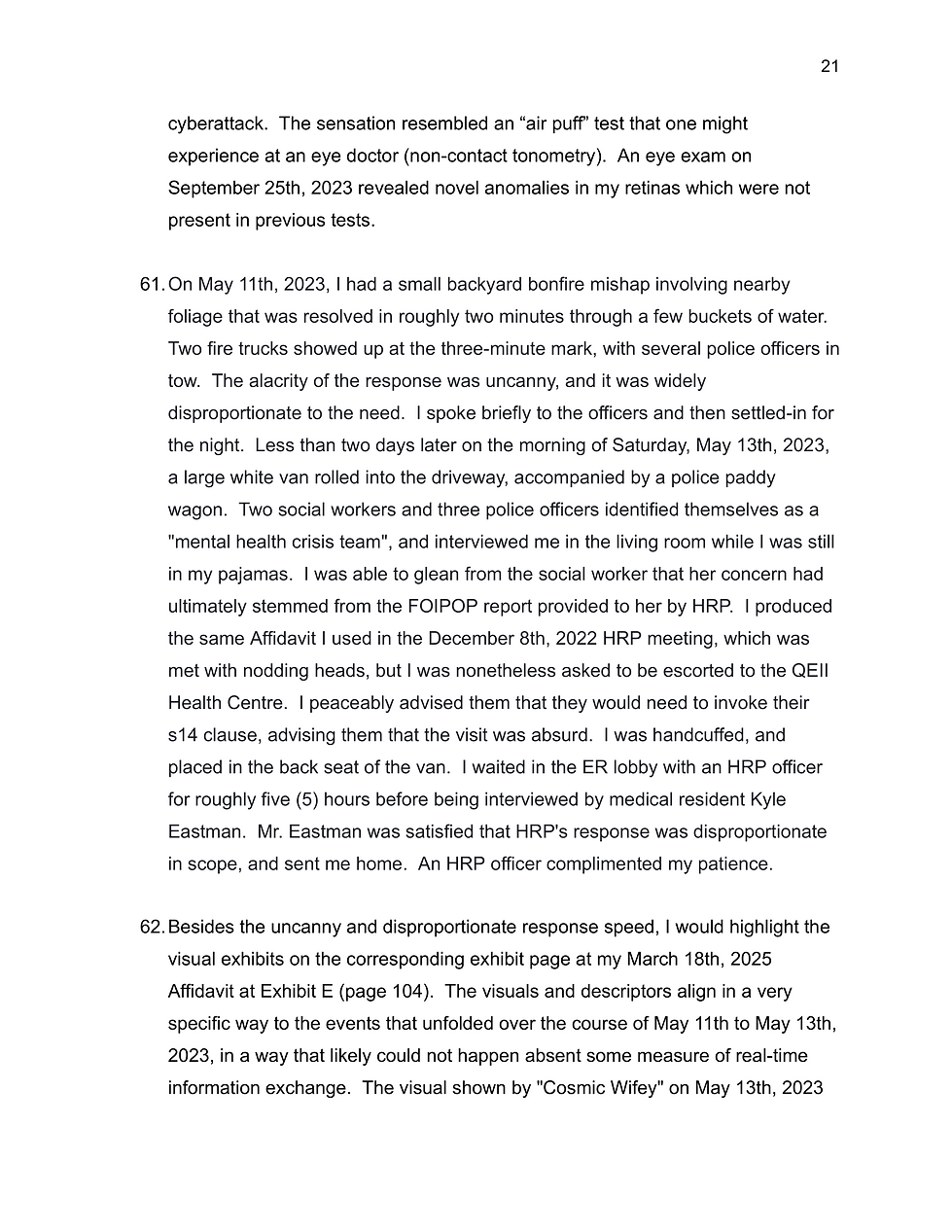
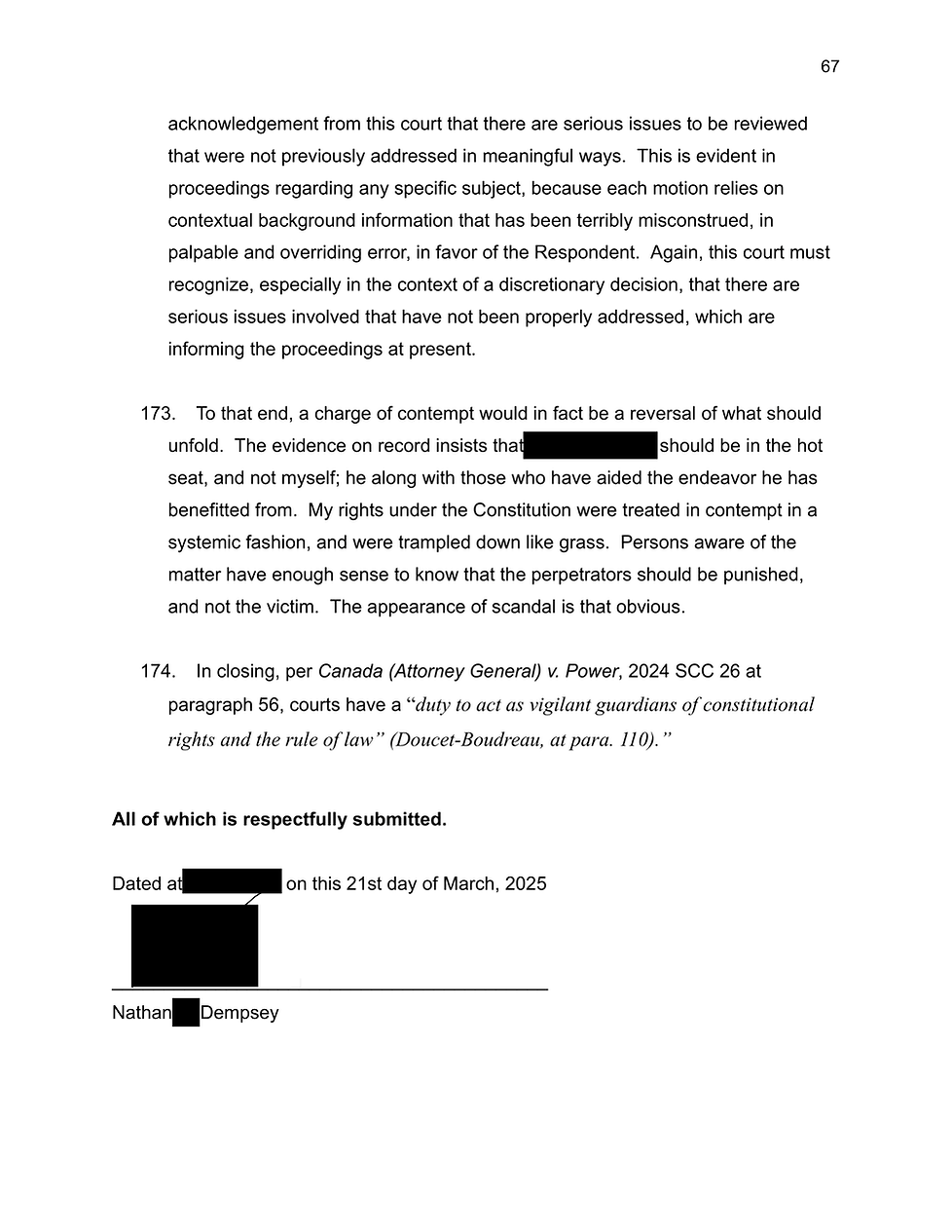
The briefs below contains a detailed event chronology from inception (September 2020) through to the date of its filing on March 21st, 2025. The stamps below indicate other dates when a chronology of event milestones was filed into the court of jurisdiction at the time, and supported by evidence. A transcript excerpt concerning a hearing held in June 2025 is shown below the brief, and should be read carefully. Any third-party information concerning the scandal detailed on this website, including from authorities, must reconcile with the accounts published on this site.
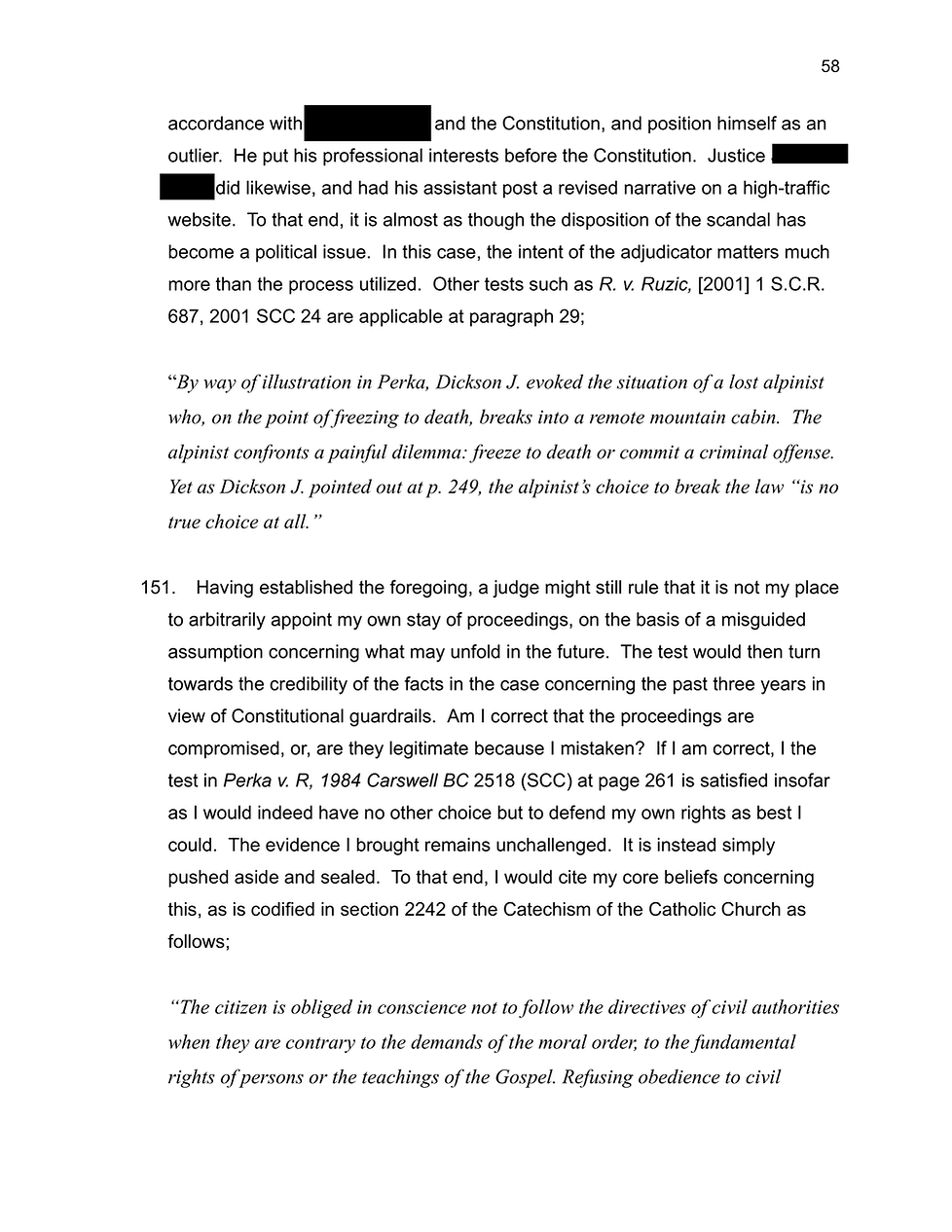
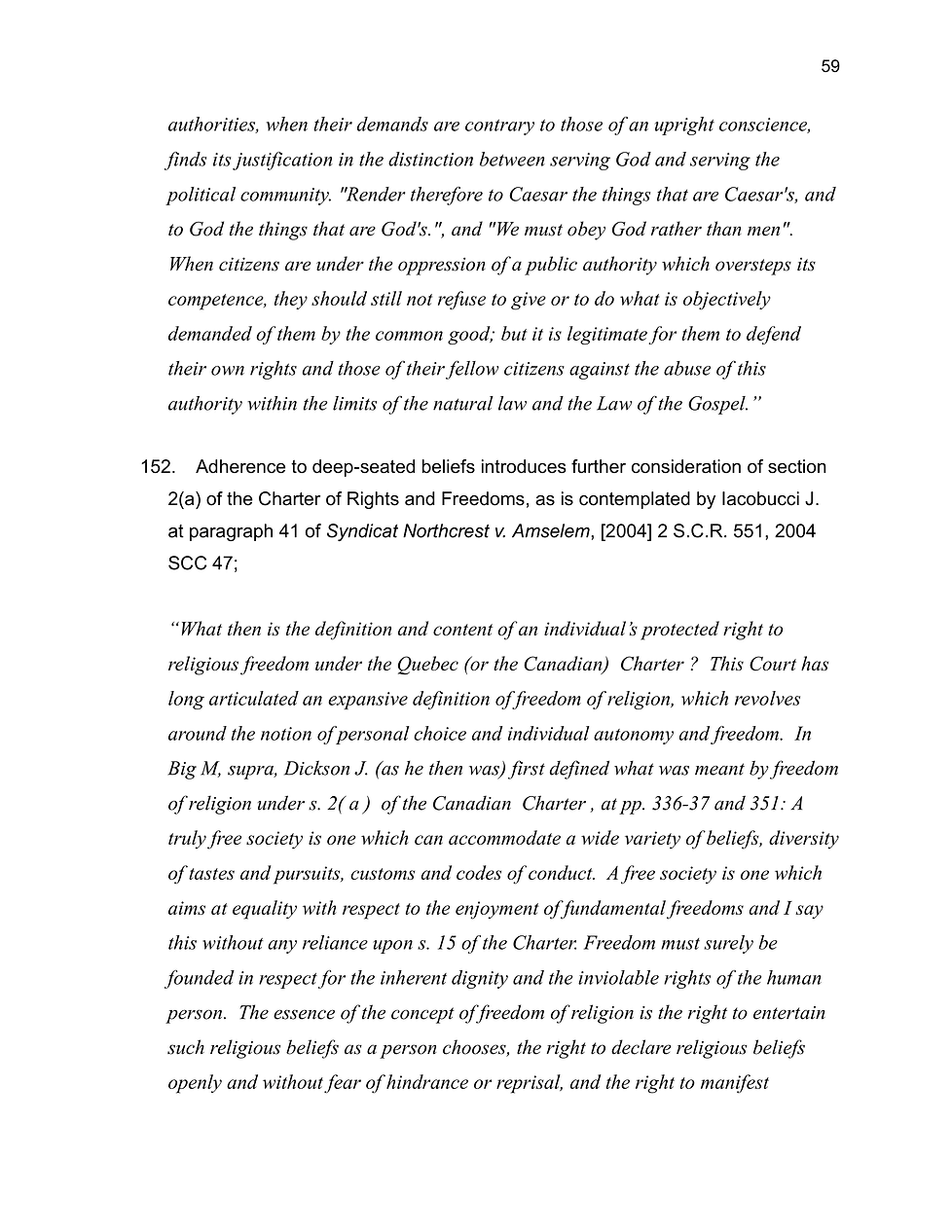
Detailed Chronology Brief [Inception to March 2025]
1.1 The Shareholder Scandal
1.2 Related PsyOps, Zersetzung, & Police Obstruction
1.3 Neurotech Crime
1.4 The Compelled BC Civil Lawsuit & Following
1.5 August 2024 Incarceration (Events)
1.6 August 2024 Incarceration (Health Records)
2.0 Case Law Review
3.0 Post-Democratic Institutions
4.0 A False Dilemma




















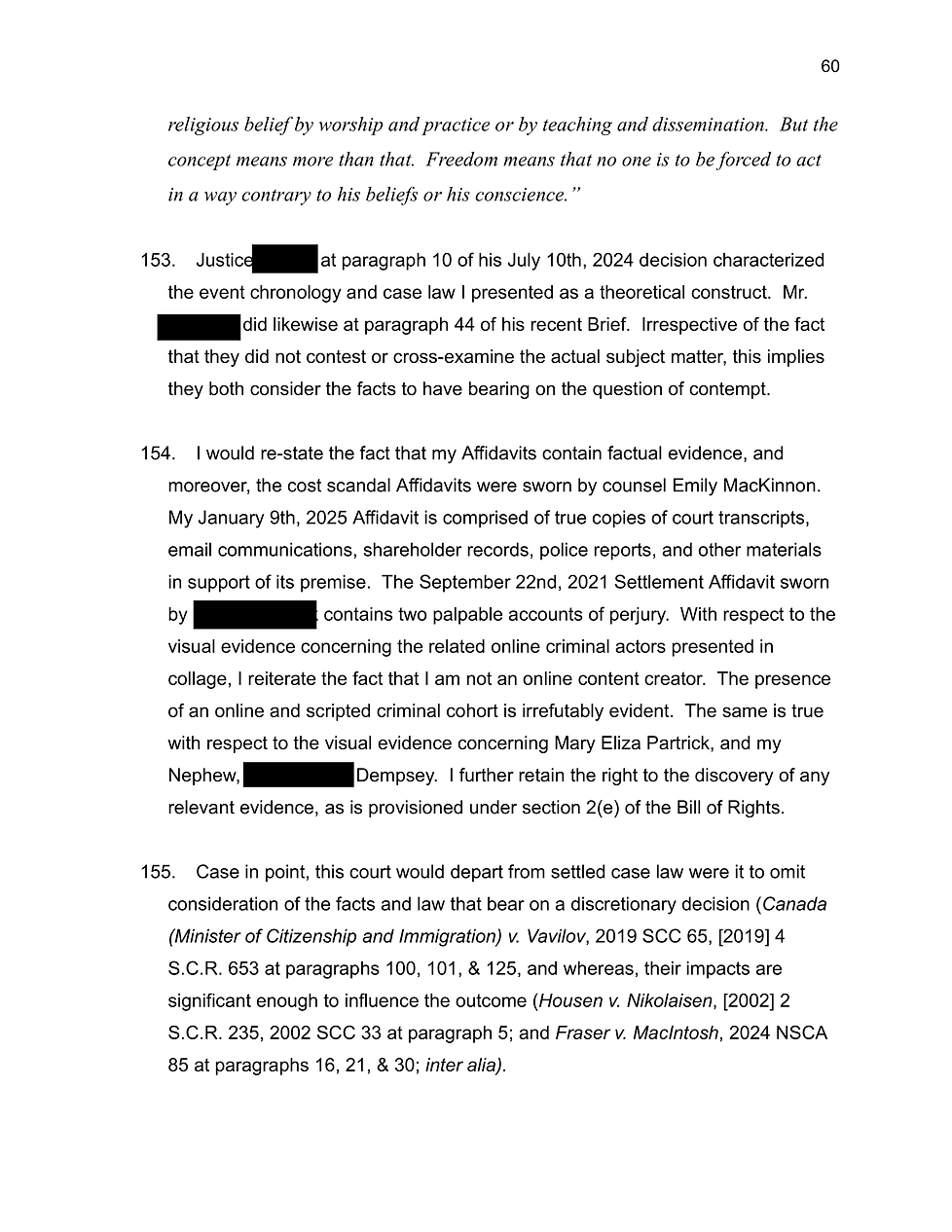


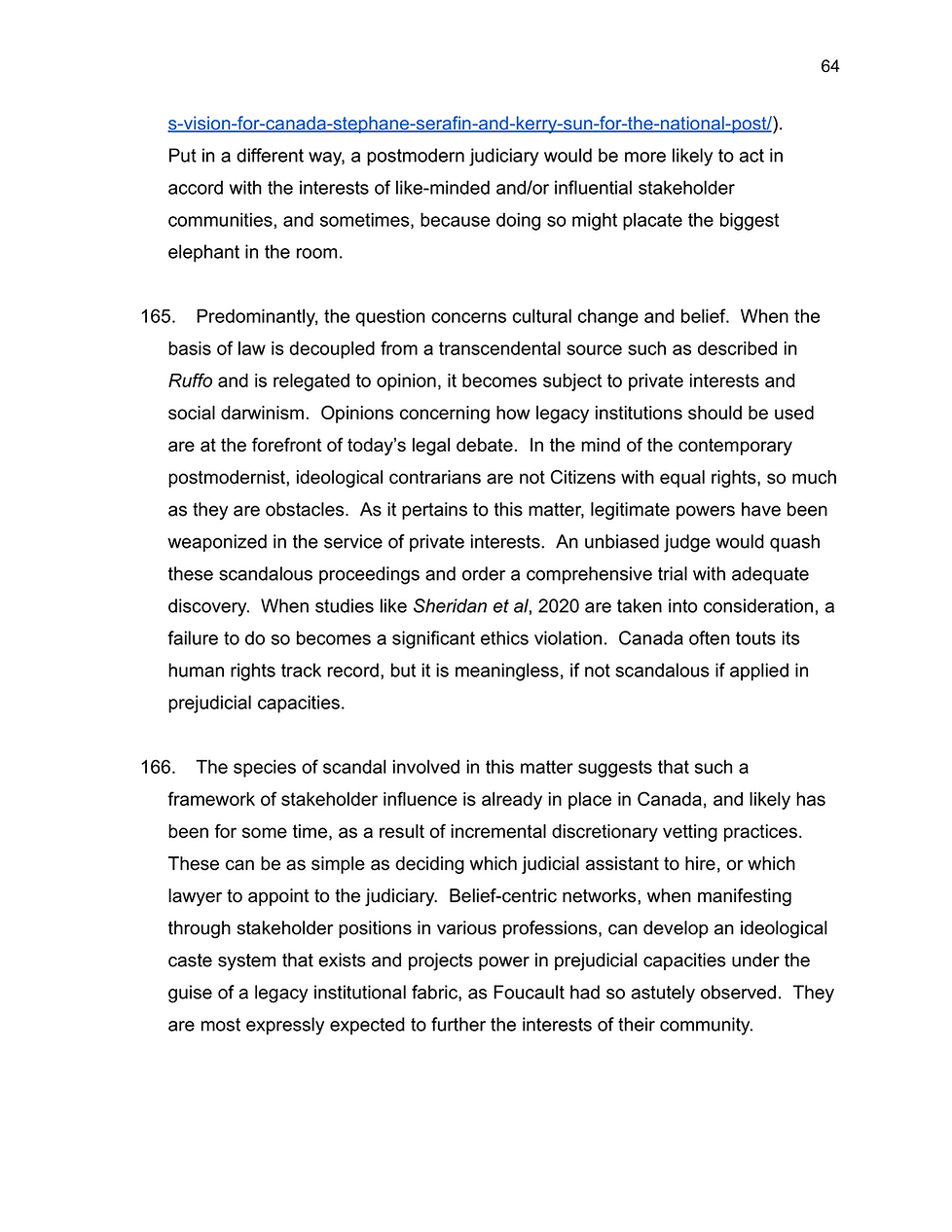
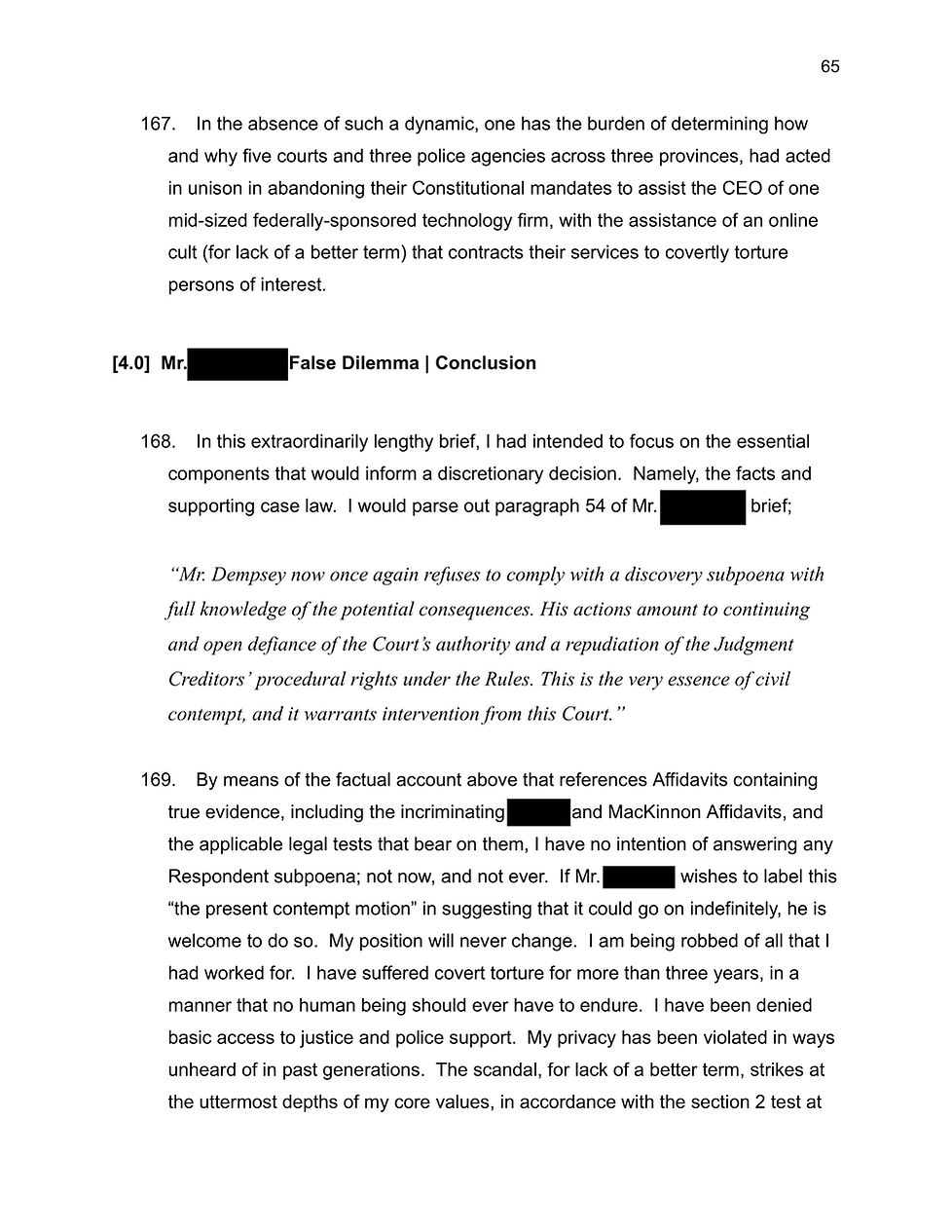
![RGC March 21 2025 Brief NSSC 529459 [Filed]_66.png](https://static.wixstatic.com/media/5b4df5_4df24d5a91114086b3c26e207b6fa3a4~mv2.png/v1/fill/w_978,h_1266,al_c,q_90,usm_0.66_1.00_0.01,enc_avif,quality_auto/RGC%20March%2021%202025%20Brief%20NSSC%20529459%20%5BFiled%5D_66.png)
A June 2025 Transcript Excerpt
Read This Carefully.
The motion judge implied that she was excused from considering the issues in the scandal because she did not have the jurisdiction to correct them. Her comments present a false dilemma (Canada (Minister of Citizenship and Immigration) v. Vavilov, 2019 SCC 65, [2019] 4 S.C.R. 653 at paragraph 104). A judge is never permitted to ignore relevant contextual evidence in a motion that is nonetheless expected to impact its decision (Colburne v. Frank, 1995 NSCA 110 at paragraph 9; Charkaoui v. Canada (Citizenship and Immigration), [2007] 1 S.C.R. 350, 2007 SCC 9 at paragraph 48; Coast Foundation v. Currie, 2003 BCSC 1781 at paragraphs 13 and 15; inter alia). It was within her jurisdiction to order a stay civil contempt proceedings to prevent the enforcement of a felony and possible incarceration (R. v. Babos, 2014 SCC 16, [2014] 1 S.C.R. 309 at paragraphs 76-78; Canada (Minister of Citizenship and Immigration) v. Tobiass, [1997] 3 S.C.R. 391 at paragraphs 91 & 110; Carey v. Laiken, 2015 SCC 17, [2015] 2 S.C.R. 79 at paragraphs 36-37; and United States of America v. Cobb, [2001] 1 S.C.R. 587, 2001 SCC 19; inter alia). The entirety of what happened is hidden from public view. See the Civil page (here), and the Felony Page (here). Learn about the sealing orders (here).