Crimes Against Humanity and War Crimes Act (S.C. 2000, c. 24) [Link]

Authorities Part II:
The Record
Systematic Procedural Failures in Cross-Jurisdictional Civil Litigation:
A Case Study in the Erosion of Fundamental Justice.
AI-Assisted Preview
Shellshock: Persistent characteristics of the sort that preclude any benign explanation.


Cross-Institutional Choreographed Procedural Chains.

One Interlocutory Procedure Example, Illustrated.

You Can Trust Computer Audits If They Are Reproduceable Against the Record (R. v. Khelawon, p. 49).


Jurisprudence Case Study: Milestone References Sourced From the Court-Filed Records
Executive Summary
This Case Law Review examines proceedings contemplated at the Litigation page and its sub-pages. The record reveals a layered failure of constitutional guardrails designed to ensure openness, procedural fairness, and access to justice.
In reviewing the applicable jurisprudence, the core conclusion is that the steps taken across both jurisdictions create a compelling appearance of systemic miscarriage of justice, satisfying threshold tests for extraordinary corrective relief. Common sense suggests the same.
A. Overview of Proceedings
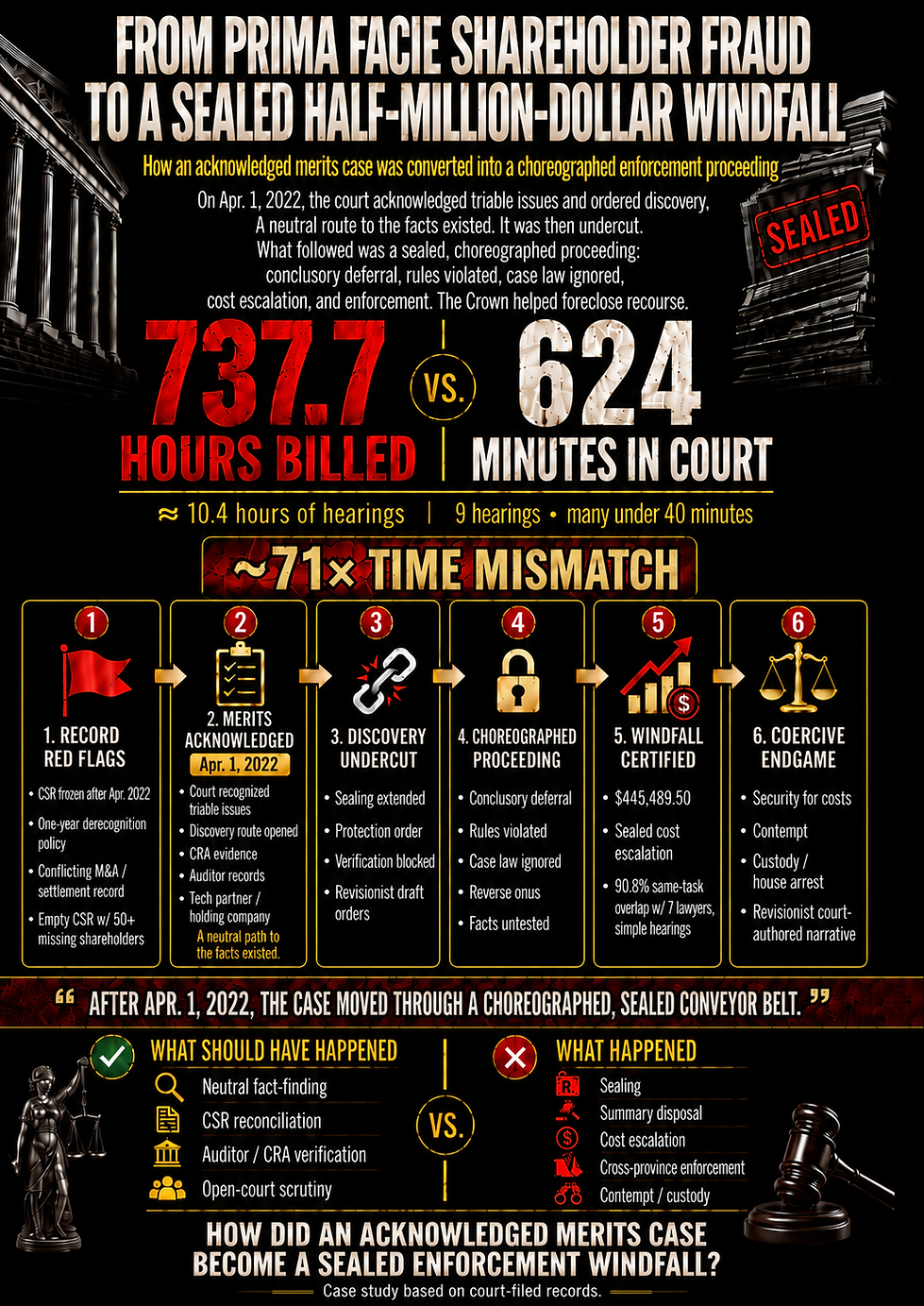
Materially related to the Zersetzung accounts, a prima facie case of shareholder fraud concerning the Director of a Canadian Commercial and Government Entity ("CAGE") was reversed into a $445,489.50 award of special costs to the same perpetrator (737.7 hours vs. 867 recorded minutes in simple hearings under 40 minutes apiece). This disposition remained unchecked despite Canadian Constitutional Law and jurisprudence. The scope, consistency, and characteristics of this scandal, involving multiple courts and police agencies across three provinces, precludes consideration of the CAGE Director as an independent perpetrator. Because one relatively unknown CEO cannot be expected to capture an adjudicative framework in two provinces to serve his interests alone, an inference of third-party tampering is required (R v. Villaroman).
Throughout the proceedings, key material evidence—shareholder agreements, corporate records (CSRs), and anomalous billing—was consistently sidelined in favor of an enforcement-first track, and pushed through a comity-driven conveyer belt, each relying on the last decision in a conclusory fashion. Appellate venues reinforced the same errors rather than correcting them, and police refused investigation.
Three linked failures structure the pattern:
-
Systemic Opacity
Broad, court-initiated sealing orders were imposed without applying the Dagenais/Mentuck–Sierra Club requirement of necessity and minimal impairment, and in some cases in the absence of a hearing. Courts in both provinces (BC and NS) adopted public information asymmetry. Rather than enabling independent fact verification, the record abused comity and concealment.
-
Financial Gatekeeping and Weaponization
Disproportionate security-for-costs orders converted constitutional appeal rights into a de facto “pay-to-play” regime. These amounts far exceeded accepted benchmarks (such as Power v. Power), erecting financial barriers to correcting factual errors and advancing constitutional claims. Solicitor-client costs in BC billed simple chambers hearings in excess of Canada's average annual salary.
-
Manipulative Procedural Asymmetry and Coercion
Full evidentiary testing and discovery were neutralized by subsequent summary orders, procedural foreclosure, manipulated draft orders, and conclusory deferral judgments, while enforcement culminated in contempt and custody. This is inconsistent with authorities like Carey, Teamsters, and Chong, which require that judicial discretion be genuine, proportionate, and least intrusive.
In aggregate, these characteristics occasion serious consideration of project-centric third-party interests.
B. Key Findings: Appearance of a Systemic Miscarriage of Justice
Taken cumulatively, the milestones across the NSCA and BCSC show a persistent failure to grapple with material facts. The record engages multiple constitutional and common law thresholds:
-
Open Court Principle Violations
Sealing orders in NS and BC contravene settled open court doctrine as recently restated in CBC v. Named Person (2024 SCC 21), which rejects blanket secrecy and requires tailored, justified restrictions.
-
Access-to-Justice Barriers
Security-for-costs orders were imposed while serious over-billing concerns were live, engaging Beals v. Saldanha’s fraud and natural justice exceptions. Costs and security escalated even as proof of a +9,000% solicitor-client billing delta emerged (737.7 hours vs. 867 minutes: "the billing delta", like the Boeing 737-7 passenger jet).
-
Failure to Grapple with Evidence
Courts advanced enforcement while ignoring probative shareholder, CSR, billing, and BC procedural records. This violates the duty to address key facts under Vavilov and the requirement of documentary coherence in Bradshaw v. Stenner.
-
Abuse of Process
Summary dismissals and the use of contempt/custody as an enforcement lever create the “pre-wired outcome” warned against in Babos and Tobiass. The delayed recognition of serious health evidence further offends Baker’s command to be “alert, alive and sensitive” to vulnerability.
Viewed together, the deviations from core standards are “clear, cogent and convincing” in the McDougall sense and support a finding of a serious appearance of injustice. Discovery, openness, proportionality, credibility testing, and fairness were each compromised in ways that predictably produced an enforcement-first outcome while the underlying merits stayed untouched.
C. Proposed Corrective Relief
The scale and depth of the systemic failure call for remedies beyond minor corrections to reasons. This review concludes that extraordinary corrective relief is required to restore the integrity of the process:
-
Vacating Coercive Orders
All contempt, custody, and disproportionate security-for-costs orders should be vacated.
-
Unsealing with Tailoring
All blanket sealing orders should be lifted and replaced, if necessary, with narrowly tailored redactions that satisfy the CBC v. Named Person and Sherman Estate standards.
-
Publicly-Transparent Neutral Fact-Finding
A neutral mechanism (e.g., Special Master or equivalent) should be appointed to test the sidelined merits issues (shareholder status, CSR anomalies, billing practices, procedure) on a full evidentiary footing, in a public setting, independent of the prior summary track.
-
Comprehensive Police Investigation
A full police and regulatory investigation is required into: (i) the near-certain likelihood of state-adjacent assurances behind the billing/sealing pattern; (ii) the Osler, Hoskin, & Harcourt LLP trust accounts; (iii) related psychological operations, surveillance, and neurotech components; and (iv) the role of family-adjacent actors and other intermediaries.
Annotated Chronological Milestones
September 18, 2020 – M&A Transaction Notice
A DocuSign package for a proposed M&A transaction is circulated with an ~8-hour overnight deadline. The SPA and cover materials refer to a July 25, 2016 shareholders’ agreement, although the operative “Agreement to be Bound” for the minority shareholder is dated July 27, 2016. A separate Share Transfer and Power of Attorney in favour of 1260706 B.C. Ltd., denominated “For Value Received,” is executed but not clearly linked to the SPA or any specified consideration. The SPA schedules list 41 named employee vendors plus option-holders, while later CSRs and the FY2020 audit adopt a one-year-only derecognition policy under which 2020 transfers do not appear on the register.
This creates an immediate misalignment between the transaction paper trail and formal share records, setting up the later “cancellation vs. concealment” and access-to-records disputes that drive the BC litigation and downstream NS enforcement.
Applicable Legal Framework
-
BCE Inc. v. 1976 Debentureholders
Directors must treat affected securityholders fairly, including through process and information. An overnight “sign-or-else” M&A deadline, built on an incorrect governing agreement, undermines a minority shareholder’s ability to assess the transaction and access BCE-style remedies.
-
Bradshaw v. Stenner
Credibility and reliability turn on internal and external consistency and motive to fabricate. The July 25 vs. July 27 agreement dates are precisely the sort of documentary conflict Bradshaw requires a court to scrutinize, especially where they affect inclusion/exclusion from a major transaction.
-
Bhasin v. Hrynew
The duty of honest performance prohibits knowingly misleading a counterparty in contractual performance. Circulating deal documents that misidentify the governing agreement—then insisting on an overnight decision—engages this duty.
-
Theratechnologies Inc. v. 121851 Canada Inc.
Securities law depends on timely, accurate disclosure of material facts. Contradictory core documents (wrong agreement; standalone “For Value Received” transfer not clearly tied to the SPA) create a material information deficit for a minority shareholder.
-
Vancouver Sun (Re)
Openness and intelligible records are fundamental. In a governance context, corporate records must be clear enough to permit verification; an unexplained governing-agreement discrepancy is inconsistent with this transparency.
-
Hercules Managements Ltd. v. Ernst & Young
Audited statements and related records exist to inform shareholder oversight. Where transaction records are inconsistent and later “derecognition” policies obscure equity events, shareholders cannot exercise the governance oversight Hercules contemplates.
December 4, 2020 – Cancellation Notice
A notice is sent stating that the September 18 M&A transaction is “off” because a partner has supposedly terminated its agreement with the issuer. The notice supplies a partner-termination timeline that is inaccurate but conveniently positions the breakdown almost exactly outside the two-year basic limitation period under BC’s Limitation Act. The communication also warns the minority shareholder not to contact the sender’s legal counsel.
The notice (i) recasts the situation as a dead deal driven by a third party, (ii) shapes the shareholder’s perception of when any claim accrued, and (iii) discourages independent legal advice—all against the backdrop of already-misaligned M&A documents.
Applicable Legal Framework
-
Limitation Act, S.B.C. 2012, c. 13, ss. 6, 12, 21
The two-year basic limitation runs from discovery; fraudulent concealment and s. 12 (fraud/trust) can postpone that clock. A factually wrong termination date that “solves” a limitation problem is properly scrutinized as an attempt to manipulate discoverability.
-
Presidential MSH Corporation v. Marr Foster & Co. LLP
Limitation periods are part of the fairness architecture. When a potential defendant’s communications shape the plaintiff’s understanding of timelines, courts examine whether those communications undermine fairness. Back-dating the partner termination to neutralize claims engages that concern.
-
1582235 Ontario Ltd. v. Ontario; Entreprises Sibeca
Bad faith includes conduct “so markedly inconsistent” with the governing legal context that it cannot be viewed as good faith. Providing an incorrect termination date aligned with limitation periods while instructing the shareholder not to contact counsel is difficult to reconcile with good faith.
-
Wallace v. United Grain Growers; Styles v. AIMCo
Termination-style communications must be candid and honest. Misstating material facts at the point of “quasi-termination” of a transaction, while discouraging legal advice, violates the duty of honest performance.
-
Fraudulent Concealment (equity)
Where a party deliberately misleads another about key dates or rights to make a claim appear stale, courts may toll the limitation period. The precision with which the wrong date tracks statutory limits, combined with a “do not contact my counsel” warning, is consistent with a lulling/concealment pattern.
-
Frame v. Smith (fiduciary indicia)
In closely held corporations, controlling insiders often satisfy fiduciary indicia. A cancellation notice mixing threats with misstatements about key dates raises fiduciary-duty concerns, not just contractual ones.
February 8, 2021 – Anomalous Health Incident
During an active period of corporate dispute and harassment reporting, the subject experiences sudden, severe localized pain at home during a snowstorm, requiring an ER visit. Hospital records document intense pain, unusual symptoms, and logistical difficulty reaching care. Morphine is administered enroute by ambulance despite an allergy history, and unusual sensations are reported afterward. The incident is later raised, within a broader pattern of stalking/harassment, as potentially consistent with DEW or other external interference (ie., "havana syndrome").
Whatever its precise cause, the event is an objectively documented, serious health incident meaningfully engaged with an evidence-based metanarrative. It becomes legally relevant when (i) police decline to obtain CCTV or explore non-routine causation, and (ii) courts later consider coercive remedies without ever requiring or analyzing the underlying ER records.
Applicable Legal Framework
-
Baker v. Canada
Decision-makers must be “alert, alive and sensitive” to affected individuals’ vulnerabilities. Ignoring a documented serious health incident when imposing contempt, security, or other coercive measures is the opposite of the contextual sensitivity Baker requires.
-
Hill v. Hamilton-Wentworth Regional Police Services Board
Police owe a duty of care in conducting investigations. Once notified of a serious and unusual ER-documented incident linked to ongoing harassment, reasonable care would normally include obtaining ER records and obvious CCTV or environmental evidence. A blanket refusal is inconsistent with Hill’s standard.
-
R. v. Loewen
Reasonable-grounds and proportionality assessments rely on the “totality of the circumstances.” Treating the February 8 incident in isolation, rather than as part of a cumulative pattern of harassment and anomaly, is contrary to this holistic approach.
-
R. v. McNeil
Relevant information in police hands must be disclosed to support fair, accurate proceedings. ER and occurrence records are clearly relevant to vulnerability, risk, and credibility. Adjudicating coercive measures without insisting on that record frustrates the truth-seeking function.
-
Fontaine v. British Columbia (Official Administrator)
Circumstantial evidence is weighed with direct evidence to decide if a prima facie case exists. A documented ER visit for an abnormal event, combined with other harassment indicators, can reach a prima facie threshold that “something is wrong,” shifting the burden to authorities to offer a coherent explanation rather than simple denial.
April 6, 2021 – Shareholder Records Request
After discovering anomalies in the capital structure and transaction history, the subject makes a formal written request under the BCBCA for core shareholder records: the central and branch securities registers, share register, and related records. Despite mandatory inspection rights, the request is ignored. No access is provided, forcing further steps in an informational vacuum.
Applicable Legal Framework
-
Business Corporations Act, S.B.C. 2002, c. 57, ss. 42–46, 50
Companies must keep core records at the records office and allow inspection/copying by shareholders. A complete non-response is a statutory breach, not business discretion; s. 50 provides a remedy by court order.
-
Invermere Hotel (1977) Ltd. v. Pottruff
Inspection rights exist so shareholders can monitor management. Obstructing those rights, particularly amid concrete concerns, supports oppression-style relief even before a full merits hearing.
-
Primer Enterprises Ltd. v. Westmore Distributors Ltd.
Systematic denial of access to core records can be “oppressive” or “unfairly prejudicial.” Where management controls all information and uses that control to freeze out a minority, the oppression remedy is engaged.
-
BCE Inc. v. 1976 Debentureholders
Reasonable expectations include that statutory inspection rights will be honoured and records will be sufficient to assess fair treatment. Ignoring a proper records request defeats those expectations.
-
Theratechnologies; Vancouver Sun (Re)
Modern investor-protection and openness doctrines stress that regimes depend on timely, non-misleading information. Withholding basic records deepens information asymmetry and undermines both governance and any later court process that must rely on those records.
May 3, 2021 – BC Registrar Orders Disclosure
On May 3, 2021, the Registrar orders the company to produce the CSRs and derecognition policy. The CSRs show no shareholder activity after April 14, 2020, despite dozens of employees, option-holders, and participants in the September 2020 M&A process. The following day, the company removed its public employee roster web page.
For an objective observer, a CSR freeze post-April 2020, an M&A process involving 40+ employee vendors, and deletion of public-facing information together present a major governance red flag. The Registrar’s order confirms that inspection rights were breached; the disclosure raises more questions than it answers.
Applicable Legal Framework
-
BCE Inc. v. 1976 Debentureholders
Shareholder protection depends on access to accurate information sufficient to assess fair treatment. A CSR that goes blank at a critical period creates an unacceptable information deficit.
-
Bradshaw v. Stenner
The four Bradshaw factors support an inference of purposeful opacity: (i) internal inconsistency (a frozen CSR in an active period); (ii) temporal proximity to the M&A; (iii) motive to fabricate (preventing verification of holdings); and (iv) corroboration via the deletion of the “Team” page.
-
Slattery (Trustee of) v. Slattery; R. v. Jarvis
CRA records can be obtained and serve as a reliable external cross-check on equity transactions. Characterizing CRA discovery as unnecessary despite a documented CSR freeze disregards their evidentiary importance.
-
Primer Enterprises; BCBCA s. 46
The sequence—denied access, Registrar order, anomalous records—is the classic oppression pattern. The Registrar’s intervention confirms breach of statutory rights and justifies further judicial scrutiny.
July 9, 2021 – Financial Statements Anomalies
The subject requests FY2020 financial statements. The audited statements show an audit report signed June 25, 2021, while corporate counsel states on July 9, 2021 that the company is “still collecting signatures” on the same documents, and whereas, the CPA firm audit report is signed and dated June 25th, 2021. FY2020 numbers show significant operational deltas from prior years and introduce a new derecognition policy not present previously. The policy derecognizes any and all share transfers within FY 2020, effectively concealing any share transfer or SPA within that calendar year. The policy sits comfortably with the CSR vacancies and the remainder of the irregular shareholder record corpus.
Applicable Legal Framework
-
CPA Code of Professional Conduct (BC), Rules 205 & 206
CPAs must not associate with misleading statements and must comply with professional standards, including proper dating and documentation. A June 25 audit report date inconsistent with a July 9 “still collecting signatures” account engages concerns under both rules.
-
IAS 8 (Accounting Policies, Changes in Accounting Estimates and Errors)
Policies must be applied consistently; changes must improve reliability/relevance and be properly disclosed. A one-year derecognition policy appearing only in FY2020 and aligned with disputed transactions is inconsistent with IAS 8’s consistency and disclosure obligations.
-
BCE; Bradshaw
Shareholders reasonably expect coherent, transparent financials. A novel derecognition policy plus conflicting descriptions of audit completion and the CSR records undermines both the BCE fairness expectations and the Bradshaw reliability analysis.
-
Central Trust Co. v. Rafuse; Hercules
Professionals (auditors and counsel) owe a duty of reasonable care; audited statements are intended to support shareholder oversight. Backdated or opaque audit processes and policy changes directly impair that oversight function and raise classic negligence and governance concerns.
July 19, 2021 – BC Legal Counsel Retained
By July 2021, voluntary efforts to obtain accurate records had failed; the Registrar-ordered disclosure showed a post-April 2020 CSR freeze and the FY2020 derecognition policy. The subject retains a BC law firm to: (i) confirm the equity position through BCBCA inspection mechanisms; and (ii) pursue oppression-style remedies, including a potential buyback, if the conduct is oppressive, unfairly prejudicial, or unfairly disregards the subject’s interests.
From this point, the file shifts from informal efforts to a formal solicitor–client relationship with attendant fiduciary and professional duties.
Applicable Legal Framework
-
BCBCA, ss. 50, 227–228
These provisions enable court-ordered records production and oppression remedies. Once voluntary disclosure failed and anomalies were evident, engaging these mechanisms through counsel was the only realistic way to protect the investment.
-
BCE Inc. v. 1976 Debentureholders
Retaining counsel is a direct attempt to vindicate reasonable expectations (accurate records; fair treatment) via the oppression remedy.
-
Strother v. 3464920 Canada Inc.; Central Trust
The solicitor–client relationship is fiduciary; lawyers owe loyalty and a duty to exercise the care of a reasonably competent practitioner. From July 19 onward, failures to analyze CSR anomalies, pursue BCBCA remedies, or obtain informed instructions are assessed against these duties.
-
Theratechnologies; Primer Enterprises
Modern investor-protection regimes are flexible and remedial. Retaining counsel aimed to access that flexibility—records orders, buyback, corrective relief—in response to deliberate opacity.
July 23, 2021 – Cross-Canada Relocation
On July 23, 2021, the subject abruptly relocates across Canada. The home is listed and effectively liquidated; a one-year lease is signed in the destination city. Neither act served a practical or psychological purpose. BC counsel was likewise retained to makage the matter on the subject's behalf. Compared with a lifelong history of stability and risk-averse decisions, this combination (rapid move, home sale, fixed lease, no conventional driver) is a marked behavioural outlier.
In 2022, and view of an emerging picture, the subject advances the hypothesis that such outliers may be consistent with external cognitive interference or “remote neuromodulation.” The same is well grounded in UN HRC resolutions, the related evidentiary context, and known enabling technologies, while removing less likely theories of causality under Villaroman.
Applicable Legal Framework
-
R. v. Villaroman, 2016 SCC 33, [2016] 1 S.C.R. 1000
Circumstantial inferences must be grounded in proven facts and be reasonable. Less likely inferences can be displaced, and novel inferences can be accepted if no other explanation fits. The relocation is one component in a circumstantial matrix (health incident, CSR anomalies, retainer, harassment) that supports an inference of cognitive tampering in accordance with the characteristics and the UN reports.
-
Sherman Estate v. Donovan, 2021 SCC 25, [2021] 2 S.C.R. 75
Courts assess “serious risk” holistically (p. 97-98). Any later sealing or protective-order analysis must situate the relocation within the broader pattern of harm and vulnerability; it cannot be compartmentalized away.
-
Geffen v. Goodman Estate
Undue influence presumptions arise where a relationship allows domination and the transaction is not readily explicable by ordinary motives. Selling a home, moving across the country, and taking a long lease without economic or family drivers is a “not readily explicable” outcome that invites an explanation and may shift the evidentiary burden regarding influence.
-
Bhasin v. Hrynew
If relocation decisions were materially shaped by pressures arising from the shareholder dispute or related contracts, and counterparties knew or ought to have known this, then relying on the apparent voluntariness of the move while concealing these dynamics risks breaching the duty of honest performance.
-
Saadati v. Moorhead; R. v. Malmo-Levine; s. 7 Charter
Mental injury and serious psychological disturbance can ground legal consequences even without a DSM label. The relocation sequence amid harassment and financial distress is cogent evidence of impact on security of the person that courts and investigators must engage, not dismiss as self-inflicted.
-
UN HRC Neurotechnology Materials (A/HRC/57/61; A/HRC/58/58; A/HRC/RES/58/6)
These instruments now formally recognize risks to cognitive liberty, mental privacy, and psychological continuity from emerging neurotechnologies. They do not prove what occurred in 2021, but they confirm that the interference risks described are legally and institutionally recognized. Courts and investigators cannot plausibly treat the cognitive-interference hypothesis as frivolous; it aligns with risks UN bodies have flagged as requiring heightened rights-sensitive scrutiny.
August 3, 2021 – Counsel’s Breach of Confidentiality
On August 3, 2021, the subject's BC counsel filed materials that were expressly subject to a shareholder confidentiality agreement onto the public court registry, without the subject's knowledge or instructions, without seeking a sealing order, and without directions from the court. Only after the damage was done did counsel seek a consensual sealing order. One week after a consensual sealing order was entered, opposing counsel served a default notice for fees (automatic buy-back for pennies). The subject's counsel claimed the opposing party acted in bad faith, and advised it would withdraw the retainer. Opposing counsel said it was "playing hardball", while the parties were in settlement talks, and after a consensual sealing order remedy had been entered. There are strong optics of collusion here.
Applicable Legal Framework
-
Central Trust Co. v. Rafuse, [1986] 2 S.C.R. 147
Confirms that lawyers owe a duty to exercise the care, skill, and knowledge of a reasonably competent solicitor and may be liable in both contract and tort. Publicly filing confidential materials without authority, protection, or warning is a straightforward breach of that standard; the harm (loss of confidentiality) is obvious and foreseeable.
-
Folland v. Reardon, 2005 CanLII 1403 (ON CA)
The Ontario Court of Appeal recognizes that breaches of solicitor–client confidentiality can ground both negligence and fiduciary claims. Confidentiality is a foundational aspect of the relationship; a breach can justify reopening or adjusting proceedings tainted by that disclosure.
-
Strother v. 3464920 Canada Inc., 2007 SCC 24, [2007] 2 S.C.R. 177 at para. 40
The Supreme Court underscores that the core fiduciary duty of a lawyer is loyalty, which includes confidentiality, candour, and avoiding conflicts. Using or exposing client information in a way that disadvantages the client—then pivoting to fee pressure and withdrawal—sits squarely within the mischief Strother seeks to prevent.
-
R. v. Murray, 2017 ONCA 393
Although a criminal case, Murray stresses that termination of a retainer at a critical stage raises serious fairness concerns. Here, the retainer collapses immediately after counsel’s own confidentiality breach and rushed “damage control” sealing, which supports the inference that counsel’s misstep—not client “bad faith”—precipitated the crisis.
-
Federation of Law Societies of Canada, Model Code of Professional Conduct, rr. 3.3 & 3.6
-
Rule 3.3 requires strict confidentiality absent informed consent or legal compulsion.
-
Rule 3.6 requires fair and reasonable fees and prohibits coercive financial pressure.
Filing confidential materials openly, then almost immediately issuing a default notice in a high-stress, high-stakes file, engages both sections of the rules
-
August 27, 2021 – Consensual Sealing During Settlement
On August 27, 2021, a consensual sealing/redaction order was made while settlement negotiations were underway. The order targeted specific commercial and shareholder materials; it did not seal the entire file, and on its face aligned with a narrow, temporary confidentiality rationale during an ongoing resolution process.
In hindsight, some of the sealed materials—particularly the CEO’s affidavit evidence—were later shown or alleged to be materially inaccurate or perjured. What began as a limited commercial-protection measure evolved into a functional shield for misleading evidence.
Applicable Legal Framework
-
Dagenais v. Canadian Broadcasting Corp., [1994] 3 S.C.R. 835 and R. v. Mentuck, 2001 SCC 76, [2001] 3 S.C.R. 442
Set the governing test: limits on openness must be (1) necessary to prevent a serious risk to the administration of justice, and (2) proportionate, with salutary effects outweighing deleterious effects on openness. Temporary, targeted redactions during active settlement can meet this test; long-term secrecy protecting perjured evidence cannot.
-
Sierra Club of Canada v. Canada (Minister of Finance), 2002 SCC 41, [2002] 2 S.C.R. 522 at para. 53
Extends Dagenais/Mentuck to civil confidentiality orders. Any order must protect an important interest (e.g., legitimate commercial sensitivity) and be as limited as possible, favoring redactions over blanket sealing. Once it emerges that sealed materials may include perjury, the “important interest” shifts to exposing, not concealing, that evidence.
-
Sherman Estate v. Donovan, 2021 SCC 25, [2021] 2 S.C.R. 75
Confirms that court records are presumptively public and that any restriction must meet a serious-risk test and be proportionate and minimally impairing. Commercial or settlement optics can justify only narrow, time-limited secrecy. Sealing that effectively hides perjury conflicts with Sherman Estate’s core logic.
-
R. v. E.(O.N.), 2001 SCC 77, [2001] 2 S.C.R. 459 at para. 27
Recognizes courts’ inherent jurisdiction to address perjury and abuse of process. Courts cannot allow their procedures—including sealing orders—to operate as a shelter for sworn falsehoods.
-
Vancouver Sun (Re), 2004 SCC 43, [2004] 2 S.C.R. 332 at para. 25
Emphasizes that parties cannot “contract out” of the open court principle; even fully consensual sealing requires ongoing judicial justification.
-
Gold v. Gold, 2020 ONSC 26
Confirms that consent orders can be set aside where obtained or maintained through fraud, misrepresentation, or non-disclosure. The same logic applies to consent-based sealing: if secrecy persists in part because the court was never told the sealed material is false, the foundation for that order is compromised
September 13, 2021 – Notice of Default and Retainer Termination
On September 13, 2021—barely a week after the August 27 sealing order—BC counsel issued a notice of default for fees and effectively terminated the retainer. At that point:
-
the subject’s equity position (~$240,000 on paper at the company's pre-seal settlement offer) had been reduced to roughly $1,260 in liquidity;
-
counsel had recently filed confidential materials publicly; and
-
“damage control” sealing had just occurred.
Counsel’s correspondence described the subject as acting in “bad faith” and opposing counsel as merely “playing hardball,” framing the client as the problem just as the subject was forced into self-representation.
Applicable Legal Framework
-
1582235 Ontario Ltd. v. Ontario, 2020 ONSC 1279 at para. 127
Drawing on Entreprises Sibeca Inc. v. Frelighsburg (Municipality), 2004 SCC 61, [2004] 3 S.C.R. 304, the court defines bad faith as conduct “so markedly inconsistent with the relevant legislative context” that it cannot reasonably be viewed as in good faith. Here, the relevant context includes fiduciary duties, confidentiality, and BCBCA oppression/inspection rights. Casting the subject as the “bad faith” actor immediately after counsel’s breach and during a financial collapse shaped by that breach is difficult to reconcile with this standard.
-
R. v. Murray, 2017 ONCA 393
Highlights that withdrawal at a critical stage engages fairness and the integrity of proceedings. The subject’s transition to self-representation was not voluntary but followed counsel’s error and fee pressure; this heightens the fairness concerns going forward.
-
Strother v. 3464920 Canada Inc., 2007 SCC 24 at para. 40
The core duty of loyalty requires lawyers to put the client’s interests ahead of their own within the retainer’s scope. Where counsel’s confidentiality breach helped create the financial and procedural crisis used to justify withdrawal, Strother supports an inference that responsibility lies with counsel, not the client.
-
Folland v. Reardon, 2005 CanLII 1403 (ON CA) and Central Trust Co. v. Rafuse, [1986] 2 S.C.R. 147
Together, these cases support that a breach of confidentiality and negligent performance can taint subsequent steps and create compensable harm. The close temporal link between the August 3 breach, the August 27 sealing, and the September 13 default/withdrawal raises a serious causation question.
-
Pintea v. Johns, 2017 SCC 23, [2017] 1 S.C.R. 470 at para. 4
The Supreme Court endorses principles requiring courts to treat self-represented litigants with heightened fairness and accommodation. This obligation is even stronger where self-representation is forced by circumstances—including counsel withdrawal after a professional breach—rather than chosen.
Result: By September 13, 2021, the subject is involuntarily self-represented in a shareholder dispute, with severe financial and procedural disadvantages materially shaped by prior counsel’s conduct.
September 22, 2021 – Settlement Affidavit Perjury
On September 22, 2021, the company’s CEO swore a settlement-stage affidavit containing demonstrably false statements about (i) the status and identity of key technology partners and (ii) the treatment of former employees and option-holders in the Central Securities Register (CSR). These statements were contradicted by existing documents and later disclosures.
The affidavit was used to support the narrative that the settlement and file “closure” were fair and complete, at a moment when the subject was self-represented and financially constrained.
Applicable Legal Framework
-
R. v. E.(O.N.), 2001 SCC 77, [2001] 2 S.C.R. 459 at para. 27
The Supreme Court confirms that perjury goes to the heart of the administration of justice and that courts have inherent jurisdiction to address it whenever it arises, including in civil and settlement contexts.
-
Criminal Code, R.S.C. 1985, c. C-46, s. 131
Defines perjury as making a false statement under oath, knowing it to be false, with intent to mislead, in a judicial proceeding. Settlement-stage affidavits fall squarely within “judicial proceeding.”
-
Groia v. Law Society of Upper Canada, 2018 SCC 27, [2018] 1 S.C.R. 772 at para. 71
Reaffirms that lawyers owe duties to the administration of justice and cannot facilitate, tolerate, or quietly exploit false evidence. Where an affidavit is demonstrably wrong on central points:
-
the CEO’s own counsel must not exploit that falsity;
-
opposing counsel who discover it must squarely put it before the court; and
-
the court must address it before relying on the affidavit as a settlement foundation.
-
-
Liverant v. Jabre, 2018 ONSC 6404
Holds that settlements procured by material misrepresentation or fraud can be rescinded or refused enforcement.
-
Beals v. Saldanha, 2003 SCC 72, [2003] 3 S.C.R. 416 at para. 40
Establishes that judgments obtained by fraud—including via perjured evidence—will not be enforced. Although Beals concerns foreign judgments, the fraud exception operates equally in domestic contexts.
-
Sherman Estate v. Donovan, 2021 SCC 25
As noted earlier, the open-court jurisprudence does not permit sealing regimes to shield perjury. Once there is a credible basis to allege sworn falsehoods, the justification for secrecy collapses.
Implication: The September 22, 2021 CAGE affidavit is a sworn instrument that proves wrongdoing.
September 29, 2021 – Settlement Closure Problems
On September 29, 2021, the BC settlement was formally “closed” with a new law firm acting. The subject received a cheque which proved to be an initially uncashable instrument at the branch level, and the settlement closure events were omitted from the law firm's service record. The subject obtained a separate "statement of written-off services" three weeks later after repeated follow-ups, which did list the settlement closure events under a different file number.
In practical effect, a purported resolution of a ~$240,000 equity position yielded a nominal, non-liquid sum and a defective payment instrument. When read alongside the prior CEO perjury and confidentiality issues, the “closure” appears as the endpoint of a tainted sequence rather than a genuine, fully performed settlement.
Applicable Legal Framework
-
Liverant v. Jabre, 2018 ONSC 6404
Confirms that settlement agreements induced by material misrepresentation or fraud can be set aside. Here, the closure follows directly on a perjured affidavit and is implemented via an uncashable cheque—two strong indicators that the factual and financial foundations of consent were defective.
-
Gold v. Gold, 2020 ONSC 26
Affirms that even consent orders can be revisited where fraud or serious non-disclosure is present. A court asked to rely on or enforce this “closure” must grapple with the combination of perjured evidence and defective consideration.
-
Beals v. Saldanha, 2003 SCC 72
The fraud exception to enforcement applies equally to settlement-based orders: if the order rests on perjury and sham performance, it is not entitled to routine deference, whether in BC or in downstream NS enforcement.
-
Bradshaw v. Stenner, 2010 BCSC 1398, aff’d 2012 BCCA 296
The Bradshaw framework (internal consistency, external consistency, motive, corroboration) highlights:
-
internal incoherence in a “settlement” paid with an uncashable cheque;
-
external consistency with a broader pattern of underpayment and valuation collapse;
-
motive to generate the appearance of finality without delivering real value; and
-
corroboration via missing or opaque court-record entries.
-
-
1582235 Ontario Ltd. v. Ontario, 2020 ONSC 1279 at para. 127
Providing a non-negotiable cheque while asserting full settlement is conduct “markedly inconsistent” with the legal context of settlement performance and supports an inference of bad faith.
-
R. v. E.(O.N.), 2001 SCC 77
Perjury and related fraud obligate the court to revisit the process, not to accept the resulting “closure” at face value.
November 7, 2021 – Second Cross-Canada Relocation
After returning from BC to Nova Scotia following the mid-October 2021 after settlement closure, the subject again relocated across Canada, departing again for BC on November 7, 2021. The Nova Scotia home was sold; another year-long lease was entered into in BC; and the subject was between work contracts at the time. As with the first time, there were no practical or psychological enabling factors. It just felt right.
For someone with a lifelong pattern of geographical stability and risk-averse decision-making (with a documented track record to prove it), the BC → NS → BC sequence, with home sale and repeated fixed-term leases, is an extreme behavioural outlier, and strong circumstantial evidence of major functional disruption that is expected to have originated externally, through a cognitive tampering mechanism, commensurate with the findings in the UN Human Rights Council reports.
Applicable Legal Framework
-
R. v. Villaroman, 2016 SCC 33, [2016] 1 S.C.R. 1000
Circumstantial inferences must be grounded in proven facts and be reasonably available on the whole of the evidence and best-fit inferences are allowable. By this point, the record includes the CSR anomalies, counsel failures, perjured settlement evidence, an uncashable cheque, and an earlier relocation. The subject was fortunate to have emerged from the 2021 dispute with a check in hand. A second cross-country relocation with no rational driver fits a Villaroman-style inference of abnormal pressure or impairment; it cannot simply be ignored as random.
-
Sherman Estate v. Donovan, 2021 SCC 25
Sherman Estate’s emphasis on holistic, pattern-based assessment means that later courts considering risk, sealing, or protective orders must see this relocation as part of a broader destabilization pattern, not an isolated lifestyle choice.
-
Geffen v. Goodman Estate, [1991] 2 S.C.R. 353
Geffen’s presumption of undue influence arises where transactions are not readily explicable by ordinary motives and operate to the person’s manifest disadvantage. Selling a home, incurring two disruptive cross-country moves, and undertaking a new long lease without employment is precisely the kind of irrational-on-its-face pattern that triggers questions about external pressure.
-
Bhasin v. Hrynew, 2014 SCC 71, [2014] 3 S.C.R. 494
The duty of honest performance prohibits parties from presenting courts with a sanitized narrative of voluntariness where they know decisions were made under abnormal pressure linked to the very agreements they seek to enforce.
-
Saadati v. Moorhead, 2017 SCC 28, [2017] 1 S.C.R. 543
Confirms that mental or psychological injury can be established by showing serious functional impairment without a DSM label. The relocation pattern is strong evidence of such impairment relative to the subject’s baseline.
-
R. v. Malmo-Levine; R. v. Caine, 2003 SCC 74, [2003] 3 S.C.R. 571
Harm in constitutional analysis includes impairment of major life choices and functioning. The back-and-forth relocations, against a backdrop of financial and legal distress, show direct impact on housing, stability, and the ability to pursue litigation.
November 15, 2021 – “Diffuse & Disrupt” Harassment Begins
Around November 15, 2021, the subject began experiencing coordinated harassment: online abuse referencing the BC settlement, physical stalking, repeat break-ins to the Surrey BC condo he had rented, and cyber intrusions. The harassment targeted multiple life domains—housing, devices, employment prospects, and personal safety. Despite repeated reports, the RCMP declined to meaningfully investigate.
Applicable Legal Framework
-
R. v. Babos, 2014 SCC 16, [2014] 1 S.C.R. 309
Abuse of process arises where state conduct undermines the integrity of the justice system or public confidence in it. If courts continue enforcing coercive orders against the subject while the state ignores credible harassment linked to the litigation, Babos-type concerns about systemic unfairness are squarely engaged.
-
Hill v. Hamilton-Wentworth Regional Police Services Board, 2007 SCC 41, [2007] 3 S.C.R. 129
Recognizes the tort of negligent investigation: once police engage with a complaint, they must investigate with the care of a reasonably competent officer. Repeated perfunctory responses and failure to gather basic evidence (CCTV, device logs, platform reports) are difficult to reconcile with Hill.
-
R. v. Loewen, 2011 SCC 21, 281 C.C.C. (3d) 60
Requires assessments based on the totality of circumstances, not siloed incidents. The harassment must be understood alongside governance anomalies, relocations, and earlier incidents; seen together, they suggest a targeted campaign.
-
R. v. Ahmad, 2020 SCC 11, [2020] 1 S.C.R. 577
While about entrapment, Ahmad highlights the corrosive effect of digital misconduct on the rule of law. Here, the concern is the reverse: state under-reach in the face of serious cyber harassment.
-
Jane Doe v. Metropolitan Toronto (Municipality) Commissioners of Police (1998), 160 D.L.R. (4th) 697 (Ont. Gen. Div.)
Establishes that police owe duties of care toward vulnerable complainants and cannot systematically downplay known threats. The subject is plainly vulnerable—facing power asymmetries and repeated targeting that referenced a recently-closed shareholder dispute.
-
Nelles v. Ontario, [1989] 2 S.C.R. 170
Frames malicious prosecution as a check on abusive state power; by analogy, selective non-enforcement in favour of powerful actors raises a mirror-image concern: state powers mobilized against the vulnerable (through courts and costs) but withheld for their protection.
December 21, 2021 – Affidavit Implicating Senior Actors
On December 21, 2021, the subject swore an affidavit directly implicating senior actors in serious criminal conduct and linking:
-
the shareholder dispute and settlement irregularities;
-
the “diffuse & disrupt” harassment; and
-
concrete evidentiary steps available to police (CCTV, cyber-forensics, break-in investigation).
The subject kept this on his person. Despite this detailed sworn record, disruption continued; new counsel declined engagement on a preemptive basis; and the RCMP refused meaningful investigation.
Applicable Legal Framework
-
Hill v. Hamilton-Wentworth Regional Police Services Board, 2007 SCC 41
Once specific investigative steps are laid out—especially in a sworn affidavit—doing effectively nothing falls below the standard of a reasonably competent investigation.
-
R. v. Loewen, 2011 SCC 21
By December 21, the affidavit synthesized a pattern of events that Loewen requires to be viewed cumulatively, not dismissed piecemeal.
-
Nelles v. Ontario, [1989] 2 S.C.R. 170
While focused on malicious prosecution, Nelles is instructive on selective enforcement: refusing to investigate because allegations touch institutional or well-connected actors is inconsistent with neutral application of state power.
-
R. v. Babos, 2014 SCC 16
Continued civil enforcement and escalating costs/contempt while the state ignores a detailed record of plausibly linked criminality risks undermining public confidence in justice.
-
Criminal Code, R.S.C. 1985, c. C-46, s. 129
Makes it an offence to obstruct or defeat the course of justice. If any actors discouraged or blocked basic investigative steps after the December affidavit, the boundary between negligence and obstruction is conceptually engaged.
-
R. v. McNeil, 2009 SCC 3, [2009] 1 S.C.R. 66 at para. 11
Links disclosure obligations to the justice system’s truth-seeking function. A sworn affidavit detailing investigative avenues is precisely the kind of “relevant information” McNeil presumes will be developed and made available. Institutional refusal to investigate throttles that process.
January 20, 2022 – Electronic Attack via Smartphone
On January 20, 2022, the subject reported an incident in which a cyber intrusion through a smartphone coincided with a distinct physical sensation to the eyes, analogous to an air-puff non-contact tonometry test, while viewing a youtube post by a recognized harassment actor. A concurrent cyberattack occurred. The subject sought RCMP assistance; but no technical investigation or forensic collection occurred. The CRCC later suggested it was "beyond reality", despite heavy documentation and UN warnings concerning the proliferation of sophisticated tools that can impact the central nervous system (in this case, via the retina).
This milestone reflects an escalation from harassment to technologically mediated physical harm, paired with a categorical investigative refusal in a context directly engaging digital privacy and bodily integrity. This event marks the second physically discernible anomalous health event.
Applicable Legal Framework
-
UN Reports A/HRC/43/49, A/HRC/57/61, & A/HRC/58/58. UN Resolution A/HRC/RES/58/6.
Offers a normative framework for cognitive-liberty violations in the ambit of denyable AI-assisted "cybertorture", conducted by organized criminal hubs supported by state-adjacent actors (Sheridan et al., 2020; BAE Systems Detica and London Metropolitan University, 2012). Neuroethicists such as Professor Nita Farahany (Duke) have for a decade warned of the commercial and ideological drivers behind covert neurotech deployment, and dual use scenarios. Taken together, these data points render an inference of deliberate cognitive tampering uncomfortably cogent - and, under Sherman Estate, sufficiently grounded to warrant serious investigative attention.
-
R. v. Spencer, 2014 SCC 43, [2014] 2 S.C.R. 212 at para. 51
Establishes a robust reasonable expectation of privacy in digital activities and recognizes exigent circumstances as a basis for immediate police action. A device-mediated physical assault is paradigmatic exigency; Spencer’s logic suggests an obligation to act, not to disengage.
-
R. v. Fearon, 2014 SCC 77, [2014] 3 S.C.R. 621
Treats smartphones as intensely private devices requiring heightened protection. If the law demands careful police conduct when they search phones, then when a phone itself is plausibly weaponized, a careful, technologically literate investigation is required.
-
R. v. Vu, 2013 SCC 60, [2013] 3 S.C.R. 657 at para. 41
Acknowledges that technologies evolve rapidly and that legal responses must adapt. Dismissing a novel device-mediated attack as psychiatric without any technical inquiry is the opposite of the adaptive posture Vu mandates.
-
Hunter v. Southam Inc., [1984] 2 S.C.R. 145
Hunter’s concern with unexplained state knowledge is relevant where police display prior knowledge about a complainant but decline to explain its source or to investigate new harms, raising Charter-level questions.
-
R. v. Grant, 2009 SCC 32, [2009] 2 S.C.R. 353 at para. 71
Centers autonomy and dignity in s. 8 and s. 9 analysis. Reframing a physical-harm complaint as a mental-health issue without investigation undermines autonomy and dignity in exactly the way Grant cautions against.
-
R. v. Tessling, 2004 SCC 67, [2004] 3 S.C.R. 432 at para. 64
Stresses that privacy and legality analysis must track what technology can do. Whether such an attack is feasible is a technical question; Tessling implies that feasibility must be examined before harm is dismissed as impossible.
Integrated Conclusion for This Milestone
Taken together, R. v. Spencer, R. v. Fearon, R. v. Vu, Hunter v. Southam Inc., R. v. Grant, and R. v. Tessling point in one direction: emerging, device-mediated harms trigger heightened investigative and constitutional obligations, not psychiatric deflection. The January 20, 2022 incident fits the broader pattern: technological escalation, institutional disengagement, and a justice system that increasingly inverts its protective logic against the complainant. UN reports like A/HRC/57/61 and A/HRC/43/49 move anomalous cyber events into real-world actionable concerns.
February 8, 2022 – Protective Petition S-220956 Filed in BCSC
On February 8, 2022, after multiple break-ins and a major remote intrusion in which a caricature of the CAGE director appeared on the subject’s laptop and uttered explicit threats of death and identity theft, the subject filed BCSC Petition S-220956 at the Vancouver Registry.
The materials consisted of:
-
A draft petition; and
-
The January 24, 2022 affidavit, which:
-
set out a settlement-validity test, and
-
attached documentary proof of perjury in the prior BC proceedings.
-
The subject was unemployed, unrepresented, and not in a position to prosecute a full oppression/shareholder action. The filing was a protective evidentiary anchor: in the face of sustained police non-response and escalating interference, the subject placed the core record in a superior court so it could not be quietly erased, discredited as “mere narrative,” or left wholly outside institutional channels if conditions later allowed a fuller litigation strategy.
Applicable Legal Framework
R. v. McNeil, 2009 SCC 3, [2009] 1 S.C.R. 66
In McNeil, the Court held that relevant information in the hands of the state (including police and related institutions) is not the “property” of a single actor but part of the justice system’s truth-seeking inventory. It stresses that such information must be available to ensure proceedings are fair and accurate. By placing proof of perjury, CSR anomalies, and settlement-validity analysis into S-220956, the subject ensured that this evidence sat inside an institutional file accessible to courts, regulators, and oversight bodies. Later adjudicators who treated that record as irrelevant or invisible acted contrary to the McNeil premise that relevant information, once within the system, should inform decision-making.
R. v. Stinchcombe, [1991] 3 S.C.R. 326
Stinchcombe establishes that criminal justice cannot operate on a starved evidentiary record; the Crown’s disclosure duty flows from the system’s obligation to arrive at the truth. While S-220956 is civil, the same structural logic applies: where serious allegations of fraud, perjury, and coordinated interference exist, and the evidence is formally lodged with a superior court, subsequent decisions that ignore or sideline that record effectively re-create the “trial by ambush” Stinchcombe condemns. The February 8 petition is thus the civil analogue of a Stinchcombe disclosure foundation; later processes that pretended it did not exist were operating upside-down.
February 10, 2022 – Order to Insert Settlement Into Petition
On February 10, 2022, the BCSC ordered that the prior settlement materials be inserted into S-220956 and imposed a temporary sealing order. This recognized that the settlement, the shareholder dispute, the CSR freeze, and the harassment pattern formed a single factual continuum and that the petition could not be understood in isolation from the settlement record.
Applicable Legal Framework
Coast Foundation Society v. Currie, 2005 BCSC 1187
In Coast Foundation, the court emphasized that where multiple proceedings or issues share a common factual matrix, they should be case-managed together to avoid inconsistent outcomes and unfairness. Requiring the settlement to be formally imported into S-220956 reflects that logic: the settlement’s validity, the corporate record anomalies, and the harassment narrative had to be reviewed holistically, not in silos.
Prevost v. Vetter, 2002 BCCA 202, 99 B.C.L.R. (3d) 267 (C.A.)
Prevost confirms that overlapping disputes involving the same parties and core facts should be coordinated or consolidated where possible, to conserve resources and prevent contradictory findings. The February 10 order did exactly that at the structural level: it recognized that any adjudication of the petition required visibility into the settlement record, not a piecemeal approach.
Sherman Estate v. Donovan, 2021 SCC 25, [2021] 2 S.C.R. 230
Sherman Estate refines the test for limiting openness. Restrictions on public access may be justified temporarily, where necessary to protect an important interest, but must be reassessed as the case progresses and as new facts emerge. A short-term seal at the intake/case-management stage can align with Sherman Estate; the later problem is that this temporary step hardened into long-term secrecy without the required ongoing reassessment.
Dagenais v. Canadian Broadcasting Corp., [1994] 3 S.C.R. 835; R. v. Mentuck, 2001 SCC 76, [2001] 3 S.C.R. 442
Dagenais/Mentuck require that any limit on openness be:
-
Necessary to prevent a serious risk to the administration of justice;
-
Not achievable through reasonable alternatives; and
-
Proportionate in its overall effects.
For February 10, a short-term seal to allow orderly intake of sensitive settlement materials could meet that test. But the same framework makes clear that as the case evolved, continued secrecy needed fresh, explicit justification, not inertia.
B.M.P. Global Distribution Inc. v. Bank of Nova Scotia, 2009 SCC 15, [2009] 1 S.C.R. 504
B.M.P. Global stresses the need for active, proportionate case management. Temporarily sealing while inserting the settlement record can be seen as a proportionate initial measure. Later steps that turned that temporary seal into a structural opacity tool, however, departed from the modern, proportionate approach B.M.P. mandates.
Re Vancouver Sun, 2004 SCC 43, [2004] 2 S.C.R. 332
Vancouver Sun confirms that court records are presumptively open and that sealing must be continuously justified. The February 10 seal is defensible as an interim step. The doctrinal problem arises when that interim seal becomes the foundation for an entrenched, layered secrecy regime (sealing + protection order) without fresh, Vancouver Sun-compliant analysis.
February 16, 2022 – Emergency Evacuation from Surrey
On February 16, 2022, the subject conducted an emergency mid-winter evacuation from a Surrey condo after:
-
repeated break-ins,
-
severe cyber intrusions with real-time remote control of the subject's PC,
-
audible taunts from an adjacent unit during those intrusions, describing a live computer hijack (PC takeover) event.
The subject left B.C. by car at 11:30 pm, was overtly photographed several times as he exited by persons in the hallway and elevator with smartphones. The subject made it back to Nova Scotia several days later, in a horror story episode that involved three tow-truck blizzard rescues.
Applicable Legal Framework
Coast Foundation Society v. Currie, 2005 BCSC 1187
Coast Foundation stands for the basic proposition that courts must manage related proceedings in a way that is fair in light of actual circumstances. This episode was mentioned in an Affidavit sworn May 20th, 2022, among a library of data pertaining to the events in BC. The court ignored these events entirely in subsequent hearings, as did police.
B.M.P. Global Distribution Inc. v. Bank of Nova Scotia, 2009 SCC 15
B.M.P. Global elevates proportionality as a core civil-procedure value. Proceeding as though none of this had happened is difficult to reconcile with B.M.P.’s emphasis on context-sensitive, fair management.
Pintea v. Johns, 2017 SCC 23, [2017] 1 S.C.R. 470
In Pintea, the Court endorses the Canadian Judicial Council’s Statement of Principles on Self-Represented Litigants, stressing that courts must adapt procedure so SRLs can participate meaningfully. An SRL who has just fled a province for safety reasons and driven across Canada in winter is the paradigm case for heightened accommodation. Instead, later orders increased burdens.
Baker v. Canada (Minister of Citizenship and Immigration), [1999] 2 S.C.R. 817
Baker requires decision-makers to be “alert, alive and sensitive” to the vulnerabilities of affected individuals when shaping procedures. After February 16, any decision that ignored the subject's displacement and trauma amid related criminal interference failed the Baker standard.
April 1, 2022 – Master Cameron Discovery Order (“The Road Not Taken”)
On April 1, 2022, Master Cameron issued a discovery order in S-220956 that:
-
required service on the Canada Revenue Agency (CRA);
-
directed that service directions be sought for the technology partner, the external audit (CPA) firm, and the BC holding company involved in the 2020 M&A notice.
Cameron explicitly recognized that:
-
the petition raised meritorious, triable issues;
-
the CSR freeze after April 2020, the derecognition policy, former employee shareholders listed in the settlement affidavit, the two accounts of perjury therein could be buttressed through neutral third-party evidence, not just management-controlled records.
Applicable Legal Framework
Slattery (Trustee of) v. Slattery, [1993] 3 S.C.R. 430
In Slattery, the Supreme Court accepted that CRA records can be produced under court supervision with appropriate confidentiality safeguards. The Court acknowledged that tax authorities and courts are well equipped to reconcile privacy with truth seeking. Cameron’s reference to CRA as “well-versed in protecting confidentiality” is precisely what Slattery envisages: using CRA documentation to verify whether the equity events (2020 transfers, options, buyout mechanics) actually occurred.
Supreme Court Civil Rules, Rule 7-1 (B.C.) – Documentary Discovery
Rule 7-1 allows for third-party documentary discovery where those third parties hold relevant, material records. The technology partner, auditor, and BC holding company all sit at the heart of the equity story:
-
the tech partner: the M&A and termination timeline;
-
the auditors: workpapers and rationale for the one-year derecognition policy;
-
the holding company: actual beneficial ownership paths.
Ordering those entities into the process is exactly the kind of proportionate, targeted discovery Rule 7-1 supports.
British Columbia (Attorney General) v. Malik, 2011 SCC 18, [2011] 1 S.C.R. 657
Malik (arising out of the Air India proceedings) endorsed thorough, sometimes complex evidentiary processes where serious allegations and large sums are at stake, particularly where independent verification is available. Cameron’s order follows that philosophy: you do not resolve allegations of perjury and equity erasure by looking only at what the company’s own CSR says; you go to CRA, auditors, and business partners.
Inspiration Management Ltd. v. McDermid St. Lawrence Ltd. (1989), 36 B.C.L.R. (2d) 202 (C.A.)
Inspiration Management is a leading BC authority warning against summary disposition where material factual disputes exist, especially on credibility and complex commercial arrangements. The CSR freeze vs. executed transfers, the derecognition policy, and the CEO affidavit contradictions are classic “genuine issues requiring trial” in Inspiration terms. Cameron’s order reflects that stance.
Hryniak v. Mauldin, 2014 SCC 7
Hryniak promotes proportionate summary procedures but insists they are inappropriate where credibility is central and the record is underdeveloped. Cameron’s path is Hryniak-compliant: build the record first through third-party discovery; only then decide whether summary disposal is appropriate.
R. v. Stinchcombe, [1991] 3 S.C.R. 326
Transposed to a civil context, Stinchcombe supports the idea that serious allegations cannot be decided on a record that “deliberately excludes” readily available relevant evidence. Cameron’s order is essentially a civil-procedural implementation of that logic.
May 20, 2022 & June 13, 2022 – Initial Surveillance Indicators in Proceedings
On three separate occasions in 2022 (the third being noted later), the respondents acted as if they had advance knowledge of affidavit materials that had not yet been filed, served, or even disclosed to them on paper. The pattern follows the event characteristics noted from November 2021 and following concerning AI-assisted harassment fed by a near-real-time information feedback loop.
Timeline – First Affidavit (AI-Assisted Harassment Evidence)
-
May 20, 2022 – The subject swore an affidavit containing exhibits about related AI-assisted criminal harassment related to the respondents.
-
May 24, 2022 – The affidavit was in transit by courier to British Columbia. There had been no mention of its existence to the respondents; they had not been served.
-
May 24, 2022 – On that same date, the respondents appeared in ensconced chambers (in violation of Rule 22-1(5)) and threatened to bring a motion to strike the petition—only weeks after Cameron J.’s April 1, 2022 discovery order in S-220956. The timing and aggressiveness of the strike threat, coming before the new affidavit had even arrived, align poorly with any innocent or reasonable litigation strategy.
-
May 25, 2022 – In response to this anomalous conduct, the subject instructed the BC process server not to file the affidavit.
-
June 7, 2022 – The respondents backed away from their previously threatened motion to strike
The net effect is a sequence in which the respondents launched a pre-emptive, off-record strike threat that made sense only if they knew what was coming in the unfiled, unserved affidavit. When the same subject matter was introduced in a later affidavit, the respondents filed for a permanent, blanket seal of the file, which they did receive.
Timeline – Second Affidavit (September 20, 2020 M&A Memorandum)
-
June 13, 2022 – The subject swore a second affidavit that, for the first time, attached the September 20, 2020 M&A memorandum—a document that had never previously been filed.
-
June 13, 2022 – The affidavit was sent by courier to BC, with an expected transit time of roughly three days. There was no mention yet to the respondents.
-
June 14, 2022 – The very next day, the respondents swore an affidavit that specifically referred to that same M&A memorandum and filed for a protection order.
Again, the respondents behaved as if they already knew the contents of a document that had only just been sworn and was still physically in transit. Taken together, these two episodes strongly suggest real-time monitoring or interception of the subject’s legal materials, digital activity, or communications—precisely the sort of systematic surveillance the Supreme Court of Canada has warned against in its s. 8 jurisprudence. They are but two episodes of several score, as outlined in the Zersetzung and Guide pages, with further examples cited in this paper.
Applicable Legal Framework – Surveillance, Digital Traces, and Reasonable Expectation of Privacy
1. R. v. Wise, [1992] 1 S.C.R. 527
In R. v. Wise, the Supreme Court held that using an electronic tracking device to follow a person’s movements is a search within the meaning of s. 8 of the Charter. The Court emphasized:
-
It would be wrong to confine Charter protection to a single technology; Duarte’s reasoning “must be held to embrace all existing means … and any means which technology places at the disposal of law enforcement authorities in the future.” Supreme Court of Canada Decisions
-
An individual has a reasonable expectation of privacy not only in communications but in their movements, even in public. Supreme Court of Canada Decisions
-
The Court quoted 1984 to underline that a society where citizens reasonably fear their every movement is subject to electronic surveillance stands in stark contrast to a free society. Supreme Court of Canada Decisions
Wise condemns systematic, technology-enabled monitoring, even of movements and patterns, as s. 8-engaging surveillance rather than mere “observation”.
Applied:
Here, the “movements” at issue are not just physical; they include the subject’s procedural movements through the court system (what he swears, when he swears it, what is sent by courier, and what is about to be filed). If:
-
Court-facing digital activity (drafting, printing, scanning, uploading),
-
Courier or registry metadata, or
-
Other AI-assisted surveillance tools
were used to track, in real time, the subject’s litigation steps and to cue pre-emptive responses by the respondents (strike threats; protection orders keyed to never-filed exhibits), that fits the Wise paradigm: continuous, technologically assisted surveillance of a person’s movements, used tactically against them.
Wise makes clear that such surveillance is not neutral—it is a search that engages s. 8 and, by extension, s. 7 liberty and security interests.
2. R. v. Duarte, [1990] 1 S.C.R. 30
In R. v. Duarte, the Court held that surreptitious electronic recording of private communications by the state, without prior judicial authorization, is an unreasonable search and seizure under s. 8. The Court rejected the idea that the state can simply “piggy-back” on a participant’s consent; once electronic surveillance is added, the intrusiveness crosses a constitutional line.
Applied:
If, as the pattern suggests, the subject’s communications with counsel, couriers, or the registry were being electronically intercepted or duplicated (e.g., email, cloud storage, or scanning systems), Duarte signals that such unconsented interception is constitutionally suspect. The respondents’ ability to react before service, before filing, and before any formal notice strongly implies that the content of the affidavits—or at least their existence and subject matter—was known through channels that were not part of ordinary, authorized procedure.
3. R. v. Wong, [1990] 3 S.C.R. 36
In R. v. Wong, the Court held that warrantless video surveillance can constitute a search where there is a reasonable expectation of privacy; individuals in a closed hotel room could expect that state agents would not secretly film them, even if multiple people are present.
The key lesson is contextual: the degree and method of surveillance matter. Covert monitoring in a setting where people reasonably expect freedom from systematic recording triggers s. 8.
Applied:
The subject had a reasonable expectation that pre-filing interactions—drafting and swearing affidavits, arranging courier delivery, communicating with the registry—would not be turned into a live surveillance feed for the opposing side. If those steps were being systematically monitored and used to choreograph responsive filings, that is functionally analogous to Wong-style covert video surveillance: the state (or state-adjacent actors) watching and reacting to private procedural moves in real time.
4. R. v. Spencer, 2014 SCC 43
In R. v. Spencer, the Court held that there is a reasonable expectation of privacy in subscriber information that links an individual’s identity to their online activity. Warrantless requests for such data, even from private intermediaries, are generally unconstitutional.
Spencer underscores that:
-
Privacy includes informational and anonymity interests in the digital environment.
-
Even seemingly “routine” data (who did what, when, from which IP) can be sufficiently revealing that it demands prior judicial authorization.
Applied:
To the extent that the respondents’ pre-emptive knowledge depended on:
-
Accessing the subject’s digital footprint (cloud drafts, email traffic, IP logs),
-
Cross-referencing login or usage data from court portals, or
-
Leveraging AI tools to predict or reconstruct confidential litigation steps,
Spencer indicates that this kind of identity-linked, metadata-driven insight into a person’s legal activity is part of their informational privacy, not public “ambient” information. Using such data covertly to shape litigation strategy, especially in a sealed or semi-sealed environment, raises serious s. 8 concerns.
5. Section 8 Charter Doctrine
Section 8 jurisprudence reiterates that:
-
The Charter “protects people, not places” from unjustified intrusions on their privacy;
-
Privacy interests extend to territorial, informational, and communications privacy; and
-
The threshold question is whether there is a reasonable expectation of privacy in the activity or information at issue.
Applied:
The subject’s choice to swear affidavits, courier them to the court, and decide when to file lies at the core of his litigation strategy and legal autonomy. It is not plausible in a free society to treat those steps as fair game for covert, real-time surveillance by the opposing party or by state-adjacent actors. Under the section 8 framework:
-
The subject had a reasonable expectation of privacy in the timing and content of unfiled, unserved affidavits;
-
Covert monitoring of those steps—if occurring—would qualify as a search; and
-
Doing so without any judicial authorization or notice, then weaponizing the resulting knowledge (strike threats, protection orders keyed to unseen documents), goes to both unreasonableness under s. 8 and appearance of unfairness under s. 7.
Summary
The May–June 2022 episodes are not random coincidences; they form a pattern of pre-emptive, surgically timed responses that only make sense if someone had advance visibility into the subject’s supposedly private litigation steps.
Read through Wise, Duarte, Wong, Spencer, and s. 8 doctrine, this pattern is best understood as:
-
Technology-enabled, systemic observation of the subject’s movements and communications in the justice system;
-
Use of that surveillance to choreograph procedural counter-moves (strike threats, protection orders) before lawful notice; and
-
A Charter-engaging intrusion that is incompatible with the expectation that litigants can prepare and send affidavits without being watched, mapped, and pre-empted in real time.
In a criminal context, such conduct would clearly raise s. 8 red flags under Wise and its companion cases. In this civil and regulatory setting, the same principles apply as constitutional values: the appearance that one party is litigating under the gaze of invisible surveillance while the other benefits from that gaze is, itself, a core facet of the broader miscarriage of justice documented in this chronology.
May 24, 2022 – Justice Tammen: Sealing Extension and Post-Cameron “Open Season”
On May 24, 2022, Justice Tammen:
-
sat in an effectively ensconced hearing;
-
extended the interim sealing order over S-220956;
-
and directed that respondents were free to “file any motion or seek any relief” they wished post-Cameron—including relief that could undercut the April 1 discovery order.
This created a procedural asymmetry: the file remained sealed and constrained the subject, while respondents were expressly permitted to attack the very discovery framework that was designed to test the facts.
Applicable Legal Framework
Dagenais v. Canadian Broadcasting Corp., [1994] 3 S.C.R. 835; R. v. Mentuck, 2001 SCC 76
Every time a sealing or publication-ban order is extended, the Dagenais/Mentuck test must be applied anew:
-
Is the order still necessary to prevent a serious risk?
-
Are less intrusive alternatives available now?
-
Do the salutary effects of continued sealing still outweigh the deleterious effects?
By May 24, the case had received merits validation and had obtained a discovery roadmap. Extending sealing without an explicit, stage-sensitive analysis runs contrary to Dagenais/Mentuck.
Sierra Club of Canada v. Canada (Minister of Finance), 2002 SCC 41, [2002] 2 S.C.R. 522
Sierra Club adapts Dagenais/Mentuck to civil confidentiality orders and emphasizes minimal impairment: wherever possible, use targeted redactions rather than global sealing. By May 24, much of the file—procedural history, chronology, legal argument—could have been public with surgical redaction of narrow commercial details. A broad sealing extension at this stage conflicts with Sierra Club’s preference for limited, precise confidentiality.
Sherman Estate v. Donovan, 2021 SCC 25
Sherman Estate highlights that justifications for secrecy are dynamic. Allegations of perjury and fraud typically strengthen the public interest in openness: the integrity of the process becomes itself a “public interest.” Extending a broad seal after a third-party discovery plan has been ordered, and after perjury allegations are central, is the reverse of what Sherman Estate expects.
Supreme Court Civil Rules, Rule 7-1 (B.C.)
Rule 7-1 assumes that parties can brief third parties (CRA, auditors, partners) with sufficient record material to explain what is at issue. A sealing extension that constrains what can be shown to neutral third parties turns sealing into a functional discovery blockade, undermining both Rule 7-1 and Cameron’s order.
Toronto (City) v. C.U.P.E., Local 79, 2003 SCC 63, [2003] 3 S.C.R. 77
CUPE warns against collateral attacks on final decisions. Cameron’s discovery order was a final interlocutory ruling on how to develop the record. An order that invites motions “including relief contrary to Cameron” under cover of sealing comes close to an impermissible collateral modification of that discovery order.
Re Vancouver Sun, 2004 SCC 43
Vancouver Sun requires that each secrecy step be independently justified, not simply carried forward by inertia. Tammen’s broad extension, coupled with a structural invitation to re-litigate discovery under a sealed umbrella, does not reflect that discipline.
June 27, 2022 – Justice Tucker Protection Order and Discovery Blockage
On June 27, 2022, again in a closed hearing under Rule 22-1(5), Justice Tucker:
-
accepted the respondents’ speculative concerns that the subject might “deliver materials on third parties,” even though they later conceded this was only hypothetical and cut against the documentary record;
-
imposed a protection order over an already-sealed file, claiming the protection order was "required for the sealing order to function";
-
and required the subject to obtain leave before executing the April 1, 2022 discovery order (CRA service and third-party directions).
Cameron’s discovery roadmap, already vetted and ordered, was thus converted into something the subject could only pursue if he first convinced a judge to let him. The discovery roadmap and its merits were thus relitigated without the respondents having to file an appeal.
Applicable Legal Framework
R. v. Mahalingan, 2008 SCC 63, [2008] 3 S.C.R. 316
Mahalingan links abuse of process by relitigation to the policy values behind res judicata and issue estoppel: finality, fairness, and institutional integrity. Once a legal issue—here, whether CRA and third-party discovery was warranted—has been determined by a court, it cannot be indirectly undermined through later procedural moves that effectively re-decide the point.
Danyluk v. Ainsworth Technologies Inc., 2001 SCC 44, [2001] 2 S.C.R. 460
Danyluk explains that issue estoppel prevents parties from “trying again” on issues already decided, save in exceptional fairness circumstances. Tucker’s insistence that the subject obtain leave to do what Cameron had already ordered is functionally a re-litigation of Cameron’s decision without appeal.
Dagenais / Mentuck
Every new confidentiality layer (sealing, then protection order) must be independently justified. The fact that a file is sealed does not automatically justify a protection order; the court must:
-
identify a new, serious risk; and
-
show why redactions or undertakings are insufficient.
Reliance on a speculative allegation that respondents themselves downgraded mid-hearing does not meet the Dagenais/Mentuck necessity standard.
Sierra Club of Canada v. Canada (Minister of Finance), 2002 SCC 41
Sierra Club requires courts to consider less intrusive alternatives such as redaction. Tucker’s reasons dismissed redaction at a high level, saying it “wouldn’t work,” without detailed explanation—contrary to Sierra Club’s demand for tailored, minimally impairing orders.
CBC v. New Brunswick (Attorney General), [1996] 3 S.C.R. 480
In CBC v. New Brunswick, the Court framed openness as a constitutional value. Layering a protection order on top of sealing, without clear identification of a separate, compelling interest, creates a “double barrier” that is difficult to justify under this constitutional framework.
Toronto (City) v. C.U.P.E., Local 79, 2003 SCC 63
Under CUPE, a final order cannot be effectively modified indirectly. Turning a right to conduct discovery (Cameron’s order) into a privilege requiring fresh judicial leave is a functional modification of that final interlocutory order, absent appeal.
Lac Minerals Ltd. v. International Corona Resources Ltd., [1989] 2 S.C.R. 574
Lac Minerals holds that equitable doctrines such as confidentiality cannot be used to shield fraud or serious wrongdoing. Here, the protected/sealed record includes alleged perjury, CSR anomalies, and the roadmap to CRA/auditor verification. Using a protection order to further restrict access to that record moves in the opposite direction of Lac Minerals: it turns confidentiality into a shield against scrutiny.
June 30, 2022 – Tucker Written Reasons (Blanket Censorship and Protection Over Redaction)
On June 30, 2022, Justice Tucker released written reasons confirming the June 27 protection order. The reasons:
-
explicitly rejected redaction, asserting it would "balkanize the petition beyond recognition", thus presuming to think for the public;
-
endorsed a blanket protection regime over an already-sealed file;
-
endorsed the idea of predictive justice;
-
ignored an outstanding order for discovery, forcing the subject to seek permission to carry out that order;
-
ignored the probative record and specific tests required to grant an exception to open court;
-
did not explain why the earlier August 27, 2021 consensual redaction model (during settlement) was viable then but not now.
Applicable Legal Framework
Canada (Minister of Citizenship and Immigration) v. Vavilov, 2019 SCC 65, [2019] 4 S.C.R. 653
Vavilov requires that reasons demonstrate the decision-maker has genuinely grappled with the central issues, including obvious alternative pathways. A bare conclusion that redaction “wouldn’t work,” without:
-
specifying what content is supposedly impossible to redact; or
-
explaining why targeted redaction was feasible in 2021 but not in 2022,
falls short of Vavilov’s requirement for transparent justification.
Sierra Club of Canada v. Canada (Minister of Finance), 2002 SCC 41
Sierra Club instructs courts to use “surgical” redaction rather than global secrecy whenever possible. Tucker’s reasons adopted the most intrusive form of confidentiality while giving no granular analysis of why less intrusive options (redactions, anonymization, limited categories of sealing) were unworkable.
Sherman Estate v. Donovan, 2021 SCC 25
Sherman Estate emphasizes that courts should identify specific portions of the record that engage privacy or safety interests and tailor orders accordingly. Treating the entire file—procedural history, legal argument, factual chronology, and alleged perjury evidence—as equally sensitive is antithetical to Sherman Estate’s category-based approach.
CBC v. New Brunswick (Attorney General), [1996] 3 S.C.R. 480
The Court in CBC v. New Brunswick stressed that limits on openness must be carefully justified by reference to Charter values, and that public understanding of what courts are doing is itself a constitutional interest. Blanket protection over the whole file, absent detailed explanation, fails to respect that interest.
R. v. Mentuck, 2001 SCC 76
Mentuck makes the alternatives analysis mandatory, not optional. Before imposing broad restrictions, the judge must show why each plausible alternative is inadequate. Tucker’s reasons do not engage in that structured exercise; they simply assert, contrary to Mentuck, that alternatives fail without demonstrating why.
Dagenais v. Canadian Broadcasting Corp., [1994] 3 S.C.R. 835
Under Dagenais, necessity must be assessed against the current stage and risks. By June 2022, perjury and fraud allegations, plus Cameron’s discovery order, were central. Tucker’s reasons do not explain why this context created a “serious risk” that could only be addressed by total protection rather than partial openness. That gap is doctrinally significant.
Sierra Club of Canada v. Canada (Minister of Finance), [2002] 2 S.C.R. 522, 2002 SCC 41
In Sierra Club, Iacobucci J. at paragraph 55 defined "important commercial interest" in that it must satisfy a public interest in order to be enforceable. For example, a private company could not argue simply that the existence of a particular contract should not be made public because to do so would cause the company to lose business, thus harming its commercial interests. However, if exposure of information would cause a breach of a mutual confidentiality agreement, then the commercial interest affected can be characterized more broadly as the general commercial interest of preserving confidential information. None of those principles applied here, and a public authority had unlawfully used its power in the service of private interests while violating settled constitutional law.
August 12, 2022 – Justice MacNaughton Summary Hearing Order
On August 12, 2022, a referral judge (Justice MacNaughton):
-
acknowledged being unfamiliar with the file;
-
nonetheless signed a pre-drafted summary-hearing order that:
-
sent the petition to a two-day summary hearing set for September 15–16, 2022;
-
authorized summary-judgment applications;
-
and in practice sidelined the CRA/third-party discovery ordered by Cameron.
-
The subject, now self-represented, displaced back to Nova Scotia, under sealing and protection orders, were given roughly one month to prepare for a compressed hearing in a file the judge herself admitted she did not know.
Applicable Legal Framework
Canada (Minister of Citizenship and Immigration) v. Vavilov, 2019 SCC 65
Vavilov requires reasons that demonstrate the decision-maker has actually engaged with the material before them. A judge who admits unfamiliarity with the record while issuing a transformative case-management order—one that effectively abandons a prior discovery roadmap—raises a serious Vavilov-style reasoning problem.
Imperial Oil v. Jacques, 2014 SCC 66, [2014] 3 S.C.R. 287
In Jacques, the Court stressed that case-management judges must:
-
be sufficiently familiar with the record to make informed procedural decisions; and
-
avoid procedural rulings that implicitly prejudge merits before an adequate record exists.
By authorizing summary procedures and fixing a hearing date while ignoring Cameron’s outstanding discovery order, MacNaughton effectively decided, without analysis, that further record development was unnecessary—contrary to Jacques.
Hryniak v. Mauldin, 2014 SCC 7
Hryniak’s push toward summary judgment is explicitly conditioned on having an adequate record and on the judge being able to make a fair and just determination. Here, key evidence (CRA, auditors, tech partner) had not been obtained, and the subject was procedurally constrained by sealing/protection. Ordering a two-day summary hearing in that environment reverses the Hryniak sequence: it puts procedure ahead of evidence.
R. v. S. (R.D.), [1997] 3 S.C.R. 484
S. (R.D.) explains that a reasonable apprehension of bias arises where, viewed objectively, a well-informed person would think the decision-maker might not be impartial. Signing a pre-drafted order that aligns with one side’s agenda, while confessing unfamiliarity with the file and ignoring a prior discovery order, raises a serious appearance issue in S. (R.D.) terms.
Pintea v. Johns, 2017 SCC 23
Under Pintea, courts must ensure that SRLs have a meaningful opportunity to participate and must adjust procedure accordingly. Compressing an SRL into a one-month window to prepare for a complex summary/petition hearing—after displacement, sealing, protection orders, and blocked discovery—runs directly counter to Pintea’s accommodation mandate.
Girao v. Cunningham, 2020 ONCA 260
In Girao, the Ontario Court of Appeal cautioned that efficiency measures must not systematically disadvantage SRLs. The August 12 order—tight timelines, summary procedures, unexecuted discovery—tilted the field sharply toward the represented respondents, in precisely the way Girao warns against.
August 22, 2022 – Justice Willcock Security for Costs (Appeal)
On August 22, 2022, Justice Willcock of the BC Court of Appeal:
-
imposed security for costs on the subject's appeal from Justice Tucker’s protection order;
-
did so despite:
-
obvious financial distress (post-September 13, 2021 default and evacuation);
-
the systemic nature of the issues (layered secrecy, blocked discovery, open-court rights);
-
and the fact that the underlying record was sealed/protected, limiting opportunities for intervention.
-
The security order functioned not as a neutral risk-management safeguard, but as a financial gate blocking any appellate scrutiny of the protection/sealing regime. The quantum was 40x higher than benchmark.
Applicable Legal Framework
Williams Lake Indian Band v. Kimberly-Lloyd Developments Ltd., 2011 BCCA 192
BC appellate authority has repeatedly characterized security for costs as exceptional, not routine. It should not operate to bar access to appeal where there are serious arguable issues. The subject's appeal raised core questions:
-
whether a sealed file could be further shielded by a protection order without fresh Dagenais/Mentuck analysis; and
-
whether that regime could lawfully constrain execution of a prior discovery order.
Those questions are far from frivolous; under Williams Lake, their seriousness weighs against security. There were no exceptional circumstances in the respondents' favor.
Power v. Power, 2013 NSCA 10, 322 N.S.R. (2d) 259
While a Nova Scotia decision, Power is often cited for the principle that security must never become a wealth-based filter for appellate rights. Security should be proportionate to realistic costs and sensitive to ability to pay. Imposing security in the face of obvious impecuniosity (to the point of emergency evacuations and default notices) contradicts that principle.
Okanagan Indian Band v. Oliver (Town), 2019 BCCA 330
The BC Court of Appeal has recognized that where appeals raise issues of public importance, security should be reduced or dispensed with. The subject's appeal challenged a secrecy/protection regime in a civil file involving allegations of fraud and perjury—issues with clear systemic significance. Okanagan-type reasoning would suggest that the public-importance dimension militated against security.
Little Sisters Book and Art Emporium v. Canada (Commissioner of Customs and Revenue), 2007 SCC 2, [2007] 1 S.C.R. 38
In Little Sisters, the Court warned that disproportionate costs exposure can chill and/or effectively deny access to justice, especially for Charter or systemic claimants. Applying that logic, a security order that did not satisfy the remainder of the case law tests in its own right was an abuse of process.
Trial Lawyers Association of British Columbia v. British Columbia (Attorney General), 2014 SCC 59, [2014] 3 S.C.R. 31
Trial Lawyers held that fees that prevent people from accessing superior courts undermine the s. 96 constitutional role and the rule of law. A security-for-costs order that an impecunious appellant cannot satisfy has the same effect: it turns access to the Court of Appeal into a paywalled privilege, contrary to Trial Lawyers’ core principle.
BC Court of Appeal Rules, Rule 14(5)
Rule 14(5) requires a structured analysis of:
-
merits of the appeal;
-
ability to pay;
-
respondent’s risk;
-
public interest.
On the described facts, a proper Rule 14(5) analysis would have emphasized the seriousness of the issues, and the systemic implications of secrecy and discovery blockage. Imposing security anyway suggests the discretion was exercised in a manner inconsistent with those factors.
September 13, 2022 – DeWitt-Van Oosten Stay Dismissal (BCCA)
On September 13, 2022, Justice DeWitt-Van Oosten of the British Columbia Court of Appeal dismissed the subject’s stay application. During the hearing, when the subject raised Income Tax Act s. 241(3.1) in relation to charitable-donation deductions involving online social influencers participating in harassment linked to the litigation, the chambers were immediately closed and no further exploration of the CRA-evidence pathway was permitted.
The dismissal cleared the way for the petition to proceed without CRA evidence, even though Master Cameron had already determined on April 1, 2022 that CRA records were a necessary, neutral, verifiable evidence source and that CRA was “well-versed in protecting confidentiality.” From an objective standpoint, the September 13 ruling signaled that the appellate court prioritized procedural closure over evidentiary completeness, allowing a summary trajectory to overrun a standing discovery mandate.
Applicable Legal Framework
R. v. Mills, [1999] 3 S.C.R. 668
In R. v. Mills, the Supreme Court of Canada held that privacy and confidentiality interests in records (there, sexual assault complainant records) must be respected but cannot be treated as absolute bars to accessing relevant evidence. The Court stressed that trial fairness and the truth-seeking function can be protected through tools such as in-camera review, redactions, and protective orders rather than outright refusal to consider confidential material.
Applied here, closing chambers when Income Tax Act, R.S.C. 1985, c. 1 (5th Supp.), s. 241(3.1) was raised, and then effectively refusing to engage with the CRA route, inverts Mills: rather than using confidentiality mechanisms to enable controlled judicial review of CRA materials, confidentiality was treated as a reason not to approach CRA evidence at all.
Slattery (Trustee of) v. Slattery, [1993] 3 S.C.R. 430 – CRA records can be accessed with safeguards
In Slattery (Trustee of) v. Slattery, the Court accepted that tax-return information can be accessed and used in litigation under appropriate safeguards, notwithstanding taxpayer confidentiality. The decision implicitly recognizes that CRA records can be produced to a court, reviewed in camera, and selectively disclosed where relevant and necessary.
Master Cameron’s April 1, 2022 order, and the observation that CRA is “well-versed in protecting confidentiality,” track that Slattery logic. The proper application of Slattery at the stay stage would have been to acknowledge that CRA could be brought into the process under s. 241(3.1), not to shut down discussion of CRA evidence when the statutory mechanism was invoked.
RJR-MacDonald Inc. v. Canada (Attorney General), [1994] 1 S.C.R. 311 – Mandatory three-part test for stays
RJR-MacDonald sets out the governing test for interlocutory relief, including stays pending appeal:
-
Serious issue to be tried
The subject’s appeal and stay application clearly engaged serious issues:
-
the lawfulness of layered sealing and protection orders under Dagenais v. Canadian Broadcasting Corp., [1994] 3 S.C.R. 835, and R. v. Mentuck, 2001 SCC 76, [2001] 3 S.C.R. 442;
consistency with Sherman Estate v. Donovan, 2021 SCC 25, [2021] 2 S.C.R. 321; -
enforcement and protection of a final interlocutory discovery order (Master Cameron, April 1, 2022) directing CRA and third-party discovery.
-
-
That easily clears the low “not frivolous or vexatious” threshold.
-
Irreparable harm
If the petition proceeded to a summary-style hearing without the CRA and third-party evidence that Cameron had ordered, any resulting judgment would rest on a structurally incomplete record. That kind of defect—where discovery that has been judicially mandated is never executed—is not realistically remediable after the fact. It is irreparable in the RJR-MacDonald sense: the opportunity to test the facts through neutral records at the proper time cannot be reconstructed later.
-
Balance of convenience
-
Preserving the status quo long enough to enforce Cameron’s April 1 discovery order would have imposed modest delay on the respondents.
-
Allowing the petition to advance without CRA and third-party evidence risked locking in an outcome on a starved record, with severe consequences for the subject’s shareholder rights and credibility.
-
-
On that balance, RJR-MacDonald points toward granting the stay, not dismissing it.
To the extent that the September 13 decision did not transparently apply the RJR-MacDonald framework to these facts, it is difficult to reconcile with the mandatory nature of that test.
Toronto (City) v. C.U.P.E., Local 79, 2003 SCC 63, [2003] 3 S.C.R. 77 – Finality and collateral modification of prior orders
In Toronto (City) v. C.U.P.E., Local 79, the Court emphasized that parties and courts cannot indirectly re-decide or nullify issues already determined, outside appropriate appeal or review channels. The doctrine of res judicata and its abuse-of-process corollary protect finality and the integrity of earlier decisions.
The sequence here is crucial:
-
April 1, 2022 – Master Cameron issues a final interlocutory order directing CRA and third-party discovery.
-
June 30, 2022 – Justice Tucker places a qualifier in front of the Cameron order.
-
August 12, 2022 – Justice MacNaughton sets a summary/petition hearing track that effectively sidesteps that discovery roadmap.
-
September 13, 2022 – The Court of Appeal refuses a stay, allowing the MacNaughton track to proceed while Cameron’s order remains outstanding.
The net result is that Cameron’s order was functionally nullified, not by an appeal, but by subsequent procedural choices that overtook it. C.U.P.E. warns against precisely that kind of collateral modification, and the stay application was the procedural moment where the Court of Appeal could have prevented Cameron’s order from being rendered meaningless.
Income Tax Act, s. 241(3.1) – Statutory in-camera route for CRA disclosure
Section 241(3.1) of the Income Tax Act expressly authorizes courts to receive CRA information in camera where it is relevant to proceedings. The design is straightforward:
-
CRA produces material to a judge, not into the general public record;
-
the judge conducts in-camera review;
-
only those portions found relevant are disclosed, often under strict conditions.
This is a statutory invitation to courts to engage with CRA material under controlled conditions, not a prohibition on tax-based evidence. By closing chambers when s. 241(3.1) was raised and failing to meaningfully pursue that route, the appellate court reversed the intended function of the provision: a tool meant to enable neutral, confidential fact-finding was treated as a reason to retreat from CRA evidence altogether.
Integrated conclusion for this milestone
Read together, Mills, Slattery, RJR-MacDonald, C.U.P.E., and s. 241(3.1) all point one way: CRA materials could and should have been brought under judicial control and used to test core factual disputes before the petition proceeded. The September 13, 2022 dismissal of the stay instead cleared a path for the file to move forward without that neutral evidence, leaving the subject’s claims about share transfers, derecognition, and perjury to be decided on a management-controlled record contrary to the discovery and stay framework set out in the governing authorities.
September 27, 2022 – Proceed-In-Absentia Authorization
On September 27, 2022, after a roughly four-minute hearing, a chambers judge authorized Petition S-220956 to proceed in the subject’s absence.
The court did not meaningfully engage with:
-
the subject’s self-represented status;
-
the prior emergency evacuation from British Columbia on February 16, 2022, the events that led to filing, and the related criminal matters;
-
the cumulative effects of sealing, the June 27 protection order, and security for costs;
-
the unexecuted April 1, 2022 discovery mandate (CRA, tech partner, auditors, numbered company); or
-
the outstanding affidavits alleging perjury, collusion, and related misconduct in the settlement process.
The subject had filed written submissions, and an expose of the procedural foreclosure that had reconfigured the metanarrative.
Applicable Legal Framework
Vancouver Sun (Re), 2004 SCC 43, [2004] 2 S.C.R. 332 – Exceptional nature of in-absentia proceedings
In Vancouver Sun (Re), the Court stressed that the open-court principle protects not only public access but also public confidence in the fairness of proceedings. Any step that undermines the perception that decisions are reached after genuine adversarial testing must be scrutinized carefully.
Proceeding in absentia in a civil matter—particularly one involving allegations of perjury, fraud, and systemic abuse—is inherently exceptional. Before allowing such a step, a court ought to ask:
-
whether notice has been effective in the real-world sense (not just formally served); and
-
whether the absence is voluntary or the product of structural impediments.
-
if it is in the interest of justice
By September 2022, the subject had arrived at the realization, and rightly so, that the proceedings were choreographed from their onset.
R. v. Babos, 2014 SCC 16, [2014] 1 S.C.R. 309
In R. v. Babos, the Court held that proceedings must be stayed (or otherwise remedied) where state conduct undermines societal confidence in the administration of justice. The focus is not only trial fairness but also overall integrity.
By September 27, the trajectory included:
-
exceptional circumstances in opening the file
-
related criminal interference
-
broad sealing and a protection order that significantly constrained the subject’s use of the record;
-
non-execution of a standing discovery order;
-
security for costs that inhibited appellate review of the protection order;
-
rapid scheduling of a summary hearing on an incomplete record.
-
unwillingness of the court to be persuaded on a prima facie evidence that is obvious on face and initially recognized
Authorizing the petition to proceed without the subject, against that backdrop, risks creating exactly the sort of appearance Babos condemns: that the system is more focused on moving a difficult file off the docket than on ensuring a fair, participatory process.
R. v. Tayo Tompouba, 2023 ONCA 112
In R. v. Tayo Tompouba, the Ontario Court of Appeal emphasized that certain procedural defects—especially those involving denial of a meaningful opportunity to participate—are so serious that the resulting decision must be set aside regardless of the outcome. Some flaws are structural and cannot be cured by appellate deference.
Here, the in-absentia authorization did not occur in a procedural vacuum; it sat atop:
-
sealing and protection orders that limited communications and record-building;
-
a failure to execute third-party discovery;
-
financial barriers to appeal;
-
compressed timelines for a summary hearing.
Treating the subject’s absence as if it were merely a scheduling inconvenience, without examining the cumulative obstacles, resembles the category of structural unfairness Tayo Tompouba regards as fundamentally incompatible with a valid adjudicative process.
Andrews v. Law Society of British Columbia, [1989] 1 S.C.R. 143
Andrews introduced the modern Canadian concept of equality as substantive, not merely formal. In procedural terms, this means equal access and equal ability to present one’s case, not identical rules applied without regard to context.
By September 27, a represented corporate respondent enjoyed:
-
counsel capable of navigating sealing/protection regimes;
-
infrastructure for document management and scheduling;
-
the ability to seek adjournments, tailored orders, or modifications of deadlines.
The subject, by contrast, was self-represented, displaced across the country, procedurally foreclosed, and facing escalating harassment. Allowing the matter to proceed in the subject’s absence, without first addressing those asymmetries, is inconsistent with the Andrews conception of substantive equality in the courtroom.
Baker v. Canada (Minister of Citizenship and Immigration), [1999] 2 S.C.R. 817
In Baker, the Court held that procedural fairness requires decision-makers to be “alert, alive and sensitive” to the interests and vulnerabilities of affected individuals. In this context, the Chambers judge ought to have explicitly asked:
-
What explains the subject’s absence given the evacuation, harassment, and sealing constraints?
-
Are there practical or psychological conditions preventing attendance?
-
Would modest accommodations or adjournments restore meaningful participation?
None of these questions appear to have been ventilated in the brief hearing. The speed and lack of apparent analysis suggest that the subject’s vulnerability—self-representation, displacement, trauma—was not given the weight Baker requires for fair procedure.
Integrated conclusion for this milestone
Viewed through Vancouver Sun (Re), Babos, Tayo Tompouba, Beals, Andrews, and Baker, the September 27, 2022 authorization to proceed in absentia is not a routine scheduling exercise. It is the point at which the court formally accepted that the matter would be decided without the subject, despite cumulative structural barriers to participation and untested allegations of serious wrongdoing. That decision sits uneasily with the foundational procedural safeguards those authorities demand.
October 4, 2022 – Dismissal of Petition S-220956
On October 4, 2022, Justice Majawa dismissed Petition S-220956. This occurred after detailed written submissions and a substantial evidentiary record had been filed, including:
-
the CSR showing a post-April 2020 freeze and derecognition anomalies;
-
the executed Share Transfer & Power of Attorney;
-
the perjury-based critique of the CEO’s settlement affidavit;
-
derecognized share transfers in 2020;
-
evidence of an uncashable settlement cheque and inconsistent account notations;
-
the standing April 1, 2022 discovery order directed to CRA and third parties.
The reasons, as described, asserted that the petition had effectively been closed before the June 27 Tucker protection order, treated the CSR as “irrelevant,” and accepted a narrative that the subject had improperly disclosed confidential material, without independent testing of that allegation against the sealed record or the subject’s explanations. The core documentary contradictions and the live discovery mandate were not substantively engaged.
Applicable Legal Framework
Canada (Minister of Citizenship and Immigration) v. Vavilov, 2019 SCC 65, [2019] 4 S.C.R. 653 – Reasons must meet the evidence where it lives
In Canada (Minister of Citizenship and Immigration) v. Vavilov, the Court held that reasonableness review focuses on whether reasons are responsive to the parties’ central submissions and key evidence. Even though Vavilov is an administrative-law case, its requirement that decision-makers “meaningfully grapple” with critical evidence is equally instructive for superior-court judges.
In Petition S-220956, the “critical evidence” included:
-
the CSR freeze after April 2020 in tension with public statements about vendors and option-holders;
-
the one-year derecognition policy coinciding with the contested transfers;
-
the executed transfer instruments versus sworn assertions that no transaction occurred;
-
the perjury-alleged CEO affidavit;
-
related criminal activity that resulted in the petition being filed
-
the unresolved third-party discovery roadmap.
Justice Majawa claimed the CSR was “irrelevant” and failed to analyze the derecognition policy, transfer instruments, and perjury allegations. He ignored the related criminal element as well. It is difficult if not impossible to reconcile with Vavilov’s insistence on responsive, evidence-based reasoning.
Bradshaw v. Stenner, 2010 BCCA 139, 5 B.C.L.R. (5th) 1
In Bradshaw v. Stenner, the British Columbia Court of Appeal provided a structured approach for resolving contradictions in documentary evidence, focusing on:
-
internal consistency;
-
external consistency with other evidence;
-
plausibility and motive;
-
corroboration.
The petition presented precisely the kind of contradictions Bradshaw addresses:
-
an executed Share Transfer & Power of Attorney dated September 18, 2020 vs. affidavits suggesting no transaction occurred;
-
a CSR that goes blank for shareholder movements after April 2020 vs. company materials boasting numerous vendors/option-holders;
-
a one-off derecognition policy in 2020 vs. prior practice;
-
an audit signature date (June 25, 2021) vs. counsel’s July 9, 2021 statements about still gathering signatures.
Under Bradshaw, these conflicts demanded explicit analysis. Declaring the CSR “irrelevant” and skating past the derecognition and audit-date anomalies amounts to not applying Bradshaw to the core evidence at all.
Performance Industries Ltd. v. Sylvan Lake Golf & Tennis Club Ltd., [2002] 1 S.C.R. 678, 2002 SCC 19 at paragraphs 64, 84-85; “[F]raud ‘unravels everything’”: Farah v. Barki, [1955] S.C.R. 107, at p. 115 (Kellock J. quoting Farwell J. in May v. Platt, [1900] 1 Ch. 616, at p. 623).
R. v. Tobiass, [1997] 3 S.C.R. 391
In R. v. Tobiass, the Court underscored that courts must act where the cumulative conduct of a proceeding offends fundamental notions of fair play and decency. Even if individual steps might be defensible in isolation, their overall pattern can amount to abuse.
By October 4, 2022, the dismissal came after:
-
secrecy had been layered over the file (sealing plus protection);
-
a final discovery order had been functionally neutralized;
-
security for costs had obstructed appellate review;
-
a proceed-in-absentia authorization had been granted in minutes.
Rubber-stamping a dismissal in that context, without confronting the structural unfairness, risks aligning the outcome with the kind of system-level breakdown Tobiass warns against.
BCE Inc. v. 1976 Debentureholders, 2008 SCC 69, [2008] 3 S.C.R. 560
In BCE Inc. v. 1976 Debentureholders, the Court emphasized that corporate and oppression remedies turn on whether the corporation’s conduct treated the complainant’s reasonable expectations and interests fairly, as demonstrated by evidence of how management actually behaved.
The subject put forward substantive evidence about:
-
CSR manipulation;
-
derecognition policies;
-
transfer instruments;
-
settlement mechanics including payment failure.
Under BCE, a court cannot declare such evidence irrelevant and still claim to have assessed whether the shareholder’s interests were fairly treated. The fairness analysis requires engagement with those corporate records, not their dismissal at the threshold.
Gichuru v. Pallai, 2013 BCCA 60, 41 B.C.L.R. (5th) 239
In Gichuru v. Pallai, the Court of Appeal warned that summary procedures are generally inappropriate where credibility issues and serious documentary conflicts dominate. Petition S-220956 was saturated with precisely those problems:
-
alleged perjury in the CEO’s affidavit;
-
contradictory corporate records;
-
conflicting narratives about settlement performance.
Dismissing the petition on a paper record, in a format functionally akin to summary judgment, without executing third-party discovery or holding a full evidentiary hearing, diverges from Gichuru’s cautionary guidance.
Hawitt v. Campbell, (1983) 148 D.L.R. (3d) 341 (B.C.C.A.)
In Hawitt v. Campbell, Macfarlane J.A. articulated when a court may refuse to stay proceedings on the basis of an alleged settlement, setting out four grounds, including:
-
limits on solicitor authority;
-
misapprehension of instructions or facts;
-
fraud or collusion;
-
an issue to be tried on any of the above.
The subject’s petition invoked at least grounds (2)–(4): a misapprehension of facts and value; fraud/perjury via the CEO affidavit; and a live issue to be tried concerning settlement validity. Under Hawitt, Justice Majawa could not treat the settlement as a complete answer without first analyzing those factors. The absence of a Hawitt-style assessment further underscores the extent to which the dismissal bypassed the central legal framework governing contested settlements.
Integrated conclusion for this milestone
When Vavilov, Bradshaw, Beals, Tobiass, BCE, Gichuru, and Hawitt are applied together, they converge on a simple requirement: a lawful, reasoned dismissal had to address the CSR freeze, derecognition policy, transfer instruments, alleged perjury, settlement mechanics, and unresolved discovery. Justice Majawa’s dismissal, as described, did the opposite, treating critical evidence as irrelevant and leaving the most serious contradictions unexplained.
November 3, 2022 – Civil Contempt Finding (Redacted Public-Interest Disclosure)
On November 3, 2022, the British Columbia Supreme Court found the subject in civil contempt in relation to heavily redacted disclosures sent to agencies, media, and police about events in late 2021–2022, when it became apparent that the subject was contending with an institutional framework that appeared to be captured, alongside the sophisticated AI-assisted harassment earlier noted. These disclosures alleged corporate fraud, harassment, and institutional failures, and were redacted in keeping with the 2021 court order concerning similar materials while the shareholder agreement was still active. None of the contents submitted to media had satisfied any exceptions to open court in their own right.
The contempt finding proceeded on the premise that the subject had “breached” blanket sealing orders by communicating in a public-interest, safety-driven context, rather than first seeking clarification or tailoring of those orders to reconcile secrecy with whistleblowing and reporting duties. Later, in Nova Scotia, a representative of the NS court stated that it was appropriate for the court to discuss a fully sealed file (the asymmetric “Schedule A” later described in this article) because doing so was “necessary for the public to understand the workings of the court.” In other words, the subject was refused relief and punished for speaking out, while a Canadian superior court subsequently claimed its own latitude to speak publicly about the sealed matter.
Applicable Legal Framework
United Nurses of Alberta v. Alberta (Attorney General), [1992] 1 S.C.R. 901
In United Nurses of Alberta, the Court described contempt as an exceptional remedy aimed at preserving the authority of courts, not a mechanism for punishing mistakes or good-faith misunderstandings. It requires:
-
a clear and unequivocal order;
-
knowledge of that order;
-
deliberate disobedience that poses a real risk to the administration of justice.
Where the alleged contempt involves heavily-redacted disclosures to police, regulators, or media on matters of public protection, United Nurses required the court to interrogate whether any breach was wilful defiance or a good-faith attempt to reconcile overlapping obligations (obey orders vs. report crime and danger). Treating such disclosures as straightforward contempt without that analysis diverges from United Nurses’ narrow conception of the remedy.
Carey v. Laiken, 2015 SCC 17, [2015] 2 S.C.R. 79
In Carey v. Laiken, the Court reaffirmed the three elements of civil contempt and stressed that contempt is “an enforcement power of last rather than first resort.” Courts are urged to consider alternatives: clarification of orders, tailored variations, or lesser remedial responses.
Here, the court could have:
-
clarified the scope of the protection order;
-
created explicit carve-outs for reporting to law enforcement, regulators, or narrow media channels;
-
modified the order to allow redacted public-interest disclosures.
Moving directly to contempt against a party attempting to sound the alarm about systemic wrongdoing—using redactions to respect confidentiality—sits uneasily with Carey’s last-resort approach.
Sierra Club of Canada v. Canada (Minister of Finance), 2002 SCC 41, [2002] 2 S.C.R. 522
Sierra Club requires that confidentiality orders:
-
protect an important interest;
-
be necessary to prevent a serious risk;
-
impair openness as little as reasonably possible.
If the alleged contempt flows from Justice Tucker’s June 27 protection order, Sierra Club required the court to ask:
-
was the order itself minimally impairing?
-
were carve-outs for police/regulatory reporting a reasonable alternative?
-
was punishing redacted disclosures justified by any concrete risk, beyond technical violation?
Treating the protection order as a total gag, and then weaponizing contempt to enforce it against public-interest reporting, departs from Sierra Club’s minimal-impairment and alternatives framework.
Grant v. Torstar Corp., 2009 SCC 61, [2009] 3 S.C.R. 640
In Grant v. Torstar Corp., the Court recognized the defence of responsible communication on matters of public interest in defamation law. The central idea is that public-interest disclosure—if made responsibly—ought to be protected, not punished.
Although Grant arises in a different doctrinal context, its logic is directly relevant: disclosures about alleged corporate fraud, harassment, and police inaction, made in a heavily redacted, careful way, align with the kind of responsible public-interest communication that Grant treats as legally valued. To respond with contempt, without any visible inquiry into the subject’s responsibility or the public-interest dimension, undermines that jurisprudential balance.
Dagg v. Canada (Minister of Finance), [1997] 2 S.C.R. 403
In Dagg, the Court emphasized that the purpose of access-to-information regimes is to facilitate democracy by enabling accountability and participation. Secrecy is treated as an exception requiring justification.
A contempt sanction for disclosing information to oversight bodies and media—especially where the disclosures are redacted and oriented toward safety and accountability—effectively flips that presumption. Without concrete evidence of harm beyond “disobedience of order,” the response conflicts with Dagg’s core democratic transparency principle.
R. v. Wholesale Travel Group Inc., [1991] 3 S.C.R. 154
Wholesale Travel dealt with strict-liability offences and insisted that liability is constitutionally suspect where a person, despite exercising all reasonable care, has no realistic path to avoid conviction. By analogy, where a litigant faces:
-
confidentiality orders;
-
legal and ethical duties to report crime or risk;
-
a strong public-interest imperative to warn regulators/media;
imposing contempt without creating a workable path to reconcile these obligations resembles the “no real opportunity to comply” scenario Wholesale Travel warns against. Punishing the subject for attempting, in good faith, to thread
R. v. Bellusci, 2012 SCC 44, [2012] 2 S.C.R. 509
Per the court at paragraph 25; Having found that Mr. Bellusci had been provoked and subjected by a state actor to intolerable physical and psychological abuse, it was open to the trial judge to decline to enter a conviction against him. As the Court explained in Tobiass, “if a past abuse were serious enough, then public confidence in the administration of justice could be so undermined that the mere act of carrying forward in the light of it would constitute a new and ongoing abuse sufficient to warrant a stay of proceedings”
Integrated conclusion for this milestone
United Nurses, Carey, Sierra Club, Grant, Dagg, Bellusci, and Wholesale Travel collectively depict contempt as rare, confidentiality as narrow, and public-interest disclosure as something to accommodate, not crush. The November 3, 2022 contempt finding—aimed at heavily-redacted whistleblowing to agencies, media, and police—points toward a system that used secrecy orders and contempt powers to silence disclosure about possible institutional failures rather than to preserve the administration of justice.
November 7, 2022 – Full Sealing of Charter File S-228567
On November 7, 2022, a new Charter file S-228567 was fully sealed pre-merits, along with the appeal. The supporting affidavit was limited to public social-media posts documenting the alleged AI-assisted harassment tied to the litigation. The result was that a Charter claim—centrally about freedom of expression, security of the person, and surveillance—was transformed into a closed proceeding before any constitutional issues were adjudicated.
Applicable Legal Framework
Sherman Estate v. Donovan, 2021 SCC 25, [2021] 2 S.C.R. 321
In Sherman Estate, the Court held that:
-
there is a strong presumption of openness;
-
limits on openness are justified only where openness poses a serious risk to an important public interest (e.g., physical safety, serious dignity threats);
-
even then, orders must be narrowly tailored and minimally impairing.
Public social-media posts are, by definition, already exposed. Filing them in a Charter record does not newly endanger privacy in a way that meets Sherman’s “serious risk” threshold. A full pre-merits seal of S-226567, including procedural history and legal arguments, with no attempt at redactions, is difficult to reconcile with Sherman’s insistence on narrow, tailored restrictions.
Canadian Broadcasting Corp. v. Named Person, 2024 SCC 21
In CBC v. Named Person, involving police-informer privilege (one of the most secrecy-laden corners of Canadian law), the Court held that even highly sensitive cases must retain a public-facing structure: a visible file, public reasons (albeit heavily redacted), and a basic docket trace.
If informer-privilege proceedings cannot be made fully invisible, a fortiori a Charter proceeding anchored in public-domain social-media posts should not be sealed in toto. The full, pre-merits sealing of S-226567 pushed constitutional litigation further into the shadows than the Supreme Court accepts even for informer cases.
Dagenais v. Canadian Broadcasting Corp., [1994] 3 S.C.R. 835 & R. v. Mentuck, 2001 SCC 76, [2001] 3 S.C.R. 442
Dagenais and Mentuck govern publication bans and related secrecy measures. They require:
-
necessity to prevent a serious risk to the proper administration of justice or another important public interest;
-
no reasonably available alternative measures;
-
proportionality—benefits outweigh harms to openness and expression.
Applied to S-226567:
-
Necessity – No serious risk to administration of justice is created by the mere filing of public-domain posts documenting harassment.
-
Alternatives – If certain identifiers were sensitive, redaction or partial sealing would be obvious alternatives.
-
Proportionality – The public interest in open adjudication of novel AI-harassment Charter issues is extremely high.
On this analysis, a blanket pre-merits seal fails the Dagenais/Mentuck test on all three prongs.
R. v. McNeil, 2009 SCC 3, [2009] 1 S.C.R. 66 & R. v. O’Connor, [1995] 4 S.C.R. 411 – Evidence for constitutional fairness must be examinable, not buried
McNeil and O’Connor concern disclosure and production of records in criminal/Charter contexts. Their core principle is that information relevant to Charter rights and trial fairness must be accessible to courts, typically through controlled production and in-camera review where privacy is engaged.
If S-226567’s affidavit material, FOIPOP-revealed police records, and other evidence shed light on:
-
state response to harassment and surveillance;
-
psychological operations or AI-assisted targeting;
-
systemic investigative failures;
then McNeil/O’Connor logic favours their development and judicial examination, not their entombment behind a full seal. A sealed Charter file cannot perform the truth-seeking function these decisions presuppose.
Canadian Charter of Rights and Freedoms, ss. 2(b), 7, 8
-
Section 2(b) (freedom of expression) – The open-court principle has a s. 2(b) dimension: court processes are a mode of expression, and public access enables public debate. Sealing a Charter file about expressive activity and AI-assisted harassment is itself a restriction on expression and on the public’s ability to understand and critique state response.
-
Section 7 (life, liberty, security of the person) – Where the Charter claim alleges serious psychological operations and harassment affecting security of the person, suppressing the proceeding undermines the Charter’s protective function.
-
Section 8 (unreasonable search and seizure) – Claims about surveillance and technological intrusion require visible adjudication if jurisprudence on emerging harms is to develop.
A fully sealed Charter file in these circumstances is not merely a procedural oddity; it is a form of prior restraint on constitutional litigation, contrary to the animating values of ss. 2(b), 7, and 8.
Integrated conclusion for this milestone
Sherman Estate, CBC v. Named Person, Dagenais/Mentuck, McNeil/O’Connor, and the Charter itself all point away from blanket secrecy and toward controlled openness, especially in Charter cases about new forms of harm. The full, pre-merits sealing of S-226567, based on public-domain evidence, is best understood as a form of unconstitutional censorship of a Charter challenge, removing it from public law precisely when its subject matter—AI-assisted harassment and surveillance—demanded transparent judicial engagement.
December 8, 2022 – Police Meeting: Evidence Praised, Then Denied on Paper
On December 8, 2022, a 79-minute police meeting took place in which a Halifax Regional Police Constable repeatedly praised and validated the subject’s evidence, acknowledging its coherence and the need for follow-up. The respondent was named as a criminal actor and an investigative roadmap was articulated. The meeting was discreetly audio-recorded by the subject in its entirety. However, in materials obtained via FOIPOP, official police documentation either denied that such evidence existed or dismissed it by pathologizing the subject rather than engaging the substance. The live audio and the written records are in direct conflict. The episode accounted for a clear violation of CCC 137.
Applicable Legal Framework
Hill v. Hamilton-Wentworth Regional Police Services Board, 2007 SCC 41, [2007] 3 S.C.R. 129
In Hill, the Court recognized the tort of negligent investigation and held that police owe complainants a duty to conduct investigations with the care of a reasonable officer, free from reckless indifference or discriminatory assumptions.
The December 8 sequence—praising evidence in person, then reducing or erasing it in official records via “MH pejoratives”—falls outside the bounds of good-faith, competence-based investigation. It suggests that institutional narrative management, rather than open-minded fact-gathering, guided the documentation process.
R. v. McNeil, 2009 SCC 3
McNeil ties disclosure duties to the justice system’s truth-seeking function. Police-held information relevant to proceedings (including misconduct or credibility issues) must be preserved accurately and made available so that courts can adjudicate fairly.
Where an audio recording shows officers validating evidence, but FOIPOP-disclosed notes deny or pathologize that same evidence, McNeil is directly engaged. The divergence points to a failure both to maintain an accurate institutional record and to disclose relevant information about the state’s treatment of the complaint.
R. v. O’Connor, [1995] 4 S.C.R. 411
O’Connor requires that where third-party records (often including police records) may affect fairness or credibility, courts must review them in camera and balance privacy against the accused’s ability to make full answer and defence.
The December 8 clash between audio and written records is exactly the type of discrepancy O’Connor anticipates: where police documentation and underlying reality diverge, the court’s role is to examine both, not to accept the paper record at face value.
Criminal Code, R.S.C. 1985, c. C-46, s. 137
Section 137 criminalizes the fabrication or falsification of evidence with intent to mislead. While criminal liability is a separate question, the juxtaposition of:
-
recorded statements praising the subject’s evidence and promising follow-up; and
-
later written records denying that evidence or recasting it as “mental health” complaints;
is a textbook fact pattern raising s. 137 concerns. At minimum, any judicial or oversight body confronted with these materials is required to scrutinize whether the written record was altered or crafted to mislead.
R. v. Loewen, 2011 SCC 21, [2011] 2 S.C.R. 167
Loewen holds that reasonableness and legality must be assessed on the totality of circumstances, not by siloing incidents. The December 8 event must be read alongside:
-
earlier police refusals to investigate technological harassment;
-
the February 10, 2022 meeting where an officer displayed unexplained prior knowledge;
-
ongoing online and physical harassment linked to litigation milestones.
Taken together, these events describe a pattern of disengagement and narrative control that courts are not permitted to ignore under Loewen’s totality standard.
R. v. Babos, 2014 SCC 16
Finally, Babos’ abuse-of-process framework applies to systemic state conduct that undermines public confidence in the administration of justice.
A pattern in which:
-
police privately endorse evidence;
-
publicly or on paper deny its existence or recast the complainant as mentally ill;
-
and then continue to abstain from meaningful investigation,
fits the category of misconduct that risks crossing the Babos line. It not only prejudices the subject’s case but also sends a signal to other complainants that truthful reporting may be met with pathologization and record distortion rather than impartial investigation.
Integrated conclusion for this milestone
Through the lens of Hill, McNeil, O’Connor, s. 137, Loewen, and Babos, the December 8, 2022 meeting is more than an unfortunate inconsistency. It is a critical evidentiary pivot where the institutional record diverges sharply from recorded reality, revealing a pattern of narrative control, potential evidence fabrication, and systemic avoidance of investigative responsibility at precisely the moment when neutral police engagement was most needed
December 13, 2022 – S-229680 Sealed Before Acceptance of Service and Prior to Any Hearing
On December 13, 2022, the Charter / civil file S-229680 (a duplicate of S-229567 filed under the correct style of cause) was sealed before service was accepted by the respondents, before the court had jurisdiction over the parties, and before any hearing was held. The subject made this discovery while logged into the BC Court Services Online ("CSO") online portal. Within seconds (approximately 15 seconds) of the subject discovering the seal on BC CSO, opposing counsel emailed and accepted service—aligning powerfully with the surveillance mechanisms that had been identified in early 2022, and which form the backbone of the scandal.
Sealing a file pre-service, pre-response, pre-hearing, and without a sealing application on notice is irreconcilable with the open-court principle and the procedural safeguards the Supreme Court of Canada has made mandatory.
Applicable Legal Framework
1. Vancouver Sun (Re), 2004 SCC 43
In Vancouver Sun (Re), the Court held that the open-court principle is the starting point for all judicial proceedings. Any limit on access (sealing, publication bans, in camera hearings) must:
-
Be ordered by a judge,
-
Be supported by evidence, and
-
Be justified through the Dagenais/Mentuck framework (necessity, lack of alternatives, proportionality).
Administrative or “back-office” secrecy, imposed without a hearing and without reasons, is incompatible with that framework. A court file that is automatically sealed the moment it is opened—before service and before any party can be heard—does not satisfy Vancouver Sun (Re)’s requirement of a judicial, reasoned, minimally impairing limitation on openness.
Applied: S-229680 was sealed without notice, without evidence being tested, and without a visible application of the open-court test. That is the antithesis of what Vancouver Sun (Re) requires.
2. Sherman Estate v. Donovan, 2021 SCC 25
Sherman Estate sets out the modern test for sealing orders:
-
Serious risk to an important public interest (e.g., public-aspect privacy, safety, administration of justice) if openness is maintained;
-
No reasonable alternative to a sealing order; and
-
Benefits outweigh harms to the open-court principle.
Crucially:
-
The burden lies on the party seeking confidentiality,
-
The analysis must be evidentiary and specific, and
-
Sealing must be narrow and proportionate, not global.
Pre-emptively sealing an entire file before any defendant has been served and before submissions on risk, alternatives, or proportionality are heard is exactly the kind of “pre-merits opacity” Sherman Estate warns against: a protective order that precedes rather than follows judicial reasoning.
Applied: On December 13, 2022, S-229680 was sealed in the absence of any on-notice application, evidence, or structured reasoning under Sherman Estate. That timing and manner are irreconcilable with the case’s requirements.
3. Dagenais v. CBC & R. v. Mentuck
Dagenais and Mentuck govern all significant departures from openness (publication bans, sealing, anonymity):
-
Necessity: There must be a serious risk to the administration of justice or other compelling interest;
-
No reasonable alternative: Narrower tools (e.g., redaction, anonymization, delayed disclosure) must be insufficient;
-
Proportionality: The salutary effects must outweigh the deleterious impact on openness and expression.
Automatic, administrative, or pre-emptive sealing without a hearing means none of these steps occurred. There was:
-
No articulated “serious risk,”
-
No discussion of narrower alternatives,
-
No reasoned proportionality assessment.
Applied: A pre-service, pre-hearing seal on S-229680 is, by definition, a non-Dagenais/Mentuck seal. It lacks the mandatory elements that make a limit on openness lawful.
4. CBC v. Named Person, 2024 SCC 21
In CBC v. Named Person, the Supreme Court dealt with police-informer privilege, one of the most secrecy-sensitive contexts in Canadian law. The Court nevertheless insisted that:
-
There must be a public docket,
-
There must be public reasons, albeit heavily redacted, and
-
Total disappearance of a proceeding from public view is not acceptable.
If informer-privilege matters cannot be conducted as “secret trials” with no public footprint, it is difficult to see how a Charter / civil file like S-229680 could be sealed entirely and silently at the registry level before service and hearing.
Applied: S-229680 had no public, reasoned sealing order at the time of sealing. That pattern is even more opaque than the informer-privilege proceedings Named Person was concerned with. It falls outside the constitutionally acceptable spectrum of secrecy.
5. Ruby v. Canada (Solicitor General), 2002 SCC 75
Ruby holds that where rights and interests are affected, procedural fairness generally requires:
-
Notice of the issue being decided,
-
An opportunity to be heard, and
-
Sufficient reasons to understand the decision.
Sealing a proceeding before the subject is even permitted to complete service denies:
-
Notice of any sealing application,
An opportunity to argue openness, tailoring, or alternatives, -
Access to the evidentiary and reasoning basis for the seal.
Applied: The subject was deprived of basic Ruby-style participation rights in relation to the sealing of S-229680. That is a procedural fairness breach, irrespective of whether the ultimate outcome might have been the same.
6. Cardinal v. Director of Kent Institution, [1985] 2 SCR 643
Cardinal stands for a categorical rule: a denial of natural justice or procedural fairness renders a decision invalid, regardless of outcome. Courts do not “save” decisions where a right to be heard was absent; the remedy is to set aside and reconsider.
Applied: A sealing decision made:
-
Without service,
-
Without notice,
-
Without hearing, and
-
Without an opportunity for submissions on openness,
falls squarely within Cardinal’s invalidity rule. The problem is not just that the seal is undesirable; it is that the process by which it was imposed is legally defective in itself.
7. Maple Ridge (District) v. Thornhill Aggregates Ltd., 2002 BCCA 336
The BCCA has affirmed that courts cannot make binding orders affecting parties who have not yet been properly brought before the court via service or equivalent jurisdictional steps. Orders directed at a party presuppose that the court is seized of that party.
While a sealing order is directed at the record rather than a particular defendant, in practice it affects the procedural rights of all parties and the public. Imposing such an order before service is accepted and before the court is seized of the defendants at all stretches jurisdiction to its breaking point.
Applied: Sealing S-229680 pre-service conflicts with the jurisdictional logic in Thornhill Aggregates: the court acted as if it were fully seized and in a position to determine limits on access, when it was not.
8. A.G. (Nova Scotia) v. MacIntyre, [1982] 1 SCR 175
MacIntyre established the baseline rule that the public is entitled to inspect court documents (e.g., search warrants) unless and until a valid judicial order, properly justified, says otherwise.
Applied: In the absence of a reasoned, on-notice sealing order under Sherman Estate / Dagenais/Mentuck, S-229680 should have remained presumptively public. An administrative notation “sealed” without process does not meet MacIntyre’s threshold.
9. Toronto Star v. Ontario, 2018 ONCA 258
The Ontario Court of Appeal, in Toronto Star, struck down a statutory scheme that effectively imposed automatic presumptive secrecy on certain proceedings. The Court held that default secrecy is incompatible with the open-court principle and s. 2(b) of the Charter; limits on openness must be justified in individual cases.
Applied: A registry-level practice of sealing a file like S-229680 before any judicial hearing or reasons mirrors the “automatic secrecy” condemned in Toronto Star.
10. Charter s. 2(b) – Open Courts as a Mode of Expression
Section 2(b) protects freedom of expression, which includes:
-
The public right to receive information about court proceedings, and
-
The subject’s ability to speak about and rely on court processes as part of public discourse.
A pre-hearing, pre-service seal functions as a form of prior restraint on both public access and the subject’s ability to build a public record through litigation. Under s. 2(b) doctrine, such prior restraint is only justified under stringent conditions, which were not observed here.
11. R. v. Wise, [1992] 1 S.C.R. 527
In Wise, the Supreme Court of Canada held that the use of an electronic tracking device by the state is a search under s. 8 of the Charter, and that this principle extends beyond any specific technology in use at the time. Building on Duarte and Wong, the Court held that:
-
Charter protection is not limited to a single surveillance tool; it “embraces all existing means” by which the state can electronically intrude on privacy, and any means which technology places at the state’s disposal in the future.
-
An individual has a reasonable expectation of privacy in their movements, not just in their communications.
-
There is a critical distinction between casual public observation and systematic, technologically enhanced monitoring.
-
A fear of systematic observation, even in public places, destroys the sense of freedom essential in a democratic society.
-
It is “absolutely outrageous” in a free society for police or state agents, on mere suspicion and at their sole discretion, to be able to track a person’s movements continuously over extended periods.
Applied: The sequence on December 13, 2022—where S-229680 was discovered as sealed on CSO and, within approximately 15 seconds, opposing counsel emailed to accept service—aligns with the hallmarks of real-time, technology-enhanced surveillance of the subject’s movements within the court system. If state actors, court-adjacent actors, or their agents were monitoring the subject’s online interactions with BC CSO and using that surveillance to trigger immediate procedural steps (such as pre-emptive sealing and tactical email responses), Wise squarely characterizes that as Charter-engaging surveillance, not innocuous observation.
In combination with the pre-service, pre-hearing seal on S-229680, this pattern suggests a scenario in which technology-enabled monitoring and pre-emptive opacity operated together: the subject’s attempts to engage the court were both watched and silently constrained. Under Wise, such systematic monitoring of a litigant’s movements through digital court infrastructure, when used to shape or foreclose their access to open proceedings, engages s. 8 (privacy in movements) and connects directly to s. 7 and s. 2(b) concerns already identified in this section.
Summary
Across Vancouver Sun (Re), Sherman Estate, Dagenais/Mentuck, CBC v. Named Person, Ruby, Cardinal, MacIntyre, and Toronto Star, a consistent rule emerges:
-
No pre-service sealing;
-
No administrative, non-judicial sealing;
-
No sealing without application, evidence, and reasons;
-
No sealing without jurisdiction.
The December 13, 2022 sealing of S-229680:
-
Was made before service and before the court was properly seized,
-
Occurred without notice or hearing,
-
Has no visible Sherman / Dagenais analysis, and
-
Lacks reasons.
-
Aligns with the 4ir / neurotech / state-adjacent interference leg
Within this jurisprudential framework, the sealing is not a mere irregularity; it is legally defective on its face—a jurisdictional and constitutional error rather than a permissible exercise of discretion.
January 26 – February 1, 2023 – Case-Management Judge Request Acknowledged, Then Ignored After Email from AG Counsel
Between January 26 and February 1, 2023, the registry initially acknowledged the subject’s formal request for a Case Management Judge (CMJ) and a case-management conference under BCSC Practice Direction 5 (PD-5) and the Class Proceedings Act (CPA), recognizing:
-
That S-229680 was styled under the CPA;
-
That PD-5 applied; and
-
That the proceeding required coordinated judicial management.
Within days, following an email from counsel for the Attorney General (a respondent in S-229680), the registry abruptly backed away from PD-5 and the CPA framework, ignored the class-proceeding style-of-cause, and reassigned the matter to Justice Majawa—the judge who had previously dismissed S-220956.
Applicable Legal Framework
1. Practice Direction 5 (PD-5)
PD-5 provides that in class proceedings and complex or Charter-intensive litigation, the Court will assign a Case Management Judge who:
-
Oversees all steps,
-
Conducts early case-management conferences
-
Ensures procedural consistency, and
-
Limits forum shopping and fragmented adjudication.
While labelled a “practice direction,” PD-5 operates as a binding procedural framework on court administration: assignment is a judicial function that cannot be quietly overridden at the request of a party. It is a requirement for claims brought under the CPA, like S-229680.
Applied: Scheduling initially acknowledged the CMJ request under PD-5. Abandoning that course immediately after AG counsel’s intervention contradicts the direction’s structure and purpose.
2. Class Proceedings Act, R.S.B.C. 1996, c. 50 – Single-Judge and Certification Architecture
The CPA sets out a structural regime:
-
Certification and pre-trial management are to occur under a single judge;
-
The court must address common issues and procedural matters together;
-
Certification, supporting affidavits, and case management occur before merits determination.
Where a proceeding is pleaded under the CPA (as S-229680 was), this architecture is not optional.
Applied: Discarding the CPA style-of-cause and routing the file back to ordinary chambers, at the request of one litigant, effectively sidestepped a statutory framework designed to protect class-wide and systemic Charter issues. That is more than a mere scheduling decision; it is a structural departure from the CPA itself.
3. Rules 22-3 and 1-3 – Style of Cause and the Overriding Objective
-
Rule 22-3 requires that documents use the correct style of proceeding, and where a proceeding is brought under the CPA, that fact must appear in the style of cause.
-
Rule 1-3 sets the overriding objective: the “just, speedy, and inexpensive determination of every proceeding on its merits.”
Applied:
-
Scheduling’s initial acknowledgment of the CPA style-of-cause reflected Rule 22-3 compliance.
-
Its later abandonment, prompted by AG counsel’s email, amounts to an administrative override of Rule 22-3 and undermines Rule 1-3’s objective by fragmenting what should have been a unified, case-managed proceeding.
4. Imperial Oil Ltd. v. Jacques, 2014 SCC 66 – Role of Case-Management Judges
In Jacques, the Supreme Court underscored that case-management judges:
-
Must be sufficiently familiar with the record,
-
Should coordinate complex steps (especially in class or multi-party settings), and
-
Are central to ensuring fair, efficient, and proportionate proceedings.
The point is continuity and expertise: assigning a CMJ is meant to enhance fairness, not to create tactical opportunities.
Applied: Denying CMJ assignment and re-routing S-229680 to a judge who had already decided S-220956 deprived the file of Jacques-style continuity and neutrality, while reinforcing the appearance that forum selection was influenced by one party’s preferences.
5. Coast Foundation Society v. Currie, 2005 BCSC 1187
Currie recognizes that related proceedings involving overlapping facts and parties should be case-managed together to avoid inconsistent outcomes and duplicative effort.
Applied: S-229680 and S-220956 share core factual ground: corporate records, harassment, police conduct, sealed files, institutional responses. PD-5 / CPA case management was the natural mechanism to apply Currie. Abandoning that mechanism at the behest of an institutional litigant goes in the opposite direction.
6. Pintea v. Johns, 2017 SCC 23 – Duties Toward Self-Represented Litigants
Pintea confirms that courts and court officials must adapt procedures so that self-represented litigants are not unfairly disadvantaged. S-229680 is precisely the kind of matter where formal case management is essential to prevent the procedural foreclosure noted in S-220956.
Applied: Removing PD-5 case-management protections after acknowledging them deprived the subject—self-represented, displaced, and facing sealed files—of the very structural safeguard Pintea suggests courts should employ.
7. R. v. Bain & R. v. S. (R.D.) – Appearance of Justice and Forum Steering
-
Bain condemns processes in which one party appears to influence the composition of the decision-making body.
-
S. (R.D.) adopts the test for reasonable apprehension of bias: whether an informed person, viewing the matter realistically, would conclude that the decision-maker might not be impartial.
Applied: The sequence—
-
PD-5 / CMJ acknowledgment,
-
AG counsel email,
-
Reassignment away from CMJ toward a judge previously associated with adverse rulings—
creates classic Bain / S. (R.D.) optics: an institutional litigant appears to have influenced who will hear the case.
8. Canadian Judicial Council – Ethical Principles for Judges (2021)
The CJC’s Ethical Principles emphasize that:
-
Judicial assignments must be made independently;
-
Appearance of impartiality is as important as impartiality itself;
-
The court must avoid any impression that litigants can steer or select judges.
Applied: A registry reversal that follows, almost immediately, an email from AG counsel asking that the matter go to a particular judge undermines those ethical expectations, even if no actual bias existed.
9. BC Supreme Court Civil Rules and Class Proceedings Act
The British Columbia Supreme Court Civil Rules and the Class Proceedings Act (“CPA”) impose a tightly structured framework for how class proceedings must be styled, managed, and advanced. That framework includes:
(a) Style of Proceeding and Heading Requirements
-
Rule 22-3(5) requires that every document prepared for use in the proceeding be headed with the style of proceeding set out on the most recent originating pleading filed in that proceeding.
-
Rule 22-3(6)(a) provides that, where it is intended at the start of the proceeding to seek certification under the Class Proceedings Act, the style of proceeding must include the words:
“Brought under the Class Proceedings Act”
immediately below the listed parties. In S-229680, that intention is articulated in paragraphs 7 and 53 of the Notice of Civil Claim, which expressly frame the matter as a proposed class proceeding.
(b) Practice Direction 5 – Case Management Judge Requirement
-
BCSC Practice Direction 5 governs matters brought under the CPA. It provides that:
-
The Court will assign a Case Management Judge to preside in the proceeding;
-
The Court will advise the parties when that judge is assigned; and
-
A Case Management Conference will be scheduled.
-
-
In other words, once a matter is instituted as a class proceeding on its face, there must be a structured case-management architecture with a designated judge overseeing the file.
(c) Single-Judge Continuity for Pre-Trial Applications
-
Section 14(1) of the Class Proceedings Act, R.S.B.C. 1996, c. 50 requires that the same judge who makes the certification order must adjudicate all applications filed in the matter prior to the trial of the common issues.
-
This rule is designed to ensure continuity, coherence, and consistency in all interlocutory rulings that affect the certified (or proposed) class.
(d) Common Issues to Be Determined Together
-
Sections 11(1)(a), 18(1), and 20(1) of the CPA maintain that the common issues are to be determined together by the Court.
-
This reinforces that the proceeding is not a series of disconnected individual disputes, but a unified structure where common questions are centrally resolved for the class.
(e) Affidavit-Based Record and Disclosure of Material Facts (CPA s. 5)
-
In light of s. 5(5) of the CPA, and its effect of supplanting ordinary BCSC Rule 7(1) in the class context, materials supporting the cause of action are to be disclosed in supporting affidavits on a certification application.
-
A person filing an affidavit under s. 5(2) or (4) must:
-
Set out the material facts on which they intend to rely at the certification hearing;
-
Swear that they know of no material fact relevant to the application that has not been disclosed in their affidavit or in any affidavits previously filed in the proceeding; and
-
Provide their best information on the number of members in the proposed class.
-
-
This creates a heightened duty of candour and completeness at the certification stage: the evidentiary record must be fulsome, forthright, and anchored in sworn evidence.
-
Section 5(6) provides that the Court may adjourn the application for certification to allow:
-
Amendments to materials or pleadings; and/or
-
The filing of further evidence.
This reflects a remedial, flexible approach intended to ensure that certification is decided on a complete and properly framed record, rather than through technical ambush.
-
-
Section 5(7) confirms that an order certifying a proceeding as a class proceeding is not a determination on the merits.
Certification is a procedural gateway decision, not a finding of liability. Substantive merits remain to be adjudicated in the trial of common and individual issues.
(f) Power to Strike Abusive or Prejudicial Materials
-
Rule 9-5(3)(b) of the Supreme Court Civil Rules authorizes the Court to strike any document on the ground that it:
-
May prejudice, embarrass, or delay the fair trial or hearing of the proceeding, or
-
Constitutes an abuse of the process of the court.
-
-
In the class context, this power interacts with the CPA regime: it may be used to police pleadings or affidavits that undermine the fair, efficient adjudication of common issues or that misrepresent the nature of a proposed class proceeding.
Applied – Structural Obligations in This Proceeding
Taken together, these provisions establish that once a proceeding is launched as a proposed class proceeding (as signalled in the Notice of Civil Claim and required by the style “Brought under the Class Proceedings Act”):
-
The style of cause and document headings must consistently reflect the CPA framework (Rule 22-3(5), 22-3(6)(a));
-
A Case Management Judge must be assigned under Practice Direction 5, with structured case management;
-
All pre-trial applications are to be heard by the same judge who ultimately determines certification (CPA s. 14(1));
-
Common issues must be treated as common, and determined together (CPA ss. 11, 18, 20);
-
The certification record must be built through full and candid supporting affidavits disclosing all material facts and best information on class size (CPA s. 5(5)); and
-
The Court retains a screening power under Rule 9-5(3)(b) to strike documents that prejudice, embarrass, delay, or abuse the process, including where the CPA structure is being evaded or distorted.
To the extent any of these structural safeguards were ignored, bypassed, or handled by judges other than a properly assigned case-management / certification judge, the proceeding departs from the mandatory framework imposed by the Supreme Court Civil Rules, the CPA, and Practice Direction 5.
Likewise, when PD-5, the CPA, Rules 22-3 and 1-3, Jacques, Currie, Pintea, Bain, S. (R.D.), and CJC ethics are read together, they point to a unified principle: Case management and judicial assignment must follow established statutory and procedural structures, not litigant preference.
This milestone marks the point where court administration ceased to act in a visibly neutral, framework-driven way and began to respond to the preferences of an institutional respondent. The result is a serious appearance-of-justice problem and a structural fairness deficit baked into everything that followed in S-229680.
January 26, 2023 – Weaponized Solicitor-Client Billing Commences
On January 26, 2023, the first major indicators of the billing scandal emerged. Costs arising from the November 2022 contempt finding—an appearance lasting approximately twenty minutes supported by the Respondents' 11-page PDF submission—were settled in the British Columbia Court of Appeal on the basis of solicitor-client special costs totaling no less than 89 hours of billed time. Three lawyers claimed overlapping work in large, block-billed segments that bore no rational relationship to the task performed.
For context, equivalent motions in Nova Scotia had proceeded on comparable subject matter, filings, and time, for approximately $500 per motion. The one hearing totaled $41,500—$5,000 being the contempt fine, and the remaining $36,500 was predicated on the respondents' billing claim, yielding a 7,300% increase above the presumptive tariff. The BCCA Registrar was quick to respond to an error notification by the Respondents regarding personal pronouns in the decision, but had ignored my subsequent letter regarding the arithmetic and case law.
The magnitude, structure, and timing of the accounts strongly suggest that the special-costs award was premised on inflated, unreasonable, and potentially fraudulent professional billing. Given that special costs are paid into and out of law firm trust accounts, this pattern requires regulatory scrutiny of the Osler Hoskin & Harcourt LLP trust accounts involved. Taken together with the surrounding procedural irregularities, the billing conduct forms one of the earliest objective “hard signal” indicators of systemic misconduct.
Applicable Legal Framework
1. Bradshaw Construction Ltd. v. Bank of Nova Scotia (1991), 54 B.C.L.R. (2d) 309 (S.C.) at para. 44:
“Special costs are fees a reasonable client would pay a reasonably competent solicitor to do the work described in the bill.”
The notion that a reasonable client would pay 89 hours for a 20-minute hearing is untenable. Bradshaw is plainly violated.
2. 1582235 Ontario Limited v. Ontario, 2020 ONSC 1279 at para. 27, adopting Enterprise Sibeca:
Bad faith includes acts “so markedly inconsistent with the relevant legislative context that a court cannot reasonably conclude they were performed in good faith.”. Billing 89 hours for a 20-minute hearing—while the underlying file remains sealed and the opposing party is foreclosed from verifying the accounts—fits precisely within this category.
3. R. v. Wolkins, 2005 NSCA 2 at para. 89:
A miscarriage arises where conduct “shakes public confidence in the administration of justice.”
Inflated, opaque, and punitive costs on this scale—particularly where the underlying proceeding is sealed and the affidavits allege fraud—are emblematic examples of outcome-controlling unfairness.
4. Beals v. Saldanha, 2003 SCC 72 at paras. 218, 220:
Courts may refuse to enforce orders that:
-
Involve “egregious conduct” (para. 220),
-
Constitute a “judicial sniff test” failure, or
-
“Shock the conscience of Canadians.”
An 8,325% markup on costs associated with a constrained sealed-file contempt motion falls squarely within Beals’ residual category of unenforceable, conscience-shocking orders.
5. Performance Industries v. Sylvan Lake, 2002 SCC 19 at paras. 64, 84–85:
“Fraud unravels everything.” A court does not require immediate proof of fraud to act; irregularities in costs can justify discovery or further inquiry.
6. A Lawyer v. The Law Society of British Columbia, 2021 BCSC 914
Ironically, Justice Majawa—the same judge criticized for his role in S-229680 and S-220956—has elsewhere endorsed a broad, public-protection-oriented mandate for investigations into lawyers and their trust accounts. In Lawyer (para. 63), he held that regulatory investigatory powers should be read expansively, not narrowly, so as not to “preclud[e] [regulators] from employing the best means to ‘uncover the truth’ and ‘protect the public’”, including investigation of a lawyer’s entire practice and trust accounts where necessary.
8. Chong v. Donnelly, 2019 ONCA 799 at para. 12:
Courts must exercise caution before entering a contempt finding where discretionary factors or broader context make such a finding unjust.
In this case, the penalty ($5,000) was eclipsed not by any legitimate compensatory logic, but by a massively inflated special-costs regime designed to punish beyond the contempt itself—contrary to Chong and the restraint traditionally associated with contempt proceedings.
February 8, 2023 – Police Counsel Refuses Acknowledgment of Service Despite Filed Affidavit of Service
On February 8, 2023, counsel for Halifax Regional Police refused to acknowledge personal service for the purpose of joining HRP to a Charter proceeding—even though an executed Acknowledgment of Service (AoS) was already on the court record. The effect was to:
-
Block joinder,
-
Prevent production of police records, and
-
Obstruct adjudication of constitutional claims directly concerning police conduct.
Applicable Legal Framework
1. Rule 3-7(5) – Acknowledgment of Service Is Conclusive Proof
Under the BC Supreme Court Civil Rules, once an AoS is signed and filed, it constitutes proof of service. Service is perfected; an opposing party cannot “un-acknowledge” or unilaterally negate it.
Applied:
-
The AoS on file meant that service on police was legally complete.
-
Counsel’s later refusal was without legal effect—a nullity.
-
The registry was required to treat service as proven and to process joinder accordingly.
2. Rule 14-1(11) – Necessary Parties Must Be Joined
Rule 14-1(11) requires that a person whose interests may be affected by the relief sought must be joined (or at least given notice). In a Charter proceeding challenging:
-
Police obstruction,
-
Police records and pejorative “MH” language,
-
Non-response and mischaracterization,
the police are not peripheral actors; they are central respondents.
Applied: Refusing acknowledgment of service in the face of a filed AoS is, functionally, an attempt to evade necessary-party status, contrary to Rule 14-1(11).
3. Hill v. Hamilton-Wentworth, 2007 SCC 41
Hill confirms that police are subject to civil liability for negligent or bad-faith investigations. They cannot place themselves beyond judicial review.
Applied: Police counsel’s refusal to accept service—despite perfected proof—fits a pattern of attempting to avoid judicial scrutiny of policing conduct that is squarely in issue. That posture runs against the spirit of Hill.
4. R. v. McNeil, 2009 SCC 3
McNeil holds that information in police possession relevant to fairness, credibility, or Charter issues must be made available to the justice system. The state cannot unilaterally control the evidentiary record by withholding such material.
Applied: Refusing service, and thus joinder, blocked the court’s access to:
-
Investigative files,
-
Internal notes and communications containing “MH pejoratives”,
-
Materials contradicting the public-facing reports.
This is directly at odds with McNeil’s insistence that relevant police information be available for judicial review.
5. Pintea v. Johns
In a context where the subject is self-represented, technical resistance to joinder by a public authority—despite a filed AoS—creates barriers a represented litigant would be better positioned to overcome (e.g., through immediate applications, sanctions requests, etc.).
Applied: Allowing a public authority to block joinder in this way is precisely the sort of procedural trap Pintea says courts must guard against where an SRL is involved.
6. R. v. Babos, 2014 SCC 16
Babos identifies abuse of process where state conduct:
-
Undermines trial fairness; or
-
Compromises the integrity of the justice system.
Applied:
-
Fairness: The court cannot properly adjudicate Charter allegations against the police if the police, through counsel, refuse to be parties while simultaneously controlling key evidence.
-
Integrity: A public institution denying service already proven by an AoS conveys the appearance that the institution can opt out of accountability.
This conduct fits comfortably within a Babos-style abuse: using procedural manoeuvres to prevent adjudication of serious rights-based claims.
Summary
Read together, Rule 3-7(5), Rule 14-1(11), Hill, McNeil, Pintea, and Babos support a simple principle:
A public authority cannot evade Charter scrutiny by refusing service that has already been perfected, nor can it avoid joinder where its conduct is at the heart of the proceeding.
February 8, 2023 marks the transition from passive non-cooperation to active obstruction by police counsel, further skewing the playing field against meaningful Charter adjudication.
February 23, 2023 – Majawa Summary Dismissal of S-229680 and Vexatious-Litigant Declaration
On February 23, 2023, Justice Majawa summarily dismissed the Charter proceeding S-229680, imposed special costs, and declared the subject vexatious, barring future access to the BC courts without leave. The ruling characterized S-229680 as an impermissible duplicate of S-220956, even though:
-
S-220956 was under appeal and still subject to case-management steps; and
-
AGC counsel had earlier instructed the subject to re-file S-228567 as S-229680 under the CPA after S-228567 was sealed on November 7, 2022, thus admitting the relief sought was fundamentally different.
The dismissal ignored the PD-5 / CPA regime, joinder issues, service irregularities, and the Charter merits. It is one of the sharpest inflection points in the chronology. The declaration also foreclosed the subject's ability to address these matters in BC, even through the provincial court, and with respect to "any person or entity related to the subject matter".
Applicable Legal Framework
1. Pintea v. Johns – Fairness to Self-Represented Litigants ("SLRs")
Pintea makes clear that while SRLs must respect rules, courts and opposing parties must take reasonable steps to ensure SRLs are not unfairly disadvantaged.
Applied:
-
The subject re-filed S-226567 as S-229680 following AGC counsel’s explicit suggestion—a sign of good faith, not abuse.
-
Punishing that reliance with a vexatious designation reverses Pintea’s logic: instead of accommodating and guiding an SRL, the system penalized the subject for following institutional instructions in a complex, sealed-file environment.
2. Girao v. Cunningham, 2020 ONCA 260 – Structured Test for Vexatiousness
Girao emphasizes that:
-
Vexatious-litigant orders require a careful, structured analysis;
-
The court must distinguish between deliberate abuse and SRL missteps arising from complexity;
-
Context—including procedural obstacles imposed by the system—must be weighed.
Applied:
-
The re-filing of S-228567 as S-229680 was undertaken in reliance on AGC guidance and in response to a sealing order.
-
The procedure in S-229680 was distorted by PD-5 abandonment, CMJ denial, pre-service sealing, and police refusal of service.
-
There is no indication that a Girao-style structured analysis was undertaken.
On those facts, the legal threshold for vexatiousness was not met.
3. Jonsson v. Lymer, 2020 ABCA 167
Jonsson warns that vexatious-litigant orders must not be used to silence litigants with legitimate claims, even if their approach is imperfect.
Applied: The subject’s claims—sealed-file irregularities, police conduct, corporate fraud, emerging-tech harassment, and Charter violations—are plainly substantive. The February 23 order silenced those grievances rather than filtering out abusive litigation.
4. Baumann v. Dalrymple, 2019 BCSC 1547 – Special Costs Require Reprehensible Conduct
BC case law holds that special costs are reserved for:
-
Reprehensible,
-
Scandalous,
-
Outrageous, or
-
Clearly improper conduct.
Acting on opposing counsel’s procedural instruction and attempting to navigate sealed files, PD-5 reversals, and service obstruction is not misconduct, much less exceptional misconduct.
Applied: The award of special costs operates less as indemnification and more as punitive disablement, contrary to Baumann.
5. R. v. Wolkins (and similar appellate guidance) – Cumulative Procedural Unfairness
The NSCA and other appellate courts have repeatedly emphasized that procedural irregularities must be assessed cumulatively, not in isolation: even if individual steps might be defensible, their combined effect can render a proceeding fundamentally unfair.
Applied to S-229680, the cumulative picture includes:
-
Pre-service sealing (Dec 13, 2022),
-
PD-5 / CPA case-management obligations abandoned after AG intervention,
-
Police counsel refusing service despite a filed AoS,
-
No certification process under the CPA,
-
No proper joinder of necessary parties,
-
No Charter merits examination, and
-
A vexatious declaration with special costs at the end.
Viewed cumulatively, the process was structurally incapable of producing a fair adjudication.
6. PD-5 and the Class Proceedings Act – Structural Preconditions Ignored
As noted earlier:
-
PD-5 contemplates CMJ assignment and active case management;
-
The CPA requires certification architecture and unified handling of common issues.
Applied: Proceeding through a summary dismissal, with a vexatious label, without a CMJ, without CPA-compliant certification or case-management conferences, and without a proper merits hearing, is inconsistent with the procedural architecture these instruments prescribe.
Summary
Across Pintea, Girao, Jonsson, Baumann, appellate guidance on cumulative unfairness, PD-5, and the CPA, a common rule emerges:
Vexatious-litigant designations and special-costs orders must not be imposed where procedural irregularities were created or amplified by the court or institutional respondents, particularly where an SRL acted in good faith on institutional guidance.
The February 23, 2023 ruling:
-
Ignored pre-service sealing
-
Punished the subject for following AG counsel’s own direction,
-
Ignored mandatory case-management and class-proceeding structures,
-
Failed to grapple with Charter merits,
-
Filed to distinguish between the S-220956 appeal and S-229680
-
Imposed punitive costs, and
-
Extinguished access to the BC courts.
Within the chronology, S-229680 is the milestone where systemic procedural foreclosure was supported by court services and adjacent employees, resulting in institutional foreclosure.
March 23, 2023 – Public-Interest Website Launch
On March 23, 2023, the subject launched this public-interest website documenting:
-
Corporate irregularities and CSR anomalies,
-
Court-sealing practices and sealed-file anomalies,
-
Police non-response and record-integrity concerns,
-
Emerging AI-assisted harassment patterns,
-
Neurotech ("Cognitive Liberty") crime; and
-
Cross-jurisdictional procedural failures.
Biographical information was redacted; the content was evidence-driven and carefully archived. The Attorney General was formally notified of the site in February 2024.
The site functions as:
-
An evidence repository,
-
A whistleblowing platform,
-
A transparency mechanism compensating for improper sealing, and
-
A counter-narrative to institutional mischaracterizations.
Applicable Legal Framework
1. Grant v. Torstar Corp., 2009 SCC 61 – Responsible Communication on Matters of Public Interest
Grant creates a defence for journalists and non-journalists who publish on matters of public interest while acting responsibly: verifying facts where possible, giving subjects an opportunity to respond, and treating contentious material with care.
Applied:
-
The website addressed issues of clear public importance: governance of a tech company, police conduct, sealed-file practices, harassment linked to litigation, and emerging technology harms.
-
The subject relied on documents, FOIPOP records, transcripts, and court materials, with redactions and contextualization.
This is the archetype of responsible communication that Grant seeks to protect.
2. Dagg v. Canada (Minister of Finance), [1997] 2 SCR 403
Dagg emphasizes that access to information is fundamental to democratic accountability.
Applied: Where court processes and public institutions had placed key materials behind seals or in opaque internal records, the website restored a measure of transparency consistent with Dagg’s democratic rationale.
3. Charter s. 2(b) – Core Political and Institutional Expression
Section 2(b) protects:
-
Criticism of government and institutions,
-
Dissemination of information on public bodies, and
-
Attempts to mobilize oversight via public debate.
Applied: The website’s content—detailing court processes, sealed files, police responses, and institutional behaviour—is squarely within the core of s. 2(b) expression. Sealing orders cannot legitimately be stretched to prohibit citizens from speaking about their own experiences and public-interest concerns, provided genuinely confidential materials are respected.
4. Edmonton Journal v. Alberta (AG), Vancouver Sun (Re)
These cases anchor the open-court principle in the Charter and stress that public scrutiny is essential to judicial legitimacy.
Applied: Where the courts themselves have, in the chronology, departed from open-court norms, a public-interest website documenting those departures is a Charter-aligned response, not an affront to the administration of justice.
5. WIC Radio Ltd. v. Simpson, 2008 SCC 40
WIC Radio protects honestly-held opinions on matters of public interest, as long as they are based on facts that can be indicated to the audience.
Applied: The website combines:
-
Primary documents and timelines (facts), with
-
Clearly signposted analysis and critique (comment).
That structure fits comfortably within the fair-comment paradigm and underscores that the site’s purpose is not to defame individuals but to present and interpret a record of systemic events.
Summary
The March 23 milestone reflects a constitutional pivot: as formal legal channels closed via sealing, non-joinder, vexatious orders, police obstruction, and non-response by oversight bodies, the subject turned to protected s. 2(b) expression—responsible, evidence-based public communication—to preserve and present the record. Under the foregoing case law, that response is shielded and encouraged.
May 11–13, 2023 – Real or Near-Real-Time AI-Assisted Surveillance Pegged to a NS Health Record
At 12:35 PM on May 13, 2023, the subject was involuntarily detained under Section 14 of Nova Scotia's Involuntary Psychiatric Treatment Act following a routine back-yard bonfire that caught nearby foliage that occurred two days earlier. Two police cars and a fire truck arrived within three minutes of the small fire spreading, which the subject had already put out prior to their arrival. Emergency registration notes document:
-
"Bizarre/paranoid behavior"
-
"Struggling with paranoia that the military persecute him since Nov 2021"
-
"Fire to flowers which burned wharf stairs" (actual event: the fire was out prior to arrival of police and FD)
-
Police and fire department simultaneously arrive within three minutes of the flowers catching (a widely disproportionate response)
The subject was transported by a "big white van" (psychiatric mobile crisis unit), held for five hours at the QEII hospital under guard, and released with no clinical intervention as the transcript notes.
Within minutes of the arrest, YouTube channel "Brittany The Intuitive Cosmic Wifey", a known actor contemplated in the AI-assisted psychological operations shown on this website, uploaded video titled "Ur So Special They Wasted time and $$ Coming for You" featuring:
-
Wilted flowers as an AI-generated visual motif (matching the "fire to flowers" in the sealed clinical notes)
-
White van imagery (matching the transport vehicle)
-
"They wasted time and money coming for you" (mirroring the mobile psychiatric response unit)
-
"You're so special" (target profiling)
Temporal proximity: < ten minutes from arrest. The clinical record was sealed (not public), the detention was unannounced, and no media coverage existed. Yet the content is acutely symbolically precise in close proximity to private events, within minutes. This couples with an array of over fifty (50) social media accounts across a four-year period that reveals a persistent, systematic correlation between the subject's non-public legal and personal events and the subsequent appearance of thematically-matched online content.
Applicable Legal Framework
1. R. v. Wise, [1992] 1 S.C.R. 527
In R. v. Wise, the Supreme Court of Canada held that the use of an electronic tracking device is a search under s. 8 of the Charter, emphasizing that Charter protection extends to “all existing means” and future technologies that allow the state to electronically intrude on privacy. The Court stressed that:
-
Individuals have a reasonable expectation of privacy not only in their communications, but in their movements.
-
There is a critical difference between casual observation and systematic, technologically enhanced surveillance.
-
A fear of constant observation, even in public places, erodes the sense of freedom essential to a free society.
Applied:
The ultra-tight temporal and symbolic alignment between (a) a sealed psychiatric detention involving “wilted flowers”, a white psychiatric van, and a simultaneous police–fire response, and (b) a near-immediate video titled “Ur So Special They Wasted time and $$ Coming for You” featuring wilted flowers, a white van, and mirrored messaging, cannot be reasonably reconciled with coincidence. If AI-assisted monitoring or data-mining of sealed records and real-time events is being used to generate tailored online content, Wise frames this as systematic surveillance—an intrusive search into the subject’s movements and circumstances, weaponized to create a continuous sense of being watched.
2. R. v. Ahmad, 2020 SCC 11
In R. v. Ahmad, the SCC clarified the doctrine of entrapment, focusing on when the state:
-
Creates an opportunity to commit an offence without reasonable suspicion, or
-
Induces the commission of an offence by exploiting a person’s vulnerabilities or using manipulative tactics.
While Ahmad is a criminal case about “dial-a-dope” operations, it contains broader principles about state-initiated contact and manipulation: the state cannot manufacture circumstances that unduly pressure or shape an individual’s choices and then rely on the resulting conduct.
Applied:
Here, the concern is not inducement to crime but inducement to psychic destabilization: if AI-assisted actors (or those using privileged data) deliberately generate hyper-specific, mocking, or threatening content immediately after a sealed, coercive event (involuntary psychiatric detention), it mirrors the Ahmad pattern of state-initiated manipulation—contact that is crafted to exploit known vulnerabilities and to deepen fear, confusion, or perceived persecution.
3. Hunter v. Southam Inc., [1984] 2 SCR 145 – Prior Authorization for State Intrusion
Hunter establishes that state intrusions into privacy generally require prior judicial authorization; exigent circumstances are narrow exceptions.
Applied:
-
Two fire trucks and multiple police in response to a two-minute, self-extinguished fire; and
-
A later multi-unit police / social-work response ending in handcuffed hospital transport,
are not obviously exigent on the record described. Absent a warrant or urgent risk, such intrusions and detentions are difficult to reconcile with Hunter’s baseline requirement.
4. R. v. Tessling, 2004 SCC 67 – Emerging Technologies and Enhanced Surveillance Capabilities
Tessling instructs courts to consider the capabilities of emerging technologies when assessing privacy expectations: if a technology reveals patterns, inferences, or intimate details not otherwise accessible, constitutional protection must track that power.
Applied: The pattern-responsive, “mirroring” nature of the harassment—especially the coordinated online/offline timing—is indicative of advanced, possibly AI-driven surveillance capabilities. Under Tessling, that technology-enhanced intrusive potential strengthens, not weakens, s. 8 protection.
5. R. v. Grant, 2009 SCC 32 – Detention and Loss of Autonomy
Grant defines detention as state conduct that:
-
Significantly constrains liberty,
-
Or communicates that compliance is compulsory.
Applied: On May 13, the subject was:
-
Handcuffed,
-
Transported involuntarily to a hospital,
-
Held for approximately five hours.
This is classic detention under Grant. If that detention was precipitated by algorithmic surveillance and disproportionate response, rather than concrete safety concerns, its lawfulness is in serious doubt.
6. R. v. Babos – Abuse of Process and State Interference with Justice
Babos identifies abuse of process where state conduct:
-
Undermines fairness,
-
Compromises the integrity of the justice system, or
-
Constitutes unacceptable interference with ongoing proceedings.
Applied:
-
The May 11–13 events occurred in the midst of live litigation and oversight efforts,
-
They involved heavy-handed state responses that produced additional “MH”-coded records,
-
They coincided with online mirroring that appears designed to intimidate and destabilize the subject.
This pattern supports an inference that surveillance and “wellness” mechanisms were used as behavioural-control tools. That is exactly the sort of systemic integrity concern Babos was meant to address.
Summary
Across Wise, Ahmad, Marakah, Spencer, Hunter, Tessling, Grant, and Babos, a coherent rule emerges:
Emerging, technology-enhanced state surveillance and coercive responses engage the highest levels of Charter protection under ss. 7 and 8, and when deployed in a way that intersects with ongoing litigation and whistleblowing, they raise serious abuse-of-process concerns.
The May 11–13 milestone marks the point where:
-
AI-assisted harassment patterns,
-
Disproportionate emergency responses in timing and scope,
-
Involuntary detention, and
-
Real-time online mirroring
intersected in a way that cannot easily be dismissed as coincidence. When placed in the chronology alongside sealing, discovery blockage, police non-cooperation, and vexatious-litigant sanctions, this sequence supports the subject’s contention that external, technologically mediated forces were used to reinforce institutional foreclosure and suppress both evidence and voice.
June 6, 2023 – Supreme Court of Canada Leave Application Filed
On June 6, 2023, the subject filed a leave application in the Supreme Court of Canada, together with several motions. The record before the Court extended far beyond an individual shareholder dispute. It raised recurring, systemic questions about:
-
sealing orders imposed without proper Dagenais/Mentuck/Sherman Estate analysis;
-
discovery obstruction in the face of a neutral third-party roadmap (CRA, auditors, tech partner, numbered company);
-
procedural treatment of self-represented litigants under escalating constraints;
-
disproportionate security-for-costs orders and their impact on access to appellate review; and
-
the use of vexatious-litigant designations to extinguish court access after an institutional actor had already instructed the subject to re-file.
From an objective perspective, the leave materials invited the Supreme Court to address not only whether the subject had been treated lawfully, but also whether Canadian courts can allow procedural irregularities and secrecy to cumulatively foreclose access to justice in cases engaging open-court, Charter, and institutional-accountability principles.
Applicable Legal Framework
1. Supreme Court Act, s. 40
Section 40 requires an applicant to demonstrate that the proposed appeal raises questions of public importance or issues of law that transcend the specific parties. The Supreme Court has repeatedly treated the following as public-importance themes:
-
correct application of the open-court principle and its limits;
-
proper use of summary procedures where records are incomplete;
-
structural treatment of self-represented litigants;
-
national standards on costs and security for costs where access to justice is at stake; and
-
systemic patterns of procedural unfairness that cannot be dismissed as isolated error.
The subject’s leave materials mapped onto all of these categories. The issues were not merely factual; they asked whether Canadian courts may:
-
maintain broad, largely unexplained sealing and protection orders in civil and Charter contexts;
-
permit a neutral discovery roadmap to be displaced by compressed summary procedures;
-
treat a self-represented litigant as vexatious for following an Attorney General office’s own procedural instructions; and
-
use security-for-costs and special-costs regimes in ways that effectively close appellate doors.
Each of these questions, individually, meets the s. 40 public-importance test; together, they frame a national problem about procedural foreclosure.
2. Canada (Minister of Citizenship and Immigration) v. Vavilov, 2019 SCC 65
Vavilov confirms that appellate intervention is warranted where a decision fails to respect “legal constraints that bear on the decision-maker” or commits an error of central importance to the legal system as a whole (paras. 53–56, 108–110).
The leave record disclosed multiple such failures:
-
sealing and protection orders issued or extended without applying Dagenais/Mentuck, Sierra Club, Sherman Estate, Vancouver Sun (Re);
-
a discovery order (Cameron, April 1, 2022) effectively neutralized without appeal, contrary to CUPE-style finality;
-
a vexatious declaration imposed where the subject had followed AGC instructions;
-
class-proceeding and case-management rules (CPA, PD-5) ignored.
These are not marginal or fact-bound missteps; they implicate how courts across Canada must structure openness, discovery, case management, and SRL fairness. Under Vavilov’s logic, they are precisely the type of “systemic” or “centrally important” errors that justify Supreme Court scrutiny.
3. R. v. Hinse, [1995] 4 S.C.R. 597
Hinse recognizes that where an application reveals a plausible miscarriage of justice, the Court’s corrective role is engaged, even if the procedural path is complex or unusual. The concern is not limited to wrongful convictions; the jurisprudence extends the concept of “miscarriage” to situations where serious, entrenched procedural defects undermine legitimacy.
The subject’s narrative presented, inter alia:
-
a CSR freeze and one-off derecognition policy in FY2020;
-
a perjured CEO settlement affidavit;
-
collapsed discovery following Cameron’s neutral order;
-
broad, poorly justified sealing and protection orders;
-
subsequent contempt, vexatiousness, and security measures used in ways that disabled participation.
Taken cumulatively, these facts illustrate not simply a hard case, but a structural breakdown in the safeguards designed to prevent unfair outcomes, squarely engaging Hinse-type concerns.
4. Sherman Estate v. Donovan, 2021 SCC 25
Sherman Estate reiterates that court records are presumptively public and that any departure must satisfy a stringent three-part test: serious risk to an important public interest, no reasonable alternative, and proportionality (paras. 38–42, 60–66). It also emphasizes that the justification for sealing must be re-assessed as a case progresses, including as it moves up the appellate ladder.
The leave application gave the Supreme Court its first opportunity to examine:
-
the full sealing of Charter file S-228567 based largely on public-domain evidence;
-
the sealing of S-229680 pre-service and pre-hearing;
-
protection orders layered atop existing sealing in S-220956, coupled with discovery blockage.
Under Sherman Estate, the Court was invited to question whether these secrecy structures could be allowed to “travel upwards” unexamined, or whether they had to be recalibrated in light of later events—perjury allegations, billing scandals, and cross-jurisdictional enforcement.
5. Trial Lawyers Association of British Columbia v. British Columbia (AG), 2014 SCC 59
Trial Lawyers frames access to justice as a constitutional precondition for the legitimate operation of s. 96 courts (para. 39). Measures that effectively prevent participation—whether court fees, security orders, or procedural devices—attract constitutional scrutiny.
The leave record documented:
-
extraordinary special-costs awards and security requirements;
-
sealing and protection orders constraining what could even be said in public or in new filings;
-
a vexatious declaration that barred new proceedings without leave;
-
interprovincial enforcement used to amplify the economic impact of those costs.
Viewed through Trial Lawyers, these were not isolated costs or security decisions; they formed a system of barriers that, in combination, effectively closed the courts to the subject. The leave application thus squarely raised Trial Lawyers-type access-to-justice concerns.
6. Rules of the Supreme Court of Canada, Rule 54
Rule 54 governs the mechanics of leave applications and presupposes timely and orderly treatment of materials. Where delay or procedural drift exacerbates lower-court irregularities, fairness at the national level can itself be implicated.
In this case:
-
the subject’s leave application and motions sat for over five (5) months (6 months if you count the SCC's July exception);
-
by the time leave was refused, some of the requested interim safeguards had become moot;
-
the lower-court enforcement machinery continued moving while national-level relief remained pending.
From an objective vantage, this raised a further procedural concern: that delay at the apex level allowed the very harms complained of—enforcement of irregular costs, foreclosure of proceedings—to crystallize before the merits of the systemic issues could be examined.
Seen in aggregate, the June 6, 2023 milestone marks a pivot: the subject moved from provincial and interprovincial forums into the only court capable of harmonizing the multiple strands—sealing law, SRL treatment, costs, and class/case-management—into a coherent national standard. The issues presented were squarely within the Supreme Court’s mandate, even if leave was ultimately refused.
June 28, 2023 – The Principal Solicitor-Client Billing Scandal is Manifested
By late June 2023, the overarching billing scandal had emerged in the record. In British Columbia, approximately $400,000 in special costs had been claimed for nine short hearings totaling 867 minutes of court time (about 14.5 hours, a +9,000% uptick compared to tariff). The invoices reflected 737.7 billable hours, with up to seven lawyers involved, including overlapping attendances by senior counsel and articled students at the same hearings. Most of the overlap pertained to zoom meetings and overlapping "review" of the simple matters that had been reduced to 5-10 page templated briefs. Counsel's affidavits claim the time was reasonably required, and that the client had paid. By comparison, the respondent's counsel in NS had the same workload, and hearings were customarily billed at $500 per, with inflated billing in NS beginning to appear in 2025, in the neighborhood of $5,000 per appeal, as a barrier to further relief. The characteristics of the BC billing scandal would reasonably require state-adjacent assurances and coordination. No reasonable litigant agrees to a $400k retainer for what is expected to be a $4,500 tariff if he/she is successful. No reputable law firm would offer it, and, no unbiased judge would certify and/or enforce it. It neatly if not necessarily coincides with the other of the characteristics of the scandal.
When layered on top of sealing, discovery blockage, and procedural foreclosure, this billing pattern appeared less like compensation for work and more like an economic instrument capable of disabling a less-resourced litigant. The amount exceeds the subject's life savings.
Applicable Legal Framework
1. 1582235 Ontario Ltd. v. Ontario, 2020 ONSC 1279 (“Enterprise Sibeca”)
In Enterprise Sibeca, the court described bad faith in public-law and legal-services settings as conduct “so markedly inconsistent with the relevant legal framework or relationship that it cannot reasonably be viewed as in good faith.” The precise wording varies, but the core idea is that where behaviour departs drastically from professional norms, the inference of bad faith becomes difficult to avoid.
Applied here:
-
737.7 hours billed against 14.5 hours of hearing time;
-
multiple lawyers billing for the same simple interlocutory matters;
-
block entries bearing no necessary relationship to procedural outputs.
-
Billing well in excess of the Canadian annual average salary for just one brief hearing (in one case, over $78,000)
Those features are so inconsistent with ordinary practice in cost-sensitive litigation that they sit squarely within the Enterprise Sibeca bad-faith zone, commensurate with a Villaroman-based inference of state-adjacent third party interests and oversight.
2. Bradshaw Construction Ltd. v. Bank of Nova Scotia (1991), 54 B.C.L.R. (2d) 309 (S.C.)
Bradshaw Construction articulates a central standard: special costs must reflect “what a reasonably competent solicitor would charge, and a reasonable client would pay, for the work actually done.” They are exceptional, but not unlimited.
In this case, a “reasonable client” standard cannot reconcile:
-
seven overlapping lawyers appearing for short chambers matters and agreed to by a frugal respondent;
-
nearly 740 hours billed for fewer than 15 hours in court;
-
cost figures approaching $400,000 for what, procedurally, involved routine interlocutory matters.
Under Bradshaw Construction, those figures push well past the boundary of what can plausibly be called reasonable.
3. Gichuru v. Smith, 2014 BCCA 414
Gichuru holds that only objectively reasonable fees are recoverable as special costs (para. 155). The court identified proportionality—between the work performed, the issues at stake, and the fees sought—as a key constraint.
The 89× multiplier between billed and actual hearing time, combined with overlapping counsel, is objectively able to shock the conscience of Canadians on fair view. Complexity, urgency, and “all hands on deck” justification cannot credibly bridge that gap.
4. Smithies Holdings Inc. v. RCV Holdings Ltd., 2017 BCCA 177
Smithies re-emphasizes that special costs are punitive rather than compensatory (para. 56). They are meant to censure conduct, not to reimburse every dollar of effort.
In this context, the punitive nature of special costs collides with the billing data. A pattern of excessive, overlapping, and disproportionate fees—secure in the knowledge that a less-resourced opposing party may never pay—risks transforming special costs into a tool of economic punishment, especially where underlying procedural irregularities already exist, as a state-sanctioned means for the respondent to recover his 2021 settlement payout.
5. Bradshaw v. Stenner, 2010 BCCA 139
Bradshaw v. Stenner provides a four-factor framework for assessing conflicting documents:
-
Internal consistency;
-
Temporal proximity to events;
-
Possible motivation to misstate or inflate;
-
Corroboration by independent evidence.
Applied to the billing records:
-
Internal consistency: multiple time entries for the same short hearings, with several lawyers “attending” simultaneously, strain internal coherence;
-
Temporal proximity: the billing entries are contemporaneous with clerk-recorded hearing times showing much shorter durations;
-
Motivation: clear financial incentive to inflate billable units;
-
Corroboration: Court Clerk's Notes confirm the real hearing durations, highlighting the gap between time recorded and time billed.
Under Bradshaw v. Stenner, these features strongly support the conclusion that the billing record lacks reliability.
6. R. v. Babos, 2014 SCC 16
Babos defines abuse of process to include situations where conduct “undermines the integrity of the justice system” (para. 31). While Babos is criminal, its abuse-of-process framework has been applied analogically in civil contexts where systemic practices erode public confidence.
The combination of:
-
extreme cost inflation;
-
layering of those costs atop sealed and procedurally compromised proceedings;
-
cross-jurisdictional enforcement to amplify financial pressure,
raises exactly the type of systemic-confidence concern Babos addresses. Reasonable observers could conclude that the goal had become financial incapacitation, not merits-based resolution.
7. Boucher v. Public Accountants Council (Ontario), 2004 CanLII 14579 (ON CA)
Boucher stresses that costs must be proportionate to the issues, complexity, and amounts in dispute (para. 35).
Here:
-
nine short hearings;
-
a shareholder/Charter dispute of mid-scale financial scope;
-
nearly $400,000 in claimed costs.
That magnitude is disproportionate by any standard Boucher contemplates.
8. Garland v. Consumers’ Gas Co., 2004 SCC 25
Unjust enrichment requires: (1) enrichment of the defendant; (2) corresponding deprivation; (3) no juristic reason.
Applied to the billing scandal:
-
enrichment: the law firm claims nearly $400,000;
-
deprivation: the subject faces a corresponding obligation;
-
juristic reason: no convincing legal basis explains an 89× multiplier for short chambers attendances.
On these facts, a restitutionary claim is at least prima facie engaged.
9. R. v. S. (R.D.), [1997] 3 S.C.R. 48
S. (R.D.) asks whether an informed person, viewing the matter realistically, would think the process was not fair (para. 111).
When the billing scandal is combined with:
-
sealed proceedings,
-
blocked discovery,
-
punitive costs and security measures,
-
and a meritless vexatious declaration,
an informed observer could reasonably perceive that the financial and procedural architecture had been aligned against the subject from early on. The June 28 milestone thus reinforces an appearance that the process, taken as a whole, may have been structurally tilted rather than neutrally adjudicative.
Taken together, these authorities frame the second billing scandal not as an accounting anomaly but as a core rule-of-law problem: the justice system’s coercive instruments—costs and enforcement—were engaged in a way that appears incompatible with good faith, proportionality, and public confidence. By way of terrible irony, the same case law justice Majawa authored in A Lawyer v. the Law Society of British Columbia would serve to unpack what happened here, in investigating the trust accounts at Osler, Hoskin, & Harcourt LLP. This is not just unlawful enrichment, this is fraud.
July 12–21, 2023 – Rosinski Stay Hearing & Dismissal (First-Leg Billing Scandal)
On July 12, 2023, Justice Rosinski heard the subject’s motion in Nova Scotia to stay enforcement of the British Columbia costs judgment. The application focused on the first leg of the billing scandal: roughly $400,000 in costs for nine short hearings, including one BC hearing where approximately 89 hours were billed for a matter that lasted around 20 minutes.
For the Nova Scotia stay hearing itself—a routine chambers appearance of 15–20 minutes—three overlapping lawyers billed a further 89 hours, replicating the same inflationary pattern the subject sought to challenge.
On July 21, 2023, Justice Rosinski dismissed the stay. The reasons, as understood from the record, emphasized that it was “unlikely the SCC will take it” and described the situation as the subject having “sued in BC,” rather than engaging with:
-
the RJR-MacDonald stay test (serious issue, irreparable harm, balance of convenience);
-
the Beals fraud and natural-justice exceptions; or
-
the detailed billing evidence demonstrating an 89× multiplier.
This left the subject exposed to enforcement of the contested BC costs without any meaningful judicial examination of the alleged fraud or systemic irregularities.
Applicable Legal Framework
1. Beals v. Saldanha, 2003 SCC 72 – Fraud and Natural-Justice Exceptions to Enforcement
Beals confirms that foreign (and, by extension, interprovincial) judgments will not be enforced where:
-
the judgment was obtained by fraud; or
-
enforcing it would offend natural justice).
The stay motion squarely invoked both:
-
fraud: the 89× billing multiplier; overlapping lawyers; block-billing for minimal court time;
-
natural justice: sealing, protection orders, blocked discovery, and procedural barriers in BC that prevented a full airing of the merits and corrective relief.
Under Beals, a court faced with such allegations must examine their substance before enforcing the judgment. Dismissing the stay without that analysis deprives the Beals safeguards of practical effect.
2. R. v. Babos, 2014 SCC 16
Babos frames abuse of process as conduct that compromises trial fairness or undermines the integrity of the justice system (para. 31). The combination of:
-
exorbitant costs;
-
a documented pattern of billing inflation;
-
and cross-jurisdictional enforcement without scrutiny,
raises a Babos-type concern: it suggests that the cost regime may have been used to financially suppress a litigant with serious procedural complaints, rather than to compensate for legitimate, proportionate work.
3. R. v. Tobiass, [1997] 3 S.C.R. 391
Tobiass holds that courts must intervene where the overall conduct of proceedings offends the community’s sense of fair play and decency.
From a reasonable observer’s standpoint:
-
$40,000 for a ~20-minute Nova Scotia hearing,
-
on top of ~$400,000 for nine short BC hearings,
is difficult to reconcile with any notion of fair play. The stay motion provided the court with a chance to address that concern; the dismissal, without engagement, left the issue unexamined.
4. Boucher v. Public Accountants Council (Ontario), 2004 ONCA 14579
Boucher requires courts to ensure costs are proportionate to the issues and work actually done (para. 35). A short, routine stay hearing does not justify tens of thousands of dollars in fees.
Failure to assess proportionality—either in the underlying BC costs or in the Nova Scotia overlay—amounts to a departure from Boucher’s proportionality requirement.
5. Garland v. Consumers’ Gas Co., 2004 SCC 25
The stay motion also implicitly engaged unjust enrichment principles: a party should not be enriched by costs that dramatically exceed any plausible work. A stay is the natural procedural mechanism to prevent enforcement and allow a restitutionary claim to be explored.
6. Karasiewicz v. Collins, 2021 ONSC 4953 & Labatt Brewing Co. v. NHL, 2011 ONCA 511
These authorities emphasize that courts must decide motions based on grounds advanced by the parties, not new bases introduced by the court (Karasiewicz, para. 114; Labatt, para. 15).
In the stay motion:
-
the judge wrote at paragraph (1) of his decision that the subject had been "successfully sued in BC by the Respondents"; a facially incorrect claim that neither party had advanced.
-
the subject advanced Beals fraud/natural-justice grounds, proportionality concerns, and abuse-of-process arguments;
-
the dismissal instead turned on the court’s prediction that the SCC was “unlikely” to grant leave—an issue not argued by either party and not part of the established stay test.
-
the false narrative set by the judge, atop a sealed file, coincides with the SCC registry delay (until the NS appeal had completed), and the SCC's subsequent dismissal of a file that should attract national attention.
7. RJR-MacDonald Inc. v. Canada (AG), [1994] 1 S.C.R. 311
RJR-MacDonald sets out a three-part test for interlocutory relief:
-
a serious issue to be tried;
-
irreparable harm if relief is denied;
-
balance of convenience.
Applied here:
-
Serious issue: fraud and natural-justice defects in the BC proceedings;
-
Irreparable harm: enforcement of $400,000+ in contested costs against a financially vulnerable litigant;
-
Balance of convenience: overwhelmingly favoured maintaining the status quo until the fraud and procedural complaints were adjudicated.
The reasons, as understood, do not engage with these factors. Substituting a prediction about SCC leave for the RJR-MacDonald test is a misapplication of the governing framework.
8. Vavilov v. Canada (AG), 2019 SCC 65
Vavilov requires decision-makers to grapple with the central issues and evidence (para. 127). Here, that included:
-
the 89× multiplier;
-
clerk-confirmed hearing durations;
-
comparative NS cost data;
-
the pattern of procedural irregularities in BC.
A bare statement about SCC leave likelihood does not meet the Vavilov standard of responsive, evidence-based reasoning.
9. Pintea v. Johns, 2017 SCC 23
Pintea stresses that courts must adapt procedures so that self-represented litigants are not unfairly disadvantaged (para. 4). The subject’s stay motion was a last structural safeguard against immediate enforcement of suspect costs.
Refusing the stay without engaging the evidence, and while the subject had limited means and no counsel, conflicts with Pintea’s fairness mandate. It exposed the subject to execution risk before appellate bodies or the SCC could even consider the underlying issues.
10. R. v. C.P., 2021 SCC 19
At paragraph 137, Iacobucci J. held; “There is no basis to believe that a serious argument pointing to a miscarriage of justice would not meet the public interest standard for leave to appeal to the Court [...] The Supreme Court would and does exercise its leave requirement in accordance with the principles of fundamental justice."
Summary
Taken together, these authorities show that the July 12–21 sequence was not a routine discretionary denial. It was a missed opportunity to apply Beals, RJR-MacDonald, Babos, Boucher, Vavilov, and Pintea, allowing a heavily contested and facially disproportionate cost regime to be enforced without meaningful scrutiny. It bore all the hallmarks of a choreographed enforcement frame that covered the evidence.
August 24, 2023 – NSCA Security for Costs Order (Beaton J.A.)
On August 24, 2023, Justice Beaton of the Nova Scotia Court of Appeal ordered security for costs in an amount approximately ten times higher than the benchmark recognized in prior appellate jurisprudence. The order was made despite:
-
the subject’s well-documented financial collapse following security demands and enforcement steps;
-
the subject’s self-represented status;
-
clear evidence of scandal on the record;
-
the public-importance issues raised by the proposed appeal, including Beals fraud/natural-justice concerns and systemic billing irregularities.
No detailed analysis appears to have been undertaken with respect to the mandatory factors governing security for costs, and the practical effect of the order was to extinguish the subject’s ability to proceed with the appeal.
Applicable Legal Framework
1. Power v. Power, 2013 NSCA 10
In Power, the NSCA indicated that security for costs should normally be capped around 40% of anticipated appeal costs and must never operate as a de facto bar to appellate review or chill appellate recourse in a "pay as you go" justice system. Here, the ordered security was roughly 12.5× that benchmark ($500 lower court matter x 40% = $200 x 12.5 = $2,500)
Under Power, such an order exceeds protective purposes and becomes a gate-closing mechanism.
2. Williams Lake Indian Band v. Kimberly-Lloyd, 2011 BCCA 192
Williams Lake (persuasive authority) confirms that security should be reserved for exceptional circumstances and must not be used to stifle appeals where serious issues exist.
The subject’s appeal raised:
-
facially-evident fraud in billing;
-
potential misapplication of Beals;
-
systemic abuse-of-process concerns.
Those are precisely the kinds of serious issues that militate against security, not in favour of it.
3. Okanagan Indian Band v. Oliver (Town), 2019 BCCA 330
Okanagan holds that where appeals raise public-importance questions, security should often be reduced or waived (para. 18).
The appeal at issue addressed:
-
enforcement of suspected fraudulent cost awards;
-
proportionality and access-to-justice norms;
-
the operation of national safeguards in Beals and Trial Lawyers.
Under Okanagan’s logic, the public-law dimension weighed strongly against a high security order.
4. Little Sisters Book and Art Emporium v. Canada, 2007 SCC 2 – Costs Cannot Chill Legitimate Claims
Little Sisters cautions that disproportionate costs can chill or prevent legitimate claims, particularly where Charter or systemic issues are involved (para. 37).
The pattern here—BC special costs, NS stay-hearing costs, and now elevated security—collectively functions as a cross-jurisdictional chill. Legitimate systemic concerns about billing, sealing, and abuse of process were likewise omitted from the decision.
5. Rule 90.37, Nova Scotia Civil Procedure Rules
Rule 90.37 requires the court to consider:
-
the merits of the appeal;
-
the appellant’s ability to pay;
-
the risk of unrecoverable costs;
-
the overall balance of convenience.
The record suggests:
-
Merits: the appeal raised non-frivolous, serious issues;
-
Ability to pay: a half-million dollar billing scandal had manifested
-
Risk: respondents were institutional actors sponsored by the federal government, not fragile private litigants;
-
Balance: strongly favoured enabling appellate scrutiny before further enforcement.
An order made without clear engagement with these factors is, at minimum, vulnerable as an arbitrary exercise of discretion.
6. Yaiguaje v. Chevron Corporation, 2017 ONCA 827
At paragraph 15; "The motion judge found that the appellants had not established that they were impecunious or that third party litigation funding was unavailable. Because impecuniosity had not been established, the motion judge ruled that the appellants had to demonstrate that their claim has a good chance of success."
Applied:
Security for costs motions, when read through Yaiguaje, become a gatekeeping device that invites the court to pre-judge the merits of the appeal at an interlocutory stage. Instead of simply protecting against unenforceable cost awards, the motion judge is effectively required to conduct a preliminary merits assessment (“good chance of success”) before the appeal is even heard. In practice, this permits security for costs to function as a backdoor summary dismissal / leave test, allowing respondents to litigate the strength of the appeal twice: first on the security motion, and again (if the appellant survives) on the appeal proper.
Viewed in light of Power, Williams Lake, Okanagan, Little Sisters, Yaiguaje, and Rule 90.37, the August 24, 2023 milestone represents the point at which appellate access itself was effectively withdrawn. Security for costs, a tool meant to protect respondents from unrecoverable costs, was applied in a way that ensured no appellate court would ever review the combined effects of sealing, discovery blockage, vexatious designation, and the dual billing scandals.
Summary
Across June–August 2023, the proceedings had shifted from provincial irregularity to national foreclosure:
-
The SCC leave application framed the case as a test of sealing law, SRL treatment, and access to justice under s. 40 of the Supreme Court Act.
-
The second billing scandal exposed cost patterns that, when measured against Bradshaw, Gichuru, Smithies, Boucher, Garland, and Babos, are difficult to reconcile with good faith or proportionality.
-
The Rosinski stay sequence declined to engage Beals, RJR-MacDonald, or the core billing evidence, instead relying on speculative SCC-leave reasoning.
-
The Beaton security order converted an already steep procedural hill into a wall, functionally barring appellate scrutiny in Nova Scotia.
Taken together with prior phases, the proceedings show the institutional response reaching a kind of closure point: the combination of secrecy, discovery obstruction, punitive cost regimes, and oversized security orders produced not just an unfavourable outcome for the subject, but a practical exclusion from the justice system at precisely the moment when national-level correction was most needed. It gets far worse.
October 10, 2023 – Van den Eynden Sealing Extension (Off-Day, Ensconced Hearing)
On October 10, 2023, Justice Van den Eynden J.A. conducted an off-day, ensconced hearing in what was presented as a consensual, modest-redaction motion. The subject sought narrow, surgical redactions. Instead, Van den Eynden extended a blanket seal over the entire appellate file, an act that is likewise juxtaposed against the precedents she had set in other matters.
The practical outcome was a continued blackout of the appellate record, even while the corresponding Supreme Court of Canada leave file existed only in skeletal form on the public docket, and in a manner that omitted mention of the "meat and potatoes" probative issues. The public, media, and members of the public remained unable to access probative materials central to the administration of justice. As far as they were concerned, the matter was a private dispute in well-functioning courts that found the respondents in favor, and the subject, a bad actor undeserving of any access to justice.
From an objective vantage, this milestone reflects court-authored censorship: the extension of blanket secrecy where only limited redaction was requested, contrary to the constitutional presumption of openness and the Supreme Court’s established sealing frameworks.
Applicable Legal Framework
1. Dagenais v. Canadian Broadcasting Corp., [1994] 3 S.C.R. 835 & R. v. Mentuck, 2001 SCC 76
The Dagenais–Mentuck test governs publication bans and functionally analogous secrecy measures (including many sealing orders). It requires that a court be satisfied that:
-
The order is necessary to prevent a serious risk to the proper administration of justice (or another important public interest), because reasonably available alternative measures will not prevent the risk; and
-
The salutary effects of the order outweigh its deleterious effects, particularly on the open-court principle and freedom of expression.
Consent of the parties is never sufficient; a court must independently apply this test.
Applied:
-
The subject sought modest redaction, not a renewed full seal.
-
Extending blanket sealing required a fresh Dagenais–Mentuck analysis: identifying a serious risk, assessing alternatives (redaction, anonymization, delayed access), and weighing proportionality.
-
The extension, as described, did not:
-
Identify a specific, serious risk tied to particular categories of information;
-
Explain why a the court's discretionary power was used to upend a consensual motion and elicit unconstitutional effects;
-
Explain why NS Rule 84 did not apply;
-
Explain why redactions (expressly requested) were inadequate; or
-
Address the deleterious effects on public scrutiny and appellate transparency.
-
On that account, the extension is difficult to reconcile with the Dagenais–Mentuck framework.
2. Sierra Club of Canada v. Canada (Minister of Finance), 2002 SCC 41
In Sierra Club, the Court held that confidentiality orders are exceptional and must be minimally impairing, favouring redaction and narrower measures over full sealing, provided the narrower measures can address the risk (paras. 53–57).
Applied:
-
The subject’s motion expressly sought targeted redactions.
-
Renewing full sealing over the entire appellate file is the most impairing measure available.
-
Rejecting the redaction route without explaining why redaction could not adequately protect any identified interest in confidentiality reverses Sierra Club’s hierarchy, which treats full sealing as a last resort, not a default.
3. Sherman Estate v. Donovan, 2021 SCC 25
Sherman Estate modernizes the sealing-order test and stresses that any such order requires:
-
A serious risk to an important public interest (e.g., physical safety, public-aspect privacy/dignity);
-
Proof that the order is necessary, in the sense that reasonable alternatives (redaction, partial sealing, anonymization) will not prevent the risk; and
-
A proportionality analysis: the benefits of confidentiality must outweigh the harm to the open-court principle (paras. 38–42, 60–66).
Crucially, Sherman Estate emphasizes that sealing justifications must be reassessed over time as the case evolves (para. 38).
Applied:
-
By October 2023, the litigation posture had shifted: the subject’s disputes were now in an appellate and national-importance context, and questions about costs, discovery, harassment, and procedural integrity had intensified.
-
Extending a blanket seal at this stage, without revisiting whether any ongoing “serious risk” remained and without considering narrower alternatives, is the opposite of the ongoing reassessment Sherman Estate requires.
-
Instead of diminishing as the case moved upward, secrecy expanded.
4. Canadian Broadcasting Corp. v. Named Person, 2024 SCC 21
In CBC v. Named Person, the Supreme Court dealt with one of the most secrecy-sensitive domains in Canadian law: informer privilege. Even there, the Court stressed that:
-
The open-court principle continues to apply, and
-
Measures such as redactions, anonymized reasons, and structured public dockets must be employed to avoid creating de facto secret trials.
The Court recognized the need for confidentiality but insisted on maintaining a public-facing structure—reasons and a visible record, albeit redacted where necessary.
Applied:
-
If informer-privilege matters must retain a public footprint, a civil/Charter appellate file grounded largely in documentary and corporate records should not be sealed in toto without detailed justification.
-
Extending blanket sealing over an entire appellate file—covering corporate records, affidavits, harassment evidence, and procedural materials—runs against the tailoring logic affirmed in CBC v. Named Person.
5. Sorensen v. Swinemar, 2020 NSCA 62 (Van den Eynden J.A.)
In Sorensen v. Swinemar, the Nova Scotia Court of Appeal, per Van den Eynden J.A., emphasized that lower courts are bound by existing Supreme Court of Canada Charter frameworks and cannot casually depart from or ignore settled constitutional principles.
Applied:
-
The constitutional architecture governing openness (Dagenais–Mentuck, Sierra Club, Sherman Estate, etc.) was well settled by 2023.
-
An off-day, opaque hearing that treats sealing as presumptive, ignores the consensual basis of the motion, ignores the legal tests, ignores Rule 84, ignores the characteristics of the record, and keeps the record sealed, especially in the midst of an SCC docket evaluation, is directly antagonistic to the very precedent she had written in Swinemar.
6. Vancouver Sun (Re), 2004 SCC 43
In Vancouver Sun, the Court reaffirmed that:
-
The open-court principle is the constitutional default.
-
Court records and proceedings are presumptively open, and
-
Even where parties agree, judges must independently ensure any limit on openness meets constitutional standards (para. 25).
7. Roncarelli v. Duplessis, [1959] S.C.R. 121
Discretionary power cannot be exercised for an improper purpose or in a manner inconsistent with the governing legal framework. A discretion purportedly exercised "because the law permits it" but actually used to suppress or punish lawful activity is unlawful.
Applied: Using sealing powers not to protect a legitimate confidentiality interest, but to insulate a troubling record from public view, and foreclose scrutiny as the matter climbs the appellate ladder, is a classic Roncarelli-style abuse of power.
8. Housen v. Nikolaisen, 2020 SCC 33
While appellate courts owe deference on questions of discretion and fact, they may intervene for errors of law or where the exercise of discretion is unreasonable in light of the legal constraints and evidence.
Applied: An order that (1) ignores binding openness jurisprudence, (2) expands secrecy when redaction was consented, and (3) fails to identify risk crosses from mere "debatable" into unreasonable within Housen's framework.
Summary
Taken together, Dagenais, Mentuck, Sierra Club, Sherman Estate, CBC v. Named Person, Sorensen v. Swinemar, and Vancouver Sun establish that:
-
Sealing is exceptional, not routine;
-
Redaction and narrower measures are presumptively preferred over full sealing;
-
Every extension of a sealing order requires fresh, evidence-based justification;
-
Discretionary power cannot be used for improper purposes;
-
Consent or convenience cannot substitute for a proper constitutional analysis; and
-
The scope of secrecy should generally shrink, not expand, as cases move up the appellate ladder.
The October 10, 2023 ensconced hearing did the opposite: it expanded blanket secrecy in response to a request for modest redaction, without transparent engagement with the governing tests. In the chronology, this is the point at which the appellate record was further insulated from public scrutiny at the very moment higher-court oversight was most needed.
October 26, 2023 – SCC Certiorari Motion Filed
On October 26, 2023, the subject filed a certiorari motion at the Supreme Court of Canada. The motion did not merely contest isolated errors; it consolidated a systemic pattern, including:
-
Approximately $400,000 in fees for nine brief hearings (737.7 billed hours vs. ~14.5 hours of court time);
-
Discovery obstruction despite an extant order;
-
Sealing orders issued and extended without proper analysis;
-
Use of a vexatious-litigant declaration in BC after the subject followed Attorney General counsel’s procedural instructions;
-
Algorithmically patterned harassment and neurotech-linked interference intersecting with emergency and psychiatric response pathways;
-
Severe access-to-justice barriers: punitive costs, disproportionate security for costs, and sealing preventing record access.
The motion essentially asked whether, in light of this cumulative pattern, the Supreme Court should intervene via prerogative relief where ordinary appellate routes had been structurally disabled.
Applicable Legal Framework
1. 1582235 Ontario Ltd. v. Ontario, 2020 ONSC 1279 (the “Enterprise Sibeca test")
In 1582235 Ontario, the Court, drawing on the “Enterprise Sibeca” line, described bad faith as conduct “so inconsistent with the legal context or the relationship between the parties that it cannot reasonably be viewed as consistent with good faith” (approx. para. 127).
Applied:
-
Billing 737.7 hours for ~14.5 hours of actual hearing time;
-
Multiple overlapping lawyers billing for the same brief attendances;
-
Using those invoices to obtain massive cost awards against a less-resourced self-represented litigant;
-
Blocking discovery and using sealing to shield irregularities.
Taken together, these are difficult to reconcile with ordinary good-faith legal practice. The certiorari motion presented these patterns as paradigmatic bad faith under the Enterprise Sibeca standard.
2. R. v. Babos, 2014 SCC 16
Babos provides the modern framework for abuse of process, emphasizing cumulative state conduct that either compromises trial fairness or undermines public confidence in the administration of justice (para. 31).
Applied:
-
The motion did not allege a single misstep; it mapped a cross-jurisdictional sequence:
BC sealing → discovery denial → summary dismissal → vexatious declaration → inflated costs → NS stay refusal → excessive security for costs → appellate sealing extension → algorithmic harassment intersecting with state response. -
Under Babos, this sort of pattern must be evaluated in its entirety, not reduced to isolated incidents.
-
Certiorari was invoked precisely because ordinary appellate pathways had been constrained or foreclosed by that pattern.
3. Criminal Code ss. 380 & 462.31 (Fraud and Proceeds of Crime)
Section 380 criminalizes obtaining economic advantage through deceit, falsehood, or other fraudulent means. Section 462.31 addresses laundering or dealing with proceeds of crime.
Applied:
-
Presenting massively inflated hours as genuine work product, using those figures to obtain cost awards, and then enforcing those awards across jurisdictions raises at least a fraud-adjacent concern.
-
The certiorari motion invited the Court to consider whether the judicial process had been used, or risked being used, as an instrument of extraction in a way engaging the criminal-law concepts of fraud and proceeds.
4. Slattery (Trustee of) v. Slattery, [1993] 3 S.C.R. 430
In Slattery, the Supreme Court endorsed the use of CRA records under statutory confidentiality mechanisms (now including Income Tax Act s. 241(3.1)) to resolve financial and asset-related disputes, subject to protective measures (see generally para. 27).
Applied:
-
Master Cameron’s April 1, 2022 order sought CRA evidence concerning share transfers, derecognition practices, and corporate valuation—the same axis of factual dispute that underpins the broader chronology.
-
Subsequent sealing and summary filings effectively neutralized that Slattery-compatible discovery path.
-
The certiorari motion invited the Supreme Court to restore the CRA-evidence pathway as part of a broader truth-seeking exercise.
5. Canadian Charter of Rights and Freedoms, ss. 7, 8, 15
-
Section 7 (life, liberty, security of the person): The motion documented neurotech-linked and algorithmically patterned harassment, emergency/psychiatric interventions, and sealed processes that collectively affected the subject’s psychological integrity and liberty.
-
Section 8 (search and seizure): The pattern-responsive harassment, temporally synchronized media content, and coordinated institutional responses suggested surveillance of digital and physical activities of the sort at issue in cases like R. v. Ahmad, R. v. Spencer, Hunter v. Southam, and R. v. Tessling (all of which stress the need for prior authorization and heightened privacy protections when emerging technologies enable intrusive monitoring).
-
Section 15 (equality): The combination of sealing, punitive costs, and security orders produced a form of systemic unequal treatment for a self-represented, financially compromised litigant, contrasting sharply with the procedural resilience typically available to institutionally backed parties.
The certiorari motion integrated these Charter dimensions into a single, systemic narrative.
6. R. v. Hinse, [1995] 4 S.C.R. 597
In Hinse, the Court recognized that extraordinary relief is appropriate where there is a “genuine, serious question of justice” requiring intervention.
Applied:
-
The certiorari record raised multiple such questions: fraud indicators, discovery obstruction, unconstitutional sealing, vexatiousness misuse, surveillance-linked state responses, and cross-jurisdictional access-to-justice failures.
-
The motion argued that these questions could not be adequately addressed through traditional appeals, which had been constrained by the very irregularities in issue.
7. MacMillan Bloedel Ltd. v. Simpson, [1995] 4 S.C.R. 725
MacMillan Bloedel confirms the inherent jurisdiction of superior courts, including the authority to issue prerogative writs such as certiorari to prevent abuse of process and to safeguard the rule of law.
Applied:
-
Invoking certiorari at the Supreme Court level was framed as an appeal to that inherent supervisory function: where ordinary procedural channels fail, prerogative relief remains as a tool to prevent systemic abuse and jurisdictional distortion.
8. Dunsmuir v. New Brunswick, 2008 SCC 9 & Canada (Minister of Citizenship and Immigration) v. Vavilov, 2019 SCC 65
Both Dunsmuir and Vavilov emphasize that meaningful judicial review is essential to maintaining the rule of law. Vavilov, in particular, stresses that errors touching questions of central importance to the legal system or the administration of justice require heightened attention.
Applied:
-
The certiorari motion framed the pattern of sealing, costs, and procedural foreclosure as precisely such a system-level error.
-
It argued that without Supreme Court intervention, there would be no meaningful review of those central issues: sealing practice, access to evidence, economic suppression through costs, and technologically mediated interference with litigation.
9. Skogman v. The Queen, [1984] 2 S.C.R. 93
In Skogman, the Supreme Court clarified the proper scope of certiorari in relation to inferior tribunals (there, a preliminary inquiry judge). Drawing on Douglas Aircraft Co. v. McConnell and related authorities, the Court held that:
"Certiorari remains available… only where it is alleged that the tribunal has acted in excess of its assigned statutory jurisdiction or has acted in breach of the principles of natural justice, which, by the authorities, is taken to be an excess of jurisdiction (see Forsythe v. The Queen). It need only be added by way of emphasis that such certiorari review does not authorize a superior court to reach inside the functioning of the statutory tribunal for the purpose of challenging a decision reached by that tribunal within its assigned jurisdiction on the ground that the tribunal committed an error of law in reaching that decision, or reached a conclusion different from that which the reviewing tribunal might have reached."
Applied:
-
The October 26, 2023 certiorari motion to the Supreme Court of Canada was not framed as an invitation to re-litigate ordinary errors of law or to substitute the Court’s view on the merits of costs, sealing, or contempt.
-
Instead, it alleged that multiple tribunals and courts had:
-
Acted beyond their lawful authority (e.g., sealing without jurisdiction or proper test; using vexatiousness and security for costs to effectively bar access to appeals; enforcing facially irrational, fraud-adjacent costs), and
-
Operated in breach of natural justice (denial of meaningful participation, sealed reasons, blocked discovery, structurally disabled routes of review).
-
Under Skogman, these are precisely the circumstances in which certiorari is available: not to correct every legal error, but to address jurisdictional overreach and fundamental fairness breaches that distort the functioning of the justice system itself.
Summary
Across the foregoing case law, the certiorari motion presented:
-
A coherent theory of bad faith and abuse, rooted in concrete billing records and procedural history;
-
A Charter-integrated narrative of liberty, privacy, and equality harms;
-
A claim that ordinary appellate channels had been structurally disabled by the very defects they were supposed to correct.
In the chronology, October 26 marks the point at which the subject placed the entire procedural architecture before the Supreme Court and asked whether the justice system, taken as a whole, had functioned in a way compatible with the rule of law. As it turned out, the motion was never adjudicated. Paired alongside the leave applications, it was dismissed automatically prior to a hearing, and prior to response submissions.
December 4, 2023 – NSCA Appeal Dismissed in ~5 Minutes
On December 4, 2023, the Nova Scotia Court of Appeal dismissed the subject’s appeal in approximately five minutes.
-
No respondent submissions were required.
-
No oral or written reasons were delivered.
-
The appellate file remained fully sealed, preventing the public from understanding the basis for the outcome.
This outcome followed a sequence of earlier events: Rosinski J.’s stay dismissal relying on extraneous considerations, Beaton J.A.’s disproportionate security-for-costs order, and Van den Eynden J.A.’s sealing extension. Given that the legal error was obvious in mischaracterizing the file differently than the parties had presented, this dismissal by a three-judge panel again bears the hallmarks of institutional capture. The subject, for his part, followed the NS procedural roadmap with textbook precision.
Applicable Legal Framework
1. R. v. Sheppard, 2002 SCC 26
In Sheppard, the Supreme Court held that where reasons are so deficient that appellate review is effectively impossible, this can constitute an error of law (para. 55). Reasons need not be lengthy, but they must provide some insight into the path of reasoning.
Applied:
-
A five-minute dismissal with no reasons—oral or written—leaves no basis to determine:
-
Whether the Court applied the correct legal tests (e.g., for sealing, for enforcement, for abuse of process);
-
Whether central evidence (billing records, discovery obstruction, sealing concerns) was considered; or
-
Whether the appeal was treated as arguable or merely as a docket-management problem.
-
-
By analogy with Sheppard, the absence of any reasons at all makes meaningful review and public understanding impossible.
2. Canada (Minister of Citizenship and Immigration) v. Vavilov, 2019 SCC 65
Vavilov stresses that reasons are a primary mechanism by which decision-makers demonstrate that they have “grappled with the key issues” and acted in a manner consistent with legal constraints (paras. 81, 127–128).
Although Vavilov addresses administrative decisions, its rule-of-law rationale applies more broadly: without reasons, neither the parties nor the public can verify that the law was followed.
Applied:
-
The NSCA dismissal did not show any engagement with:
-
The stay-test framework (RJR-MacDonald);
-
The Beals fraud / natural-justice exceptions;
-
The proportionality and access-to-justice principles engaged by security for costs (Power v. Power, Trial Lawyers);
-
The openness and sealing jurisprudence (Vancouver Sun, Sherman Estate).
-
-
The absence of reasons is, at minimum, in tension with the transparency and justification values emphasized in Vavilov.
3. R. v. S. (R.D.), [1997] 3 S.C.R. 484
R.D.S. articulates the test for reasonable apprehension of bias: whether an informed person, viewing the matter realistically and practically, would conclude that the decision-maker might not decide fairly (para. 111).
Applied:
-
A “hearing” lasting only a few minutes, without respondent submissions, without reasons, and following a series of earlier irregularities (anchoring error, excessive security, sealing extension) creates an appearance that:
-
The outcome may have been pre-determined;
-
The hearing functioned as a formality rather than genuine adjudication; and
-
The sealed materials may never have been meaningfully reviewed.
-
-
This cumulative appearance raises a serious R.D.S. concern, particularly given the subject’s documented vulnerability and the systemic issues at stake.
4. R. v. Wolkins, 2005 NSCA 2
In Wolkins, the NSCA emphasized the need to assess cumulative procedural unfairness, not just isolated irregularities (para. 71).
Applied:
-
By December 4, 2023, the subject had already experienced:
-
A stay dismissal based on extraneous considerations;
-
A highly elevated security-for-costs order;
-
An appellate sealing extension;
-
Cross-jurisdictional costs and sealing anomalies.
-
-
A five-minute sealed dismissal, without reasons, is precisely the kind of event that Wolkins suggests should trigger careful, cumulative fairness analysis—not rapid termination.
5. Sherman Estate v. Donovan, 2021 SCC 25 & Vancouver Sun (Re), 2004 SCC 43
As above, these cases require any departure from open courts to be:
-
Justified by a serious risk to an important interest;
-
Minimally impairing; and
-
Accompanied by transparent reasoning.
Applied:
-
Maintaining full sealing over an appellate dismissal with no reasons:
-
Eliminates public access to both the evidence and the judicial rationale;
-
Prevents media or civil society from assessing whether the disposition was lawful; and
-
Forecloses any possibility that the decision will assist future litigants facing similar issues.
-
-
This runs counter to the idea that “open courts belong to the public,” a central holding in Vancouver Sun.
6. Baker v. Canada (Minister of Citizenship and Immigration), [1999] 2 S.C.R. 817
Baker requires decision-makers to be “alert, alive and sensitive” to the circumstances of those affected, particularly where vulnerability is evident.
Applied:
-
The subject’s vulnerability had been documented throughout:
-
Financial collapse;
-
Health impacts;
-
Exposure to harassment and surveillance;
-
Multiple sealed and procedurally irregular proceedings.
-
-
A five-minute dismissal with no reasons evidences no such sensitivity and no adjustment of procedure to account for that vulnerability.
7. Karasiewicz v. Collins, 2021 ONSC 4953 & Labatt Brewing Co. v. NHL, 2011 ONCA 511
Courts must decide motions based on grounds advanced by the parties, not new bases introduced by the court (Karasiewicz, para. 114; Labatt, para. 15). All the panel had to do was recognize the palpable and overriding error at paragraph (1) of the lower court reasons. Slam-dunk. It's "unanimous finding of no merit" was like reading an astronomy brief from the Flat Earth Society.
Summary
Drawing on Sheppard, Vavilov, R.D.S., Wolkins, Sherman Estate, Vancouver Sun, and Baker:
-
Reasons are essential to transparency and review, especially after a series of earlier irregularities;
-
Cumulative fairness must be assessed, not brushed aside;
-
Sealing cannot be allowed to erase both the record and the reasoning;
-
Vulnerability demands heightened procedural care.
Instead, the NSCA dismissed the appeal in minutes, provided no reasons, and maintained full sealing. In the chronology, this marks the point at which the provincial appellate process effectively closed its doors without demonstrating that the governing legal frameworks had ever been applied.
December 21, 2023 – SCC Leave Dismissed Without Reasons (Russia/Ukraine War, Day 666)
On December 21, 2023, leave to appeal at the Supreme Court of Canada was denied without reasons.
-
The subject’s leave and certiorari materials had been before the Court for several months;
-
Registry inaction had delayed hearings, against rule 54(4), for over five months;
-
The leave refusal closely followed the NSCA’s sealed dismissal on December 4, 2023, creating the appearance of a sequential shutdown.
-
The Russia/Ukraine 666 milestone is referenced by way of the AI-assisted harassment cohort (see Guide page or the Q/A page).
The result was that the cumulative pattern of sealing, costs, discovery obstruction, surveillance-linked harms, and procedural foreclosure never received a publicly reasoned response at Canada's highest court.
Applicable Legal Framework
1. R. v. C.P., 2021 SCC 19
In R. v. C.P., the Supreme Court addressed how its leave to appeal function interacts with allegations of miscarriage of justice. At paragraph 137, former Deputy AG and Minister of Justice Iacobucci J. stated:
“There is no basis to believe that a serious argument pointing to a miscarriage of justice would not meet the public interest standard for leave to appeal to the Court […] The Supreme Court would and does exercise its leave requirement in accordance with the principles of fundamental justice.”
Two key propositions flow from this:
-
Serious miscarriage-of-justice arguments inherently satisfy the “public importance” / public interest dimension of leave. The Court expressly rejects the notion that a credible miscarriage-of-justice claim might somehow fall outside the public interest standard. If the argument is serious and non-frivolous, it meets that standard.
-
The leave filter itself is constrained by the principles of fundamental justice. The Court affirms that it must exercise its gatekeeping function in accordance with those principles. In other words, leave discretion is not a free political or docket-management choice divorced from fairness; it is a Charter-inflected function that must be compatible with fundamental justice where serious injustice is credibly alleged.
Applied to December 21, 2023:
-
The subject’s leave and certiorari materials did not raise a minor technical complaint; they advanced a systemic miscarriage-of-justice narrative, including:
-
Massive, facially irrational costs (~$400,000 for ~14.5 hours of hearing time);
-
Discovery obstruction and neutralization of CRA-based truth-seeking;
-
Sealing and re-sealing practices that prevented public and appellate scrutiny;
-
Surveillance-linked harms and psychiatric/emergency interventions;
-
Compounded access-to-justice barriers (security for costs, vexatiousness, procedural foreclosure).
-
-
Under C.P., a serious, evidence-backed claim of miscarriage of justice of this type:
-
Should, in principle, satisfy the public interest standard for leave; and
-
Triggers a duty on the Court to exercise its leave discretion in a manner consistent with fundamental justice, not merely administrative convenience.
-
-
The combination of:
-
A detailed record alleging systemic, cross-jurisdictional miscarriage,
-
Multi-month registry delay that allowed some relief to be overtaken by events, and
-
A no-reasons leave refusal,
-
creates a tension with the assurance in C.P. that credible miscarriage-of-justice arguments will be treated as inherently meeting the public-interest threshold for leave.
2. Rules of the Supreme Court of Canada, Rule 54
Rule 54 and related provisions set out timelines for:
-
Filing leave materials;
-
Serving and filing responses;
-
Processing motions and applications.
While the Court retains broad discretion in managing its docket, chronic delay or administrative inaction that causes motions to lapse or become practically moot raises procedural fairness concerns, particularly for self-represented litigants.
Applied:
-
The subject experienced multi-month delay during which motions were not adjudicated.
-
By the time of the December 21 refusal, some relief sought was no longer practically available, not because it was denied on the merits but because it had been overtaken by events.
-
This kind of delay is structurally similar to the problems the Court has identified in other contexts where procedural inaction causes substantive prejudice.
\
2. R. v. Jordan, 2016 SCC 27 (by analogy)
Jordan concerns criminal delay, but its core insight is that systemic delay can translate into individual injustice when it impairs meaningful participation or the ability to obtain a fair determination.
Applied:
-
The subject’s motions—raising systemic access-to-justice and fairness concerns—became functionally unaddressed as time passed.
-
Although Jordan is not directly applicable, its logic highlights how delayed or absent processing of applications can produce substantive unfairness, especially where the surrounding procedural landscape is already compromised.
3. R. v. Hinse, [1995] 4 S.C.R. 597
As noted above, Hinse stands for the proposition that extraordinary remedies and reconsideration are appropriate where genuine, serious questions of justice remain unanswered.
Applied:
-
The leave and certiorari materials clearly raised such questions.
-
The absence of reasons means it is impossible to know whether those questions were ever substantively confronted or whether the denial reflected docket pressures, procedural posture, or any other factor.
4. Vavilov’s Rule-of-Law Rationale
The Supreme Court is not legally required to give reasons for routine leave refusals. However, Vavilov’s broader rule-of-law rationale—that justification and transparency are key to maintaining public confidence—has particular resonance where:
-
A record alleges systemic abuse of process, sealing abuses, and access-to-justice failures; and
-
All lower-court processes have already operated under conditions of secrecy.
Applied:
-
While the Court is entitled to deny leave without reasons, the combination of:
-
a sealed provincial appellate record,
-
documented systemic concerns, and
-
a no-reasons leave refusal
-
-
leaves the public with no way to assess how, if at all, these systemic concerns were evaluated.
5. Trial Lawyers Association of British Columbia v. British Columbia (AG), 2014 SCC 59
Trial Lawyers recognizes access to justice as a constitutional imperative bound up with the core jurisdiction of s. 96 courts (para. 39).
Applied:
-
The subject faced escalating barriers: sealing, costs, security orders, a vexatious declaration, and brief non-reasoned dismissals.
-
The leave refusal, following that cascade, completed a closed loop: no forum provided a publicly reasoned answer on the systemic access-to-justice issues themselves.
-
Taken together, that sequence is difficult to square with the access-to-justice values articulated in Trial Lawyers.
6. R. v. Bain, [1992] 1 S.C.R. 91
Bain underscores that the justice system must avoid even the appearance that outcomes are pre-determined or coordinated in a way that undermines independence and fairness.
Applied:
-
The temporal sequence—NSCA’s brief, sealed dismissal on December 4 followed by SCC leave denial on December 21—creates at least the perception that:
-
Once the provincial appeal was summarily disposed of, national-level scrutiny became functionally unlikely;
-
The Supreme Court’s leave decision may have been influenced by the absence of a visible provincial record or reasons;
-
The combined effect was a joint foreclosure rather than independent review.
-
While there is no direct evidence of coordination, the appearance of a “sequential shutdown” raises the kind of perception problem Bain warns against.
Summary
Within the constraints of the Supreme Court’s leave jurisdiction, the December 21, 2023 refusal is formally unremarkable: leave is often denied without reasons. What makes it a critical milestone in this chronology is the context:
-
Lower courts had relied on sealing, extraordinary costs, security orders, and brief non-reasoned dismissals;
-
The certiorari and leave materials raised serious, system-level questions of justice;
-
Registry delay had aligned with the information asymmetry and foreclosure mechanism in the NS courts;
-
Leave was then refused without a public explanation, on a day the AI-assisted cohort was disproportionately excited about.
In aggregate in viewing the foregoing case law, the December 21 event completes a cross-jurisdictional arc:
A pattern of institutional foreclosure originating in BC was ultimately ratified, without written reasons, at the national level, leaving unresolved whether the cumulative sequence of sealing, costs, discovery obstruction, and technologically mediated interference is compatible with Canada’s constitutional commitments to openness, fairness, and access to justice.
January 9, 2024 – SCC Motion for Reconsideration Filed
The subject filed a Motion for Reconsideration at the Supreme Court of Canada, re-engaging the entire leave record and re-opening the question whether Nova Scotia courts could lawfully enforce British Columbia costs judgments under Nova Scotia’s Enforcement of Canadian Judgments and Decrees Act, S.N.S. 2001, c. 30 (the ECJDA).
The reconsideration motion sought to correct systemic irregularities that meet the "exceedingly rare" threshold, including:
-
extreme billing (an ~89× time-multiplier);
-
discovery obstruction (the April 1, 2022 Cameron order overridden in practice);
-
blanket and pre-service sealing practices that prevented scrutiny of the underlying record;
-
cross-jurisdictional procedural foreclosure (BC → NS → SCC);
-
the unlawful use of comity and conclusory reasons; and
-
Charter-level harms involving surveillance, cognitive liberty, and privacy (a Canada first)
Applicable Legal Framework
1. R. v. Hinse, [1995] 4 S.C.R. 597 – Reconsideration Where a “Genuine, Serious Question” Persists Supreme Court of Canada Decisions
In Hinse, the Court recognized that reconsideration is appropriate where a panel member identifies a genuine and serious question about justice or the integrity of the result.
The subject’s motion presented multiple such questions, including whether:
-
approximately $400,000 in costs for nine very short hearings reflected a fraudulent multiplier scheme;
-
the April 1, 2022 Cameron discovery order was lawfully bypassed;
-
indefinite sealing regimes in BC and NS had been used to conceal probative evidence; and
-
cross-jurisdictional procedural collapses created a justice-system integrity problem, rather than isolated error.
Each issue, standing alone, engages the Hinse threshold; together, they are the paradigm of a “genuine, serious question” warranting reconsideration.
2. Beals v. Saldanha, 2003 SCC 72, [2003] 3 S.C.R. 416
Beals confirms that an enforcing Canadian court must refuse to enforce another jurisdiction’s judgment where:
-
the judgment was procured by fraud;
-
natural justice was denied; or
-
enforcement would offend Canadian public policy.
The reconsideration motion directly re-engaged these Beals defences in the ECJDA context. If the underlying BC costs awards were tainted by:
-
fraudulent billing (e.g., ~737.7 hours billed for ~14.5 hours of court time);
-
discovery suppression that blocked material shareholder evidence from ever being led;
-
sealing that prevented adversarial challenge and public scrutiny; and
-
in-absentia orders and vexatious-litigant declarations that cut off access;
then enforcement in Nova Scotia becomes constitutionally and doctrinally impermissible. Under Beals, the enforcing court (and, on reconsideration, the SCC) is required to scrutinize fraud indicators and natural-justice defects before allowing enforcement.
3. Supreme Court Act, R.S.C. 1985, c. S-26, s. 40; Rules of the Supreme Court of Canada, r. 25
Section 40 and Rule 25 create a narrow, discretionary reconsideration mechanism. The jurisprudence and SCC practice recognize several triggers:
-
new evidence or new clarity (e.g., detailed billing audits, cost comparators, and hours-to-time ratios);
-
procedural irregularities (e.g., registry delays or missteps causing motions to lapse);
-
issues of public importance (e.g., sealing practices, access-to-justice barriers, systemic gatekeeping); and
-
misapprehension or oversight of critical evidence.
The subject’s record engaged each of these triggers. Reconsideration was the only available vehicle once ordinary routes (appeal, motion to vary, rehearing) had been foreclosed by sealing, summary dismissals, and registry inaction.
4. Sherman Estate v. Donovan, 2021 SCC 25, [2021] 2 S.C.R. 133
In Sherman Estate, the Court held that sealing orders are constitutionally permissible only where:
-
a serious risk to an important interest is established;
-
the order is necessary because reasonably available alternatives will not prevent the risk; and
-
the order is as limited as possible (redactions, category-specific tailoring).
The reconsideration motion challenged the ongoing blanket sealing regimes in BC and NS, arguing that they:
-
prevented verification of the billing scandal;
-
concealed shareholder-record anomalies (CSR freeze, derecognition policy, 2020 transfer documents);
-
buried affidavit contradictions; and
-
blocked public understanding of the procedural chronology.
Reconsideration was thus necessary to restore Sherman Estate compliance and to permit limited unsealing for verification before enforcing the BC costs awards under the ECJDA.
5. R. v. Babos, 2014 SCC 16, [2014] 1 S.C.R. 309
Babos identifies three categories of abuse of process, all engaged here:
-
Prejudice to trial/hearing fairness
-
discovery blocked (Cameron order shelved in practice);
-
sealing blocking public oversight;
-
misapplication of procedural rules.
-
-
State conduct undermining justice-system integrity
-
costs awards used punitively;
-
vexatious-litigant tools deployed to bar access;
-
forum steering / adjudicator selection concerns.
-
-
Cumulative pattern requiring exceptional relief
The reconsideration motion framed the matter as a cross-jurisdictional collapse in fair process—precisely the sort of systemic integrity problem Babos contemplates when discussing stays or other extraordinary remedies.
6. Trial Lawyers Association of British Columbia v. British Columbia (Attorney General), 2014 SCC 59, [2014] 3 S.C.R. 31
Trial Lawyers holds that laws and practices that render meaningful access to the courts “illusory” violate the Constitution’s rule-of-law commitments. The reconsideration record showed:
-
BC courts had barred access through sealing, summary dismissal, and a vexatious-litigant order;
-
the NSCA imposed a security-for-costs regime at ~10× the Power v. Power benchmark, then disposed of the appeal in minutes without reasons;
-
SCC motions were allowed to lapse through registry inaction; and
-
leave was dismissed without reasons.
The motion argued that only the SCC, via reconsideration, could now restore functional access to justice in line with Trial Lawyers.
7. Newfoundland and Labrador Nurses’ Union v. Newfoundland and Labrador (Treasury Board), 2011 SCC 62, [2011] 3 S.C.R. 708
Newfoundland Nurses stands for the proposition that, under reasonableness review, reasons must be read in light of the record—but it presupposes that reasons exist at all.
Here, both the NSCA and SCC leave decisions were rendered without reasons. In the absence of reasons:
-
legality cannot be coherently assessed;
-
errors cannot be identified or corrected; and
-
compliance with natural justice cannot be confirmed.
The reconsideration motion contended that, without reasons, the Newfoundland Nurses deferential posture is inapplicable, and reconsideration was necessary to obtain a legally reviewable explanation.
8. Mission Institution v. Khela, 2014 SCC 24, [2014] 1 S.C.R. 502
In Khela, the Court held that reviewing courts must intervene where the underlying record is incomplete, inaccurate, or misleading.
Here:
-
BC records were sealed and incomplete;
-
NS records contained materially inconsistent descriptions of the same events;
-
SCC registry inaction prevented correction or supplementation; and
-
affidavits described shareholder evidence, harassment, and billing practices that were never adjudicated on their merits.
This constellation of defects met the Khela threshold for extraordinary corrective intervention.
Summary
Under Hinse, Beals, Sherman Estate, Babos, Trial Lawyers, Newfoundland Nurses, and Khela, the January 9, 2024 reconsideration motion:
-
raised issues of compelling public importance;
-
exposed facially-evident fraud and natural-justice failures;
-
challenged unconstitutional or misapplied sealing regimes;
-
documented systemic foreclosure of appellate access; and
-
identified a cross-jurisdictional breakdown in fair process.
-
identified related state-adjacent criminal interference
-
highlighted a UN-recognized emerging risk flag
It was not a routine reconsideration request. It was a structural challenge to a multi-level collapse of adjudicative safeguards. On any orthodox application of these authorities, reconsideration warranted at least:
-
calling for submissions from respondents;
-
a partial unsealing order;
-
consideration of appointing an amicus or special master; or
-
referral to a full panel for determination.
July 5, 2024 – SCC Reconsideration Refused Entry
On July 5, 2024, the Registrar refused to submit the reconsideration motion to a panel, stating that there were “no exceedingly rare circumstances,” and thereby blocked reconsideration at the threshold stage.
Applicable Legal Framework
1. R. v. Hinse, [1995] 4 S.C.R. 597
The Hinse framework focuses on whether a genuine, serious question remains—not on whether the case is “exceedingly rare.” The Registrar’s language appears to import a more restrictive standard than that articulated in Hinse.
Given the record—fraud-level billing multipliers, discovery denial, comprehensive sealing, Charter-level harms—each issue independently met the Hinse threshold. Applying a “no exceedingly rare circumstances” test arguably misconstrued the governing reconsideration standard.
2. Sherman Estate v. Donovan, 2021 SCC 25
Sherman Estate and related openness jurisprudence require that the continued necessity of sealing orders be revisited over time. Reconsideration was a logical vehicle to revisit sealing, especially where commercial or privacy rationales from a 2021 settlement landscape had little bearing on a 2024 enforcement scenario.
Refusing even to place the reconsideration motion before a panel, without addressing whether the sealing remained necessary or proportionate, thwarted Sherman Estate’s periodic-review requirement.
3. Canadian Broadcasting Corp. v. Named Person, 2024 SCC 21
In Canadian Broadcasting Corp. v. Named Person, 2024 SCC 21, the Court reaffirmed that secret trials and comprehensive secrecy are “intolerable” in Canada, and that courts must be creative and flexible in preserving openness while protecting legitimate confidentiality interests.
The reconsideration motion raised exactly this concern: overlapping, cross-jurisdictional sealing that had effectively created a shadow process around the subject’s matter. The Registrar’s refusal, shortly after CBC v. Named Person, suggests that:
-
the new precedent was not appreciated; or
-
it was deemed inapplicable without explanation; or
-
the decision was made without meaningful engagement with the recent jurisprudence.
Each scenario is problematic under the open-court principle.
4. Canada (Minister of Citizenship and Immigration) v. Vavilov, 2019 SCC 65, [2019] 4 S.C.R. 653
Vavilov requires that even brief administrative decisions demonstrate engagement with the central issues and the evidentiary record. A conclusory statement that there were “no exceedingly rare circumstances,” with no discussion of:
-
the billing records and cost comparators;
-
the shareholder and CSR evidence;
-
the sealing and procedural chronology;
fails to meet Vavilov’s requirement that reasons show the decision maker grappled with the core issues.
5. Trial Lawyers & Rule 25
Rule 25 formally creates a reconsideration mechanism. Trial Lawyers requires that such mechanisms be functionally available, not illusory. If, in practice, reconsideration is almost never permitted past the Registrar gate, the mechanism may exist on paper but not in reality.
The refusal to even place this record—replete with public-importance issues—before a panel reinforces the appearance that reconsideration is effectively unavailable, undermining the rule-of-law commitments emphasized in Trial Lawyers.
March 21, 2024 – Justice Ann E. Smith Dismisses Stay of Enforcement
On March 21, 2024, Justice Ann E. Smith dismissed the subject’s application to stay enforcement of approximately $300,000 in BC costs awards arising from eight hearings under 30 minutes (part of the ~89× billing pattern); a portion of the billing scandal. The decision:
-
ignored all shareholder evidence (CSR freeze, derecognition policy, 2020 transfer documents);
-
ignored all billing-fraud evidence;
-
ignored BC procedural irregularities (discovery suppression, sealing, vexatious declaration);
-
barred the subject from quoting his own sworn affidavit (“you can't refer to it because it’s sealed”);
-
opened the enforcement track despite the unresolved ECJDA / Beals issues;
-
deferred to BC decisions and the 2023 NS decisions in conclusory reasons (contrary to Vavilov);
-
imposed a further $1,000 in costs.
The result bears the appearance of institutional capture: a receiving court enforcing another province’s judgment without examining fraud, natural-justice defects, or proportionality, contrary to binding Supreme Court jurisprudence. Conveyer-belt enforcement.
Applicable Legal Framework
1. Beals v. Saldanha, 2003 SCC 72
Beals holds that enforcement of an external judgment must be refused if:
-
fraud tainted the process;
-
natural justice was violated; or
-
enforcement would offend public policy.
The stay motion placed all three directly in issue:
-
Fraud:
-
~737.7 billable hours vs. ~14.5 hearing hours (an 89× multiplier);
-
overstaffing, duplication, and block-billing anomalies;
-
costs approaching ~$400,000 for short, procedural attendances attended by articling students.
-
-
Natural Justice:
-
Cameron discovery order overridden;
-
record sealed in BC and NS;
-
procedural manipulation and foreclosure;
-
misused comity and conclusory deferral to past judgments;
-
summary dismissal and vexatious declaration foreclosing access;
-
evidence blocked from ever being led.
-
related criminal interference
-
-
Public Policy:
-
costs weaponized to financially disable shareholder oversight;
-
a punitive regime applied to a self-represented shareholder raising records-integrity concerns.
-
Justice Smith did not meaningfully analyze any of these mandatory Beals defences, rendering the decision irreconcilable with Beals’ basic framework.
2. Enforcement of Canadian Judgments and Decrees Act, S.N.S. 2001, c. 30 (ECJDA)
The ECJDA presumes enforceability of Canadian judgments, but it does not authorize enforcement of judgments that fail core Canadian procedural-justice standards. Enforcement must be read harmoniously with Beals: fraud, natural-justice failures, or public-policy violations preclude registration and enforcement.
Justice Smith opened the enforcement track without determining whether the BC proceedings:
-
complied with minimum standards of procedural fairness;
-
had been structurally affected by sealing; or
-
were infected by fraud-level billing practices.
That approach undermines the ECJDA’s integrity and its implicit reliance on Beals.
3. R. v. Babos, 2014 SCC 16
Enforcing $300,000 in costs that were:
-
generated through grossly inflated billing;
-
extracted from sealed proceedings; and
-
used to crush a litigant raising credible concerns about record integrity
falls squarely within Babos’ concern for systemic confidence. The decision engages all three abuse categories: unfairness, integrity threat, and cumulative systemic failure.
4. Canada (Minister of Citizenship and Immigration) v. Vavilov, 2019 SCC 65, [2019] 4 S.C.R. 653
Under Vavilov, a decision is unreasonable where it fails to grapple with central, probative evidence. Justice Smith’s reasons did not address:
-
the April 2020 CSR freeze;
-
the 2020 share-transfer paperwork;
-
the derecognition policy;
-
the billing records showing 89× time multipliers;
-
the sealing and discovery chronology in BC; or
-
Nova Scotia’s own cost benchmarks (~$500 per short motion / chambers appearance).
This omission is a textbook violation of Vavilov’s requirement to engage with key evidence.
5. R. v. Bain, [1992] 1 S.C.R. 91
Bain emphasizes that justice must both be done and be seen to be done. Enforcing a massive costs award while refusing to hear the subject’s own affidavit (because it is “sealed”), and while ignoring the fraud and procedural-fairness record, creates a reasonable apprehension of institutional bias in favor of the enforcing jurisdiction.
6. Pintea v. Johns, 2017 SCC 23, [2017] 1 S.C.R. 470
Pintea requires courts to ensure fair process for SRLs, adapt procedures as needed, and avoid technical traps that prevent substantive justice.
Here:
-
the subject was prohibited from quoting his own evidence;
-
complex, probative materials were not engaged; and
-
enforcement was granted without meaningful participation.
This is the inverse of what Pintea demands.
7. F.H. v. McDougall, 2008 SCC 53, [2008] 3 S.C.R. 41
F.H. v. McDougall confirms that while there is a single civil standard (balance of probabilities), the evidence must be “sufficiently clear, convincing and cogent” to meet it. The subject tendered:
-
statutory shareholder records;
-
CPA-quality financial materials;
-
detailed billing records and clerks’ logs;
-
procedural orders; and
-
cost benchmarks.
Justice Smith did not explain why this evidence failed to meet the McDougall standard.
8. Boucher v. Public Accountants Council for the Province of Ontario, 2004 CanLII 14579 (ON CA), 71 O.R. (3d) 291
Boucher stresses that costs must be proportionate to complexity, time, and stakes. A $300,000 costs regime for short procedural hearings—particularly where duplication and overstaffing are proven—is facially disproportionate. No proportionality analysis was undertaken.
9. Little Sisters Book and Art Emporium v. Canada (Commissioner of Customs and Revenue), 2007 SCC 2, [2007] 1 S.C.R. 38
Little Sisters underscores that costs must not be used in ways that effectively deny access to justice, especially in rights-laden or public-interest contexts. Enforcing $300,000 in costs against an SRL facing financial collapse, harassment, and multi-jurisdictional sealing is a paradigmatic Little Sisters access-barrier scenario.
Summary
Justice Smith’s ruling handed the respondents a $1,000 bonus, and disregarded binding safeguards governing the enforcement of out-of-province judgments:
-
Beals defences were not addressed;
-
Babos integrity concerns were manifest;
-
Vavilov’s evidentiary-engagement requirement was breached;
-
Pintea’s SRL protections were inverted;
-
Bain’s appearance-of-justice standard was compromised;
-
McDougall’s evidentiary standard and Boucher’s proportionality guidance were ignored; and
-
the ECJDA’s implied reliance on valid, procedurally intact judgments was undermined.
The result is not a mere error but an appearance of institutional alignment: a receiving court enforcing structurally defective judgments from a sealed, procedurally compromised foreign proceeding without performing the mandatory inquiries required by Canadian law.
May 14, 2024 – NSCA Security for Costs Order (Bourgeois J.A.)
On May 14, 2024, Justice Bourgeois imposed a massive security-for-costs layer, tripling the already excessive security imposed by Beaton J.A. in August 2023 to a total of $7,500. Per the Power v. Power benchmark, Justice Smith's cost elevation at $1,500 would render a security quantum at $600, or $200 if the Rule 77 tariff had applied. Coupled with layers of procedural closure in other hearings, this created a powerful chilling effect. The message was, "Mr. Dempsey, we're not going to give you any ground, regardless of the evidence, do you understand..?"
For context, the same materials and issues were before the court as in the 2023 hearing, albeit the arithmetic was much higher. Bourgeois' reasons rejected the comity principle here, "I am not bound to adopt Beaton's quantum", which sits in tension with other judges who had wrongly relied on comity to replicate unconstitutional sealing orders through conclusory deferral.
The order:
-
provided no explanation for the increased risk of unrecoverable costs;
-
did not engage with the public-importance of the issues; and
-
functioned as a de facto bar to appellate review.
This was a textbook escalation of procedural foreclosure.
Applicable Legal Framework
1. Yaiguaje v. Chevron Corporation, 2017 ONCA 827
In Yaiguaje, the Ontario Court of Appeal warned that security for costs must remain a protective tool, not a gatekeeping device:
Paragraph 23: "The Rules explicitly provide that an order for security for costs should only be made where the justness of the case demands it. Courts must be vigilant to ensure an order that is designed to be protective in nature is not used as a litigation tactic to prevent a case from being heard on its merits, even in circumstances where the other provisions of Rules 56 or 61 have been met.”
Applied:
-
By May 14, 2024, security had been driven to roughly 30× the Power benchmark, in a case involving facially-fraudulent solicitor-client billing.
-
In that context, Bourgeois J.A.’s order:
-
Did not explain why “the justness of the case” demanded further security,
-
Ignored the risk that escalating security would prevent the case from being heard on its merits, and
-
Functioned, in practice, as a litigation tactic in the Yaiguaje sense—a barrier, not a shield.
-
On Yaiguaje’s own terms, the May 14, 2024 order crossed the line from protective security into impermissible merits-blocking gatekeeping, reinforcing the conclusion that this was a textbook escalation of procedural foreclosure rather than a neutral application of the Rules.
1. Power v. Power, 2013 NSCA 137, 337 N.S.R. (2d) 306
In Power v. Power, the NSCA confirmed that:
-
security must bear a rational relationship to anticipated costs; and
-
security must not operate as an effective bar to an appeal.
Beaton J.A.’s 2023 order already imposed security at approximately 10× the Power benchmark. Bourgeois J.A.’s decision to triple that figure again results in an approximate 30× level that is:
-
untethered from any realistic estimate of appeal costs;
-
disproportionate to the file’s size and complexity (and the same as 2023); and
-
indistinguishable, in functional terms, from an outright denial of appellate access—contrary to Power.
2. Williams Lake Conservation Co. v. Kimberly-Lloyd Developments Ltd., 2005 NSCA 44
In Williams Lake Conservation, Fichaud J.A. emphasized that a mere risk that an appellant may not be able to pay costs, without more, does not justify a security-for-costs order. The case anchors the principle that special or exceptional circumstances are required.
Here, no new circumstances were identified that would justify:
-
tripling an already excessive security order; or
-
treating the risk profile as having radically worsened since 2023.
The absence of such findings suggests an arbitrary escalation, inconsistent with Williams Lake Conservation and related NSCA jurisprudence on security for costs.
3. Trial Lawyers & Christie
Trial Lawyers, and British Columbia (Attorney General) v. Christie, 2007 SCC 21, [2007] 1 S.C.R. 873, recognize that financial barriers cannot be used to extinguish access to the courts, given the rule-of-law commitments in the Constitution.
A ~30× security order imposed:
-
on an impecunious SRL;
-
after documented financial collapse;
-
in litigation raising systemic irregularities and public-interest issues;
is not a protective measure—it is an access-extinguishing device. Under Trial Lawyers and Christie, this is constitutionally suspect.
4. R. v. Babos, 2014 SCC 16, [2014] 1 S.C.R. 309
The cross-jurisdictional pattern is instructive:
-
Aug 22, 2022 (BC) – ~40× security from Willcock J.A.
-
Aug 24, 2023 (NS) – ~10× security from Beaton J.A.
-
May 14, 2024 (NS) – ~30× security from Bourgeois J.A.
-
May 2025 (NS) – ~40× security from Van den Eynden J.A.
Viewed cumulatively, security is not being used to protect respondents from unrecoverable costs; it is being used as a weapon to prevent merits-based adjudication. That is precisely the kind of systemic abuse of process Babos addresses when it warns against state conduct that undermines confidence in the administration of justice.
British Columbia (Minister of Forests) v. Okanagan Indian Band, 2003 SCC 71, [2003] 3 S.C.R. 371
Okanagan Indian Band does not deal with security per se, but it articulates a core principle: where litigation raises important public-interest issues and the claimant is impecunious, the court should consider reducing or even waiving costs burdens, not escalating them.
By May 2024, the appeal’s public-importance dimension had increased:
-
a receiving court had enforced out-of-province costs without Beals analysis;
-
sealing regimes had deepened;
-
the billing-fraud record had crystallized;
-
evidence-gathering remained obstructed.
Under the Okanagan logic, security should have approached zero—not tripled.
6. Charter s. 15 & Pintea
While socio-economic status is not an enumerated ground, Canadian courts recognize that neutral procedural rules can have disproportionate impacts. A 30× security order:
-
is payable only by wealthy litigants;
-
predictably excludes impecunious SRLs; and
-
thus creates a two-tier justice system in practice.
Combined with Pintea’s obligations toward SRLs, the Bourgeois order represents a clear departure from the Charter-infused equality and fairness norms that govern procedural discretion.
7. Boucher v. Public Accountants Council for Ontario, [2004] O.J. No. 2636 (C.A.)
Again, proportionality matters. No Nova Scotia appeal of this type could plausibly generate costs anywhere near the quantum implied by a ~30× Power multiplier. The order therefore reflects a proportionality collapse rather than a reasoned application of cost-projection principles.
Summary
Justice Bourgeois’s security-for-costs ruling:
-
magnified an already unconstitutional barrier (Beaton’s Security);
-
converted a protective tool into a de facto bar on appeals;
-
ignored Power’s proportionality and access constraints;
-
departed from Williams Lake Conservation’s special-circumstances requirement;
-
conflicted with Trial Lawyers, Christie, and Okanagan on financial barriers and public-interest litigation;
-
disregarded Pintea’s duties to SRLs; and
-
reinforced the Babos-type pattern of systemic gatekeeping.
Cumulatively with earlier BC and NS measures, this decision aligns with the broader pattern observed to chill and/or foreclose relief.
June 27, 2024 – NSCA Sealing Motions Heard (Bryson J.A.)
On June 27, 2024, the Nova Scotia Court of Appeal heard sealing motions before Bryson J.A.
The hearing revealed several critical features:
-
The Court showed open reluctance to test the sealed evidence, signaling a default posture of maintaining secrecy rather than scrutinizing it.
-
Bryson J.A. expressly acknowledged that he was sealing information that was already public, confirming that at least some materials were plainly in the public domain.
-
He invoked “comity” / horizontal stare decisis to justify continued sealing, effectively deferring to earlier sealing decisions rather than applying the constitutional framework afresh, even though comity does not permit the replication of past error.
-
He claimed that the “public has little interest” in the file—despite the obvious circularity that the public cannot show interest in contents it is legally barred from knowing. These comments likewise suggest courts should presume to think for the public.
-
The hearing was framed as laying “groundwork” for a written sealing order, rather than as a genuine, evidence-first interrogation of whether sealing remained justified in light of new facts, new jurisprudence, and the public-interest dimensions of the case.
Applicable Legal Framework
1. Dagenais / Mentuck
Dagenais v. Canadian Broadcasting Corp., [1994] 3 S.C.R. 835 and R. v. Mentuck, 2001 SCC 76 establish that every publication ban or functionally analogous secrecy measure (including sealing orders and their extensions) must satisfy a three-part test:
-
There is a serious risk to the administration of justice or another important public interest;
-
The order is necessary, in that no reasonable alternative (e.g., tailored redactions) can mitigate the risk; and
-
The order is proportionate: its salutary effects outweigh its deleterious impact on openness and freedom of expression.
Crucially:
-
Consent of the parties is not enough.
-
The mere existence of prior sealing orders is not enough.
-
Comity is not enough.
Applied:
By signalling unwillingness to test the sealed evidence and leaning on earlier sealing as though it were determinative, Bryson J.A. effectively inverted Dagenais–Mentuck. Instead of asking:
-
Is there a current serious risk?
-
Can redaction or tailoring address it?
-
Does sealing still pass a proportionality analysis?
the working presumption was: sealing will continue because it already exists and because “the public appears disinterested.” That is the opposite of what Dagenais–Mentuck requires.
2. Sherman Estate v. Donovan, 2021 SCC 25
In Sherman Estate v. Donovan, 2021 SCC 25, the Court held that sealing orders require:
-
Specific identification of the information needing protection;
-
An explanation of why each category must be withheld;
-
Recognition that justifications can attenuate over time; and
-
Active, periodic reassessment of whether sealing remains necessary and minimally impairing.
Applied:
-
The Court’s reluctance to meaningfully review the sealed record—and the explicit admission that public-domain material would remain sealed—shows Sherman’s category-specific and minimal-impairment duties were not fulfilled.
-
Sealing information that is already public cannot meet a “necessity” standard; by definition it is overbroad.
-
Maintaining sealing over public-domain content is a real-time acknowledgment that Sherman’s narrow tailoring requirement is being ignored.
3. Sierra Club of Canada v. Canada (Minister of Finance), [2002] 2 S.C.R. 522, 2002 SCC 41
In Sierra Club, the Court held that confidentiality orders must be as limited as possible; redaction is the primary tool and full sealing is exceptional.
Applied:
The June 27 hearing was a prime opportunity to:
-
Direct the parties to propose concrete redactions;
-
Separate public-domain or benign material from anything arguably confidential; and
-
Build a category-based regime (e.g., narrow protection for specific commercial or safety-sensitive content, with the rest open).
Instead, the Court signaled that global sealing would likely persist, despite:
-
Acknowledged public information being kept under seal;
-
An obvious path to partial unsealing; and
-
The ready availability of surgical redactions.
Skipping directly to blanket sealing is irreconcilable with Sierra Club’s minimal-impairment requirement.
4. CBC v. Named Person, 2024 SCC 21
In Canadian Broadcasting Corp. v. Named Person, 2024 SCC 21, the Court reaffirmed that:
-
Even in informer-privilege cases—among the most secrecy-sensitive contexts—courts must avoid de facto secret trials;
-
Openness must be maximized, with tools such as redacted reasons, anonymization, and structured public dockets;
-
Any residual secrecy must be carefully tailored to preserve a meaningful public record.
Applied:
Post-Named Person, an appellate court cannot simply:
-
Invoke “comity,”
-
Assert that “the public has little interest,” and
-
Preserve global secrecy without first tailoring and justifying each limit on openness.
The idea that the public has “little interest” in a sealed file is circular: the public cannot show interest in materials they are legally barred from seeing. Named Person implicitly rejects this logic by insisting on a visible, intelligible public footprint even in highly sensitive cases.
5. Vavilov, 2019 SCC 65
In Canada (Minister of Citizenship and Immigration) v. Vavilov, 2019 SCC 65, the Court held that decision-makers must provide:
-
An internally coherent, rational chain of analysis; and
-
Reasons that meaningfully engage with the evidence and governing legal constraints, rather than rubber-stamping a pre-decided outcome.
Applied:
When a hearing is explicitly characterized as “laying the groundwork” for a sealing order and the judge signals reluctance to probe the record, there is a real risk that:
-
The outcome (continued sealing) is effectively pre-decided; and
-
The hearing functions as a legitimacy ritual, not a genuine evidence-driven assessment.
That model is incompatible with Vavilov’s requirement that reasons emerge from engagement with the record, rather than the record being used to decorate a pre-existing conclusion.
6. Vancouver Sun (Re), 2004 SCC 43
In Vancouver Sun (Re), 2004 SCC 43, the Court affirmed that:
-
The open-court principle is the constitutional default;
-
Court proceedings and records belong to the public, not to the parties; and
-
Any derogation from openness must be strictly justified by law and evidence, not by convenience or subjective impressions of “interest.”
Applied:
-
“The public has little interest” is not a legal test.
-
It also rests on the fallacy that public interest can be measured after the court has sealed the information in question.
-
By invoking low public interest and sealing explicitly public information, Bryson J.A. departed from Vancouver Sun’s core principles:
-
Default openness,
-
Exceptional secrecy, and
-
Evidence-based justification for any departure.
-
7. Apotex Inc. v. Allergan Inc., 2012 FCA 308
In Apotex Inc. v. Allergan Inc., 2012 FCA 308, the Federal Court of Appeal clarified the doctrine of judicial comity in a closely related context. The Court emphasized that:
-
Comity is a “rule of practice”, not binding law;
-
A judge may depart from a co-ordinate judge’s earlier decision “where there are cogent reasons to do so”, including where the earlier decision is wrong on fact, binding authorities were ignored, circumstances have changed, or new evidence or arguments have emerged.
In other words, comity is meant to promote coherence, not to entrench error.
Applied:
-
By June 27, 2024, there were multiple cogent reasons to revisit earlier sealing orders:
-
New jurisprudence, including Sherman and Named Person;
-
A matured record demonstrating systemic public-interest dimensions (billing scandal, CRA-blocked discovery, neurotech-linked harassment, etc.);
-
The Court’s own acknowledgment that it was sealing already public material.
-
-
Under Apotex v. Allergan, these are classic grounds to depart from earlier sealing, not to double-down on it.
-
Treating comity as a shield to perpetuate unconstitutional sealing in the face of such reasons reverses its proper role and morphs it into a mechanism for entrenching opacity—precisely what Apotex warns against.
Summary
Seen through Dagenais–Mentuck, Sherman, Sierra Club, CBC v. Named Person, Vavilov, Vancouver Sun, and Apotex (comity), the June 27 hearing is best understood as:
-
A missed opportunity to narrow or lift sealing in line with modern constitutional standards;
-
An instance where comity was misused to replicate and intensify earlier errors, rather than to ensure principled consistency; and
-
A further institutional choice for secrecy, even while the Court admitted that plainly public content would remain sealed.
In the chronology, June 27, 2024 marks the point at which the Nova Scotia Court of Appeal consciously aligned itself with past sealing practices, not by re-running the constitutional tests, but by invoking comity and low “public interest” as justification for continuing a regime of court-authored opacity.
July 11, 2024 – Norton J. Civil Contempt Finding (NSSC)
On July 11, 2024, Justice Norton found the subject in civil contempt in the Nova Scotia Supreme Court. The finding relied on the Carey v. Laiken triad and was imposed against a backdrop of:
-
unresolved allegations of fraudulent billing (~89× multiplier);
-
natural-justice failures in the underlying BC proceedings;
-
entrenched sealing preventing public and appellate scrutiny; and
-
a self-represented, financially exhausted litigant facing harassment and multi-level procedural barriers.
In that context, contempt ceased to look like a neutral enforcement tool and instead appeared as another step in an institutional-pressure escalation aimed at compelling compliance with orders whose legitimacy had never been properly examined. All that mattered was the enforcement of an obvious felony; an outcome no reasonable person would be expected to accept (Perka v. The Queen, [1984] 2 S.C.R. 232).
Applicable Legal Framework
1. United Nurses of Alberta v. Alberta (AG), [1992] 1 S.C.R. 901
In United Nurses, the Supreme Court stressed that the contempt power must be exercised cautiously and sparingly, with attention to Charter values, especially where expression or public-interest disclosure is in play. Courts must explicitly consider:
-
The clarity and lawfulness of the order;
-
Actual notice;
-
Intentionality of the alleged breach; and
-
Whether the conduct truly prejudices the administration of justice.
Applied:
Where alleged breaches arise in a context of whistleblowing, complaints to regulators, or attempts to expose systemic misconduct, United Nurses requires visible, reasoned caution. If Norton J.’s reasons did not clearly grapple with these elements—particularly in light of sealing, alleged fraud, and harassment—the decision falls short of United Nurses’ standard for using contempt as a last resort.
2. Carey v. Laiken, 2015 SCC 17
Carey confirms that civil contempt requires proof beyond a reasonable doubt of:
-
A clear, unequivocal order capable of meaningful compliance;
-
Actual knowledge of that order; and
-
Intentional breach or non-compliance.
Applied:
In this file:
-
The underlying orders were intertwined with sealing that captured public information, opaque costs, and discovery denial;
-
The subject was attempting to navigate competing obligations (secrecy vs. reporting suspected criminality / fraud).
Where the founding orders are vague, overbroad, or constitutionally suspect, Carey’s first element (clarity + lawfulness + capacity to comply) becomes highly contestable. A court cannot assume clarity where the orders themselves are part of the alleged systemic wrong.
3. Canadian Pacific Railway Company v. Teamsters Canada Rail Conference, 2024 FCA 136
In Canadian Pacific Railway v. Teamsters, the Federal Court of Appeal held:
“The Federal Court’s reasons also do not adequately consider the discretion to find, or not find, contempt. Even if all of the criteria in support of a finding of contempt are met, judges retain discretion in finding contempt (Carey at paras. 36-37), and the failure of a court to consider its discretion in exercising its contempt power is an error of law (Chong v. Donnelly, 2019 ONCA 799, [2019] O.J. No. 5048 at para. 12). Here, the Federal Court mentioned its discretion in its reasons (Federal Court decision at paras. 61 and 81-82) but went no further. Reasons cannot simply make note of the correct legal test, then fail to apply it (R v. Chung, 2020 SCC 8, [2020] 1 S.C.R. 405 at para. 13). The judge’s reasoning with respect to discretion was purely conclusory and does not allow this Court to understand why the judge chose to exercise her discretion or not. Contempt is a power that must be exercised lightly. It is a remedy of last resort, and it should not be used as a means to enforce judgments (Carey at para. 36). Judges entertaining contempt motions must seriously consider their overriding discretion in light of the purpose of contempt, and all other relevant circumstances, including the behaviour of the contemnor and the nature of the order.”
Applied:
Teamsters exactly aligns with the characteristics of this contempt finding:
-
Norton J. referenced Carey and the contempt framework, but if his reasons:
-
Merely recited discretion without showing how it was exercised,
-
Failed to address alternatives (clarification, variation, suspension, incremental orders), and
-
Did not explain why contempt—rather than some lesser step—was necessary in light of alleged fraud, sealing, and health/financial vulnerabilities,
-
then the decision mirrors the error in Teamsters: naming the test, but not applying it. In such circumstances, contempt becomes exactly what Teamsters and Carey forbid—a mechanism to drive enforcement of disputed judgments, not a last-resort tool to protect the administration of justice.
4. Chong v. Donnelly, 2019 ONCA 799
In Chong, the Ontario Court of Appeal held that even when the Carey elements are met, courts must still decide whether it is in the interests of justice to make a contempt finding at all, and must consider less drastic responses. Failure to do so is an error of law.
Applied: Given;
-
The ongoing allegations of fraudulent billing and discovery obstruction;
-
The subject’s impecuniosity and health vulnerabilities; and
-
The already heavy artillery of costs, security orders, and sealing,
Chong required Norton J. to squarely ask: Is a formal contempt order necessary, or would warnings, clarifications, adjournments, or tailored variations suffice? If that analysis is absent, the decision falls into the same defect Teamsters describes.
5. R. v. Babos, 2014 SCC 16
Babos identifies abuse of process where state or court conduct undermines the integrity of the justice system, even apart from trial fairness. The focus is on whether the overall pattern is so troubling that continuing along that path would bring the administration of justice into disrepute.
Applied: Here, contempt was being used to shore up:
-
Orders infected by alleged fraud, excessive costs, and sealing;
-
A cross-jurisdictional sequence of gatekeeping and foreclosure (vexatiousness, security, sealing extensions, psychiatric and emergency interventions).
Deploying contempt to enforce the output of that system, without first confronting the underlying integrity questions, risks transforming the court into an instrument of ongoing injustice. Babos would require Norton J. to engage directly with that structural concern, not treat contempt as context-free.
6. Baker v. Canada (MCI), [1999] 2 S.C.R. 817
Baker requires decision-makers to be “alert, alive and sensitive” to the interests and vulnerabilities of those affected.
Applied:
By July 2024, the record already showed:
-
Significant health issues (including risk from custody conditions);
-
Extreme financial distress and collapse;
-
Sustained harassment and surveillance-linked harms; and
-
Chronic procedural foreclosure (sealing, costs, security, delays).
A contempt order layered on top of these vulnerabilities—without visible engagement with capacity to comply, the real-world feasibility of obedience, or the risk of turning the subject into a permanent enforcement target—is difficult to reconcile with Baker’s requirement of fair, humane, and context-sensitive decision-making.
7. Perka v. The Queen, [1984] 2 S.C.R. 232
In Perka, Dickson J. articulated the doctrine of “normative involuntariness”—circumstances in which conduct technically breaching an order or statute cannot attract society’s moral blame because no rational person could have acted otherwise.
Key principles:
“The notional involuntariness of the action is assessed in the context of the accused’s particular situation.”. The court must ask not only whether the act and mental element are proven, but whether the person acted in a way that truly attracts society’s moral outrage.
In situations where a person acts to preserve life or avoid serious harm, punishment “cannot on any grounds be justified.”. Even though the act remains technically unlawful, no purpose of criminal liability—deterrence, denunciation, retribution—can be served by punishing an act that “no rational person would avoid.”
Applied:
Where a litigant faces overwhelming coercive pressures—such as:
-
multi-jurisdictional sealing eliminating legal avenues;
-
punitive financial measures (89× costs, 30× security);
-
harassment, health vulnerabilities, and threats of incarceration;
-
impossible compliance with vague, contradictory, or unconstitutional orders—
Perka recognizes that punishment may be unjustifiable, even if a breach is technically made out. If the subject acted under circumstances where a rational person could not realistically comply without self-destruction—legal, financial, or physical—then contempt sanctions fail the Perka test of moral blameworthiness.
In such conditions, the law must ask whether the conduct was “normatively involuntary”—i.e., whether society’s moral outrage is actually engaged, or whether the blame lies instead with the impossible, coercive, or unconstitutional conditions under which the litigant was forced to act. Here, the court ignored the probative record entirely, which yields not only legal error, but a moral one.
8. Syndicat Northcrest v. Amselem, 2004 SCC 47
In Amselem, the Supreme Court articulated one of the clearest modern statements of s. 2(a) religious freedom and freedom of conscience under the Canadian Charter. The Court emphasized that freedom of religion revolves around personal choice, individual autonomy, and the right to determine one’s own moral and spiritual obligations.
“A truly free society is one which can accommodate a wide variety of beliefs…
The essence of the concept of freedom of religion is the right to entertain such religious beliefs as a person chooses… and the right to manifest religious belief… without fear of hindrance or reprisal.”
“Freedom means that no one is to be forced to act in a way contrary to his beliefs or his conscience.”
The Court reaffirmed that the purpose of s. 2(a) is to prevent the state from interfering with profoundly personal beliefs that govern one’s perception of oneself, one’s obligations, and the moral order (Amselem, paras. 39–41; Big M; Edwards Books).
Applied:
Where court orders, sealing regimes, or coercive enforcement (including contempt) effectively require a litigant to:
-
act against deeply held conscience-based duties (e.g., reporting suspected criminality, exposing injustice, refusing complicity in perceived fraud);
-
remain silent where conscience dictates disclosure to protect others or prevent harm;
-
adhere to procedural directives that contradict one’s sincere moral or spiritual obligations;
then Amselem’s core principle applies: the state cannot compel conduct contrary to conscience absent demonstrable justification, and certainly not through mechanisms such as contempt that presuppose moral blameworthiness.
Here, the subject was being punished for failing to comply with orders that—given the allegations of fraud, sealing abuse, and concealment—were perceived as contrary to moral, ethical, and conscience-based obligations. Under Amselem, compelled silence or obedience in such circumstances engages the highest protection afforded by s. 2(a).
Conscience Dimension – Catechism of the Catholic Church §2242
The subject’s moral position is reinforced by the principles articulated in Catholic moral teaching at section 2242 of the Catechism:
“The citizen is obliged in conscience not to follow the directives of civil authorities when they are contrary to the demands of the moral order, to the fundamental rights of persons or the teachings of the Gospel. Refusing obedience to civil authorities, when their demands are contrary to those of an upright conscience, finds its justification in the distinction between serving God and serving the political community. "Render therefore to Caesar the things that are Caesar's, and to God the things that are God's.", "We must obey God rather than men". When citizens are under the oppression of a public authority which oversteps its competence, they should still not refuse to give or to do what is objectively demanded of them by the common good; but it is legitimate for them to defend their own rights and those of their fellow citizens against the abuse of this authority within the limits of the natural law and the Law of the Gospel."
Leviticus 5:1 | James 4:17 | Ephesians 5:11 | Proverbs 11:8, 20:10, 22:22-23, 28:13 | Matthew 7:21 | 2 Thessalonians 1:6 | Sirach 4:28, 18:22 | Psalm 33:5, 94:20-23 | Habakkuk 1:4 | Zephaniah 1:12 | Isaiah 28:7, 51:21-23 | Ecclesiastes 9:11
Under Amselem, the relevant question is not whether a belief is objectively correct, but whether it reflects a deeply held personal conviction that explains why the subject could not comply with an order without violating conscience.
Applied:
If the subject sincerely believed that complying with sealing orders—or remaining silent about alleged fraud, harassment, or systemic injustice—would violate their genuine moral obligations, Amselem instructs that such sincerity must be respected and protected. Contempt cannot be used to punish an individual for refusing to act against conscience, unless the state can meet the stringent justification burden applicable under section 1 of the Charter.
When combined with:
-
Perka’s doctrine of normative involuntariness,
-
Beals' fraud and natural justice guardrails, and
-
Teamsters/Chong’s requirement of discretionary restraint,
Amselem adds an additional Charter-level shield:
If compliance with an order would force a person to violate conscience or suppress morally mandated disclosure, punishment becomes constitutionally suspect. This directly affects:
-
mens rea under Carey (intentional breach vs. conscience-driven impossibility),
-
moral blameworthiness under Perka,
-
discretion under Teamsters, and
-
abuse-of-process analysis under Babos.
Summary
When United Nurses, Carey, Teamsters, Chong, Babos, and Baker are read together, the July 11 contempt finding appears less like neutral enforcement and more like:
-
A coercive escalation built on unresolved fraud, sealing, and discovery concerns;
-
A use of contempt that sidesteps serious questions about the lawfulness and clarity of the underlying orders; and
-
A sanction imposed without transparent, Teamsters-compliant reasoning showing that contempt was truly a last resort, proportionate response to a clear, lawful breach.
In the wider chronology, it stands as another milestone where discretionary judicial power (here, contempt) was used to tighten pressure on a single litigant rather than to correct or scrutinize the systemic irregularities that had made genuine compliance—and genuine justice—so elusive.
August 9, 2024 – Norton J. Custodial Sentence (30 Days, "Suspended if Purged”)
On August 9, 2024, Justice Norton imposed a 30-day custodial sentence for civil contempt, suspended on condition that the subject “purge” the contempt. The subject was arrested on August 13, 2024 at his residence, by two Sheriffs who were not properly informed of the proceedings. As it turned out:
-
The subject was told he could secure release by deleting online content, which was presumed to be this website (the subject is not on social).
-
The subject was denied access to duty counsel.
-
Within ~30 minutes of entering custody, the subject was assaulted by other inmates, denied food for ~24 hours, and subjected to degrading treatment (e.g., urine splashed under the floor), and was counselled by an inmate to hang himself with his bedsheet.
-
Nova Scotia Legal Aid reportedly reacted with distress but ultimately declined to assign counsel, claiming it was a "civil matter". LegalAid reiterated an offer for early release if I "deleted online content", while advising they were not privy to the actual file because it was sealed.
This marks the point at which state power shifted from financial and procedural foreclosure into physical coercion and bodily harm, in service of enforcing highly questionable underlying judgments. Jailed in secret proceedings, for state-facilitated fraudulent billing.
Applicable Legal Framework
1. Nova Scotia Legal Aid Act
CHAPTER 252 OF THE REVISED STATUTES, 1989 as amended by 1999 (2nd Sess.), c. 8, s. 8; 2020, c. 15 (except s. 2(5))
Section 15 of the Legal Aid Act, S.N.S. 2020, c. 15 provides that the Commission may grant legal aid in “any area of law involving the liberty or civil rights of an individual” and expressly includes matters touching mental health and ability to earn a livelihood:
-
s. 15(1)(c) – “social justice or administrative matters, if the matter affects the individual’s income, housing, entitlement to benefits, ability to earn a livelihood, family integrity or mental health”;
-
s. 15(3)(d) – legal aid may be provided by assisting individuals representing themselves, including summary advice, information packages, and help preparing documents;
-
s. 15(3)(c) – the Commission may provide duty counsel;
-
s. 15(4) – aid may be provided through lawyers or others, whether or not employed by the Commission.
Applied:
-
The subject’s situation engaged all of the triggers in s. 15:
-
Liberty (imminent custodial sentence for civil contempt),
-
Mental health and security of the person (documented autoimmune and psychological impacts, jailhouse assault, AI-assisted harassment since November 2021), and
-
Ability to earn a livelihood and housing/income security (enforcement of large judgments and costs, diffuse & disrupt / zersetzung).
-
-
Legal Aid’s reported response—distress, followed by refusal on the ground that “it’s a civil matter”—is difficult to reconcile with the purpose and scope of s. 15, which explicitly anticipates legal aid outside purely criminal files where liberty and mental health are at stake.
-
In light of Trial Lawyers Ass’n of BC v. British Columbia (AG), 2014 SCC 59 and New Brunswick (Minister of Health and Community Services) v. G.(J.), [1999] 3 S.C.R. 46 (custody/child-protection but centrally about funded counsel where liberty/security interests are engaged), the refusal of aid here raises serious access-to-justice and s. 7 concerns:
-
A person facing actual incarceration for contempt in a multifaceted, Charter-loaded context is precisely the kind of litigant who requires funded or at least structured assistance.
-
2. CN Rail v. Teamsters
In Canadian Pacific Railway Company v. Teamsters Canada Rail Conference, 2024 FCA 136, the Federal Court of Appeal held that:
-
Contempt is a discretionary remedy, not automatic—even where the Carey elements are technically met.
-
Judges must actively consider whether to find contempt at all, and if so, whether to impose custody or some lesser measure;
-
A court errs in law where it merely recites that it has discretion but fails to show it actually exercised that discretion or considered alternatives (paras. 68–70).
-
Quoting from Teamsters: a judge cannot just mention the correct legal test and then fail to apply it; contempt is a “remedy of last resort” and must not be used simply to enforce judgments or exert pressure.
Applied:
-
If Norton J.’s reasons jumped quickly to custody without:
-
A visible analysis of whether contempt should be found at all in light of systemic irregularities;
-
A genuine canvass of non-custodial responses (clarification, variation, payment plans, suspended or symbolic sanctions, or simply refusing contempt);
-
Any engagement with the fraud-adjacent billing narrative, sealing, and access-to-justice context,
-
then Teamsters’ critique fits squarely: the decision risks becoming a conclusory rote application of the contempt framework, rather than a considered, last-resort choice.
3. Carey / United Nurses
-
Carey v. Laiken, 2015 SCC 17 at paragraph 37 advises that a judge may refuse a contempt finding if it would work an injustice, despite the basic tripartite test being satisfied (clear order / actual knowledge / intentional breach).
-
United Nurses of Alberta v. Alberta (AG), [1992] 1 S.C.R. 901 stresses that contempt must be used cautiously and sparingly, with attention to the lawfulness and clarity of the underlying order and to Charter values.
Applied:
-
The judge pushed forward irrespective of the probative record and refused to mention its existence in his reasons.
-
The practical condition imposed was: “delete your website or stay in jail for the full 30 days.”
-
That raises obvious Carey/United Nurses questions:
-
Was there a clear, constitutionally valid, minimally impairing order requiring deletion of public-interest advocacy content?
-
Or was the deletion demand an informal gloss or interpretation by officials, unmoored from any precise court order?
-
Even if some order touched on online content, its breadth and vagueness (covering a whistleblowing site about courts, costs, and harassment) is constitutionally suspect, undermining Carey’s first element (clarity + lawfulness + realistic ability to comply).
-
4. Charter s. 2(b)
-
Slaight Communications Inc. v. Davidson, [1989] 1 S.C.R. 1038: state-compelled or state-suppressed expression squarely engages s. 2(b).
-
Dagenais / Mentuck / Vancouver Sun / CBC v. Named Person: any court-ordered limitation on communicating about the justice system, including sealing and gag-like conditions, must pass a strict necessity and proportionality test.
Applied:
-
Conditioning release from custody on erasing a website that documents alleged judicial, billing, and neurotech-linked misconduct is:
-
Content-based,
-
Aimed at core political and public-interest speech, and
-
Enforced through physical confinement.
-
-
Absent a Dagenais/Mentuck/Oakes-type analysis, this configuration is best described as state-coerced censorship, not a neutral enforcement of a legitimate order.
5. Denial of Counsel – s. 10(b), s. 7, and Legal Aid’s Role
-
R. v. Brydges, [1990] 1 S.C.R. 190, and R. v. Bartle, [1994] 3 S.C.R. 173: upon arrest or detention, a person has the right to retain and instruct counsel without delay and must be meaningfully informed of available options (including legal aid).
-
G.(J.), supra: in certain contexts, funded counsel is required to ensure a fair hearing where serious liberty or security interests are at stake.
Applied:
-
Civil contempt detention is still state detention—the Charter fully applies.
-
The combination of:
-
No effective duty counsel,
-
Legal Aid declining on a formalistic “civil matter” basis, and
-
The complexity of the surrounding record,
-
meant the subject faced incarceration essentially unrepresented, contrary to s. 10(b), the spirit of s. 7, and the purposes of the Legal Aid Act itself.
6. Conditions of Detention – ss. 7 and 12
-
Canada (AG) v. Whaling, R. v. Smith, R. v. Bissonnette: conditions or sentences that are grossly disproportionate or degrading can breach both s. 7 (security of the person) and s. 12 (cruel and unusual treatment).
-
Mission Institution v. Khela, 2014 SCC 24 and Vancouver (City) v. Ward, 2010 SCC 27: abusive confinement conditions are Charter-justiciable and can ground remedies.
Applied:
-
Immediate assault, 24-hour food deprivation, and urine-based degradation within a short civil contempt stint are wholly disproportionate to the alleged misconduct and incompatible with basic dignity.
-
Using a vulnerable contemnor’s body as the vehicle for enforcing disputed cost orders crosses into s. 7/s. 12 territory.
7. Babos, Baker, and Garland
-
R. v. Babos, 2014 SCC 16: courts must stay or intervene where state conduct undermines the integrity of the justice system, even beyond individual unfairness.
-
Baker v. Canada (MCI), [1999] 2 S.C.R. 817: decision-makers must be “alert, alive and sensitive” to the vulnerabilities of those affected.
-
Garland v. Consumers’ Gas Co., 2004 SCC 25: establishes the test for unjust enrichment (enrichment, corresponding deprivation, no juristic reason).
Applied:
-
Using custody to collect on ≈$400,000 in potentially inflated or fraudulent costs against a self-represented, financially and medically compromised litigant makes the court appear as a collection arm for unjust enrichment, not as a neutral arbiter.
-
When these enforcement tools are deployed against someone already buried by sealing, security for costs, and denial of aid, the Babos abuse-of-process alarm is plainly engaged.
Summary
When the Legal Aid Act, Teamsters/Chong, Carey/United Nurses, Dagenais/Mentuck/Vancouver Sun/CBC, Brydges/Bartle/G.(J.), Whaling/Smith/Bissonnette/Khela, Babos, Baker, and Garland are read together, the August 9 event is not just a harsh but legitimate use of contempt. It is:
-
Custody imposed without meaningful legal aid in a case squarely within the Act’s liberty/mental-health scope;
-
Censorship-linked (delete your website or remain in custody);
-
Carried out in degrading and dangerous conditions; and
-
Instrumental to enforcing contested, sealed-proceeding judgments and costs.
In that light, the 30-day custodial sentence (and its implementation) looks far less like a lawful vindication of the court’s authority and far more like a structurally abusive coercion event—one that strains the rule of law, the Charter, and the very purposes of legal aid in Nova Scotia.
September 10, 2024 – Autoimmune Medical Diagnosis
On September 10, 2024, about one month after the 30-day custodial contempt sentence ("suspended if purged”), the subject received an autoimmune medical diagnosis (Dermatitis Herpetiformis, connected to Celiac Disease and four related GI/Liver diseases exacerbated by Celiac).
Key features:
-
The condition is lifelong and triggered at very low gluten exposure (~10 ppm/day).
-
Risk is embedded in atmospheric particles and shared surfaces—conditions that are typical in communal environments, including jails.
-
Prolonged or repeated custody now carries medically foreseeable and potentially life-threatening danger.
Recent real-world litigation underscores that risk. In November 2025, a former inmate with celiac disease in Washington State received a US$630,500 settlement after three weeks in jail with no safe gluten-free food, leaving him malnourished, collapsing, and “code blue” before the facility finally acted (here). The settlement has been framed as a precedent affirming that inmates with celiac are entitled to safe, medically necessary diets in custody. In the subject's case, conditions at the jail prevented the assigned gluten-free diet from being efficacious.
This transforms custody from a “hardship” into a direct health risk.
Applicable Legal Framework
1. Baker v. Canada (Minister of Citizenship and Immigration), [1999] 2 S.C.R. 817
In Baker, the Court held that decision-makers must be “alert, alive and sensitive” to the interests and vulnerabilities of those affected.
Applied:
Once the autoimmune diagnosis is on the record:
-
Any continued or renewed reliance on custody must grapple explicitly with the medical evidence.
-
Enforcement strategies (contempt, committal, “suspended if purged” threats) must be reassessed to avoid foreseeable health harm.
-
Ignoring the diagnosis in further contempt/enforcement decisions is flatly inconsistent with Baker’s requirement of context-sensitive fairness.
2. Saadati v. Moorhead, 2017 SCC 28
Saadati holds that legally cognizable injury is established via functional impairment, not just diagnostic labels.
Applied:
Here, the subject has both:
-
A formal diagnosis (Dermatitis Herpetiformis / celiac-spectrum); and
-
Concrete functional vulnerability:
-
extreme sensitivity to low-ppm gluten;
-
environmental risk from institutional food systems and cross-contact;
-
exacerbation risk under stress and confinement.
-
In other words, this is not a theoretical condition; it is a practically disabling constraint in custody settings.
3. Charter s. 7
In PHS Community Services Society, Bedford, and Carter, the Supreme Court held that s. 7 is breached where state action or inaction creates or heightens a serious risk to health or life.
Applied:
Using custodial sentencing to enforce fraudulent solicitor-client billing against someone known to have a celiac-spectrum condition:
-
materially increases the risk of serious health events (malnutrition, emergency hospitalization, organ damage);
-
transforms incarceration into a foreseeable health hazard, not a neutral sanction; and
-
mirrors the risk-enhancing regimes condemned in PHS and Bedford—where state policy channeled vulnerable people into more dangerous conditions.
4. Charter s. 12
Section 12 is engaged where punishment is grossly disproportionate or where treatment is incompatible with human dignity. The Court has recognized that punishment can violate s. 12 when its effects on a particular individual are foreseeably extreme, even if the same sanction might be tolerable for others.
Applied:
Post-diagnosis, any custodial response to civil contempt—especially one tied to disputed costs and sealed orders—risks becoming grossly disproportionate in its actual impact:
-
For an ordinary contemnor, 30 days may be harsh but survivable;
-
For someone with a medically documented need for strict gluten control in a setting notorious for cross-contamination, the same 30 days can mean prolonged hunger, systemic inflammation, and risk of serious, possibly irreversible injury.
Layering that risk atop enforcement of contested, potentially fraudulent cost awards further aggravates the disproportionality. The focus shifts from “is 30 days facially reasonable?” to “is exposing this person to foreseeable medical danger to collect questionable costs consistent with human dignity and s. 12?”
5. Chung & Other Sentencing Principles
R. v. Chung, and more broadly Canadian sentencing jurisprudence, reiterates that imprisonment is a last resort and must be individualized, with health and vulnerability squarely considered.
Applied:
After September 10, 2024:
-
Custody is no longer just “onerous” or “deterrent”—it is medically hazardous.
-
Under a Chung-style lens, any use or threat of incarceration in this context requires exhaustive justification, showing why non-custodial alternatives (payment plans, registries, structured supervision, or even writing down the debt) will not suffice.
6. Canadian Pacific Railway Co. v. Teamsters, 2024 FCA 136
In Teamsters, the FCA held that:
-
Even when the Carey v. Laiken criteria for contempt are met, judges retain discretion whether to find contempt at all.
-
Merely reciting the discretion is not enough; reasons must show it was actually exercised, with alternatives considered.
-
Contempt is a last resort, not a routine tool to enforce judgments or compliance.
Applied:
Once the autoimmune diagnosis is known, the question is not just “were orders breached?”, but:
-
Is contempt—with custody in the backdrop—necessary and proportionate given the health risk?
-
Have alternatives (clarification, varied timelines, non-custodial sanctions, or revisiting the underlying cost orders) been seriously considered?
If courts continue to wield custody in contempt without visibly recalibrating in light of the diagnosis, they fall afoul of Teamsters’ insistence that discretion must be real, not formulaic.
7. Eldridge v. British Columbia (AG), [1997] 3 S.C.R. 624
Eldridge requires governments to take positive steps to ensure meaningful access to services for people with disabilities; formal equality is not enough.
Applied by analogy:
-
Once the autoimmune condition is documented, courts and corrections cannot rely on generic assurances about “medical care in custody.”
-
They must either:
-
guarantee safe, medically adequate gluten-free conditions;
-
or refrain from using custody as an enforcement mechanism at all.
-
Where safe conditions cannot realistically be guaranteed in practice, as they were not in this case despite being assigned a gluten free diet upon entry, a subsequent custodial sentence would clearly endanger the life of the subject, while trampling his aforementioned Charter rights.
8. Comparative Practice – The Picciano Celiac Settlement
The US$630,500 settlement in Picciano v. Clark County Jail is not binding Canadian law, but it is a concrete indicator that:
-
Courts and governments recognize that denying safe gluten-free food to an inmate with celiac for 21 days is actionable and dangerous;
-
Institutional assurances that “we’ll manage it” often fail in practice; and
-
The real-world risk profile of detention for people with celiac and related conditions is sufficiently serious to ground substantial civil liability.
That context reinforces the s. 7 and s. 12 analysis noted above.
Summary
The autoimmune diagnosis is a juridical inflection point, not a mere medical footnote.
Under Baker, Saadati, PHS, Bedford, Carter, s. 12 doctrine, Chung, Teamsters, and Eldridge, any continued use or threat of custody after September 10, 2024 must:
-
Confront the medical evidence head-on;
-
Justify, with reasons, why incarceration remains necessary, proportionate, and rights-compliant in light of the heightened risk; and
-
Explain why less intrusive alternatives cannot achieve legitimate objectives.
If that does not occur, the ongoing use or threat of custody becomes constitutionally abusive: the state is knowingly leveraging a medically dangerous environment to enforce facially-fraudulent billing in a permanently sealed file, at the expense of the subject’s security of the person, bodily integrity, and disability-related accommodation rights.
October 2024 – January 2025: Medical Records, Police Non-Engagement, and Further Pre-Emptive Denial of Fiduciary Support
Between October 2024 and January 2025, NS medical records were added to the sealed record (including autoimmune and GI/Liver documentation), materially expanding the proof of vulnerability, health risk, and ongoing harassment. Access to assistance also contracted – Nova Scotia Legal Aid withdrew, and multiple private lawyers refused or disengaged from the matter, reinforcing the appearance of an informal “do-not-touch” blacklist around the file. The same pattern had persisted since late 2021.
On October 10, 2024, the Halifax Regional Police (HRP) was engaged again regarding the impacts of ongoing AI-assisted harassment, and their connection to local family-adjacent actors by way of biological relation. None of this appeared in the officer's police report.
-
In the subject’s account and supporting materials, HRP was given probative file references (court file numbers, sealed-record context, harassment chronology).
-
In the officer’s written report, those elements were effectively airbrushed out:
-
No meaningful reference to the probative court record;
-
No engagement with the broader pattern of harassment;
-
The matter was recast as a “civil dispute”, despite allegations that, on their face, invoked criminal-law concepts (harassment, intimidation, potential witness interference).
-
The net effect for this period is a three-way convergence:
-
More evidence in the court file, but sealed;
-
No representation, as Legal Aid and private counsel step back; and
-
Police non-engagement, with harassment concerns omitted from the police report and replaced with "civil proceedings operating normally".
A self-represented, medically vulnerable litigant was left to navigate a sealed, cross-jurisdictional enforcement regime without counsel and without effective police protection.
Applicable Legal Framework
1. R. v. Tayo Tompouba, 2024 SCC 16
In Tayo Tompouba, the SCC explains that miscarriages of justice can arise in many forms, including:
-
Ineffective assistance of counsel;
-
Misapprehension of evidence that, while not making a verdict unreasonable, still constitutes a denial of justice; and
-
Unfairness resulting from the exercise of a “highly discretionary” power attributable to a judge, to be analyzed under the miscarriage-of-justice framework.
Applied with respect to the denial of access to legal counsel:
-
When no counsel will act, Legal Aid declines, and sealing/cost structures make it irrational for any ordinary lawyer to step in, the subject experiences a functional denial of legal representation, not simply a “choice” to be self-represented;
-
At the same time, judges and registries exercise highly discretionary powers (sealing, security for costs, contempt, case management) in ways that compound the impact of that lack of counsel;
-
Under Tayo Tompouba, this combination—systemic denial of access to counsel + discretionary procedural decisions that prevent merits review—fits squarely within the miscarriage-of-justice framework: unfairness in the process, not just a debatable outcome.
Refusing to acknowledge, let alone remedy, the structural denial of counsel and the compounding use of discretion risks producing exactly the category of miscarriage Tayo Tompouba is concerned with.
2. Pintea – Duties Owed to Self-Represented Litigants (SRLs)
In Pintea v. Johns, 2017 SCC 23, the Court endorsed the Canadian Judicial Council’s SRL Principles, which require courts and justice-system participants to be proactive and flexible in accommodating self-represented litigants.
Applied:
-
The subject was an SRL in a file that was entirely sealed, meaning he was effectively the only person able to coherently explain the full record.
-
At the same time, counsel were functionally unavailable, and Legal Aid would not step in.
-
No meaningful procedural accommodations (simplified processes, relaxed formalism, tailored scheduling, or explanatory reasons) appear to have been extended.
Instead of Pintea-style support, the October 2024–January 2025 period shows more secrecy, less help, and no adjustment to account for SRL status.
3. Hill / Odhavji – Police Duties, Good Faith, and Accountability
-
In Hill v. Hamilton-Wentworth Regional Police Services Board, 2007 SCC 41, the SCC confirmed that police owe a duty of care in the conduct of investigations and can be liable for negligent investigation where they fail to reasonably pursue or evaluate evidence.
-
In Odhavji Estate v. Woodhouse, 2003 SCC 69, the Court emphasized the importance of public-accountability remedies where police or public officials fail to carry out their duties in good faith or in accordance with statutory responsibilities.
Applied:
-
On October 10, 2024, HRP was given specific, probative references to court files, harassment patterns, and local actors; this was not an amorphous complaint. See family page (here), and HRP page (here).
-
Ignoring probative materials and re-labelling the matter as “civil”—is difficult to reconcile with Hill’s requirement of a reasonably thorough, open-minded police response.
-
In the broader chronology, this becomes another instance of institutional non-engagement: the one body with direct responsibility for criminal harassment effectively declined jurisdiction in practice, pushing the problem back into a civil system already hamstrung by sealing and costs.
4. Vavilov – Reports Must Engage the Substance
Canada (Minister of Citizenship and Immigration) v. Vavilov, 2019 SCC 65 insists that reasons must show an internal, rational chain of analysis responsive to central issues and evidence.
Applied (by analogy):
-
When police reduce a detailed harassment report—with references to cross-jurisdictional litigation and specific actors—to a “civil matter” without grappling with the evidence, they create the same problem Vavilov identifies: decisions that skip the real issues.
-
Courts then rely on these thin police records (or the absence of charges) to conclude that “no criminal component has been substantiated,” perpetuating the appearance of official validation of inaction.
5. Baker – Vulnerability and Fairness in State Responses
Baker v. Canada (MCI), [1999] 2 S.C.R. 817 requires decision-makers to be “alert, alive and sensitive” to the vulnerabilities of those affected.
Applied:
By this stage, the record already contained:
-
Documented autoimmune and GI/Liver diagnoses;
-
Evidence of psychological and economic strain;
-
A pattern of harassment and neurotech-linked interference; and
-
The compounding effect of being an SRL without counsel.
In that context, both police non-engagement and judicial reliance on high-friction tools (security, contempt, sealing) without discussing these vulnerabilities sit uneasily with Baker’s fairness standard.
6. Eldridge – Analogy to Accommodation of Disability
In Eldridge v. British Columbia (AG), [1997] 3 S.C.R. 624, the SCC held that governments must take positive steps to ensure meaningful access to services for people with disabilities (e.g., sign-language interpretation in medical settings).
Applied by analogy:
-
Once serious health issues and neuro-cognitive stressors are on the record, courts and police are not entitled to behave as if they are dealing with a typical, well-resourced litigant.
-
At minimum, that requires adjusting enforcement strategies (e.g., avoiding unnecessary custodial threats) and ensuring communication and procedure are navigable for the person in question.
-
The October 2024–January 2025 pattern shows the opposite: no accommodation, and instead additional pressure points (contempt risk, unaddressed harassment, lack of counsel).
Summary
This period marks a deepening of asymmetry:
-
More evidence for institutions, less visibility for the public;
-
More need for help, less help available (informal counsel “blacklist,” Legal Aid non-engagement);
-
More risk, less protection (police re-casting a harassment file as “civil” despite probative locally impactful data).
Read through Tayo Tompouba, Pintea, Hill, Odhavji, Vavilov, Baker, and Eldridge, the pattern is not random—it reflects a system that, at every junction, absorbs new vulnerability evidence without adjusting its behaviour, while simultaneously withholding both the tools of protection (police engagement, counsel, accommodation) and the sunlight of public scrutiny.
February 5, 2025 – Keith J. Permanently Seals Entire File and Issues “Schedule A” Chronology
On February 5, 2025, the NSSC:
-
Permanently sealed the entire solicitor-client billing enforcement file, and
-
Simultaneously published a “Schedule A” chronology that is widely revisionist and inconsistent with the actual record.
This created a sharp information asymmetry:
-
The court-authored narrative (Schedule A) is public;
-
The actual record remains sealed, and is not public.
Further:
-
A NSSC judicial assistant insisted that the order with Schedule A attached be published because it “contained no confidential information”.
-
The respondents agreed to public release of Schedule A, yet continue to insist that the underlying record cannot be referenced or talked about because of sealing—
-
contradicting the court staffer's assertion that the Schedule A contains nothing confidential (if the facts in Schedule A are non-confidential, there is no principled reason the supporting documents cannot at least be partially visible or redacted), and
-
preventing the subject from publicly demonstrating any contradiction between Schedule A and the sealed evidence.
-
The effect is a double standard:
-
The Court’s version of events is publicly promoted;
-
The evidentiary foundation that might falsify, qualify, or contextualize that version is locked away.
This structure engages not just open-court principles, but criminal-law values around truthful public information and obstruction:
-
Criminal Code s. 131 (Perjury) reflects Parliament’s insistence that sworn or officially presented statements must not wilfully misrepresent material facts in judicial proceedings.
-
Criminal Code s. 137 (Fabricating Evidence) criminalizes the creation or use of false or misleading “evidence” with intent to mislead a court or obstruct justice.
-
Criminal Code s. 139 (Obstructing Justice) targets actions that impede the course of justice, including concealing or distorting material information.
Applied as a lens:
-
Schedule A operates as a public, court-endorsed factual narrative.
-
The sealed record is the only means to test whether that narrative is accurate, selective, or misleading.
-
By keeping the underlying evidence sealed while promoting Schedule A, the system creates a one-way flow of information: institutional actors may rely on and repeat Schedule A publicly; the subject is gagged from using his own evidence to correct or contradict it.
-
That configuration mirrors the mischief Parliament sought to prevent in ss. 131, 137, and 139:
-
the risk of “official” narratives that cannot be tested against the full record, and
-
the risk that justice is obstructed when the only people who can see the full truth are also the only ones allowed to speak.
-
Against that backdrop, the civil doctrine problems become even more acute. The effect is likewise powerfully chilling - it suggests that, despite the subject's best efforts to air the truth, the false narrative is expected to remain. In these circumstances, it is helpful to understand the broad context of the scandal, its related criminal components and characteristics requiring the involving of state-adjacent third party actors, and recall that the subject had fled from what he understood was an imminent peril situation in Surrey, BC, in February 2022.
Applicable Legal Framework
1. Sherman Estate v. Donovan, 2021 SCC 25
Sherman Estate requires:
-
Category-by-category analysis of what may be sealed,
-
Justification of sealing for each category, and
-
Recognition that procedural history, legal argument, and much factual evidence are presumptively public.
A permanent, full-file seal with no visible categorical breakdown inverts Sherman Estate:
-
It treats all content as equally sealable,
-
Ignores the temporal dimension (risk can diminish over time), and
-
Fails to show how items such as CSR documents, billing patterns, harassment evidence, or procedural chronology could meet the “serious risk / necessity / minimal impairment” standard.
2. Canadian Broadcasting Corp. v. Named Person, 2024 SCC 21
Named Person condemns arrangements where courts offer a public-facing narrative while withholding the record needed to check that narrative’s accuracy.
Applied:
-
Schedule A is a court-authored factual chronology.
-
The public is invited to treat it as authoritative.
-
The record needed to verify or falsify it is sealed.
This is exactly the “public story / hidden proof” pattern Named Person warns against; it drifts toward “secret justice”: the story is public, the proof is not.
3. Vancouver Sun (Re), 2004 SCC 43 & CBC v. New Brunswick
Vancouver Sun and CBC v. New Brunswick affirm:
-
Court proceedings belong to the public, not to the parties,
-
Openness protects individual fairness and systemic confidence, and
-
There is no room for secrecy for its own sake.
Here:
-
The file is sealed,
-
A judicial chronology is public, and
-
The subject cannot rely on his own sealed evidence to challenge that chronology.
That is secrecy deployed not to protect a narrow privacy or safety interest, but to control the narrative—which is constitutionally suspect.
4. MacIntyre v. Nova Scotia (AG), [1982] 1 S.C.R. 175
MacIntyre rejects secrecy that is not tied to a concrete, compelling objective.
Here:
-
The secrecy is not clearly protecting specific privacy/safety interests;
-
It is insulating Schedule A from scrutiny by preventing the public (and the subject) from comparing it with the underlying materials.
That looks like secrecy used to shield a judicial characterization from testable scrutiny—precisely the sort of secrecy MacIntyre disallows.
5. Bradshaw v. Stenner, 2010 BCSC 1398, aff’d 2012 BCCA 296
Bradshaw emphasizes that conflicts in testimony or narrative must be assessed against documentary evidence, examining internal consistency, corroboration, and context.
Applied:
-
Schedule A is a narrative document.
-
The documents needed for a Bradshaw-style cross-check (affidavits, transcripts, exhibits) are sealed.
The structure fashioned by the February 5 order prevents both the public and future courts from performing the basic documentary cross-check Bradshaw demands. It is the opposite of evidence-based credibility assessment.
6. R. v. Sheppard & Vavilov
Sheppard and Vavilov require that:
-
Decisions be reviewable, with reasons that show engagement with the evidence and the legal tests;
-
There be a transparent link: record → reasons → result.
If:
-
Schedule A is public,
-
The entire record is sealed, and
-
The seal is framed as permanent,
then public-facing review becomes almost impossible. Any contradiction between Schedule A and the real record cannot be explained in public reasons, because the record itself is off-limits.
7. Toronto Star v. Ontario (2018 ONSC 2586)
Toronto Star struck down a default secrecy regime that created institutional information advantage over the public.
Applied:
-
The court and respondents can freely cite Schedule A in public.
-
The subject is barred from using the underlying record to rebut or contextualize it.
-
The court's statement that Schedule A contains “no confidential information” sits uneasily beside continued reliance on sealing to prevent evidentiary contradiction.
That is a classic information asymmetry regime, of the sort Toronto Star condemns.
8. R. v. McNeil, 2009 SCC 3
McNeil confirms that the justice system’s legitimacy depends on relevant, probative information being available to courts, parties, and—where the open-court principle applies—the public.
If the sealed file contains:
-
Evidence of billing fraud or irregular costs,
-
Corporate/CSR anomalies,
-
Police or harassment evidence,
-
Health and vulnerability documentation,
then sealing all of it while publicizing a sanitized Schedule A is exactly the truth-seeking failure McNeil warns against.
9. Rule of Law – Secession Reference & Ell v. Alberta
The Secession Reference and Ell stress that public confidence in the courts depends on transparency, fairness, and accountability.
A regime in which:
-
The Court’s story is public,
-
The evidence is permanently sealed, and
-
The affected party is legally barred from exposing discrepancies,
looks less like adjudication and more like curated history by judicial fiat. That is a rule-of-law problem, not just a “privacy” measure.
Summary
The February 5, 2025 order is more than a strong confidentiality order; it is a structural inversion of openness and truth-seeking:
-
It violates Sherman Estate by imposing a blanket, undifferentiated, permanent file seal.
-
It violates Named Person, Vancouver Sun, MacIntyre, Toronto Star, McNeil, Sheppard, and Vavilov by creating a public narrative that cannot be publicly tested.
-
Criminal Code ss. 131, 137, and 139 exist to prevent justice from being distorted by uncheckable “official” stories and the suppression of material evidence.
In practical terms, the order entrenches a state-controlled narrative with no accessible evidentiary check—a configuration that is incompatible with the open-court principle and with the rule-of-law commitments that underpin public confidence in the justice system.
April 1, 2025 – Continuation of Coercive Enforcement Track (Justice Ann E. Smith, NSSC)
On April 1, 2025, Justice Ann E. Smith:
-
Maintained the existing enforcement trajectory grounded in the BC solicitor-client billing scandal,
-
Deferred to previous conclusory decisions (the "conveyer-belt"), and
-
Again declined to engage with the probative record on shareholder governance, billing irregularities, and procedural history.
The subject was once more found in civil contempt. Enforcement continued as if the underlying Beals-type concerns (fraud, natural justice, public policy) and the subject’s health and vulnerability evidence did not exist.
Applicable Legal Framework
1. Beals v. Saldanha, 2003 SCC 72
In Beals, the Supreme Court held that a domestic court must not enforce a foreign (or extra-provincial) judgment where:
-
Fraud tainted the process,
-
Natural justice was denied, or
-
Enforcement would be contrary to public policy.
Applied:
By April 2025, the enforcement file contained allegations and documents showing:
-
Massive, facially irrational billing (~89× multiplier, ≈$400k for nine short hearings),
-
Neutralized discovery (Cameron’s April 1, 2022 CRA discovery order effectively overridden) and procedural foreclosure,
-
Comprehensive sealing and a vexatious declaration in BC, and
-
Use of those costs to financially disable shareholder oversight and governance scrutiny.
Continuing to enforce the BC costs orders without squarely addressing fraud, natural justice, and public-policy concerns is not a minor omission under Beals; it is an ongoing failure to apply the very gateway tests that govern whether enforcement is lawful at all.
2. Colburne v. Frank, 1995 NSCA 110
In Colburne v. Frank, the Nova Scotia Court of Appeal emphasized a legal error is present where no weight or insufficient weight has been given to relevant circumstances, or where facts are misapprehended. Colburne also held that the gravity and consequences of the order, especially where an interlocutory step effectively disposes of the case, are underlying considerations.
Applied:
On April 1, 2025, Justice Smith:
-
Exercised discretion to keep enforcing the BC judgment and to maintain contempt findings,
-
Did not meaningfully weigh key circumstances:
-
facially-fraudulent billing,
-
the discovery history and CRA-order suppression,
-
procedural foreclosure, opacity, rule violations, criminal interference, and abuse of process, and
-
the NS health records which were added to the file in January 2025 as a result of the 2024 sentence
-
-
Issued orders with grave consequences (continuing coercive enforcement and custodial exposure) in a posture where enforcement decisions are, practically, final disposition for the subject.
Under Colburne, courts cannot say "we're only focusing on the contempt question today" without looking at the circumstances. This is emblematic discretionary error: the court purported to exercise discretion while failing to apply relevant evidence and principles to the situation, creating what looks like “patent injustice” in a high-stakes setting.
3. Vavilov, 2019 SCC 65
Vavilov holds that a decision is unreasonable where reasons fail to grapple with central evidence that bears directly on the outcome.
Applied: The April 1 reasons:
-
Were entirely conclusory in character;
-
Re-affirmed enforcement and contempt;
-
Did not address the probative record in any capacity; and
-
Did not situate enforcement within the broader pattern of sealing, security for costs, and procedural foreclosure.
The binding guardrails in Vavilov were discarded in their entirety.
4. R. v. Babos, 2014 SCC 16
In Babos, the Court recognized abuse of process where state or court conduct undermines the integrity of the justice system, even if individual steps can be defended in isolation.
Applied:
By April 2025, the enforcement landscape included:
-
Tainted-looking costs from BC,
-
Discovery blocked and CRA evidence sidelined,
-
Sealing and vexatious-litigant tools used to suppress oversight, and
-
Contempt findings and suspended custody layered on top.
Justice Smith’s "enforcement only" track—without interrogating that architecture—contributes to a Babos-type pattern: the court risks becoming an instrument of extraction and self-protection, rather than a neutral adjudicator checking enforcement legitimacy.
5. F.H. v. McDougall, 2008 SCC 53
McDougall confirms a single civil standard (balance of probabilities), but requires evidence to be “sufficiently clear, convincing and cogent.” Documentary records are often central to that assessment.
Applied:
The subject’s materials—CSR ledgers, CPA records, CRA-aligned discovery requests, billing breakdowns, registry notes—are exactly the type of documentary, verifiable evidence McDougall expects courts to weigh. Treating them as noise and pressing ahead with enforcement short-circuits the McDougall analysis.
6. R. v. Wolkins, 2005 NSCA 2
Wolkins holds that courts must consider the cumulative effect of irregularities; multiple defects can combine to produce a miscarriage of justice requiring intervention.
By April 1, 2025, the cumulative picture included:
-
BC sealing and summary dispositions,
-
NS enforcement and escalating security for costs,
-
AI-assisted criminal harassment and surveillance,
-
Entrenched sealing regimes (including Keith’s February 5, 2025 order and Schedule A asymmetry),
-
Contempt findings and suspended custody, and
-
An emerging autoimmune diagnosis and vulnerability profile.
A mere “status quo continuation” of enforcement and contempt without a Wolkins-style cumulative fairness analysis is misaligned with that framework.
7. Baker v. Canada (MCI), [1999] 2 S.C.R. 817
Baker requires decision-makers to be “alert, alive and sensitive” to the interests and vulnerabilities of those affected.
By early 2025, the record already reflected:
-
Serious health concerns (with the autoimmune diagnosis imminent),
-
Financial collapse and SRL status,
-
Sustained harassment, and
-
Structural barriers to effective representation.
An order reaffirming contempt and coercive enforcement without any visible adjustment to—or even acknowledgement of—the subject’s vulnerabilities and the surrounding irregularities runs directly against Baker’s fairness obligations.
8. CN Rail / Teamsters
Recent Federal Court of Appeal authority in the Teamsters line (including Canadian Pacific Railway Company v. Teamsters Canada Rail Conference, 2024 FCA 136 and related CN Rail v. Teamsters decisions) underscores that:
-
Even when the formal elements of contempt or enforcement are technically met, judges retain real discretion whether to:
-
Make a contempt finding,
-
Escalate enforcement, or
-
Use alternative, less intrusive responses;
-
-
It is an error of law for a court to simply recite the test (e.g., Carey v. Laiken) and then fail to apply its discretionary component; and
-
Contempt and coercive enforcement are remedies of last resort, not automatic next steps. CNR v. Teamsters stops the conveyer belt.
Applied:
-
Justice Smith’s April 1 decision continued an enforcement / contempt regime as though it were mechanically mandated by the existence of unpaid costs and earlier rulings.
-
There is no visible engagement with:
-
Whether, in light of the fraud and natural-justice evidence, contempt remained an appropriate tool at all;
-
Whether alternative enforcement pathways or pauses were available; or
-
Whether proceeding further down the contempt/custody road would be proportionate given the systemic concerns.
-
Read against the Teamsters guidance, this looks like discretion in name only—a court that mentions its powers, but does not demonstrably weigh whether using them is still justifiable under Canadian law and the Constitution.
Summary
Justice Smith’s April 1, 2025 decision is not a neutral administrative tidying-up; it is a conscious choice to stay the course:
-
Enforcing potentially tainted BC judgments without applying Beals,
-
Exercising discretion in a manner that ignores key evidence and circumstances (Colburne / CNR v. Teamsters),
-
Failing to engage the documentary record (Vavilov / McDougall),
-
Disregarding cumulative unfairness (Wolkins / Babos), and
-
Overlooking vulnerability (Baker).
The court had not merely overlooked the red flags; it chose to proceed as if they did not matter—pushing the file deeper into what can fairly be described as structural miscarriage.
May 13, 2025 – Van den Eynden J.A. (NSCA): 40× Security for Costs and E-Filing Motion Dismissed
On May 13, 2025, Justice Van den Eynden:
-
Ordered extreme security for costs:
-
$8,000 security per appeal, for a total of $16,000 (the lower court matters were $500 apiece);
-
On files where Tariff B would peg likely appeal security at roughly $200 each (≈ 40× the Power benchmark); and
-
In a landscape where earlier orders had already imposed ~10× (Beaton J.A.) and ~30× (Bourgeois J.A.) multipliers.
-
-
Built in a 10-day "automatic kill switch”:
-
The order stipulated that if the $16,000 was not posted within 10 days, both appeals would be automatically dismissed.
-
-
Disregarded the very case law she requested:
-
When the subject protested the kill switch clause and multipliers, Van den Eynden J.A. asked for supporting authorities.
-
Within roughly 30 seconds, the subject cited Power v Power, Dataville Farms v. Colchester County, and Rule 90.42(2).
-
The judge went ahead with the order anyway, with no visible engagement with those binding authorities whatsoever.
-
-
Converted a consensual e-filing arrangement into an obstructive barrier:
-
Court staff had earlier invited e-filing in a forma memo, indicating OCR PDF files were “easier to read”.
-
At the hearing, that consensual arrangement was reframed as contested, and then refused on the basis that the Court “had no e-filing system”, forcing the subject into printing ~40 redundant bound volumes at a cost over $2,500.
-
The entire file (including the respondents materials) were over 2,600 pages; no judicial panel will flip through 40 binders to find a needle in a haystack - they will use the electronic versions in the courtroom with keyword search.
-
It is obvious that the appellate court at this juncture decided to use any an all tools they could to chill appellate access in these matters.
Applicable Legal Framework
1. No Automatic Dismissal – Rule 90.42(2)
Rule 90.42(2) states:
“A judge of the Court of Appeal may, on motion of a party to an appeal, dismiss or allow the appeal if the appellant or a respondent fails to give security for costs when ordered.”
Key points:
-
The Rule requires a motion and a judicial decision;
-
It does not authorize automatic dismissal merely because a deadline passes;
-
There is no provision anywhere in the rules or case law that permits building an “automatic dismissal” clause into the original security order.
Applied:
By hard-coding a 10-day “automatic dismissal” into the order itself, Van den Eynden J.A.:
-
Bypassed the motion requirement of Rule 90.42(2);
-
Removed the “interests of justice” discretion the Rule presupposes;
-
Ignored any and all manner of extraneous factors that might prevent payment of security on time; and
-
Converted what should be a guarded, case-specific remedy into a mechanical kill switch.
2. The E-Filing Motion – Rules 90.30(5)–(6), Rule 1.01
The e-filing motion rested squarely on the text and purpose of the Rules:
-
Rule 90.30(6): an appellant must file an electronic copy of the transcript, unless the registrar or a judge orders otherwise.
-
Rule 90.30(5): a party may move to abridge a requirement for the form or content of the appeal book.
-
Rule 1.01: the Rules exist to secure the “just, speedy and inexpensive” determination of proceedings.
Context:
-
Because of the permanent confidentiality order, the entire file had to be included in the Appeal Books (Rule 90.30(4)); truncation would gut the appeal.
-
That meant 40 bound volumes / 13,205 pages, with printing, binding, and delivery costs well over $2,000, to appeal an unconstitutional $500 lower-court decision.
-
The Court’s practice directive and the Registrar’s March 19, 2025 letter expressly indicated that:
-
The court DOES have an e-filing system (and relied on the same exclusively during Covid);
-
Searchable PDFs were preferred;
-
Judges would rely on electronic copies at the hearing; and
-
Paper sets were functionally redundant beyond archival purposes.
-
Applied:
-
The motion:
-
Was authorized and invited by Rules 90.30(5)–(6);
-
Aligned with Rule 1.01 by reducing delay, cost, and environmental impact;
-
Had zero prejudicial effect on the respondents, who had always relied on PDFs; and
-
Improved the Court’s own ability to search and navigate a massive record.
-
-
Under any National Grocers–style reasonableness or proportionality analysis, this is the archetype of a motion that should be granted:
-
It removes pointless expense;
-
It conforms to actual judicial practice (PDF-based hearings); and
-
It produces no adverse procedural consequences for any party.
-
Dismissing that motion on the assertion that the Court “had no e-filing system”, despite written invitations to file electronically and the Rules expressly contemplating electronic copies, reveals:
-
A disconnect between the decision and the text/purpose of the Rules;
-
A fettering of discretion by informal habit rather than rule-governed analysis;
-
A refusal to engage with the obvious benefits and minimal risks of the proposed order; and
-
The appearance of making the subject jump through hoops to action the appeal of an indefensible lower court judgment.
3. Power v. Power, 2013 NSCA 10
Power confirms that:
-
Security for costs is protective, not punitive;
-
It must bear a rational relationship to anticipated costs; and
-
It must not function as a bar to appellate access.
Applied:
-
A 40× multiplier cannot plausibly reflect anticipated costs of a modest NS appeal.
-
In practical terms, the order operates as “no money, no appeal”—a financial veto, not a protective measure—squarely at odds with Power.
4. Dataville Farms Ltd. v. Colchester County (Municipality), 2014 NSCA 95
Dataville holds that:
-
Dismissal for non-payment of security is discretionary, not automatic;
-
It “should not be presumed that an order for dismissal will automatically flow” from failure to post security; and
-
Even where security is unpaid, the “interests of justice” may require allowing the appeal to proceed.
This echoes Rule 90.42(2) of the NS Civil Procedure Rules:
“A judge of the Court of Appeal may, on motion of a party to an appeal, dismiss or allow the appeal if the appellant or a respondent fails to give security for costs when ordered.”
There is no provision in the statutory or rules scheme that permits an automatic, self-executing dismissal of an appeal merely because the security deadline passes. A motion and fresh discretion are required.
Applied:
-
The 10-day “kill switch” built into Van den Eynden J.A.’s order:
-
Bypasses Rule 90.42(2)’s requirement of a motion;
-
Eliminates the interests-of-justice analysis Dataville insists upon; and
-
Transforms a discretionary safeguard into a mechanical termination clause.
-
That configuration is directly contrary to both Dataville and Rule 90.42(2).
5. Trial Lawyers Ass’n of BC v. British Columbia (AG), 2014 SCC 59
Trial Lawyers holds that:
-
Access to superior courts is a core constitutional requirement; and
-
Financial obstacles cannot be designed or applied so that access is illusory for those without means.
Applied:
-
A 40× security order with a 10-day automatic dismissal clause, imposed on an impecunious SRL in a case raising systemic issues (fraud-like billing, sealing practice, neurotech-linked harassment), effectively creates a wealth gate on the right of appeal.
-
That configuration is inconsistent with the access-to-justice values in Trial Lawyers.
4. Yaiguaje v. Chevron Corporation, 2017 ONCA 827
Yaiguaje warns that:
-
Security for costs must not be weaponized as a litigation tactic to prevent a case from being heard on its merits;
-
Appellate courts are often where the common law evolves, and novel or difficult arguments must not be strangled by procedure.
Applied:
-
The subject’s appeals raise structural questions about:
-
Massive, outlier costs;
-
Sealing and open court;
-
Security-for-costs escalation;
-
Neurotech-linked harassment and surveillance; and
-
Cross-jurisdictional enforcement of potentially tainted judgments.
-
-
Using an extreme, multi-layered security regime with an automatic kill switch to terminate those appeals is exactly what Yaiguaje cautions against: procedure used to choke off systemic challenges before they can be heard.
5. Pintea v. Johns, 2017 SCC 23
Pintea confirms that courts and judges must:
-
Be conscious of SRL vulnerabilities, and
-
Avoid procedural designs that trap, confuse, or crush them.
Applied:
-
Here, an SRL:
-
Was asked for case law on security;
-
Produced Power and Dataville, which cut directly against an automatic, exorbitant order;
-
Then watched the judge ignore those authorities and impose the very structure they prohibited.
-
-
That is not Pintea-style accommodation; it is a textbook example of procedural sandbagging, especially in a file already constrained by sealing and financial collapse.
6. Hryniak v. Mauldin, 2014 SCC 7
Hryniak calls for a “culture shift” toward:
-
Proportionate, efficient procedures; and
-
The use of modern tools (including technology) to enhance access to justice.
Applied:
-
Rejecting a sensible e-filing solution (already in use during Covid and invited by staff) while simultaneously:
-
Imposing a 13,205-page, 40-volume print requirement, and
-
Demanding $16,000 in security,
is the opposite of Hryniak’s proportionality and modernization mandate.
-
-
The decision increases cost, complexity, delay, and environmental waste with no offsetting benefit to adjudication.
Summary
With the NS Rules, Power, Dataville, Trial Lawyers, Yaiguaje, Pintea, and Hryniak overlaid, the May 13, 2025 order is not just “onerous case management”:
-
It contradicts the explicit text and structure of Rule 90.42(2);
-
It ignores binding NSCA guidance that security must not become a presumptive dismissal mechanism;
-
It converts constitutional court access into a wealth-gated privilege;
-
It strangles system-shaping arguments with a procedural choke point; and
-
It weaponizes paper procedure against an SRL, despite modern, proportionality-driven doctrine.
These characteristics suggest the court had stopped pretending to be subtle about its intent to foreclose access to justice.
June 5, 2025 – Stay / Injunction Dismissed; Appellant Cut Off; "Self-Inflicted" Autoimmune Risk if Unwilling to Comply w/ Felony
On June 5, 2025, Anne S. Derrick J.A. (NSCA):
-
Dismissed the subject’s stay and injunction motions;
-
Left intact the regime of coercive enforcement, civil contempt exposure, and ≈40× Power security for costs;
-
Cut-off the appellant when he pointed to the documentary record materials; and
-
Remarked that any further autoimmune harm from renewed custodial sentencing would be “self-inflicted.”
Functionally, this:
-
Removed the last protective mechanism (interlocutory relief) capable of preventing enforcement and custody while appeals remained on paper but could not proceed;
-
Treated serious, documented health vulnerabilities as legally irrelevant to whether enforcement should be paused; and
-
Fundamentally dehumanized NS's highest court.
Applicable Legal Framework
1. RJR-MacDonald Inc. v. Canada (AG), [1994] 1 S.C.R. 311
RJR-MacDonald Inc. requires explicit analysis of:
-
Serious issue to be tried;
-
Irreparable harm if relief is denied; and
-
Balance of convenience.
By June 2025, there were plainly:
-
Serious issues:
-
Facially-fraudulent billing at 83×–89× multipliers;
-
Sealing and secrecy incompatible with Dagenais/Mentuck/Sherman;
-
Escalating security orders;
-
Charter-level harms (s. 7, s. 8, s. 12, and s. 15).
-
-
Irreparable harms:
-
Foreseeable autoimmune health risk from custody;
-
Financial collapse;
-
Enforcement of potentially tainted costs and judgments.
-
-
Balance of convenience:
-
Maintaining the status quo pending appeal vs. exposing a medically vulnerable SRL to irreversible harm and further extraction.
-
A dismissal that does not transparently walk through all three branches, in light of those facts, is a failure to properly apply RJR-MacDonald.
2. Colburne v. Frank, 1995 NSCA 110
In Colburne v. Frank, para. 9, the NSCA held that appellate courts may override a discretionary order where:
-
A wrong principle of law is applied;
-
No or insufficient weight is given to relevant circumstances;
-
Facts are misapprehended or not brought to the judge’s attention; or
-
An interlocutory decision has final-like consequences.
Colburne stresses that these situations fall under “wrong principles of law and patent injustice” and expressly includes cases where an interlocutory ruling effectively disposes of the case.
Applied:
-
Derrick J.A.’s refusal to grant a stay, in a context where:
-
Evidence exists but is sealed;
-
Appeals exist but are financially blocked by extreme security;
-
Custody carries known medical risk;
-
Enforcement proceeds on a record shot through with alleged fraud and procedural irregularities;
is exactly the kind of interlocutory ruling with final-like consequences Colburne contemplates.
-
-
Treating the autoimmune risk as “self-inflicted” while leaving enforcement/custody in place:
-
Gives insufficient weight to clearly relevant circumstances (health, prior custody harms);
-
Misapprehends the nature of the risk (state-created/exacerbated, not voluntary); and
-
Applies the stay discretion on a wrong principle (minimizing or externalizing the very harms the stay is meant to prevent).
-
On a Colburne view, this is archetypal patent injustice in the exercise of discretion.
3. R. v. Babos, 2014 SCC 16
In Babos, the SCC warns against "unforgivable" state or court conduct that:
-
Compromises trial fairness, or
-
So undermines the integrity of the justice system that continuation would “shock the conscience.”
By June 5, 2025, the pattern included:
-
Stays repeatedly denied;
-
Security for costs multiplied (≈40× Power benchmark);
-
Sealing entrenched (including full-file and “Schedule A” arrangements);
-
Contempt and custody deployed as enforcement tools;
-
Autoimmune health risks minimized or framed as “self-inflicted.”
At that point, procedural tools (security, sealing, contempt, denial of stays) are not facilitating fair process; they are blocking any path to merits-based adjudication, which sits squarely in Babos’ abuse-of-process zone.
4. R. v. Tobiass, [1997] 3 S.C.R. 391
Tobiass stresses that courts must intervene where the configuration of proceedings “offends the community’s sense of fair play and decency.”
Here, the configuration is:
-
Probative evidence exists, but is sealed;
-
Appeals nominally exist, but are priced out by security orders;
-
Stays and injunctions – the last safety valve – are refused;
-
Health risks from custody are brushed aside as self-caused.
To an informed observer, this looks like a system designed so that evidence can never affect outcomes, collapsing Tobiass’s fair-play requirement.
5. Baker v. Canada (MCI)
In Baker, [1999] 2 S.C.R. 817, the Court requires decision-makers to be “alert, alive and sensitive” to vulnerability and serious interests at stake.
With:
-
A documented autoimmune diagnosis;
-
Prior custody harms (assault, food deprivation, urine under the door);
-
Evidence of extreme stress and harassment;
Baker demands heightened sensitivity, not dismissal. Characterizing foreseeable autoimmune damage from renewed imprisonment as “self-inflicted”:
-
Mischaracterizes a medical vulnerability as a voluntary choice; and
-
Erases the state’s role in creating or exacerbating that risk through how it chooses to enforce judgment.
That is the inverse of Baker’s fairness standard.
6. Canada (Minister of Citizenship and Immigration) v. Vavilov, 2019 SCC 65
Under Vavilov, reasons must demonstrate:
-
An internally coherent and rational chain of analysis;
-
Engagement with the key evidence and submissions; and
-
Fidelity to the appropriate legal framework.
If Derrick J.A.’s reasons:
-
Do not squarely address the autoimmune risk and prior custody conditions;
-
Do not confront the magnitude and provenance of the security orders;
-
Do not engage with the public-importance dimension (systemic costs, sealing, abuse of process);
then they fall short of Vavilov. A bare conclusion that a stay is refused, without grappling with these anchors, is not a reasoned application of RJR/Vavilov, but a conclusory outcome.
7. R. v. Wolkins, 2005 NSCA 2
Wolkins instructs courts to consider whether the cumulative effect of multiple irregularities produces a miscarriage of justice or an appearance of unfairness that “shakes public confidence.”
By June 5, 2025, the cumulative pattern included:
-
BC sealing, discovery neutralization, and an unfounded vexatious designation;
-
NS enforcement and escalating, outlier security;
-
Full-file sealing and “Schedule A” asymmetry;
-
Contempt findings and custodial threats;
-
AI-assisted criminal mischief and surveillance related to the proceedings
-
A serious autoimmune diagnosis and documented prior custody harms.
A stay analysis that does not situate itself in that cumulative context is misaligned with Wolkins and blind to the system-level unfairness.
8. Trial Lawyers
In Trial Lawyers Ass’n of BC v. British Columbia (AG), 2014 SCC 59, the Court recognizes access to superior courts as a constitutional imperative bound up with the rule of law.
Where:
-
Appeals are financially blocked by extreme security;
-
Records are sealed, hindering effective advocacy;
-
The litigant is self-represented and medically vulnerable;
stays and injunctions become the last structural safeguard preventing irreparable harm. Denying that last safeguard while discounting or externalizing health risks moves access to justice from “difficult” to fictional, contrary to Trial Lawyers.
Synthesis
The June 5, 2025 decision is not simply another interlocutory refusal. It:
-
Short-circuits RJR-MacDonald by failing to transparently apply its three-part test;
-
Falls squarely within Colburne’s “wrong principle / patent injustice” territory, given the final-like impact and disregard of key circumstances;
-
Completes a Babos-style pattern in which security, sealing, contempt, and custody function as blockades, not safeguards;
-
Treats serious health vulnerability as legally irrelevant or “self-inflicted,” contrary to Baker;
-
Fails Vavilov’s requirement for responsive, evidence-driven reasons; and
-
Extinguishes the last effective mechanism for protecting liberty, health, and the integrity of the appeals.
At this milestone juncture, the highest court in NS signaled that the enforcement of the BC solicitor-client billing scandal was more important than the subject's physical well-being.
July 4, 2025 – Penalty Timetable Confirmed; Signaled Custodial Sentence Despite Documented Serious Health Risk
On July 4, 2025, during a follow-up teleconference to the April 1, 2025 hearing, Justice Ann E. Smith:
-
Confirmed and hardened a penalty timetable tied to civil contempt;
-
Told the subject he should “expect to be taken into custody by sheriffs” at the penalty hearing;
-
Did so despite having on the record:
-
A formal autoimmune diagnosis (Dermatitis Herpetiformis/Celiac-related) with extreme gluten sensitivity, including to trace/atmospheric exposure;
-
Evidence of prior custodial harms (assault by unknown inmates within minutes of admission, 24-hour food deprivation, urine thrown under the cell door);
-
A probative record of billing abuse, sealing, and systemic irregularities that directly taint the very costs being enforced.
-
Practically, this:
-
Kept the threat of incarceration alive as an enforcement tool for disputed civil costs;
-
Maintained that threat in a setting where ordinary institutional conditions are medically dangerous;
-
Communicated that even serious, well-documented health consequences would not alter the enforcement trajectory.
The subject’s position is that this configuration engages s. 7 (liberty and security of the person), s. 12 (cruel and unusual treatment/punishment), and core fairness/administrative-law principles.
Applicable Legal Framework
1. Baker v. Canada (MCI), [1999] 2 S.C.R. 817
Baker v. Canada (MCI), [1999] 2 S.C.R. 817, at para. 75 holds that decision-makers must be “alert, alive and sensitive” to the interests and vulnerabilities of affected persons.
Applied:
By July 4, 2025, Smith J. knew:
-
The autoimmune diagnosis was lifelong and triggered at particle-level gluten exposure;
-
Past custody had already produced serious, documented harms;
-
Carceral environments are nearly impossible to manage at a 10-ppm gluten maximum under stress.
Confirming a penalty timetable and explicitly signaling custody in that context suggests those vulnerabilities were not treated as a central constraint on sanction choice. Under Baker, the health evidence should have been outcome-shaping, not incidental.
2. Contempt as Last Resort – Carey + Teamsters + Chong
-
Carey v. Laiken, 2015 SCC 17 – Contempt requires:
-
A clear, unequivocal order capable of compliance;
-
Actual knowledge of the order;
-
Deliberate non-compliance, proven beyond a reasonable doubt.
And even then, contempt is a “measure of last resort”, not a routine enforcement mechanism.
-
-
Canadian Pacific Railway Co. v. Teamsters Canada Rail Conference, 2024 FCA 136, paras. 68–70 – The Federal Court of Appeal held that:
-
Judges retain true discretion whether to find contempt and how to punish;
-
Merely mentioning discretion is not enough; reasons must show actual exercise of that discretion;
-
“Reasons cannot simply make note of the correct legal test, then fail to apply it” (relying on R. v. Chung, 2020 SCC 8).
-
Contempt must not become a de facto judgment-enforcement tool.
-
-
Chong v. Donnelly, 2019 ONCA 799, at para. 12 & 87 – Even when the Carey elements are met, a court must:
-
Consider whether it is in the interests of justice to make a contempt finding;
-
Canvass less drastic alternatives;
-
Treat failure to do so as an error of law.
-
Applied:
On the subject’s account:
-
The contempt is tied to disputed civil cost enforcement built on an alleged 89× billing multiplier and systemic irregularities;
-
Smith J. nevertheless locked in a penalty timetable and flagged jail, without any visible analysis of:
-
Alternatives (clarifications, varied orders, adjusted timelines, financial re-structuring);
-
The subject’s medical vulnerability and prior custodial harms;
-
The tainted context of the underlying costs.
-
Under Teamsters/Chong, this looks like illusory discretion: contempt power acknowledged in form, but not genuinely constrained by individualized circumstances.
3. Proportionality & Individual Circumstances – Chung, Nasogaluak, Gladue/Ipeelee (Analogies)
-
R. v. Chung, 2020 SCC 8 – Imprisonment is a true last resort, and courts must consider proportionality and personal circumstances.
-
R. v. Nasogaluak, 2010 SCC 6 – Sentencing must reflect proportionality and allows departures where ordinary punishment would be unduly harsh given personal vulnerabilities (health, background).
-
R. v. Gladue, [1999] 1 S.C.R. 688; R. v. Ipeelee, 2012 SCC 13 – Though focused on Indigenous offenders, these cases entrench a general principle: individual circumstances (systemic factors, background, vulnerabilities) must meaningfully affect how state coercion is calibrated.
Applied:
-
The “offending” conduct is civil contempt in a costs-enforcement context, not violence or public-safety risk;
-
The subject faces heightened, foreseeable medical danger in any custodial setting;
-
Less intrusive responses (structured payments, suspension or reconsideration of enforcement, fines tied to means, re-opening Beals-style questions) were available.
Signaling "jail despite health” is difficult to reconcile with a Chung / Nasogaluak / Gladue / Ipeelee-style proportionality analysis. It treats incarceration as an enforcement endpoint, not a carefully scrutinized last resort.
4. Charter s. 7 – Liberty, Security of the Person & State-Created Health Risk
Key s. 7 authorities:
-
Canada (AG) v. PHS Community Services Society, 2011 SCC 44 – State action that heightens risk to life/health can violate s. 7.
-
Canada (AG) v. Bedford, 2013 SCC 72 – Laws that materially increase risk of harm to a vulnerable group breach s. 7 (overbreadth/gross disproportionality).
-
Carter v. Canada (AG), 2015 SCC 5 – s. 7 protects bodily integrity and control against state-imposed suffering.
Applied:
Maintaining incarceration as an imminent tool:
-
Targets a non-violent, financial enforcement goal;
-
Does so in full knowledge that jail conditions are medically dangerous for this person (gluten ubiquity, prior harms);
-
Offers no visible justification for why such a risk-intensifying sanction is necessary in this particular case.
That raises classic s. 7 concerns:
-
Overbreadth: Is jail a broader/harsher instrument than necessary to secure any legitimate enforcement purpose?
-
Gross disproportionality: Is the health risk to this individual out of all proportion to the state’s interest in enforcing these specific costs?
5. Charter s. 12 – Gross Disproportionality of Custody in This Context
Section 12 is breached when the real-world impact of a sanction is grossly disproportionate to the gravity of the conduct and the state interest (R. v. Smith; R. v. Bissonnette, 2022 SCC 23).
Applied:
-
Conduct: civil contempt tied to disputed cost enforcement, not violent or predatory crime;
-
Individual: serious autoimmune condition, prior carceral harms, high foreseeable risk in custody;
-
State interest: collection of contested legal fees arising from an alleged billing scandal and sealed processes.
Signalizing potential jail “despite health” for that mix of factors pushes the contemplated penalty into s. 12 territory: punishment whose foreseeable impact (serious health harm) bears little rational relationship to the underlying wrong.
6. R. v. Babos – Cumulative Abuse of Process
R. v. Babos, 2014 SCC 16 instructs courts to look at whether cumulative state or court conduct undermines the integrity of the justice system.
By July 4, 2025, the record already involved:
-
Facially-fraudulent billing (~89× tariff);
-
Multi-layered sealing and Schedule A narrative control;
-
Escalating security orders (BC and NS) that function as access barriers;
-
Denied stays/injunctions;
-
A 30-day custodial sentence (suspended), with documented prior harms;
-
A serious autoimmune diagnosis;
-
Appellate remarks elsewhere suggesting future autoimmune deterioration from custody could be viewed as “self-inflicted.”
In that cumulative setting, hardening a penalty timetable and re-signalling custody looks less like neutral enforcement and more like institutional coercion indifferent to health and fairness. Under Babos, that engages abuse-of-process concerns.
Summary
The July 4, 2025 event is not a routine “scheduling” exercise. It is:
-
A deliberate tightening of a contempt-based enforcement track;
-
With custody explicitly held out as the expected outcome;
-
In the face of serious, documented medical vulnerability and a surrounding pattern of procedural irregularities.
Seen through Baker, Carey, Teamsters, Chong, Chung, Nasogaluak, PHS/Bedford/Carter, s. 12 jurisprudence, and Babos, the decision:
-
Treats health-based vulnerability as legally irrelevant;
-
Construes contempt/custody as routine enforcement tools, not last-resort remedies;
-
Pushes the coercive system further into a zone where enforcement of disputed costs is prioritized over bodily integrity and systemic fairness.
This milestone demonstrates the systemic dehumanizing characteristics at stake.
July 29–30, 2025 – Public Email Broadcast and Shift from Custody to House Arrest
Factual Sequence
On July 29, 2025, the subject circulated a public email broadcast that:
-
Described the billing scandal (≈89× multiplier; roughly $400,000 for nine short hearings);
-
Described the 2024 custodial sentence (autoimmune diagnosis, prison assault, food deprivation, unsanitary conditions); and
-
Highlighted the procedural breakdown (sealing, escalating security for costs, contempt pressures, cross-jurisdictional foreclosure).
Given the depth of sealing and narrative control in the court files, this email functioned as a whistleblowing act: an external disclosure aimed at over fifty public servants, including NS Health employees, and referencing my NS Health file number.
The following day at the July 30, 2025 penalty hearing, NSSC justice Ann E. Smith:
-
Abandoned the previously signaled jail sentence and imposed a conditional / house-arrest regime, expressly citing the subject’s health;
-
Left the underlying enforcement structure intact (BC costs, NS registration, contempt findings, and security-for-costs regime all remained in place);
-
Did not engage with the probative evidentiary record (CSR freeze, derecognition policy, CRA discovery angle, billing multipliers, procedural anomalies) that speaks to whether those costs should be enforced at all.
The result: immediate physical custody risk was reduced, but the coercive architecture and unexamined legitimacy of the orders remained unchanged. Court transcripts suggest that absent the whistleblowing email, the subject would likely have been taken into custody.
Applicable Legal Framework
A. July 29, 2025 – Public Email as Protected Whistleblowing / Public-Interest Expression
1. Grant v. Torstar Corp., 2009 SCC 61
The July 29 broadcast addressed core matters of public interest:
-
Systemic solicitor-client billing practices and potentially fraudulent cost multipliers;
-
The health risks of enforcement choices (custody vs. autoimmune condition);
-
Structural use of sealing, security, and contempt to foreclose scrutiny.
Under Grant v. Torstar, expression is protected where:
-
The publication concerns a matter of public interest; and
-
The communicator acts responsibly, relying on a factual foundation.
Here, the broadcast was tied to invoices, court records, medical documentation, and a detailed chronology. It is an archetypal case of responsible communication on systemic justice issues, not reckless gossip.
2. Charter s. 2(b)
Section 2(b) protects:
-
Criticism of courts and public institutions;
-
Discussion of the administration of justice;
-
Efforts to mobilize public awareness about alleged abuses.
The email:
-
Critiqued specific judicial and administrative conduct;
-
Described how sealing and costs were being used in practice;
-
Invited outside scrutiny and potential corrective engagement.
This is core s. 2(b) expression: non-violent, evidence-based criticism about how state power is exercised, including in the justice system.
3. R. v. Kopyto, 1987 CanLII 176 (ON CA)
In R. v. Kopyto, the Ontario Court of Appeal recognized that even sharp criticism of courts is protected unless it creates a real and substantial risk to the administration of justice;
"The courts are not fragile flowers that will wither in the hot heat of controversy. Rules of evidence, methods of procedure and means of review and appeal exist that go far to establishing a fair and equitable rule of law. The courts have functioned well and effectively in difficult times. They are well-regarded in the community because they merit respect. They need not fear criticism nor need they seek to sustain unnecessary barriers to complaints about their operations or decisions."
Applied here, the broadcast:
-
Targets institutional patterns, not individual judges as people;
-
Is anchored in documents and procedural history;
-
Seeks accountability and reform, not disruption or disobedience of lawful orders.
It fits squarely within the kind of robust, protected criticism Kopyto contemplates.
4. Vancouver Sun (Re)
Vancouver Sun (Re) confirms that court processes belong to the public, and openness is the norm. Where sealing obliterates ordinary transparency:
-
Public interest disclosure becomes a functional substitute for open court;
-
Whistleblowing fills the gap created by institutional opacity.
In this file, sealing, “Schedule A” narrative control, and suppressed probative evidence have created an informational vacuum. The July 29 email is a form of asymmetric transparency—the only available mechanism to approximate the open-court principle.
5. Bhasin v. Hrynew, 2014 SCC 71, [2014] 3 S.C.R. 494
Bhasin recognizes a duty of honest performance in contractual contexts. By analogy:
-
Where internal channels (motions, affidavits, sealed submissions) have repeatedly failed;
-
And a public narrative (e.g., Schedule A, selective orders) diverges from the sealed record;
External, fact-based disclosure functions as corrective honesty—telling the truth about a system that is otherwise insulated from public testing.
6. Strategic Reality: Whistleblowing and Asymmetric Tactics as the Only Remaining Tools
By July 2025, the configuration was:
-
Courts: sealed files, punitive costs, security barriers, vexatious tags, contempt threats;
-
Formal remedies: repeatedly denied or confined to narrow, procedural frames;
-
Evidence: on file but largely inaccessible to the public or media.
In that landscape, whistleblowing advocacy and asymmetric tactics (e.g., public emails, media engagement, civil-society outreach, UN reporting) are realistically the only tools that can:
-
force external attention;
-
generate independent scrutiny; and
-
pressure institutions toward a just outcome.
The July 29 email sits precisely in this space: it is a strategic, rights-protected attempt to break an internally closed loop.
B. July 30, 2025 – Penalty Hearing: Health Considered, Enforcement Legitimacy Ignored
1. Baker & Chung – Adjusting the Mode, Not Questioning the Basis
At the penalty hearing:
-
The court accepted the autoimmune evidence and avoided jail, choosing house arrest instead;
-
This is partially consistent with Baker (sensitivity to vulnerability) and Chung (imprisonment as a last resort, favouring less restrictive sanctions).
But the court did not ask whether any contempt-based sanction was lawful or appropriate at all, given:
-
The 89× billing multiplier and ~$400,000 for nine short hearings;
-
Discovery denial and neutral CRA evidence being blocked;
-
CSR freezes, derecognition policies, and contested share transfers;
-
Cross-jurisdictional sealing and security barriers.
The result is selective fairness:
-
Health changes how punishment is delivered (no prison → house arrest),
-
But not whether such punishment should exist for these disputed costs in this fact pattern.
2. Carey v. Laiken & Canadian Pacific Railway Co. v. Teamsters – Contempt as a Last Resort, Not as a Collection Tool
-
Carey v. Laiken sets out contempt’s core elements and confirms it is a serious, exceptional remedy.
-
Canadian Pacific Railway Co. v. Teamsters (2024 FCA 136) underscores that even if those elements are met, judges must:
-
Exercise real discretion in deciding whether to find or penalize contempt;
-
Avoid using contempt as a routine enforcement/collection mechanism.
-
Applied:
-
On July 30, the court preserved contempt as the enforcement backbone for disputed, possibly fraudulent costs;
-
It shifted the sanction (jail → house arrest) but left contempt functioning as a collection lever, contrary to the spirit of Carey and Teamsters.
3. Vavilov – Core Evidence Still Not Engaged
Under Vavilov, reasons must show:
-
Engagement with central evidence;
-
A rational chain of analysis from record → reasons → result.
By this point, the core evidentiary pillars included:
-
Time sheets vs. actual hearing durations (737.7 hours vs. ~14.5 hours);
-
CSR anomalies, derecognition policy, share-transfer instruments;
-
CRA discovery route ordered by Cameron;
-
Sealing, Schedule A, and systemic gatekeeping;
-
Health records and prior custodial harms.
Adjusting punishment while leaving these pillars untouched is partial reasoning: the form of enforcement is considered, the legitimacy of enforcement is not.
4. Beals v. Saldanha – Fraud / Natural Justice / Public Policy Exceptions Still Unused
Beals requires that domestic courts refuse enforcement where foreign (or external) judgments are tainted by:
-
Fraud;
-
Natural justice violations; or
-
Outcomes that would shock the conscience or offend public policy.
The July 30 hearing was the logical moment to ask:
-
Are these costs, with an 89× multiplier and systemic sealing, enforceable at all under Beals?
Instead, Beals remains uninvoked in substance; the court regulates how to punish non-payment, not whether the underlying orders pass the Beals threshold.
5. Babos & Wolkins – Cosmetic Relief in a Structurally Unfair Process
By late July 2025, the cumulative pattern includes:
-
BC sealing and discovery obstruction;
-
NS enforcement, stay denials, and escalating security (10× → 30× → 40×);
-
Schedule A public narrative with a sealed underlying record;
-
Contempt and prior custody with documented harms;
-
A serious autoimmune diagnosis;
-
A public broadcast needed just to force health recognition.
Babos and Wolkins require courts to ask whether cumulative irregularities have rendered the process itself unjust.
Shifting from jail to house arrest:
-
Mitigates immediate physical risk;
-
But does not address the structural unfairness of enforcing contested costs under a sealed, gatekept regime.
It is, in Babos/Wolkins terms, a cosmetic adjustment, not a cure for the systemic problem.
Summary – Why Whistleblowing Becomes the Only Real Lever
The July 29–30, 2025 milestones show two parallel truths:
-
External Pressure Works:
-
Only after a public, whistleblowing-style email does the court meaningfully adjust the mode of sanction (jail → house arrest), consistent with Baker and Chung.
-
This suggests that advocacy, publicity, and asymmetric tactics are capable of nudging the system when internal channels fail.
-
-
The Core Miscarriage Remains Untouched:
-
The costs, contempt findings, and security architecture remain in place;
-
The probative record on fraud, natural justice, and public policy (Beals, Vavilov, Babos, Wolkins) is still not tested.
-
In a sealed, high-cost, gatekept environment where formal remedies repeatedly avoid the core evidence, whistleblowing advocacy and asymmetric tactics are not incidental—they are effectively the only tools left that can realistically influence the trajectory toward a just outcome.
The July 29 email and the July 30 hearing thus form a single hinge point:
-
Proof that public-interest disclosure can move the needle, but also
-
Proof that without sustained external scrutiny, the underlying miscarriage of justice remains structurally intact.
October 1 & 3, 2025 – NSCA Appeals on Confidentiality and Contempt: “No Arguable Issue”, and Permanent Sealing w/o Submissions
On October 1, 2025, a Nova Scotia Court of Appeal panel (Bryson, Van den Eynden, Derrick JJ.A.) heard the appeal from Keith J.’s February 5, 2025 confidentiality order.
-
The appellant sought leave to appeal a permanent seal over ~2,600 pages in an active coercive-enforcement file involving alleged fraud, autoimmune health risks, systemic irregularities, and related criminal interference.
-
The panel reserved its decision until October 8 ,2025, and issued a conclusory statement denying leave, stating that the appellant had “failed to raise an arguable issue”. The order also sealed the appellate file permanently, invoking Sherman Estate v. Donovan in formulaic terms, with no visible analysis of necessity, alternatives, or proportionality.
-
Costs of $5,500 were ordered, deducted from the previously-imposed $8,000 security for costs, with the balance returned. A +10x multiplier above the $500 lower court matter.
On October 3, 2025, a second NSCA panel (Farrar, Bryson, Bourgeois JJ.A.) heard the appeal from Smith J.’s April 10, 2025 contempt order in the same enforcement file:
-
The appellant sought leave to appeal the Smith J. decision which found the appellant in civil contempt for non-attendance at a third discovery subpoena in aid of execution, in support of enforcing a $295,581.11 portion of the BC solicitor-client billing scandal, and imposed a custodial regime despite prior health evidence and broader irregularities.
-
The panel again concluded the appellant had “failed to raise an arguable issue”, denied leave, ordered $5,000 in costs, and permanently sealed the entire appellate file. No oral submissions were given concerning the sealing of the file; chambers had closed abruptly.
-
The grounds advanced included Carey v. Laiken (contempt as last resort), Beals (enforcement safeguards), Sherman (sealing), Vavilov (reasons), and Canadian Pacific Railway v. Teamsters (discretion must be applied, not merely recited).
Taken together, the October 1 and 3 orders:
-
Screened out two appeals at the threshold using a minimal “arguable issue” standard,
-
Replicated and extended sealing over both appellate files, and
-
Imposed further costs in an already coercive, enforcement-heavy landscape.
They function as a twin gatekeeping event: confidentiality and contempt—both central to the scandal—were insulated from merits review and removed from public scrutiny at the appellate level. The gatekeeping page (here) details this episode with visual exhibits.
Applicable Legal Framework
1. “Arguable Issue” Threshold – Morrison Estate / Coughlan
-
Nova Scotia (Attorney General) v. Morrison Estate, 2009 NSCA 116, 283 N.S.R. (2d) 216, at para. 45, drawing on Coughlan v. Westminer Canada Ltd. (1993), 122 N.S.R. (2d) 385 (C.A.), holds that an “arguable issue” exists where any ground of appeal, if made out, could result in the appeal being allowed. The ground need only be:
-
Relevant to the outcome;
-
Grounded in law or mixed fact and law within jurisdiction; and
-
Realistic and reasonably specific (not a bare disagreement).
-
Applied:
Both appeals advanced concrete, authority-backed grounds:
-
Misapplication of Sherman Estate and Dagenais v. Canadian Broadcasting Corp., [1994] 3 S.C.R. 835 / R. v. Mentuck, 2001 SCC 76;
-
Improper reliance on “comity” to perpetuate sealing;
-
Disproportionate security for costs;
-
Contempt used as a collection/enforcement tool; and
-
Unaddressed fraud, natural-justice, and public-policy issues under Beals.
Labeling these as “no arguable issue” effectively elevated the leave screen into a covert merits gate, contrary to Morrison Estate / Coughlan which warn that once realistic grounds are shown, a chambers judge must not “look further into the merits.”
2. Open Courts and Sealing – Vancouver Sun, Sherman Estate, Mentuck, Sierra Club, NS Rule 85.04
-
Vancouver Sun (Re), 2004 SCC 43, [2004] 2 S.C.R. 332 – Open court is the constitutional default; any limit must be judicial, reasoned, and minimally impairing.
-
Sherman Estate v. Donovan, 2021 SCC 25, [2021] 2 S.C.R. 297 – Three-stage test:
-
Serious risk to an important public interest,
-
No reasonable alternative, and
-
Proportionality (benefits vs. harm to openness).
-
-
R. v. Mentuck, 2001 SCC 76, [2001] 3 S.C.R. 442 – Judges must consider reasonable alternatives and tailor orders as narrowly as possible.
-
Sierra Club of Canada v. Canada (Minister of Finance), 2002 SCC 41, [2002] 2 S.C.R. 522 – “Important commercial interest” must reflect a public interest in confidentiality, not mere reputational embarrassment.
-
NS Civil Procedure Rule 85.04 – Codifies the open-court principle and requires alignment with these constitutional tests.
Applied:
On both October 1 and 3, the NSCA permanently sealed entire appellate files via brief orders that:
-
Recite Sherman Estate in one line;
-
Provide no articulated “serious risk”;
-
Do not analyze alternatives such as targeted redactions or anonymization;
-
Did not allow oral submissions on October 3rd, 2025; and
-
Do not weigh the deleterious effects on openness, scrutiny of an enforcement-heavy file, or the appellant’s ability to rely on the record in oversight or public-interest fora.
This is the inverse of Sherman/Mentuck/Sierra: the Court used the language of the test to justify its avoidance of the test.
3. Contempt as Last Resort – Carey v. Laiken & Canadian Pacific Railway v. Teamsters
-
Carey v. Laiken, 2015 SCC 17, [2015] 2 S.C.R. 79 – Civil contempt is a “measure of last resort”; courts must exercise visible discretion, considering proportionality, alternatives, and context before finding or upholding contempt.
-
Canadian Pacific Railway Company v. Teamsters Canada Rail Conference, 2024 FCA 136, at paras. 68–70 – Even when the Carey elements are met, judges must actually exercise their discretion and explain why contempt (and what penalty) is necessary; merely reciting the test is not enough.
Applied:
The October 3 appeal (NSCA file CA 542305) challenged the exercise of contempt power in a context involving:
-
Outlier costs (~$400,000 for nine short hearings);
-
Blocked discovery on probative corporate records; and
-
Documented health risks from incarceration.
By declaring these grounds “not arguable” and sealing the file, the NSCA insulated coercive, liberty-engaging orders from meaningful appellate review—contrary to Carey and Teamsters, which insist that contempt discretion be fully reasoned and publicly justifiable, especially where liberty and systemic integrity are at stake.
4. Interprovincial Enforcement Safeguards – Beals v. Saldanha
-
Beals v. Saldanha, 2003 SCC 72, [2003] 3 S.C.R. 416 – When enforcing out-of-jurisdiction judgments, courts must remain open to public-policy, natural-justice, and fraud-type defences, particularly where records show irregularities or disproportionate outcomes.
Applied:
The contempt and enforcement orders in Nova Scotia arise from BC special-costs awards which are:
-
Arithmetically impossible (737.7 billed hours vs. ~14.5 hours of court time);
-
≈83–89× the benchmark tariff; and
-
Inexorably likely to involve state-adjacent assurances and coordination at inception.
Dismissing leave as “not arguable” in an enforcement file with such anomalies—and then sealing both appeals—neutralizes the Beals safeguards. Faud, natural justice, and public-policy concerns are prevented from being aired, tested, or even seen.
5. Criminal Interference With the Administration of Justice – R. v. Regan, R. v. Tobiass
-
R. v. Regan, 2002 SCC 12, [2002] 1 S.C.R. 297 – The Supreme Court stayed criminal proceedings where state misconduct and collusion undermined both trial fairness and the integrity of the justice system, emphasizing that abuse of process extends to conduct that “shocks the conscience” and compromises public confidence.
-
R. v. Tobiass, [1997] 3 S.C.R. 391 – The Court held that when government actors or justice-system participants collude or interfere in a way that undermines the appearance of impartial adjudication, a stay of proceedings may be required to protect the administration of justice.
Applied:
The record links the sealed enforcement file to:
-
Patterned harassment and AI-assisted psychological operations;
-
Local actors and agencies whose conduct intersects with the litigation; and
-
Police and institutional responses that repeatedly minimize or mischaracterize criminal-law dimensions as “civil.”
In that context, criminal-law principles from Regan and Tobiass underscore that:
-
Where related criminal interference or state-adjacent misconduct taints proceedings, courts must squarely confront that taint;
-
Simply sealing the record and declaring “no arguable issue” while ignoring the alleged interference risks repurposing the court as a channel for the very abuse of process those cases condemn.
The October 1 and 3 decisions contain no visible engagement with these interference concerns, even though they go directly to whether the enforcement file itself has been structurally contaminated.
6. Reasons, Justification, and Judicial Overreach – Vavilov & Colburne v. Frank
-
Canada (Minister of Citizenship and Immigration) v. Vavilov, 2019 SCC 65, [2019] 4 S.C.R. 653 – Decisions must show an internally coherent and rational chain of analysis, responsive to the central issues and evidence; silence on key points can render a decision unreasonable.
-
Colburne v. Frank, 1995 NSCA 110, at para. 9 – The Court of Appeal will override discretionary orders where:
-
Wrong legal principles are applied;
-
Relevant circumstances receive no or insufficient weight;
-
Facts are misapprehended; or
-
The consequences are grave, especially where interlocutory decisions effectively dispose of a case.
-
Applied:
The October 1 and 3 orders are:
-
Brief and conclusory, stating only that no arguable issue was raised and that permanent sealing was “appropriate”;
-
Non-responsive to the specific legal frameworks the subject put forward (Sherman, Carey, Beals, Vavilov, Babos, Regan/Tobiass, Charter).
Substantively, they:
-
Dispose of both avenues of appellate review on core systemic issues (openness, fraud indicators, contempt, criminal-adjacent interference);
-
Do so without visible reasoning, fitting the Colburne category of wrong-principle / no-weight-to-relevant-facts judicial overreach.
7. Access to Justice and Coercive Financial Barriers – Trial Lawyers, Power, Dataville
-
Trial Lawyers Association of British Columbia v. British Columbia (Attorney General), 2014 SCC 59, [2014] 3 S.C.R. 31 – Access to superior courts is a constitutional value; financial barriers cannot systematically bar meritorious claims.
-
Power v. Power, 2013 NSCA 137, 337 N.S.R. (2d) 306 – Security for costs must be proportionate and must not function as an access barrier; a benchmark of ~40% of lower-court costs is referenced.
-
Dataville Farms Ltd. v. Colchester County (Municipality), 2014 NSCA 95, 345 N.S.R. (2d) 91 – There is no automatic dismissal for failure to post security; Rule 90.42(2) requires a motion and an “interests of justice” assessment before an appeal is dismissed.
Applied:
Before the October hearings:
-
The subject was ordered to post $16,000 security (≈40× the Power benchmark of ≈$200x2) with an automatic 10-day dismissal clause, contrary to Dataville and Rule 90.42(2);
-
The subject was pushed toward printing 13,000+ pages of bound volumes at over $2,500 despite Rules 90.30(5)–(6) and practice-direction support for e-filing.
Against that backdrop, the “no arguable issue” + permanent sealing + further costs on October 1 and 3 complete a financially and procedurally coercive loop, moving access to appellate scrutiny from difficult to effectively illusory, contrary to the access-to-justice values in Trial Lawyers.
Summary
In combination, the October 1 and 3, 2025 NSCA decisions:
-
Convert a low “arguable issue” threshold into a merits-screening gate;
-
Extend permanent secrecy over two appellate files dealing with openness, fraud, contempt, and alleged criminal interference;
-
Layer additional costs and security consequences onto a financially exhausted SRL; and
-
Provide no visible reasoning engaging the core legal and factual issues raised.
Within the chronology, these dates mark the apex of provincial appellate gatekeeping:
-
Confidentiality (sealing, Schedule A, narrative control); and
-
Contempt-based enforcement that ignores binding authorities and Constitutional guardrails.
The appeal files were removed from public view and from merits review, even as the underlying record raised exactly the kind of systemic, constitutional, and criminal-adjacent concerns that Morrison, Sherman, Beals, Regan, Tobiass, Carey, Vavilov, and Trial Lawyers indicate ought to be confronted—not buried. The subject filed for leave to appeal at the SCC.
October–November 2025 – “Payment Out of Court” Reduced to Unusable Cheques
The subject had paid $16,000 into court as security to participate in the foregoing appeals, requiring him to liquidate assets to do so because his bank account was emptied and frozen. Each appeal awarded $5,500 in costs to the respondents; over 10x more than the lower court hearings. When the Anne S. Derrick motion was subtracted from the total (another $1,000 surcharge over the tariff), the appellant was left with a $3,500 balance—a $15,000 price tag after printing costs to be blocked by a captured institution that values the enforcement of a felony in this case over the appellant's physical well-being. The balance was ordered to be returned to the appellant. Even that did not go smoothly.
What actually happened:
-
Court Services
-
Issued two cheques totaling $3,500 payable to the subject.
-
Did so after being advised that the subject’s bank account had been frozen since July 2024 under a court order.
-
When an RBC branch manager advised that the cheques could not be negotiated, Court Services simply repeated “we only issue cheques”, and stopped communicating.
-
Two subsequent follow-ups were ignored, which quoted s. 4 of the Payment into Court Act, which governed the court's undertaking.
-
-
The Registrar
-
Declined to seek directions or explore obvious alternatives under Rule 46.07 (e.g., varying the freeze for this limited purpose, bank draft to counsel’s trust, cash payment, or direct transfer).
-
Ignored follow-up correspondence.
-
Functional outcome:
-
A statutory duty to pay money out of court “to the person entitled” was reduced to printing cheques that the decision-makers knew could not be used.
-
The court effectively outsourced its obligation to a private bank that:
-
has no duty to open an account;
-
has no obligation to negotiate a cheque; and
-
was already bound by a court-ordered freeze.
-
Applicable Legal Framework
1. Payment into Court Act, RSNS 1989, c. 338
Section 4 of the Payment into Court Act requires that money held in court be paid out “to the person or persons entitled thereto” (with accrued interest, less a small commission). The Act is silent concerning payout method, and contains no carve-out clauses for SOPs (standard operating procedures). In short, the court's SOP practice cannot displace the statutory requirement triggered by the court-ordered undertaking.
-
The purpose of the statutory regime is to ensure that:
-
Funds paid into court are safely held; and
-
When ordered, they are actually transferred to the entitled person in a usable form.
-
Applied:
Once Court Services had written confirmation that a court-ordered bank freeze prevented negotiation of any cheque:
-
Insisting that “we only issue cheques” defeated the statutory purpose;
-
“Payment out” became a formal gesture, not an enforceable right; and
-
Maintained a de facto position that its standard operating procedures could displace a statutory requirement.
A method of “payment” that is known in advance to be unusable is not payment “to the person entitled” in any meaningful sense.
2. Vavilov – Reasonableness, Statutory Purpose, and Key Evidence
Under Canada (Minister of Citizenship and Immigration) v. Vavilov, 2019 SCC 65, an administrative decision must:
-
Align with the text, context, and purpose of the governing statute; and
-
Show an internally coherent chain of reasoning that engages with key evidence.
A decision is unreasonable where it:
-
Rigidly applies an internal SOP that cannot be reconciled with the statute’s purpose; and
-
Ignores central evidence—in this case, RBC’s confirmation that the cheques could not be cashed because of a court-ordered freeze.
Applied:
-
Knowing a cheque cannot be negotiated, yet asserting that the duty under s. 4 is satisfied by issuing that cheque anyway, is a textbook Vavilov problem:
-
Formally compliant with an internal policy;
-
Substantively at odds with the legislative scheme and blind to uncontroverted evidence.
-
4. Procedural Fairness, Responsiveness, and Legitimate Expectation – Baker / Agraira
In Baker v. Canada (MCI), the Court held that fairness requires:
-
Meaningful participation; and
-
Responsive decision-making proportional to the importance of the interests at stake.
Agraira v. Canada (Public Safety and Emergency Preparedness), 2013 SCC 36, [2013] 2 S.C.R. 559 adds that where authorities signal they will act in a certain way, a legitimate expectation can deepen the fairness duty.
Applied:
-
Court Services and the Director received detailed, documented concerns, including:
-
Statutory references (Payment into Court Act s. 4);
-
RBC’s written freeze confirmation;
-
A clear request for alternate arrangements or directions.
-
-
Their response was limited to repeating “we only issue cheques” and ending communication.
Given the stakes (court-ordered funds, ongoing enforcement, and the subject’s precarious finances), this non-response is not minor administrative delay—it is a failure of fairness and responsiveness in Baker/Agraira terms.
5. Access to Justice and Practical Enforceability – Trial Lawyers Logic
In Trial Lawyers Ass’n of BC v. British Columbia (AG), 2014 SCC 59, the Court linked the rule of law to practical access to court processes and remedies.
Applied by analogy:
-
Payment into and out of court is part of the remedial machinery of the justice system.
-
A system that allows money to be paid into court, but not meaningfully paid out—even after the problem is flagged—undermines access to the benefits of court orders.
In effect, the October–November 2025 configuration:
-
Lets the state insist the statute has been “complied with” while the entitled person remains functionally unpaid;
-
Converts a remedial mechanism into another point of pressure in an already coercive enforcement landscape.
Summary
The October–November 2025 “unusable cheques” episode is best understood as:
-
A misapplication of the Payment into Court Act that treats its core right as satisfied by a knowingly futile gesture;
-
An unreasonable, policy-driven practice under Vavilov, where internal SOPs override statute and uncontroverted evidence;
-
A procedural-fairness failure under Baker/Agraira, given the lack of substantive engagement with a documented legal problem; and
-
A further access-to-justice impairment, in line with the broad list as chronicled.
December 18, 2025 – A Motion to Foreclose Court Access Rights, Filed in a Sealed Action Number
Overview
On December 18, 2025, the CAGE advised of an intention to file for a province-wide vexatious-litigant order under section 45B of the NS Judicature Act from inside a permanently sealed enforcement file. A vexatious-litigant motion is not a housekeeping step. It is a court-access restraint carrying stigma, gatekeeping consequences, and the ability to shut down existing direct and related proceedings, foreclose future proceedings without leave (permission), and severely prejudice unrelated proceedings through structural bias. In Jonsson v. Lymer, 2020 ABCA 167, the Alberta Court of Appeal states at para. 11 that vexatious-litigant orders are "extreme remedies that curtail a litigant's access to the courts"; at para. 12, that they should be "narrowly tailored and used only as a last resort"; and at para. 69, that such relief is neither appropriate nor practical when intended for use as a collection mechanism.
Due to the inherent seriousness of the legal instrument, notice is required to be given to the Attorney General under s. 45B(3) of the Judicature Act. To that end, a letter was served in hardcopy, and also in electronic format, on the AG's office on December 22, 2025.
A sealed collection file was turned into a secret launch platform for a court access sanction. When the Attorney General refused public constitutional engagement and insisted that the challenge to secrecy be argued inside the sealed proceeding, the applicant was not simply opposed. He was being silenced and cancelled in secret through public authorities.
December 30, 2025 – V.A.N.G.U.A.R.D.: A Threshold Constitutional Application on Sealed Venue
Context
On December 30, 2025, the applicant filed the "V.A.N.G.U.A.R.D." application as a separate public proceeding in the NSSC to obtain a threshold ruling on one narrow constitutional question:
Can a province-wide vexatious-litigant motion seeking restraints affecting non-party proceedings lawfully proceed from inside a permanently sealed enforcement file without a fresh Sherman Estate v. Donovan, 2021 SCC 25 necessity and proportionality analysis under Civil Procedure Rule 85.04 and section 2(b) of the Canadian Charter of Rights and Freedoms?
The acronym stands for Vexatious Allegation Neutralization and Guarding Universal Access to Review and Disclosure. The application did not seek to decide the merits of the vexatious-litigant motion. It sought a prior ruling on venue, secrecy, and sequencing before that motion could proceed. The relief sought was procedural and preventive: a public file, open-court compliance, sequencing that would avoid chilling pending public-law proceedings, and hearing time proportionate to the gravity of a province-wide filing restraint.
The matter was initially scheduled as a 30-minute chambers hearing for January 29, 2026. Realistically, that is all that would be required to address such an obvious question that engages settled constitutional law. It could in fact be answered by an unbiased judge in less than three minutes.
Background: The Sealed s. 45B Motion
On December 16, 2025, the CAGE filed a s. 45B Judicature Act motion in a permanently-sealed action number governed by a March 28, 2025 confidentiality order issued by Justice Keith declaring "the entire file" confidential with no temporal limit and no procedure for revisiting necessity or proportionality.
Section 45B of the Judicature Act permits a court to declare a person a vexatious litigant if satisfied the person has "habitually and persistently and without reasonable ground" instituted vexatious proceedings. If granted, such an order prohibits that person from instituting any proceeding in any court in Nova Scotia without leave of a judge.
The CAGE's s. 45B motion, if granted, would impose a province-wide prior restraint on court access, require leave before filing any proceeding in any Nova Scotia court, affect three pending judicial reviews in which the CAGE is not a party, and create a permanent public record branding the applicant vexatious.
The CAGE filed this motion in the sealed file under Civil Procedure Rule 88.02(2). However, Jonsson v. Lymer holds that Judicature Act vexatious litigant proceedings are distinct legal instruments—not interlocutory steps in an underlying action.
Applicable Legal Framework
Vancouver Sun (Re), 2004 SCC 43
At para. 50, the Supreme Court warned: "Secrecy then becomes the norm, is applied across the board, and sealing orders follow as a matter of course."
At para. 51: "When the Named Person indicated an intention to challenge the constitutionality of the order, the imperatives of the open court principle became even more compelling. The constitutional challenge... should have been made public, subject, if need be, to a total or partial publication ban."
At para. 52: "The unfolding of events in this case also illustrates how antithetical to judicial process secret court hearings are. Courthouses are public places... the fact that an in camera hearing is taking place, as well as the overall context in which it was ordered, are in the public domain, subject to challenge."
Violation: VANGUARD was itself a constitutional challenge to secrecy . Under Vancouver Sun, that challenge had to remain public. Instead, the sealed-file logic was allowed to swallow the challenge from the outset. The Keith Order created exactly the "mischief" Vancouver Sun describes: secrecy as the norm, sealing orders as a matter of course, without fresh analysis for each new legal instrument.
Sherman Estate v. Donovan, 2021 SCC 25
Court orders limiting openness infringe s. 2(b) of the Charter. Discretionary limits require necessity (no reasonable alternative) and proportionality (salutary effects outweigh deleterious effects on openness). The burden rests on the party seeking confidentiality to establish this.
Violation: No fresh Sherman analysis was conducted before the province-wide vexatious-litigant motion was allowed to proceed from inside the sealed file. Secrecy was treated as automatic—the very opposite, or anthesis, of Sherman Estate.
Law Society of Ontario v. A.A., 2026 ONCA 47
At para. 160: "Fresh consideration of the necessity for, and scope of, confidentiality orders is required when new proceedings are commenced or when the court is asked to exercise a new or different discretion."
At para. 239: "Each court is the custodian of its own record and each must apply the Sherman Estate test to its own materials."
Violation: A province-wide vexatious-litigant motion is a new proceeding with different scope and consequences. It could not lawfully inherit secrecy from an older enforcement file without fresh analysis. The failure to conduct that analysis is the core open-court defect.
Perry v. Nova Scotia Barristers' Society, 2016 NSSC 121
At para. 122: Abuse of process is "the improper and tortious use of a legitimately issued court process to obtain a result that is either unlawful or beyond the process's scope."
Violation: Using a sealed collection file to launch a province-wide court-access restraint is a result "beyond the process's scope". That is why VANGUARD had to be filed as a separate public proceeding before the s. 45B motion could proceed.
Summary: VANGUARD was a proper and necessary threshold application. The governing authorities required the challenge to secrecy remain public, receive fresh openness analysis, and be decided before the new legal instrument inherited the old seal. What happened instead, as noted in the forthcoming paragraphs, was the procedural foreclosure of this constitutional challenge.
January 23–28, 2026 – The Attorney General Insists the Challenge Be Argued in Secret; the Public Chambers Hearing Is Removed by an Administrative Memo That Was Treated as a Dispositive Case Management Order
Context
On January 23 and 26, 2026, the Attorney General took the position that VANGUARD was an "improper abuse of process" and that the applicant should answer the vexatious-litigant motion inside the sealed file; in direct violation of constitutional law, and Rule 85.04.
Then, on January 28—one day before the scheduled public hearing—Deputy Prothonotary Lorraine Lunn emailed that the January 29 chambers hearing had been removed from the docket. Her email states; "Justice McDougall has asked me to advise that this matter will not be heard in general chambers on January 29, 2026, thereby has been removed from the docket. You will have to go back to scheduling to seek a timeslot that provides adequate time to have the matter heard".
No formal order issued. No record of an order in the meaning of Rule 78.03 that changed the matter's procedural configuration or fixed a hearing length. No acknowledgement of the obvious risk of making VANGUARD an appointed-time matter, whereas the court scheduling calendar could moot the application by failing to ensure it is heard prior to the sealed vexatious litigant motion it was filed to address. No further reasons were provided. The applicant sought clarification and was later told that VANGUARD might require "more than a half-day" to hear. That logic squarely cuts against the narrow constitutional question at stake, and is juxtaposed against a vexatious litigant motion that would be expected to comb through a lifetime of context. The CAGE vex motion was scheduled to be adjudicated in 150 minutes, which for the astute reader, will underscore some measure of expectation on how the matter would be disposed.
The applicant then emailed both Respondents (the CAGE and the Attorney General) inviting them to propose mutually convenient chambers dates under Rule 5.05(3). Neither Respondent proposed dates. The AG responded: "I look forward to being advised of possible court dates in keeping with the direction from the Court". Both treated the Lunn email as a binding judicial order despite its administrative nature.
Applicable Legal Framework
Vancouver Sun (Re), para. 51
"The constitutional challenge... should have been made public."
Violation: The Attorney General argued the challenge should be litigated inside the sealed file, and the only scheduled public hearing was then removed by the administrative email of a court staffer. That is not ordinary case management. It is direct suppression of a challenge the Supreme Court said had to happen in public.
Civil Procedure Rule 2.03(1)
"A judge may, at any time, make an order giving directions for the conduct of a proceeding..."
Violation: The proper response to any scheduling issue was a formal judicial direction with reasons, not an administrative email that functioned like a dispositive ruling without order, record entry, or right of appeal.
Perry v. Nova Scotia Barristers' Society, para. 122
Abuse of process includes using process to obtain a result "beyond the process's scope."
Violation: An administrative communication was construed to do the work of a judicial order without the legal consequences of a judicial order. That is process used beyond its lawful scope.
The January 23–28 sequence converted the problem from an open-court risk into active suppression: the Crown insisted the constitutional challenge be argued in secret, and the only scheduled public hearing was removed through an administrative email rather than a court order.
February 3–17, 2026 – The Rule 2.03 Motion Is Dismissed, and the Public Constitutional Challenge Brought in VANGUARD Is Absorbed into the Same Sealed Proceeding It Contests
Context
On February 3, 2026, the applicant brought a proper Rule 2.03(1) motion for directions, asking the Court to determine whether VANGUARD remained a chambers application under Rule 5.05(1), and if not, to provide formal directions on hearing length and timing before the already-booked July 23 vexatious-litigant hearing.
On February 11, 2026, the Attorney General characterized the motion as a "collateral attack on Justice McDougall's decision". This characterization is doctrinally wrong, and exceptionally troubling given the AG's role as a judicial watchdog. Here is what the law says:
-
The collateral attack doctrine (Wilson v. The Queen, [1983] 2 S.C.R. 594; R v. Litchfield, [1993] 4 S.C.R. 333; Garland v. Consumers' Gas Co., 2004 SCC 25) protects final, binding judicial orders from being undermined in different proceedings;
-
The Lunn email is none of those things. Not final. Not binding. Not a judicial order. The motion was in the same proceeding seeking clarification;
-
Abuse of process (Perry, para. 122): Using the collateral attack doctrine to shield an unreviewable administrative email from judicial scrutiny is a result "beyond the process's scope"; and
-
Section 29(1) of the Public Service Act and Section 10 of the Constitutional Questions Act render the AG's posture impermissible.
On February 17, Justice Gatchalian dismissed the motion, treated the Lunn email as a binding "direction," awarded costs of $250 to each Respondent, and ordered that VANGUARD and the vexatious-litigant motion be heard on the same day.
On February 26, she signed an order:
"The Application and the Vexatious Litigant Motion shall be heard together in a full day in chambers starting at 9:30AM on July 23, 2026."
The order does not specify which file, sequencing, or whether VANGUARD remains public or moves into sealed file, but the court transcript clearly indicates that the entirety of the hearing, including VANGUARD, will be held in the sealed venue.
The practical effect: the public threshold challenge was folded into the sealed proceeding it contested, creating a double-leave appellate trap if both rulings went against the applicant. Thirty minutes would have sufficed for VANGUARD. No party asked for a specific scheduling order. The court had numerous other scheduling options to choose from for appointed times. The court could have made an order that the vexatious litigant motion would not take place before VANGUARD was heard, but it did the opposite. No benign argument can be made to suggest this was not an act of censorship and procedural foreclosure that directly violates settled constitutional authorities and NS Rule 85.04.
Applicable Legal Framework
Vancouver Sun (Re), paras. 50–52
"Secrecy then becomes the norm" (para. 50); "The constitutional challenge... should have been made public" (para. 51); "Secret court hearings are" "antithetical to judicial process" (para. 52).
Violation: The February 17 order did exactly what Vancouver Sun forbids: it made the legality of secrecy itself something to be adjudicated inside the secrecy being challenged.
Law Society of Ontario v. A.A., paras. 160, 239
"Fresh consideration... is required" when new proceedings are commenced (para. 160). "Each court is the custodian of its own record" (para. 239).
Violation: No fresh Sherman analysis was done before VANGUARD was absorbed into the sealed file. The order simply presumed the sealed file was the proper venue. That is the exact error A.A. condemns.
Jonsson v. Lymer, paras. 11, 12, 69
Vexatious litigant orders are "extreme remedies" that should be "narrowly tailored and used only as a last resort" (paras. 11-12). Such relief is not the obvious or practical remedy for collections (para. 69).
Violation: The timing asymmetry is indefensible. The narrow constitutional challenge was treated as too large for an ordinary chambers hearing, while the province-wide court-access sanction itself had originally been booked for only 2.5 hours. That trivialized the seriousness of the vexatious motion while displacing the only application trying to stop its secret hearing.
Baker v. Canada, para. 25
"The more important the decision is to the lives of those affected and the greater its impact... the more stringent the procedural protections that will be mandated."
Violation: A province-wide vexatious-litigant order carries lifelong stigma and major access-to-justice consequences. The fairness required was at the high end, not the low end. Same-day merging of the threshold constitutional challenge with the merits motion was the opposite of context-sensitive fairness—it inverted Baker's proportionality requirement.
Doucet-Boudreau v. Nova Scotia, paras. 55–59, 87
Charter remedies must be "effective, responsive" and "address the circumstances in which the right was infringed."
Violation: VANGUARD sought a prior ruling before the secret vexatious hearing occurred. Hearing both matters together destroys that remedial function. A remedy that arrives only after the secret hearing is over does not address the infringement in time.
Borowski v. Canada (Attorney General), [1989] 1 S.C.R. 342, p. 353
"It is first necessary to determine whether the requisite tangible and concrete dispute has disappeared rendering the issues academic". In other words, courts must guard against mootness created by procedural choices.
Violation: The February 17 order created structural mootness by schedule. Once the same-day configuration occurs, the sequencing relief sought by VANGUARD cannot be recreated later.
The February 17 order was the central suppressive act. It did not answer the constitutional question. It neutralized it by forcing the challenge into the sealed proceeding, on the same day, under a structure that made the substance of the application and timely review practically impossible.
The applicant sent letters February 19, 23, 27 requesting Rule 78.08 clarification on file specification and sequencing. Gatchalian's February 26 letter dismissed the constitutional objections as "not an objection to the form of order but a disagreement with my decision"—without addressing Baker, Doucet-Boudreau, Sherman Estate, or Vavilov.
February 25, 2026 – Notice of Interlocutory Appeal to Nova Scotia Court of Appeal (Because There is No Other Legal System...)
On February 25, 2026, the applicant filed a Notice of Interlocutory Appeal raising six grounds:
-
Jurisdictional error (moving VANGUARD into the same sealed vexatious litigant hearing it was filed to address)
-
Structural denial of procedural fairness (contemporaneous scheduling moots remedy)
-
Failure to apply Sherman Estate (no fresh analysis)
-
Treating an administrative scheduling email as binding order
-
Costs for invoking Rule 2.03(1), including to the taxpayer-funded judicial watchdog and its salaried lawyer
-
Inadequacy of reasons
Questions of public importance: whether sealed files can immunize themselves from constitutional challenge by scheduling the challenge inside the sealed proceeding; whether administrative emails constitute binding directives; whether costs may punish use of procedural rules.
March 2–19, 2026 – The Appellate Registrar Actively Pushed the Appeal Outside the Mandatory Timetable and Pressured the Only Meaningful Interim-Relief Path
Context
After the interlocutory appeal was filed on February 25, 2026, the registrar did not simply administer the process. She actively pushed the matter away from the mandatory timetable required by the Rules.
The governing framework was straightforward:
-
Rule 90.25 required the date-and-directions motion be heard within 15 days of filing (March 19, 2026, applying Rule 94.02)
-
Rule 90.41(2A) required the stay motion be brought at the same time and the same hearing
Instead of applying that framework, the Registrar:
-
Cited Rule 90.37 (general motions, 4 days notice) rather than Rule 90.25;
-
Proposed March 26 as a hearing date, even though that date fell outside the mandatory Rule 90.25 window;
-
Refused to file the motion materials until a new affidavit was provided, consuming three days of the 15-day window (March 2→March 5);
-
At the registry counter March 6, pressured the applicant to change the motion from "interim stay" to "stay".
That last point is more compelling that it appears. The interim-stay route preserved the possibility that the Court might have to recognize, even provisionally, that the appeal had enough merit and urgency to justify immediate relief. Pressuring the applicant to convert to a full stay stripped away that structure and made it easier for the Court to defer, refuse, and let the calendar do the work of dismissal. That is exactly what followed.
Applicable Legal Framework
Rule 90.25(2)
For an interlocutory appeal, the motion for date and directions must be heard within 15 days.
Violation: The registrar's reliance on Rule 90.37 and her proposal of March 26 were not harmless slips. They pushed the applicant toward a date outside the governing deadline and diluted a mandatory rule into a discretionary scheduling suggestion.
Rule 90.41(2A)
A party seeking a stay must also make a motion for date and directions to be heard at the same time, unless a judge orders otherwise.
Violation: The registrar's conduct did not facilitate compliance with Rule 90.41(2A); it obstructed it. Requiring a fresh affidavit before filing consumed precious time inside a compressed mandatory window and increased the risk the combined motion would be pushed out of time. This was not neutral administration. It had the practical effect of driving the applicant away from the procedural path the Rules required.
Rule 90.41 — stay jurisdiction exists to prevent the appealed order from doing irreversible work
Violation: By pressing the applicant to abandon the interim stay formulation in favor of a full stay, the registrar was not merely suggesting wording. She was steering the applicant away from the procedural mechanism most capable of obtaining immediate protective relief before the challenged order could overtake the appeal. An interim stay would have forced the Court to confront, at least provisionally, whether the appeal disclosed enough merit and urgency to justify stopping the July configuration. A full-stay-only path made it easier for the Court to collapse the question into the eventual hearing and dismiss it there—which is exactly what happened.
March 19, 2026 – Appellate Chambers Hearing - Bait and Switch
On March 19, 2026, the combined motion was heard before a single NSCA judge in appellate chambers. The appellant presented a 25-minute submission covering: the s. 45B motion's unconstitutionality, why VANGUARD must be heard first, Law Society v. A.A.'s requirement of fresh analysis, the February 17 order's violations of Baker/Doucet-Boudreau/Borowski, the registrar's wrong-rule citations, and stay test satisfaction.
The CAGE's March 16 brief: Three pages, no substantive engagement. Para. 8: "find it difficult to understand exactly what harm." Para. 9: asserts no arguable issue, no irreparable harm, without analysis. Seeks $500 costs. No submissions from the AG.
The Court's ruling:
-
Set appeal for June 17, 2026 (one month before July 23)
-
Stated "a stay motion not required"
-
Declined to order that the July 23 hearing cannot proceed pending VANGUARD's hearing
-
Stated the Appellate Court has "no control over lower court scheduling"
Legal Effects: The directions ruling did not preserve appellate review; it left the challenged order fully operative while the appeal lagged behind it. By setting the appeal for June 17, 2026 and leaving the July 23 configuration untouched, the Court allowed the order under appeal to keep doing the very work the appeal challenged during the period when a stay was most needed. Under Rule 90.41(2)(a)–(b), the Court of Appeal could “grant an interim stay” and “order stayed the execution and enforcement of any judgment appealed from or grant such other relief” pending appeal. The problem was not lack of power. It was refusal to use it. The judge said that “a positive outcome in the appeal may influence what you can do in the lower court”. Formally true, but legally hollow. Even on a successful appeal, the Appellant would be left with only two to three weeks to seek injunctive relief before July 23—relief that would itself likely require an appointed-time contested hearing, and could be bumped from the chambers calendar exactly as VANGUARD had been bumped by the Lunn email. In other words, the supposed appellate remedy did not preserve anything real. It preserved only the appearance of recourse while leaving the same procedural machinery free to overtake it again.
The statement that “a stay motion [was] not required” is also difficult to reconcile with the Rules. Rule 90.41(2A) says that if no appeal date has yet been set, a party making a stay motion “must also make a motion for date and directions in accordance with Rule 90.25, to be heard at the same time,” and Rule 90.25(2) says that in an interlocutory appeal the date-and-directions motion “must be scheduled by the appellant and heard” within 15 days. The combined motion was therefore not optional; it was the rule-based mechanism for obtaining timely appellate control before the lower-court order overtook the appeal. That is why the Court’s statement that it had “no control over lower court scheduling” was circular: it may not control the NSSC calendar in the abstract, but it plainly could have stayed the order that created the July hearing. By refusing to do so, the Court turned the calendar itself into the dispositive instrument, leaving the appeal nominally alive while allowing the challenged order to do its work first. Given the history of the file—and the fact that I had never succeeded in any contested matter in that court—the practical message was unmistakable: this was bait and switch. A remedy was left standing in theory, while the conditions needed to use it in practice were denied.
Summary: Procedural Suppression at Every Juncture
This sequence is not "aggressive case management". It is cancellation. The pattern:
-
Dec 16, 2025: The CAGE files s. 45B motion in a sealed file (province-wide restraint inherits secrecy by filing location)
-
Dec 30, 2025: V.A.N.G.U.A.R.D. filed as separate public proceeding (threshold constitutional challenge to sealed venue)
-
Jan 23-26, 2026: Attorney General insists challenge be argued inside sealed file and claims abuse of process (direct suppression)
-
Jan 28, 2026: Lunn email removes public hearing from docket (no reasons, no order, treated as binding)
-
Feb 11, 2026: AG characterizes Rule 2.03(1) motion as "collateral attack" on a scheduling memo, and avoids the constitutional issues
-
Feb 17, 2026: Gatchalian orders VANGUARD and s. 45B motion heard "together" in a sealed venue on July 23 (structural mootness)
-
Feb 26, 2026: Gatchalian dismisses objections concerning clear violations of constitutional authorities as "disagreement" (no engagement with Baker, Doucet-Boudreau, Sherman Estate, Vancouver Sun (Re))
-
Mar 2-5, 2026: Registrar cites Rule 90.37 instead of 90.25, offers March 26 (suggestion to file outside the mandatory deadline)
-
Mar 5, 2026: Registrar refuses filing until affidavit provided (consumes 3 days of 15-day window)
-
Mar 6, 2026: Registrar pressures change from "interim stay" to "stay" (eliminates path requiring AG brief)
-
Mar 19, 2026: Court "stay not required," AG "no position", "lower court may find appeal persuasive" (shields AG from substantive submissions, sets appeal one month before challenged hearing, bait-and-switch without real procedural relief)
At no point has the constitutional question—whether s. 45B motions can proceed in sealed files without Sherman Estate analysis—been substantively addressed in a public forum with a full evidentiary record and reasoned decision. At every juncture, procedural mechanisms operated to suppress rather than adjudicate.
Conclusion: Strategic Silence in Service of Unconstitutional Secrecy
The pattern is too consistent to be coincidence. Each step—CAGE filing in sealed file, AG position, Lunn email, Gatchalian order, registrar conduct, March 19 ruling—individually could be explained as procedural discretion. Together, they form a coherent strategy: prevent constitutional scrutiny by ensuring the challenge never receives substantive adjudication before being overtaken by events.
The Attorney General—charged with ensuring "the administration of public affairs is in accordance with the law" (Public Service Act s. 29(1))—has been complicit at every stage. Not by defending the sealing on the merits, but by refusing to engage while procedural mechanisms suppress the challenge. The AG's "no position" stance violates their statutory duty under the Public Service Act and Constitutional Questions Act. By not defending the sealed proceeding's constitutionality, the AG either concedes no justification exists or strategically refuses to create a public record. Either way: suppress constitutional scrutiny through silence.
Vancouver Sun (Re) at para. 52 warns: "How antithetical to judicial process secret court hearings are. Courthouses are public places... the fact that an in camera hearing is taking place... [is] in the public domain, subject to challenge". Here, the challenge itself has been suppressed. This is not an exercise in neutrality—it is state-sanctioned cancellation. On the authorities, such conduct is legally intolerable.
June 17, 2026 – NSCA Appeal of the Gatchalian Scheduling Order: Vancouver Sun (Re) Recast as a "Vexatious Collateral Attack"
Context
On June 17, 2026, the Nova Scotia Court of Appeal heard the appellant’s application for leave to appeal of the February 17, 2026 Gatchalian order, that foreclosed a constitutional question through a scheduling order. The appeal raised a Vancouver Sun (Re) issue: whether a public challenge to secrecy could be forced into the same sealed proceeding it challenged.
The appeal did not seek to overturn Justice Keith’s February 2025 sealing order. It asked a different and prospective question: whether that order could be used as procedural infrastructure for a later, distinct legal instrument—the CAGE’s January 2026 s. 45B Judicature Act court-access motion, filed into fully and permanently sealed NSSC Hfx. No. ****59—without fresh open-court analysis under Rule 85.04, Vancouver Sun (Re), Sherman Estate, and the library of other open court authorities that communicate the same constitutional mandate.
On June 18, 2026, the Court denied leave in a five-paragraph order. It described the Notice of Appeal, grounds, and arguments as “entirely without merit,” “lacking merit,” and “completely irrelevant”. It characterized the appeal as an "attempt to expand the operational terms of the order", treated the alleged errors as "immaterial and misguided", and stated that they appeared to be a "collateral attack on Justice Keith’s sealing decision". The Court further concluded that the appeal was "filed for a vexatious purpose, to embroil the respondents in continued litigation and force them to answer arguments with no chance of success”.
The practical effect was to close the appellate route for a public Vancouver Sun determination while adding a new appellate finding of vexatious purpose and further costs: $1,000 to the CAGE respondents and $500 to the Attorney General, payable forthwith and in any event of the cause.
The open-court issue was not decided under the open-court framework; it was recharacterized as collateral, irrelevant, vexatious, and unwinnable. In summary, the Gatchalian order foreclosed a constitutional red flag through a scheduling order. The appellate court foreclosed the same issue through recharacterization and pejorative narrative construction.
Applicable Legal Framework
Vancouver Sun (Re), 2004 SCC 43, [2004] 2 S.C.R. 332, at paras. 50–52
Vancouver Sun (Re) is the controlling authority. It guards against secrecy becoming normalized, confirms that a constitutional challenge to secrecy strengthens the open-court imperative, and states that secret court hearings are antithetical to judicial process.
Violation: VANGUARD (NSSC ****88) was the public challenge to the sealed s. 45B venue. The June 18 decision did not apply Vancouver Sun. It allowed the legality of secrecy to be deferred into the same secrecy being challenged, then recharacterized the appeal as collateral, irrelevant, vexatious, and having no chance of success.
Karasiewicz v. Collins, 2021 ONSC 4953, at para. 14; Labatt Brewing Company Ltd. v. NHL Enterprises Canada, L.P., 2011 ONCA 511, 106 O.R. (3d) 677, at para. 5
Karasiewicz applies Labatt’s rule that a central conclusion not anchored in the pleadings, evidence, positions, or submissions of the parties is an error. The court cannot decide a case on a basis materially different from the case actually advanced.
Violation: The appellant’s issue was Vancouver Sun: whether a public challenge to a sealed venue had to be determined publicly before the sealed s. 45B motion proceeded. The June 18 decision did not decide that issue. It substituted a different characterization—collateral attack, irrelevance, vexatious purpose, and “no chance of success”—for the actual issue pleaded and argued. This avoids the fact/law constellation entirely. It is not proper adjudication under s. 7 the Charter (Charkaoui v. Canada (Citizenship and Immigration), 2007 SCC 9 at para. 48).
Sherman Estate v. Donovan, 2021 SCC 25, [2021] 2 S.C.R. 75, at paras. 35 and 38
Sherman Estate confirms that the open-court principle is protected by s. 2(b) of the Charter and that any discretionary limit on court openness must satisfy a three-part test: necessity to prevent a serious risk to an important public interest, minimal impairment, and proportionality.
Violation: The CAGE’s later s. 45B court-access motion was treated as though it could automatically proceed under the prior file seal. No fresh Sherman Estate analysis was conducted to justify using NSSC Hfx. No. ****59 as the venue for a new court-access sanction.
Nova Scotia Civil Procedure Rule 85.04
Rule 85.04 requires that a judge not order or continue a restriction on court openness unless satisfied that the restriction accords with law, including the Charter, freedom of the press and other media, and the open-court principle.
Violation: The appeal asked whether Rule 85.04 had to be applied before the public VANGUARD challenge was absorbed into the sealed s. 45B track. The June 18 decision did not show that Rule 85.04 was applied. It treated the open-court issue as irrelevant and collateral rather than as the governing threshold question.
Canadian Broadcasting Corp. v. Manitoba, 2021 SCC 33, at paras. 33 and 63
CBC v. Manitoba confirms that courts retain supervisory jurisdiction over court openness and access to court records. Openness is not exhausted by earlier procedural steps or by a court’s prior involvement with a file.
Violation: The prior sealing of NSSC Hfx. No. ****59 was treated as effectively dispositive of the later s. 45B venue question. The Court did not exercise continuing supervisory jurisdiction to determine whether the new court-access motion required independent openness scrutiny.
Garland v. Consumers’ Gas Co., 2004 SCC 25, [2004] 1 S.C.R. 629, at paras. 71–72
Garland explains the collateral attack doctrine. The doctrine prevents a party from avoiding or invalidating the legal effect of an existing order in the wrong forum.
Violation: Although the Keith order is a patent constitutional violation, VANGUARD did not ask the court to set it aside. It asked whether the Keith order could lawfully be used as the procedural venue for a later, distinct s. 45B motion. The authorities that constrain the courts say it cannot. Treating that prospective question as a collateral attack collapsed the distinction between attacking an existing order and challenging its later use as procedural infrastructure.
Nova Scotia (Attorney General) v. Morrison Estate, 2009 NSCA 116, at para. 45
Morrison Estate states the arguable-issue threshold for leave. The appellant does not need to prove that the appeal will succeed; the question is whether there is an arguable error of sufficient importance.
Violation: Whether Vancouver Sun permits a public challenge to secrecy to be heard inside the challenged secrecy was plainly arguable and affected the administration of justice. The June 18 decision bypassed that leave inquiry by first recharacterizing the appeal as irrelevant, collateral, vexatious, and having no chance of success.
Borowski v. Canada (Attorney General), [1989] 1 S.C.R. 342, at p. 353
Borowski states that “[i]t is first necessary to determine whether the requisite tangible and concrete dispute has disappeared rendering the issues academic”. In other words, courts must guard against mootness created by procedural choices.
Violation: The Gatchalian configuration created structural mootness by schedule. Once the same-day configuration occurred, the sequencing relief sought by VANGUARD could not be recreated later. The June 18 decision left that mootness structure intact.
Doucet-Boudreau v. Nova Scotia (Minister of Education), 2003 SCC 62, [2003] 3 S.C.R. 3, at paras. 25 and 55
Doucet-Boudreau confirms that constitutional remedies must be responsive and effective, not merely formal or symbolic. A remedy must meaningfully address the right at stake.
Violation: The remedy sought in VANGUARD was prior, public determination of the open-court issue. If that issue is decided only after or within the challenged sealed s. 45B process, the remedy is no longer effective. The June 18 decision preserved only formal process, not meaningful relief.
Pintea v. Johns, 2017 SCC 23, [2017] 1 S.C.R. 470, at para. 4
Pintea confirms that self-represented litigants are entitled to fair and meaningful participation, and endorses the Canadian Judicial Council’s principles concerning self-represented litigants.
Violation: The context was a self-represented litigant facing a s. 45B court-access sanction in a sealed file. The June 18 decision did not engage that context. It treated the appellant’s attempt to preserve a public open-court determination as a vexatious burden on the respondents.
Baker v. Canada (Minister of Citizenship and Immigration), [1999] 2 S.C.R. 817, at paras. 22–28 and 75
Baker requires procedural fairness to be assessed contextually and requires decision-makers to be alert, alive, and sensitive to the consequences of their decisions.
Violation: The appellant used rule-based mechanisms to seek sequencing, preservation, and appellate review of an open-court issue. The June 18 decision converted that procedural effort into a finding of vexatious purpose and further costs.
Jonsson v. Lymer, 2020 ABCA 167
Jonsson holds that vexatious-litigant orders must not be used to silence litigants with legitimate claims, and are considered among the most extreme instruments a court has access to.
Violation: The appellant’s claim in CA ****67 was plainly substantive: whether Vancouver Sun permitted a public challenge to secrecy to be absorbed into the same sealed proceeding it challenged. The June 18 order converted a court-access safeguard into an argument for a future court-access restriction.
Entreprises Sibeca Inc. v. Frelighsburg (Municipality), 2004 SCC 61, [2004] 3 S.C.R. 304, at para. 26
Entreprises Sibeca defines bad faith broadly enough to include not only deliberate intent to harm, but also acts “so markedly inconsistent with the relevant legislative context” that they cannot reasonably be understood as good-faith exercises of power.
Violation: The governing context was binding constitutional law concerning secret proceedings: Vancouver Sun, Sherman Estate, CBC v. Manitoba, and Rule 85.04. The Court did not apply that framework, it re-wrote the appeal, and pathologized the appellant. It recharacterized a public open-court appeal as collateral, irrelevant, vexatious, and having no chance of success; authored a pejorative characterization that could be used in the pending s. 45B court-access motion; treated the Attorney General’s non-engagement with the constitutional issue as no obstacle to dismissal; and awarded costs to both the CAGE respondents and the Attorney General. That sequence is not merely an error. It is markedly inconsistent with the legislative and constitutional context to the extent that it shocks the conscience.
Summary
The June 17–18, 2026 Court of Appeal event is the culmination of the VANGUARD sequence. The appellant brought a Vancouver Sun issue: whether secrecy could be reviewed inside the secrecy being challenged. The Court did not answer that question under Vancouver Sun. It recharacterized the appeal as irrelevant, collateral, vexatious, and having no chance of success, denied leave, and imposed further costs. The legal significance is procedural foreclosure by recharacterization.
Summary and Conclusion to the Case Law Review
Summary: Canada's Judicial System Appears to be Occupied.
This comprehensive Case Law Review examines a multi-jurisdictional legal chronology spanning September 2020 through July 2025, documenting what appears to be a systemic miscarriage of justice across British Columbia and Nova Scotia courts. The matter originated as a shareholder dispute involving corporate governance irregularities but evolved into a cascade of procedural failures, unconstitutional sealing practices, and coercive enforcement mechanisms that collectively denied access to justice.
Core Evidentiary Themes
The record reveals several interlocking patterns of institutional failure.
1. Corporate Governance Irregularities
A Central Securities Register (CSR) freeze after April 2020, coinciding with a novel one-year derecognition policy, created opacity around equity ownership during a critical M&A period. Executed share transfer instruments conflicted with sworn affidavits, and a CEO settlement affidavit contained demonstrably false statements about technology partnerships and former shareholder treatment.
2. Discovery Obstruction
Master Cameron's April 1, 2022 order directed neutral third-party discovery through CRA, auditors, and business partners—a Slattery-compliant pathway to verify contested corporate records. This order was systematically neutralized through subsequent summary procedures, sealing extensions, and compressed timelines, preventing the subject from ever obtaining the independent verification Cameron deemed necessary.
3. Unconstitutional Sealing Practices
Courts imposed broad, inadequately justified sealing orders in violation of Dagenais/Mentuck, Sierra Club, Sherman Estate, and CBC v. Named Person. Critical failures included:
-
Pre-service, pre-hearing sealing
-
Sealing of explicitly public information
-
Permanent full-file sealing paired with a public judicial chronology that could not be verified against the sealed record
-
Reliance on “comity” rather than fresh constitutional analysis at each stage
-
De facto sealed filing environments where instruments such as vexatious litigant motions proceed in secrecy
-
Challenges to secrecy are heard in the same sealed venue (see Vancouver Sun (Re) at para. 51)
4. Billing Irregularities Approaching Fraud
Approximately $400,000 in special costs was claimed for nine hearings totaling roughly 14.5 hours of court time, reflecting 737.7 billed hours—an 89× multiplier. This pattern included:
-
Overlapping counsel billing for the same brief attendances
-
Block billing with no discernible work product
-
Systematic deviation from established benchmarks in Bradshaw Construction, Gichuru, Smithies, and Boucher
-
Telegraphed milestones from AI-assisted contractors
-
An inexorable likelihood of state-adjacent assurances and coordination at inception, and prior to proceedings
This pattern began in the BC Court of Appeal, with a similar uptick (+7,300% over tariff).
5. Financial Gatekeeping & Paywalls
Security-for-costs orders escalated geometrically—from 10x to 40× the Power v. Power benchmark. Combined with recently inflated chambers costs, these orders converted constitutional appeal rights into a wealth-gated privilege, directly contrary to Trial Lawyers Association and Power.
6. Algorithmic Harassment and Neurotech Concerns
The subject documented sustained, pattern-responsive harassment exhibiting temporal precision relative to litigation milestones, filings, and digital activity. Key incidents included:
-
Disproportionate emergency responses
-
Anomalous health incidents involving sophisticated and/or emerging technologies
-
Real-time online content mirroring institutional events
While direct causation remains inferential, the UN Human Rights Council’s recent recognition of neurotechnology risks to cognitive liberty and mental privacy (A/HRC/57/61; A/HRC/58/58; A/HRC/RES/58/6) confirms that the subject’s concerns align with internationally recognized human-rights threats requiring heightened scrutiny. The subject maintains this component to form the spine of the scandal.
7. Health Consequences and Coercive Enforcement
The subject experienced documented serious health effects during a 30-day custodial contempt sentence (August 2024) during which assault, food deprivation, and degrading conditions occurred within the first 24 hours. Courts continued to signal custodial consequences “despite health”, suggesting this was "self-inflicted" (Derrick J.A., June 5, 2025) until a public-interest broadcast (July 29, 2025) preceded a shift to house arrest—demonstrating that institutional sensitivity materialized only after public exposure.
8. Comity and Deferral to Conclusory Judgments
Procedural foreclosure and an opaque enforcement track were pushed along like a conveyer belt, with the support of the court ecosystem (court services plus oversight mechanisms), irrespective of the fact that judicial comity (horizontal stare decisis) must give way to natural justice concerns and binding authorities that were overlooked (Apotex Inc. v. Allergan Inc., 2012 FCA 308 at paragraphs 43-44).
9. Preemptive Posturing and Jurisdictional Ping-Pong
Police (RCMP and Halifax Regional Police) have, since inception, attempted to preemptively pathologize and discredit the subject through pejorative narratives without any discernible grounding. This, combined with the omission of evidence in reports and ongoing jurisdictional deflection create a clear and distinct probative record of police obstruction and agency capture concerning the police services every Citizen depends on. The apex in this category concerns the juxtaposition between a the discreet recording of the December 8th, 2022 HRP meeting and the FOIPOP report that followed, and the conduct of POLCOM, the police watchdog. The RCMP watchdog, the CRCC, omitted key evidentiary blocks entirely. OPSIC, for its part, conflated the criminal element as "part of a civil dispute", and the Federal court protected them.
10. The AG and Oversight Bodies Helped the CAGE
The Attorney General is not assigned a passive or ornamental role when legality breaks down within public administration. Under section 29(1) of the Public Service Act, the Minister of Justice “shall see that the administration of public affairs is in accordance with the law”. Furthermore, section 10 of the Constitutional Questions Act dictates that “the court shall not adjudge the law to be invalid or inapplicable nor shall it grant the remedy until after notice is served on the Attorney General”. Taken together, these provisions place the Attorney General at the absolute center of legal supervision when state actors, oversight bodies, or courts are confronted with constitutional unlawfulness. On this record, the Attorney General has abdicated this duty. Instead of correcting the record, insisting on lawful process, and confronting constitutional defects once notified, the Attorney General has permitted police, regulators, and oversight bodies to artificially narrow their mandates and evade the evidence. This preserves a machinery of non-engagement that operates to the direct benefit of the CAGE. Compounding this systemic failure, other oversight bodies—including the CJC, the CBA, and the Law Society—have acquiesced through willful blindness.
Jurisdictional Breakdown and Cross-Institutional Failure
The chronology demonstrates failures at every institutional level.
an
British Columbia Supreme Court
-
Initial confidentiality breaches by counsel
-
Perjured settlement evidence
-
Procedural foreclosure and reconfigured narratives
-
Public information asymmetry
-
Summary dismissal in a file slated for discovery
-
Extrajudicial sealing
-
Widespread rule and statutory departure
-
A vexatious-litigant declaration after the subject followed Attorney General counsel’s own procedural instructions
-
A solicitor-client billing scandal +9,000% above tariff
British Columbia Court of Appeal
-
Sealing extensions without fresh Dagenais/Mentuck analysis
-
Security-for-costs orders at approximately 40× benchmarks
-
Refusal of stays despite serious RJR-MacDonald grounds
-
A solicitor-client billing scandal +7,300 above tariff
Nova Scotia Supreme Court
-
Enforcement of BC judgments without examining Beals defences (fraud, natural justice, public policy)
-
Contempt findings and custodial sentences imposed without meaningful Carey/United Nurses/Teamsters analysis
-
Repeated failures to engage probative evidence under Vavilov standards
-
Comity invoked unlawfully to continue conclusory judgments that ignore, seal, and foreclose the record
-
Heinous depictions from the judiciary (ie., autoimmune harms "self-inflicted" if the subject opposes fraud-on-the-court)
-
Public information asymmetry atop permanently sealed proceedings
-
De facto sealed filing venues in violation of Vancouver Sun (Re), Sherman Estate, and CBC v. Named Person
-
Wilful procedural foreclosure using the court calendar and other mechanisms
-
Supporting a summary vexatious-litigant motion in a sealed file as a procedural foreclosure and court-access cancellation tool
-
Refusal to provide records on request, chain-of-custody concerns in record production
Nova Scotia Court of Appeal
-
Geometric escalation of security for costs with inflated cost awards to chill appellate relief
-
Automatic appeal dismissal clauses
-
Permanent full-file sealing with contradictory public narratives, and thought policing, "the public has little interest in this"
-
Dismissal of appeals in minutes without reasons
-
Denial of stays despite clear irreparable harm and serious Charter issues
-
Misapplication of the arguable issue threshold (that reasonable persons could disagree on an issue) to deny leave
Supreme Court of Canada
-
Leave denied without reasons
-
Reconsideration motion refused at the Registrar level without panel review
-
Motions allowed to lapse through registry delays—completing a national-level foreclosure that left systemic issues unaddressed
Police (RCMP / HRP)
-
Documented pattern of non-investigation despite detailed sworn affidavits, specific investigative steps, FOIPOP-accessible records, and harassment linked to litigation milestones
-
Internal records diverging sharply from audio-recorded validation, with “MH pejoratives” used to pathologize rather than investigate
Constitutional and Charter Dimensions
The cumulative pattern engages multiple constitutional protections.
Section 2(b) – Freedom of Expression
-
Sealing orders operated as prior restraints on public discourse about judicial processes.
-
Contempt sanctions were used to coerce deletion of public-interest websites.
-
The sealed-record/public-narrative structure created a state monopoly on the litigation story, contrary to Vancouver Sun, Edmonton Journal, Grant v. Torstar, and CBC v. Named Person.
Section 7 – Liberty and Security of the Person
-
Custodial contempt sentences and ongoing custody threats, imposed despite documented health vulnerabilities and in service of enforcing disputed costs, engaged liberty interests.
-
The combination of sealing, discovery denial, financial barriers, and coercive enforcement deprived the subject of the ability to meaningfully challenge the legitimacy of those costs, implicating principles of fundamental justice.
-
Technologically mediated surveillance and harassment intersecting with litigation processes raised serious psychological-integrity and autonomy concerns.
Section 8 – Unreasonable Search or Seizure
-
The pattern-responsive nature of online harassment, combined with disproportionate state responses and apparent real-time monitoring, suggests surveillance without prior judicial authorization, contrary to Hunter v. Southam, R. v. Spencer, R. v. Marakah, and R. v. Tessling.
Section 12 – Cruel and Unusual Treatment
-
Maintaining custodial threats and actually imposing custody in full knowledge of serious autoimmune risks, prior custodial harms, and the civil (non-violent) nature of the alleged contempt raises gross-disproportionality concerns under R. v. Smith and R. v. Bissonnette.
Section 15 – Equality
-
The cumulative barriers, the weaponization of discretionary power, double standards in adjudication, and procedural foreclosure suggest a two-tier system and captured public authority, contrary to substantive equality principles in Andrews and Law.
Abuse of Process and System Integrity
Under R. v. Babos and R. v. Tobiass, abuse of process arises where:
-
State conduct compromises trial fairness; or
-
The overall pattern undermines public confidence in the administration of justice.
Both thresholds are met here. The subject was systematically prevented from:
-
Executing a court-ordered discovery plan
-
Accessing and presenting corporate and financial records
-
Obtaining appellate review due to prohibitive security requirements
-
Participating meaningfully while self-represented, displaced, and under health constraints
-
Speaking publicly about the process without contempt exposure
Simultaneously, the institutional machinery—costs, security, sealing, contempt, custody—was deployed with escalating intensity to enforce judgments whose legitimacy was never tested. This is not isolated error; it is structural inversion of the justice system’s protective and corrective functions.
The Beals Enforcement Problem
Beals v. Saldanha establishes that judgments will not be enforced where:
-
Fraud tainted the original proceedings
-
Natural justice was denied
-
Enforcement would offend public policy and shock the conscience of Canadians
The record engages all three.
Fraud:
The enforcement of a 89× billing multiplier, overlapping counsel entries, and block-billing patterns bear the hallmarks of fraud on the court. No credible explanation reconciles 737.7 billed hours with 14.5 hours of actual court time. Under 1582235 Ontario Ltd. v. Ontario (“Entreprises Sibeca”), conduct “so markedly inconsistent” with professional norms that it cannot be viewed as good faith meets the bad-faith threshold; here, it approaches a fraud-adjacent standard. These characteristics assume state-adjacent third-party assurances.
Natural Justice:
The BC proceedings operated under:
-
Broad sealing and protection orders limiting adversarial challenge
-
Neutralization of a final interlocutory discovery order
-
Summary procedures on reconfigured procedural roadmap
-
Vexatious-litigant declarations that extinguished access
-
In-absentia authorizations without meaningful inquiry into structural barriers
Public Policy
Canadian public policy, rooted in Trial Lawyers, Pintea, Baker, and the open-court principle, cannot tolerate enforcement of costs that:
-
Were generated through potentially fraudulent billing
-
Were imposed in sealed proceedings that prevented scrutiny
-
Were used to financially disable a shareholder raising credible governance concerns
-
Are now being enforced through contempt and custody threats against a medically vulnerable person
Nova Scotia courts, as the enforcing jurisdiction, were required by Beals to examine these defences before allowing enforcement. They did not. That failure is not discretionary; it is a legal error going to jurisdiction.
Conclusion
This Case Law Review demonstrates that the proceedings contemplated at the Litigation page and sub-pages are not merely a “hard case” or a series of unfortunate judicial outcomes. They represent a systemic breakdown in the constitutional, procedural, and ethical safeguards that define the Canadian justice system.
The Appearance of a Miscarriage of Justice
The standard articulated in F.H. v. McDougall—evidence that is “clear, cogent and convincing”—is met across multiple independent axes:
-
Documentary Evidence: CSR freezes, derecognition policies, executed transfer instruments, audit-date contradictions, billing records, and clerk-confirmed hearing durations form an internally consistent, externally corroborated record of corporate and billing irregularities.
-
Procedural Evidence: Court orders, sealed dockets, security-for-costs amounts, recorded hearing lengths, and timelines establish systematic gatekeeping and foreclosure.
-
Health and Vulnerability Evidence: ER records, diagnostic reports, custodial incident reports, and FOIPOP materials document serious, objectively verifiable harm.
-
Comparative and Benchmarking Evidence: Nova Scotia cost norms (~$500 per short motion), Power v. Power security benchmarks, and national billing standards expose the radical departure from accepted practice reflected in this file.
When these streams converge, the conclusion is no longer merely arguable: there is a compelling appearance that justice has systematically miscarried, and that the miscarriage has been compounded—not corrected—at each appellate and cross-jurisdictional stage.
The Need for Extraordinary Corrective Relief
Ordinary appellate mechanisms have been exhausted and, in several instances, structurally disabled by the very irregularities they were meant to address. The chronology demonstrates that:
-
Sealing prevented public and appellate scrutiny
-
Security for costs barred appellate access
-
Summary procedures displaced neutral fact-finding
-
Contempt and custody coerced compliance with untested orders
-
Registry inaction and leave refusals closed national-level review
In this context, corrective relief must come from outside the ordinary appellate track, because that track has been procedurally neutralized. This review identifies several pathways.
1. Vacatur of Coercive Orders
All contempt findings, custodial sentences, suspended sentences, and disproportionate security-for-costs orders should be vacated. These orders were imposed:
-
Without proper Carey/United Nurses/Teamsters analysis
-
In violation of Baker sensitivity duties
-
To enforce judgments that themselves may be tainted by fraud and natural-justice failures
2. Unsealing with Tailored Redactions
All blanket sealing orders should be lifted and replaced with category-specific, minimally impairing redactions that satisfy Sherman Estate and CBC v. Named Person. Procedural history, legal arguments, CSR documents, billing records, and the bulk of affidavit materials are presumptively public. Commercial sensitivities, if any remain, can be addressed through surgical redaction, not comprehensive secrecy.
3. Independent Fact-Finding Mechanism
A neutral mechanism—such as a Special Master, commission of inquiry, or equivalent—should be appointed to:
-
Test the sidelined merits issues (shareholder status, CSR anomalies, derecognition policy, billing practices, BC procedural irregularities) on a full evidentiary footing
-
Execute or cause to be executed the April 1, 2022 Cameron discovery order (CRA, auditors, tech partner, numbered company)
-
Conduct proceedings in public, subject only to narrow, justified confidentiality protections
-
Operate independently of the parties and prior adjudicators, to restore confidence in the process
4. Comprehensive Investigation
A full police and regulatory investigation is required into:
-
Billing practices: Whether the 89× multiplier and related patterns constitute fraud, professional misconduct, or unjust enrichment
-
State-adjacent assurances and coordination: Whether any institutional actors provided assurances, applied pressure, or coordinated responses that shaped the sealing, enforcement, and gatekeeping trajectory
-
Psychological operations, surveillance, and neurotech components: Whether technologically mediated interference—including algorithmic harassment, pattern-responsive targeting, device-mediated physical effects, and predictive state responses—occurred, and if so, by whom and under what authority
-
Family-adjacent actors and intermediaries: Whether non-party actors played roles in the harassment, settlement pressure, or enforcement coordination
This investigation must be conducted by bodies with:
-
Independence from the institutions whose conduct is in question
-
Technical expertise in digital forensics, billing audits, corporate records, and emerging neurotech
-
Transparency mandates ensuring findings are made public, subject only to narrow, justified confidentiality
Implications for the Justice System
If the findings in this review are substantiated, the implications extend well beyond this individual matter.
-
Open Court Principle: The case demonstrates that Dagenais/Mentuck, Sierra Club, and Sherman Estate can be reduced to paper protections if courts rely on comity, consent narratives, or “public has little interest” rationales rather than conducting the required serious-risk, necessity, and minimal-impairment analysis at each stage.
-
Access to Justice: Trial Lawyers and Power establish constitutional floors; this case shows how security-for-costs, special-costs awards, and vexatious-litigant designations can be deployed in combination to create de facto wealth filters that insulate questionable judgments from appellate review.
-
Self-Represented Litigants: Pintea requires accommodation; this case illustrates how SRLs facing sealed records, complex procedural barriers, and institutional resistance to representation can be rendered functionally voiceless, even when raising serious, well-documented concerns.
-
Contempt as Coercion: Carey, United Nurses, Teamsters, and Chong frame contempt as exceptional and discretionary; this case shows how contempt can become a default enforcement tool for disputed civil obligations, deployed without meaningful health, proportionality, or legitimacy analysis.
-
Technology and Surveillance: The harassment chronology, viewed alongside recent UN human-rights instruments, highlights a legal and evidentiary gap: Canadian courts currently lack clear frameworks for addressing algorithmically driven, pattern-responsive, or neurotech-facilitated interference with litigation and personal autonomy that may, according to the UN reports, shape the conduct of adjudicators and public stakeholders. This gap must be closed through legislative, judicial, or regulatory action. See 4IR monograph (here).
-
Interprovincial Enforcement: Beals safeguards are only meaningful if enforcing courts actively examine fraud, natural-justice, and public-policy defences. This case suggests that receiving courts may defer excessively to originating jurisdictions, even where the record raises serious red flags, creating a Beals-avoidance problem that undermines the integrity of the national enforcement regime.
Final Observations
The subject’s narrative—initially dismissed by some institutional actors as implausible or exaggerated—has proven to be extensively documented, internally consistent, and corroborated by independent records (court files, billing invoices, clerk logs, FOIPOP materials, health records). At each stage where verification was possible, the subject’s account has been borne out.
The institutions’ narrative—reflected in judicial reasons, respondent submissions, and Schedule A—has not been similarly tested, because the evidence needed to test it remains sealed. That asymmetry is itself a rule-of-law problem.
Justice requires that:
-
The record be opened (subject to narrow, justified redactions)
-
The evidence be tested (through independent fact-finding and properly conducted discovery)
-
Enforcement be suspended (until legitimacy is established)
-
Coercive measures be lifted (contempt, custody threats, disproportionate security)
-
Criminal investigations proceed (into billing, coordination, surveillance, and neurotech aspects)
Anything less perpetuates the appearance—now risen to a compelling inference—that the justice system has been used not to resolve a shareholder dispute fairly, but to suppress evidence, disable a litigant, and extract payment for services that may themselves constitute fraud.
The integrity of the Canadian justice system depends on its willingness to confront and correct such patterns when they emerge. This review concludes that the threshold for extraordinary corrective intervention has been met, and that further delay or procedural exhaustion risks converting a remediable miscarriage into an entrenched injustice.
Bibliography of Case Law
Supreme Court of Canada Decisions
-
1582235 Ontario Ltd. v. Ontario, 2020 ONSC 1279
-
Andrews v. Law Society of British Columbia, [1989] 1 S.C.R. 143
-
Baker v. Canada (Minister of Citizenship and Immigration), [1999] 2 S.C.R. 817
-
BCE Inc. v. 1976 Debentureholders, 2008 SCC 69, [2008] 3 S.C.R. 560
-
Beals v. Saldanha, 2003 SCC 72, [2003] 3 S.C.R. 416
-
Bhasin v. Hrynew, 2014 SCC 71, [2014] 3 S.C.R. 494
-
British Columbia (Attorney General) v. Christie, 2007 SCC 21, [2007] 1 S.C.R. 873
-
British Columbia (Minister of Forests) v. Okanagan Indian Band, 2003 SCC 71, [2003] 3 S.C.R. 371
-
Canada (Attorney General) v. Bedford, 2013 SCC 72, [2013] 3 S.C.R. 1101
-
Canada (Attorney General) v. PHS Community Services Society, 2011 SCC 44, [2011] 3 S.C.R. 134
-
Canada (Attorney General) v. Whaling, 2014 SCC 20, [2014] 1 S.C.R. 392
-
Canada (Minister of Citizenship and Immigration) v. Vavilov, 2019 SCC 65, [2019] 4 S.C.R. 653
-
Canadian Broadcasting Corp. v. Named Person, 2024 SCC 21
-
Canadian Broadcasting Corp. v. New Brunswick (Attorney General), [1996] 3 S.C.R. 480
-
Cardinal v. Director of Kent Institution, [1985] 2 S.C.R. 643
-
Carey v. Laiken, 2015 SCC 17, [2015] 2 S.C.R. 79
-
Carter v. Canada (Attorney General), 2015 SCC 5, [2015] 1 S.C.R. 331
-
Central Trust Co. v. Rafuse, [1986] 2 S.C.R. 147
-
Dagenais v. Canadian Broadcasting Corp., [1994] 3 S.C.R. 835
-
Dagg v. Canada (Minister of Finance), [1997] 2 S.C.R. 403
-
Danyluk v. Ainsworth Technologies Inc., 2001 SCC 44, [2001] 2 S.C.R. 460
-
Dunsmuir v. New Brunswick, 2008 SCC 9, [2008] 1 S.C.R. 190
-
Eldridge v. British Columbia (Attorney General), [1997] 3 S.C.R. 624
-
Entreprises Sibeca Inc. v. Frelighsburg (Municipality), 2004 SCC 61, [2004] 3 S.C.R. 304
-
F.H. v. McDougall, 2008 SCC 53, [2008] 3 S.C.R. 41
-
Fontaine v. British Columbia (Official Administrator), [1998] 1 S.C.R. 424
-
Frame v. Smith, [1987] 2 S.C.R. 99
-
Garland v. Consumers' Gas Co., 2004 SCC 25, [2004] 1 S.C.R. 629
-
Geffen v. Goodman Estate, [1991] 2 S.C.R. 353
-
Grant v. Torstar Corp., 2009 SCC 61, [2009] 3 S.C.R. 640
-
Groia v. Law Society of Upper Canada, 2018 SCC 27, [2018] 1 S.C.R. 772
-
Hercules Managements Ltd. v. Ernst & Young, [1997] 2 S.C.R. 165
-
Hill v. Hamilton-Wentworth Regional Police Services Board, 2007 SCC 41, [2007] 3 S.C.R. 129
-
Hryniak v. Mauldin, 2014 SCC 7, [2014] 1 S.C.R. 87
-
Hunter v. Southam Inc., [1984] 2 S.C.R. 145
-
Imperial Oil Ltd. v. Jacques, 2014 SCC 66, [2014] 3 S.C.R. 287
-
Lac Minerals Ltd. v. International Corona Resources Ltd., [1989] 2 S.C.R. 574
-
Little Sisters Book and Art Emporium v. Canada (Commissioner of Customs and Revenue), 2007 SCC 2, [2007] 1 S.C.R. 38
-
MacIntyre v. Nova Scotia (Attorney General), [1982] 1 S.C.R. 175
-
MacMillan Bloedel Ltd. v. Simpson, [1995] 4 S.C.R. 725
-
Mission Institution v. Khela, 2014 SCC 24, [2014] 1 S.C.R. 502
-
Nelles v. Ontario, [1989] 2 S.C.R. 170
-
Newfoundland and Labrador Nurses' Union v. Newfoundland and Labrador (Treasury Board), 2011 SCC 62, [2011] 3 S.C.R. 708
-
Pintea v. Johns, 2017 SCC 23, [2017] 1 S.C.R. 470
-
R. v. Ahmad, 2020 SCC 11, [2020] 1 S.C.R. 577
-
R. v. Babos, 2014 SCC 16, [2014] 1 S.C.R. 309
-
R. v. Bain, [1992] 1 S.C.R. 91
-
R. v. Bartle, [1994] 3 S.C.R. 173
-
R. v. Bissonnette, 2022 SCC 23
-
R. v. Brydges, [1990] 1 S.C.R. 190
-
R. v. Chung, 2020 SCC 8, [2020] 1 S.C.R. 236
-
R. v. Cole, 2012 SCC 53, [2012] 3 S.C.R. 34
-
R. v. E. (O.N.), 2001 SCC 77, [2001] 3 S.C.R. 478
-
R. v. Fearon, 2014 SCC 77, [2014] 3 S.C.R. 621
-
R. v. Grant, 2009 SCC 32, [2009] 2 S.C.R. 353
-
R. v. Hinse, [1995] 4 S.C.R. 597
-
R. v. Jarvis, [2002] 3 S.C.R. 757
-
R. v. Jordan, 2016 SCC 27, [2016] 1 S.C.R. 631
-
R. v. Loewen, 2011 SCC 21, [2011] 2 S.C.R. 167
-
R. v. Malmo-Levine; R. v. Caine, 2003 SCC 74, [2003] 3 S.C.R. 571
-
R. v. Marakah, 2017 SCC 59, [2017] 2 S.C.R. 608
-
R. v. McNeil, 2009 SCC 3, [2009] 1 S.C.R. 66
-
R. v. Mentuck, 2001 SCC 76, [2001] 3 S.C.R. 442
-
R. v. Mills, [1999] 3 S.C.R. 668
-
R. v. O'Connor, [1995] 4 S.C.R. 411
-
R. v. S. (R.D.), [1997] 3 S.C.R. 484
-
R. v. Sheppard, 2002 SCC 26, [2002] 1 S.C.R. 869
-
R. v. Smith, [1987] 1 S.C.R. 1045
-
R. v. Spencer, 2014 SCC 43, [2014] 2 S.C.R. 212
-
R. v. Stinchcombe, [1991] 3 S.C.R. 326
-
R. v. Tessling, 2004 SCC 67, [2004] 3 S.C.R. 432
-
R. v. Tobiass, [1997] 3 S.C.R. 391
-
R. v. Villaroman, 2016 SCC 33, [2016] 1 S.C.R. 1000
-
R. v. Vu, 2013 SCC 60, [2013] 3 S.C.R. 657
-
Reference re Secession of Quebec, [1998] 2 S.C.R. 217
-
RJR-MacDonald Inc. v. Canada (Attorney General), [1994] 1 S.C.R. 311
-
Ruby v. Canada (Solicitor General), 2002 SCC 75, [2002] 4 S.C.R. 3
-
Saadati v. Moorhead, 2017 SCC 28, [2017] 1 S.C.R. 543
-
Sherman Estate v. Donovan, 2021 SCC 25, [2021] 2 S.C.R. 321
-
Sierra Club of Canada v. Canada (Minister of Finance), 2002 SCC 41, [2002] 2 S.C.R. 522
-
Slattery (Trustee of) v. Slattery, [1993] 3 S.C.R. 430
-
Slaight Communications Inc. v. Davidson, [1989] 1 S.C.R. 1038
-
Strother v. 3464920 Canada Inc., 2007 SCC 24, [2007] 2 S.C.R. 177
-
Theratechnologies Inc. v. 121851 Canada Inc., 2015 SCC 18, [2015] 1 S.C.R. 652
-
Toronto (City) v. C.U.P.E., Local 79, 2003 SCC 63, [2003] 3 S.C.R. 77
-
Trial Lawyers Association of British Columbia v. British Columbia (Attorney General), 2014 SCC 59, [2014] 3 S.C.R. 31
-
United Nurses of Alberta v. Alberta (Attorney General), [1992] 1 S.C.R. 901
-
Vancouver (City) v. Ward, 2010 SCC 27, [2010] 2 S.C.R. 28
-
Vancouver Sun (Re), 2004 SCC 43, [2004] 2 S.C.R. 332
-
Wallace v. United Grain Growers Ltd., [1997] 3 S.C.R. 701
-
WIC Radio Ltd. v. Simpson, 2008 SCC 40, [2008] 2 S.C.R. 420
British Columbia Court of Appeal
-
Bradshaw v. Stenner, 2012 BCCA 296
-
Gichuru v. Pallai, 2013 BCCA 60, 41 B.C.L.R. (5th) 239
-
Okanagan Indian Band v. Oliver (Town), 2019 BCCA 330
-
Prevost v. Vetter, 2002 BCCA 202, 99 B.C.L.R. (3d) 267
-
Smithies Holdings Inc. v. RCV Holdings Ltd., 2017 BCCA 177
-
Williams Lake Indian Band v. Kimberly-Lloyd Developments Ltd., 2011 BCCA 192
Nova Scotia Court of Appeal
-
Power v. Power, 2013 NSCA 10, 322 N.S.R. (2d) 259
-
R. v. Wolkins, 2005 NSCA 2, 233 N.S.R. (2d) 222
-
Sorensen v. Swinemar, 2020 NSCA 62
-
Williams Lake Conservation Co. v. Kimberly-Lloyd Developments Ltd., 2005 NSCA 44
Ontario Court of Appeal / ON Decisions
-
Boucher v. Public Accountants Council for the Province of Ontario, 2004 CanLII 14579 (ON CA), 71 O.R. (3d) 291
-
Folland v. Reardon, 2005 CanLII 1403 (ON CA)
-
Girao v. Cunningham, 2020 ONCA 260
-
Liverant v. Jabre, 2018 ONSC 6404
-
R. v. Kopyto, (1987) 62 O.R. (2d) 449 (Ont. C.A.)
-
R. v. Murray, 2017 ONCA 393
-
R. v. Tayo Tompouba, 2023 ONCA 112
-
Toronto Star v. Ontario, 2018 ONSC 2586
-
Yaiguaje v. Chevron Corporation, 2017 ONCA 827, (2017) 138 O.R. (3d) 1
Other Appellate / Superior Court
-
Jonsson v. Lymer, 2020 ABCA 167
-
Styles v. Alberta Investment Management Corporation, 2015 ABCA 1
Provincial Superior Court and Other Decisions
-
B.M.P. Global Distribution Inc. v. Bank of Nova Scotia, 2009 SCC 15, [2009] 1 S.C.R. 504 (referenced for proportional case management)
-
Bradshaw Construction Ltd. v. Bank of Nova Scotia, (1991) 54 B.C.L.R. (2d) 309 (S.C.)
-
Coast Foundation Society v. Currie, 2005 BCSC 1187
-
Dataville Farms Ltd. v. Colchester County (Municipality), 2014 NSCA 95, 345 N.S.R. (2d) 91
-
Gold v. Gold, 2020 ONSC 26
-
Hawitt v. Campbell, (1983) 148 D.L.R. (3d) 341 (B.C.C.A.)
-
Inspiration Management Ltd. v. McDermid St. Lawrence Ltd., (1989) 36 B.C.L.R. (2d) 202 (C.A.)
-
Invermere Hotel (1977) Ltd. v. Pottruff, 1986 CanLII 2698 (BC SC)
-
Maple Ridge (District) v. Thornhill Aggregates Ltd., 2002 BCCA 336
-
Primer Enterprises Ltd. v. Westmore Distributors Ltd., 2001 BCSC 728
Statutes and Legislative Instruments
-
British Columbia Business Corporations Act, S.B.C. 2002, c. 57
-
Canadian Charter of Rights and Freedoms, Part I of the Constitution Act, 1982
-
Class Proceedings Act, R.S.B.C. 1996, c. 50
-
Criminal Code, R.S.C. 1985, c. C-46
-
Enforcement of Canadian Judgments and Decrees Act, S.N.S. 2001, c. 30
-
Income Tax Act, R.S.C. 1985, c. 1 (5th Supp.)
-
Limitation Act, S.B.C. 2012, c. 13
-
Supreme Court Act, R.S.C. 1985, c. S-26
Rules and Practice Directions
-
BC Supreme Court Civil Rules
-
Nova Scotia Civil Procedure Rules
-
Rules of the Supreme Court of Canada
-
BC Supreme Court Practice Direction 5 (PD-5)
-
BC Class Proceedings Act
Professional Standards and Ethical Guidelines
-
CPA Code of Professional Conduct (BC), Rules 205 & 206
-
Federation of Law Societies of Canada, Model Code of Professional Conduct, Rules 3.3 and 3.6
-
Canadian Judicial Council, Ethical Principles for Judges (2021)
International Human Rights Instruments
-
UN Human Rights Council, Report on neurotechnology and human rights, A/HRC/57/61
-
UN Human Rights Council, Report on cognitive liberty and mental privacy, A/HRC/58/58
-
UN Human Rights Council, Report on psychological torture and ill-treatment, A/HRC/43/49
-
UN Human Rights Council, Resolution on neurotechnology and human rights, A/HRC/RES/51/3
-
UN Human Rights Council, Resolution on neurotechnology and human rights, A/HRC/RES/58/6
Accounting Standards
-
IAS 8 – Accounting Policies, Changes in Accounting Estimates and Errors
UN Reports Re: Criminal Interference
UN Reports A/HRC/43/49, A/HRC/57/61 & A/HRC/58/58. UN Resolution A/HRC/RES/58/6.


The First Known Case of its Kind in Canada.
